
DRIFT AUDIO
Listen to this story
Choose a voice, then press play.
In 1972, William Greaves filmed a reunion of Harlem Renaissance elders at Duke Ellington’s house and never finished it. His son did, fifty years later.
In August 1972, documentary filmmaker William Greaves invited nearly every living figure of the Harlem Renaissance he could track down to a cocktail party at Duke Ellington‘s Harlem townhouse. Many of the guests hadn’t seen one another in decades. Painter Aaron Douglas, artist and writer Richard Bruce Nugent, poet Arna Bontemps, composer and pianist Eubie Blake, and bandleader and lyricist Noble Sissle, the two of them best remembered for the groundbreaking all Black Broadway show Shuffle Along, all turned up dressed for the occasion: tan suits, teal ties, flowery dresses, ornate jewelry. So did photographer James Van Der Zee and Ida Mae Cullen, widow of poet Countee Cullen, who made sure the room didn’t forget her husband’s own contributions.
Greaves didn’t organize the gathering through Ellington himself. Accord to his son David, one of four camera operators working the room that night, the actual matchmaking ran through two librarians at the Schomburg Center, Jean Blackwell Hutson and Regina Andrews, both of whom had themselves been minor figures of the Renaissance a generation earlier. For four hours, with two sound recordists working alongside the cameras, the group reminisced, disagreed, drank, and periodically shouted out the names of people who couldn’t be there, sculptor Augusta Savage and UNIA founder Marcus Garvey among them, so their contributions wouldn’t go unspoken. Painter Romare Bearden was in the room, as was historian John Henrik Clarke, activist Louise Thompson Patterson and her husband William Patterson, journalist Gerri Major, and actor Leigh Whipper, who at 96 was among the oldest people present, old enough to have been born during Reconstruction. At one point Whipper recited, entirely from memory, a poem that Paul Laurence Dunbar had once dedicated to him.
One critic who caught the premiere described the effect of watching it as something like crashing an actual party fifty years too late: an overcast day, a glass of punch in hand, and a room drowning in noisy, overlapping conversation about art, politics, and a movement most of the guests had lived through firsthand.
What exactly prompted Greaves to stage the whole thing is a detail his own family doesn’t fully agree on. In a joint interview with the International Documentary Association, David Greaves credited a book by historian David Levering Lewis that his father had been reading around that time. His daughter Liani, who grew up to produce the eventual film, named the specific title as Lewis’s When Harlem Was in Vogue. That book wasn’t published until 1981, nine years after the party took place, a discrepancy neither of them addressed in the interview and one the finished film doesn’t resolve either.
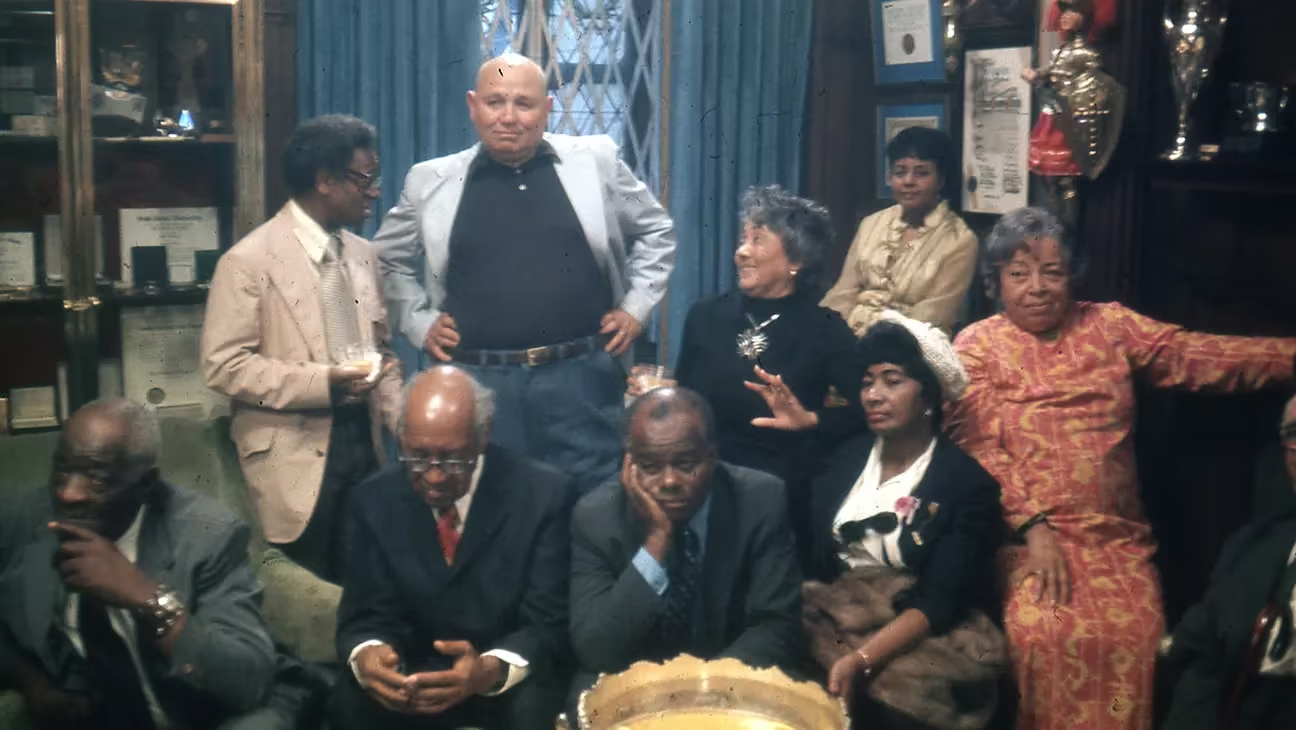
A nostalgic gathering of friends and memories.
flow
Greaves shot the entire party on 16mm and, by his own account, considered it the single most important thing he ever put on film. He also never finished it. For the rest of his life he kept circling back to the footage, occasionally shooting new interstitial material, without settling on a final shape for the project. He died in August 2014 at 87, the film still incomplete.
His wife and creative partner of 55 years, Louise Archambault Greaves, who had co-founded William Greaves Productions with him in the early 1960s, kept working on it after his death. Around 2020 she secured a grant from the Ford Foundation to preserve and restore the roughly 60,000 feet of 16mm footage Greaves had shot, an 18 month project overseen by preservationist Bill Brand. Producer Anne de Mare worked alongside her on that restoration. Louise died in March 2023, before the film was finished, having made clear to her son David and granddaughter Liani that the two of them were the ones who’d carry it the rest of the way.
David, who had worked alongside his father as an assistant and cameraman for fifteen years, took over as director. Liani, William Greaves’ granddaughter, produced the film with Anne de Mare. The result runs 100 minutes, a fraction of the original footage, built mostly from the 1972 party with some later contextual material worked in. David Greaves has called the finished film “a trailer for the archives,” since William Greaves Productions plans a separate, public facing release of the full uncut interviews for anyone who wants more than the roughly four hours that made the final cut.
By the time of his death, Greaves had produced more than two hundred documentary and picked up four Emmy nominations along the way, on top of a 2005 IDA Career Achievement Award for a career built almost entirely outside the studio system. In 2020, Firelight Media established a William Greaves Fund to support mid-career nonfiction filmmakers of color, a piece of his legacy that exists independently of whether this particular film ever got finished.
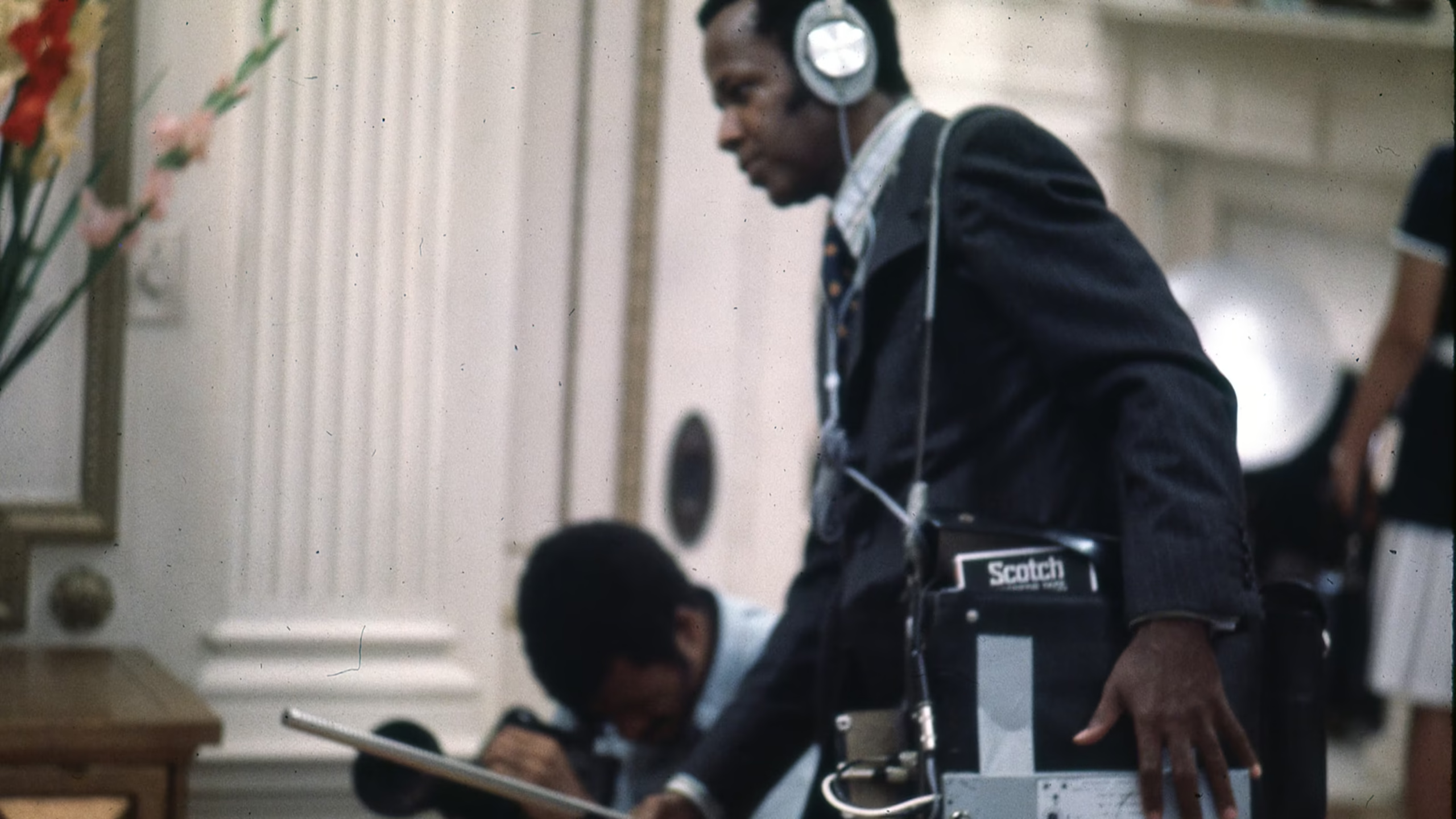
David Greaves (L) and William Greaves (R) appear in Once Upon a Time in Harlem. Image credit: William Greaves Production. All stills courtesy of Sundance Institute
huh
The guest list Greaves assembled reads like a syllabus. Beyond the names above, the finished film includes individual interviews with Blake, with Nugent (described by another attendee in the room as the boy wonder of the Renaissance), and with journalist Gerri Major. Douglas and Bearden appear alongside historians Nathan Huggins and Clarke, along with Irwin C. Miller and Jean Blackwell Hutson herself, one of the two librarians who’d helped Greaves assemble the room in the first place.
What keeps the footage from playing like a static reunion of elders, according to critics who caught it at Sundance, is how much the group disagrees with itself. Names get shouted across the room. A memory gets corrected by someone who lived through it too. The Harlem Renaissance had already been over for decades by 1972, but its survivors were also living through the Black Arts Movement then unfolding in Harlem at that very moment, afros on the street outside, a blaxploitation picture on the marquee at the Apollo, and the party captures a generational hinge as much as a historical one: people who had shaped one movement being asked, on camera, what they made of the one currently in progress around them.
The Hollywood Reporter’s review of the film situated its completion inside a broader, ongoing argument over how American institutions handle the preservation and teaching of Black history, framing the documentary less as a nostalgia piece than as a rebuttal delivered in real time by the people who were actually there.
style
The party’s most distinctive formal touch, its use of split screen to show multiple reactions happening across the room at once, has a direct lineage. Greaves developed the technique on Symbiopsychotaxiplasm, his 1968 meta documentary shot in Central Park, in which three separate camera crews filmed each other and the actors they were ostensibly documenting until the whole production turned into a study of its own making. Symbiopsychotaxiplasm found no distributor at the time and circulated only through festivals and museum screenings until Steve Buscemi caught a screening at the 1992 Sundance Film Festival and, a decade later, partnered with Steven Soderbergh to secure it a proper theatrical release, according to a Criterion Collection history of the film. It was added to the National Film Registry in 2015, the year after Greaves died. That makes Once Upon a Time in Harlem the second time in Greaves’ filmography that a Sundance premiere has arrived only after the original footage sat unseen for a generation, a parallel Criterion’s own retrospective on the film pointed out.
That wasn’t Greaves’ only brush with the Renaissance before 1972. Trained at the Actors Studio alongside Marlon Brando and Shelley Winters, he had grown disillusioned with the stereotyped parts available to Black performers in the 1940s and moved to Canada to study filmmaking, eventually returning to the United States as the civil rights movement gathered force. In 1966 the United States Information Agency sent him to Senegal to document the First World Festival of Negro Arts, a project that put him in rooms with Duke Ellington and Langston Hughes years before either man’s presence, or absence, would matter to this later film. He went on to run the pioneering PBS precursor program Black Journal, winning an Emmy in 1969 for a show built explicitly around news by and for Black Americans, and he directed dozens more documentaries on Black history and culture, including a 1989 profile of Ida B. Wells narrated by Toni Morrison. Once Upon a Time in Harlem opens with Greaves’ own voice reading a handwritten note describing his life’s ambition as making great films on great people, and at one point in that recording he breaks from the script to address his son directly, telling him to use that particular reading. It is as close as the finished film gets to an author’s statement.
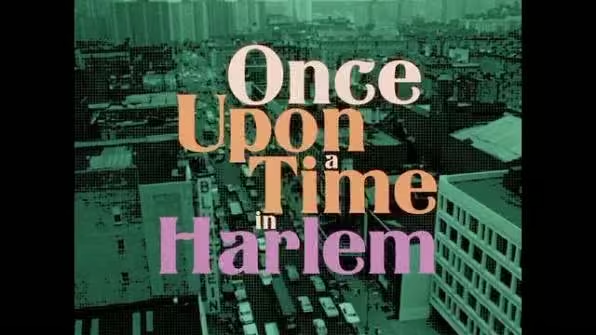
A Neon’s key art for the October rel
span
Once Upon a Time in Harlem premiered in the Premieres section of the 2026 Sundance Film Festival on January 25, where it became, by multiple critics’ accounts, the best reviewed film at the entire festival. A bidding war followed, with Netflix, Sony Pictures Classics, and Mubi all reportedly circling before Neon closed the deal on February 5, its second acquisition out of that year’s Sundance after the horror film Leviticus. Neon VP of Acquisitions Sarah Colvin negotiated the purchase opposite Cinetic Media’s Jason Ishikawa and Isadora Johnson on behalf of the Greaves family. It was a fitting landing spot: Neon has distributed North American rights to seven consecutive Cannes Palme d’Or winners dating back to Parasite in 2019, including Anora, which also won it a Best Picture Oscar, and this year’s winner, Fjord. When Neon presented its 2026 slate at CinemaCon that April, the studio framed the acquisition as part of a broader strategy of pairing awards driven auteur work with genre plays, the same approach that has made it, by some industry accounts, the only distributor to land the Palme d’Or winner every year since 2019.
Reviewing the film for TheWrap, critic Elizabeth Weitzman called it “as essential a historical document as you could ever hope to find.” Variety‘s Lisa Kennedy wrote that the film “turns viewers into time travelers.”
From there the film kept moving. It screened in the Directors’ Fortnight section of the 2026 Cannes Film Festival in May, where it was nominated for the L’Oeil d’or, and by early September it had also played Telluride, TIFF, and the London Film Festival ahead of its Main Slate berth at the 64th New York Film Festival, with screenings scheduled for September 29 and 30 at Film at Lincoln Center. As of this month, the film holds a perfect score on Rotten Tomatoes and a 94 on Metacritic, the kind of unanimous critical reception documentaries rarely get regardless of subject matter. It opens in theaters nationwide via Neon on October 16, fifty four years after the cameras first rolled at Duke Ellington’s house, and roughly a decade after the man who shot it stopped being around to see it through.
Related Articles
Where the Face Should Be, Rafael Silveira Paints Open Sky
A pink shirt, shoulder-length hair, then no face at all: in “Surprise,” Rafael Silveira lets flowers and a clear blue sky stand in for the person.