
DRIFT AUDIO
Listen to this story
Choose a voice, then press play.
Arte is airing a documentary on Sophie Marceau. Here are seven roles that explain why she still matters, four decades on.
Arte is set to broadcast Sophie Marceau à voix haute, a doc portrait of the actress directed by journalist Sophie Rosemont. It arrives as her career passes the forty five year mark, an unusually long run for a French actress and a rarer one still that has moved this freely between teen idol, art house provocateur and Hollywood leading lady. Seven roles trace that arc most clearly, from the fourteen year old who became a national phenomenon overnight to the woman who introduced her to a James Bond audience two decades later. Between those two points sits a run of directors, Maurice Pialat, Bernard Rose, Andrzej Żuławski and François Ozon among them, who each pulled a different register out of her, often against the image the public had already settled on.
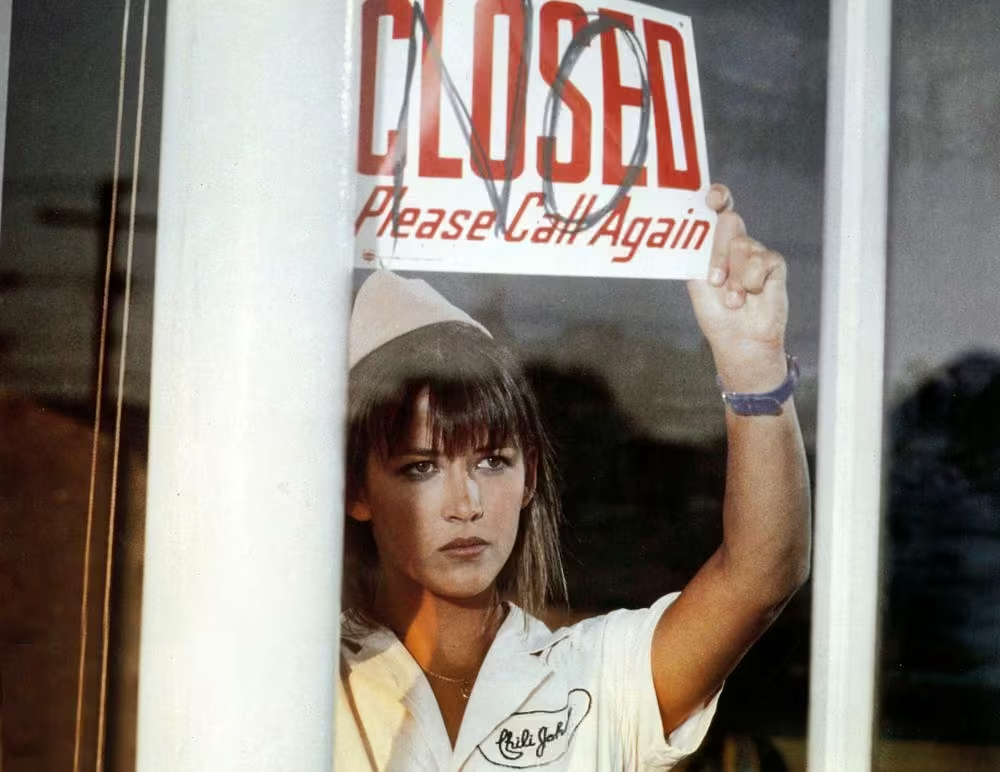
vic, in la boum (1980)
Sophie Marceau was fourteen, with no acting training and no family ties to the film industry (her father drove trucks, her mother worked in a department store), when director Claude Pinoteau cast her as Vic, short for Victoire, in La Boum: a Parisian teenager navigating first heartbreak and her parents’ divorce. Thousands of girls had auditioned for the part, reportedly including a young Emmanuelle Béart and Sandrine Bonnaire, but it was Marceau’s unpolished naturalness that won Pinoteau over.
The film, produced by Gaumont, went on to sell more than 4.3 million tickets in France, an unusually large number for the period, and the exposure that came with it was not gentle. Reporters and fans began showing up outside her family’s apartment, and Marceau has said in later interviews that her fee for the role amounted to only a few thousand francs, far out of proportion to what the film would go on to earn. A sequel, La Boum 2, followed in 1982 and earned her a César Award for Most Promising Actress. Decades later, Vic remains the role that defines Marceau for an entire generation of French viewers: the image she has spent much of her career building on, escaping and occasionally returning to.
noria, in police (1985)
Five years after La Boum, Marceau took the biggest risk of her young career by signing on to Maurice Pialat‘s Police, a bruising crime drama scripted by Catherine Breillat, who spent time reporting inside the drug trade in Belleville before writing it. Playing opposite Gérard Depardieu, who won Best Actor at Venice for his performance as the burned out detective Mangin, Marceau took the role of Noria: girlfriend to a small time trafficker, who becomes entangled, dangerously and ambiguously, with the man investigating her.
Pialat shot much of the film in a loose, improvisatory style that left little room for a young actress used to more conventional direction, and the production has long been described as an unusually demanding one for its then twenty year old lead. The film still drew close to 1.9 million admissions in France on release, respectable for a picture this bleak. Whatever the toll on set, the result showed a side of Marceau French audiences hadn’t seen before: wary, wounded and adult, in a film more interested in moral confusion than easy resolution.
valentine, in ‘etudiante (1988)
If Police pulled Marceau toward grit, L’Étudiante pulled her back toward the light, reuniting her with Pinoteau and screenwriter Danièle Thompson, the same team behind La Boum, for a romantic comedy that plays almost like an update of her earlier hit for a slightly older audience. She plays Valentine Ezquerra, a literature student cramming for her agrégation exams, whose ordered life is upended when she falls for Édouard (Vincent Lindon), a touring rock musician with none of her discipline. Their story opens on a ski lift, where Édouard first spots her, a chance encounter that lets Pinoteau restage the kind of meeting that defined his earlier film, this time between two adults working out whether ambition and romance can coexist.
The film leans on a familiar culture clash formula, books versus music, order versus spontaneity, but its real appeal lies in its snapshot of late 1980s Paris student life. It drew more than 1.5 million admissions in France on release. For many French viewers, L’Étudiante plays as an unofficial third chapter in the loose trilogy that began with La Boum, closing out Marceau’s ingénue period before she turned toward more demanding, internationally minded work the following decade.
anna, in anna karenina (1997)
Directed by Bernard Rose for Mel Gibson‘s own production company on a reported thirty million dollar budget, Anna Karenina was shot almost entirely on location in and around Saint Petersburg rather than on a studio backlot, an unusual commitment for an English language literary adaptation. It gave Marceau her most ambitious literary role: Tolstoy’s tragic heroine, torn between a stifling marriage to a senior official and her consuming affair with the cavalry officer Vronsky (Sean Bean). Marceau has spoken about being drawn to the part partly through her admiration for Greta Garbo’s 1935 version. Alfred Molina, playing the landowner Levin opposite Mia Kirshner’s Kitty, anchored the novel’s secondary romance, but the film’s fortunes rested squarely on Marceau’s ability to carry Tolstoy’s most famous heroine for an audience watching in English.
Critical reception at the time was mixed, and the film performed poorly at the American box office. Some reviewers found the adaptation handsome but emotionally distant, more interested in its lavish Russian settings than in the psychological unraveling at the novel’s core. Marceau’s performance was nonetheless frequently singled out as the film’s strongest asset, a portrait of desire curdling into isolation that asked more of her than anything she had attempted before. Coming two years after her Hollywood breakthrough in Braveheart, it confirmed that her international career would not simply recycle the period romance persona that film had established.
elektra king, in the world Is not enough (1999)
Two years later, Marceau joined an exclusive club: French actresses who have played opposite James Bond, alongside Carole Bouquet, Eva Green and Léa Seydoux. In Michael Apted‘s The World Is Not Enough, the nineteenth entry in the franchise, she is Elektra King, daughter of a murdered oil magnate, who first appears as a vulnerable kidnapping survivor and Bond’s (Pierce Brosnan) love interest, before being revealed as the film’s true architect of villainy. Robert Carlyle played Renard, the film’s other, more overtly monstrous adversary, a former KGB agent left immune to pain by a bullet lodged in his brain, giving Bond two adversaries working in tandem rather than the usual solitary mastermind.
It’s a rare structural twist for an Eon Productions entry, built almost entirely on audiences’ willingness to read Marceau as sympathetic in the first act. She plays the reversal with a coldness that retroactively recasts everything that came before it. The role capitalized on the American visibility she’d gained through Braveheart, turning her into a recognizable name well beyond French and European audiences, even as it pulled her further from the vulnerable, romantic register that had defined much of her earlier work.
clélia, in la fidélité (2000)
La Fidélité is a sprawling, unruly, very loose modern update of Madame de La Fayette‘s seventeenth century novel La Princesse de Clèves, and Marceau’s fourth and final film with her longtime partner Andrzej Żuławski, following L’Amour braque in 1985, the little seen Mes nuits sont plus belles que vos jours in 1989 and La Note bleue in 1991. Marceau plays Clélia, a photographer recruited by a scandal sheet media empire who marries a mild mannered publisher, Clève (Pascal Greggory), only to find herself pulled toward Némo (Guillaume Canet), a reckless younger photographer chasing his own stories.
The film split critics on release. Some found its two and a half hour length and heightened, almost operatic style exhausting; others read it as a fitting, faintly autobiographical farewell between director and star, who separated not long after the shoot ended. Whatever its flaws, it gave Marceau one of the most overtly sensual and formally daring roles of her career, closing out a fifteen year creative partnership that had repeatedly pushed her furthest from the image La Boum first established.
emmanuèle, in everything went fine (2021)
Two decades on, François Ozon‘s Everything Went Fine gave Marceau what many critics, and by her own account Marceau herself, consider the finest performance of her career. Adapted from novelist Emmanuèle Bernheim‘s own memoir, the film casts Marceau as Emmanuèle, a writer whose elderly father André (André Dussollier), left severely disabled by a stroke, asks his daughters to help him die on his own terms in Switzerland, where assisted suicide is legal, unlike in France. Bernheim, who co-wrote several of Ozon’s earlier scripts before her death in 2017, based the book on her own father’s request, and Ozon has said the project stayed with him for years before he felt ready to adapt it.
Sharing the weight with her screen sister, played by Géraldine Pailhas, Marceau plays a woman caught between grief, guilt and a fierce, protective love, without tipping into melodrama, in a cast that also includes a brief, sharp appearance from Charlotte Rampling as André’s former wife. That restraint let the film’s premiere in competition for the Palme d’Or at the 2021 Cannes Film Festival register as a genuine conversation starter around a subject French cinema had largely avoided.
Seen together, the seven performances sketch a career that has rarely stood still: teen idol, art house risk taker, Hollywood leading lady, Bond villain, and eventually an actress entrusted with one of French cinema’s more delicate recent subjects. Sophie Marceau à voix haute arrives with more than forty years of that range already on the record.
Related Articles

Twelve Albums on a Pharmacy Shelf
Damien Hirst has shelved Eminem's twelve albums beside pill packets, and one cabinet stocks every drug the rapper has named in a lyric.