DRIFT AUDIO
Listen to this story
Choose a voice, then press play.
In This Story
- A Golf Cart Problem Nobody Else Wanted to Solve
- Who’s Behind Amble
- The Origin Story: A School Gate, a Hotel, and a Bad Fleet of Golf Carts
- Inside the Amble One: The Spec Sheet
- Design Philosophy: Apple’s Shelved Car Project, Reimagined as a Buggy
- Street-Legal — But Exactly Where?
- The Business Model: Hospitality First, Consumers Second
- What’s Next: A More Car-Like Second Model
- Where the Amble One Fits in a Crowded Micro-EV Market
- Verified Brand Social Handles
- Pre-Publish Notes
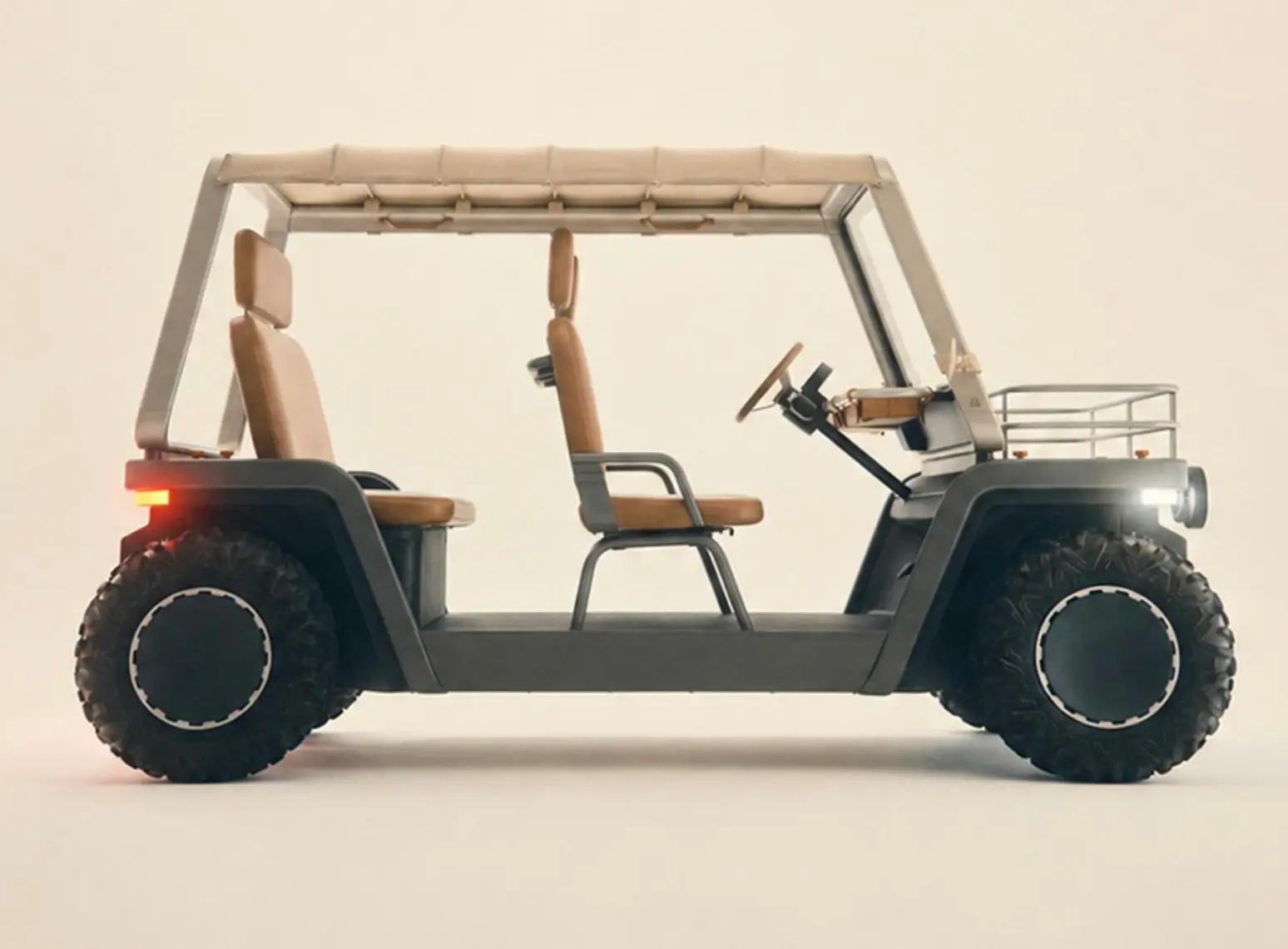
Somewhere between a Rivian and a Lime scooter sits a category of vehicle nobody has bothered to take seriously: the golf cart. That’s the gap a new Lisbon-based startup called Amble is betting on with its debut vehicle, the Amble One — a doorless, screenless, $25,000 electric buggy that tops out at 40 mph and was, by its own design team’s account, shaped in part by NASA’s 1971 lunar rover.
The company emerged from stealth mode on June 25, 2026, with a press release and a flurry of coverage spanning design outlets, automotive press, and business media — a spread that says something about how unusual the pitch is. This isn’t a faster golf cart or a cheaper EV. It’s an attempt to build an entirely new vehicle category for trips that are too short, too slow, and too low-stakes to justify a real car.
stir
Amble’s founding team reads like a cross-industry fantasy draft. Julian Hoenig, an Austrian industrial designer, spent years at Audi working on the A4, Q3, and RSQ before a stint at Lamborghini, then ten years at Apple under Jony Ive’s design team — contributing to the Apple Watch and Vision Pro, and serving as a lead designer on Apple’s since-canceled “Project Titan” car program. He now leads design at Amble.
José António Uva, the company’s chairman, is a Portuguese hospitality entrepreneur best known for spending 14 years restoring São Lourenço do Barrocal, a roughly 780-hectare Alentejo estate turned into one of Europe’s best-regarded rural retreats. He also developed Na Praia, a coastal property in Comporta, Portugal. Michael Tropper, the third co-founder, runs forpeople, a roughly 120-person London creative and design agency whose client list includes NIO, Arc’teryx, Herman Miller, and InterContinental Hotels. Adrien Roose, Amble’s CEO, co-founded Cowboy, the Belgian e-bike company known for bringing consumer-electronics-style design to bicycles with backing from Index Ventures.
The team’s engineering side includes François-Xavier Delage as chief technology officer, who previously worked as a lead engineer on a championship-winning Renault Formula 1 car before helping develop the Renault Twizy, a compact urban EV, according to Monocle.
View this post on Instagram
flow
The company’s creation myth is almost aggressively low-stakes. Uva and Hoenig knew each other because their children attended the same school. According to Dezeen, Uva was putting together a golf cart fleet for a new hotel and couldn’t find a single brand he considered well designed. Hoenig, half-joking, decided to take a crack at the problem himself — describing the ambition, in conversations with the press, as wanting to do for the golf cart what Nest had done for the home thermostat: bring real design thinking to a category nobody had bothered to rethink in decades.
Tropper, an old university friend of Hoenig’s from Austria’s FH Joanneum, got pulled in next, and the idea evolved from “design one good golf cart for a friend” into “build a company that sells to other hotels too.” Roose joined last, having separately crossed paths with Uva at a Lisbon farmers’ market — Lisbon’s growing design and startup scene meant most of the eventual founding team was already living in the same city before Amble existed as an idea.
The team spent roughly three years building the vehicle privately before this week’s public launch, pulling visual cues from 1960s and ’70s off-road vehicles, including NASA’s lunar rover, the kind of reference that explains why Bloombergreports people in Lisbon would shout “the moon rover is coming!” when they spotted prototypes being transported through town. Uva has described the chain of coincidences that built the founding team — meeting Hoenig through their kids’ school, then learning Roose had already crossed paths with him separately — as the kind of thing that happens when you’re genuinely looking for the right collaborators, rather than chasing the idea alone.
in
Stripped to numbers, the Amble One looks closer to a small EV than a traditional golf cart:
- Motor: 15 kW, 48V rear-wheel drive
- Battery: 11 kWh lithium-ion
- Range: Over 100 km (60+ miles) per charge
- Top speed: 65 km/h (40 mph)
- Charge time: 5.5 hours on a standard 220/230V outlet
- Weight: Approximately 990 lbs (450 kg)
- Dimensions: 3,200 x 1,480 x 1,850 mm (L x W x H)
- Wheels: 28-inch, with independent suspension front and rear
- Materials: Aluminum frame, leather and cotton upholstery, cork detailing (including the steering wheel), marine-grade canvas canopy sourced from a yacht supplier
- Seating: Four passengers, with rear seats that fold flat to create a cargo bed
The battery sits in an exposed, skateboard-style platform rather than tucked under a seat — a deliberate choice the design team has compared to how modern EVs are built, rather than how golf carts traditionally are.
flow
Hoenig has been direct about where some of his thinking comes from: Apple’s abandoned car program, which folded in 2024 without a single vehicle reaching the public after years of work and, by some accounts, hundreds of engineers. Rather than walk away from vehicle design altogether, Hoenig appears to have inverted the assignment — instead of a fully enclosed, screen-heavy luxury EV, the Amble One has no doors, no air conditioning, and a deliberately minimal dashboard.
Tropper has framed the approach as a reaction to how overbuilt modern cars have become for short trips, arguing that most of the technology layered into a typical car solves problems that simply don’t exist on a five-minute drive to a beach club or a school gate. That philosophy shows up throughout the build: a flat windshield borrowed visually from the Mercedes-Benz G-Class, a dashboard bar sized to match standard motorcycle handlebar mounts so existing bike accessories attach directly, and oversized orange screws marking every component meant to be removable or reconfigurable. According to Designboom, the underlying platform is built to be modular enough to support future Amble vehicles beyond the One.
theory
This is the part of the Amble story that gets murkier depending on which outlet you read, and it’s worth being precise about. Amble’s own site describes the Amble One as homologated for public roads and says it’s road legal, and Designboom reported it as fully road legal in both the US and EU. Electrek, however, flagged a real regulatory wrinkle: in the US, vehicles in this class are typically classified as Low-Speed Vehicles, which cap top speed at 25 mph — meaning the Amble One’s claimed 40 mph would normally exceed that classification’s limit. Electrek noted it wasn’t immediately clear how Amble plans to clear that bar in the US, though low-volume production vehicles do have other regulatory paths available that can bypass standard LSV limits.
Coverage has consistently confirmed Europe and the United States as the two markets where Amble is currently taking reservations, with deliveries expected in those regions starting in 2028. That’s a narrower footprint than some early consumer-facing summaries have suggested, and it’s worth double-checking before publishing any specific claim about Asia-market legality — see the note below.
trade
Amble isn’t starting with day drivers — it’s starting with hotels. According to Gizmodo’s reporting on Bloomberg’s coverage, Amble’s first buyers were hospitality groups purchasing fleets in bulk, with an average order working out to roughly 40 vehicles and about $1 million in value. Reporting from EVinfo puts the company’s traction at 12 signed clients, more than 500 vehicle commitments, and over €10 million in signed revenue ahead of launch, with early customers including Amangiri in Utah, Mustique Island, Six Senses Les Bordes in France’s Loire Valley, and Uva’s own Na Praia development in Portugal.
That hospitality-first strategy explains the delivery timeline: 2027 production slots are already fully allocated to resort and hotel customers, and Amble has said its production capacity for next year is sold out. Individual consumers — described semi-jokingly across coverage as everyone from gated-community residents to parents doing the school run — are being asked to join a waitlist instead, with a refundable deposit, for deliveries starting in 2028.
extent
Amble has been upfront that the One isn’t the end of the platform. Multiple outlets report the company is already developing a second vehicle aimed at a broader, more urban consumer base — one with features the One deliberately skips, including removable doors, a hardtop, and a lower roofline. EVinfo reports this follow-up, sometimes referred to as the Amble Two, is expected around 2029, while Electrek frames it more generally as a future model built for additional environments and use cases, including denser city settings. Either way, the pitch is consistent across coverage: Amble wants the One to prove out hospitality and resort use first, then expand the same modular platform into something closer to a second car for daily errands — the trip to pick up groceries or drop kids at school that doesn’t really need a 4,000-pound SUV.
fin
The “low-speed vehicle” category isn’t new — neighborhood EVs, golf-cart-adjacent runabouts, and tiny city cars like the Citroën Ami have all chipped away at the same basic idea, that most trips don’t need a full-sized car. What’s notable about Amble is less the category than the pedigree and the price point: $25,000 sits well above a basic golf cart but considerably below most production EVs, and the founding team’s design credentials — Apple, Audi, Lamborghini, Cowboy — give it a level of press attention that a typical neighborhood-EV launch wouldn’t generate. Gear Patrol drew a comparison to the Fiat Topolino, another small, design-forward runabout aimed at short trips rather than highway use, while Monocle frames Amble’s bet more broadly: that the long-promised shift toward smaller, lighter, purpose-built vehicles for short urban and resort trips has been stalled for years, and that a well-designed, well-funded entrant might be what finally moves it.
Whether the Amble One becomes a fixture at resorts worldwide or stays a niche design curiosity will likely depend on how the hospitality rollout goes in 2027 — and on whether the regulatory questions Electrek raised about its US street-legal status get a clear answer before consumer deliveries begin in 2028.
There’s also a question of how much the founders’ pedigree actually translates into demand versus just press coverage. A four-person founding team with Apple, Audi, Lamborghini, and Cowboy on its collective résumé is an easy story for design and business outlets to run with — and it clearly worked, given the breadth of coverage Amble generated within 24 hours of launch, spanning outlets as varied as Bloomberg Businessweek, Dezeen, Gear Patrol, and Yanko Design. But hotels and resorts buying fleets in bulk are making a more practical calculation than design enthusiasts reading a launch story: durable, parts available, and service support over a multi-year fleet lifecycle matter more to a hospitality buyer than a cork-wrapped steering wheel. The early signed deals with name-brand properties like Amangiri and Six Senses suggest Amble has cleared that practical bar with at least some buyers, but the real test will come once the first production units actually reach those resorts in 2027 and get put through daily guest use rather than a press test drive on the dunes of Tróia.
From the DRIFT archive: PANTONE’s 2026 Color of the Year Takes Shape With Play-Doh and Post-It Editions · The Supercar Stroller: Inside Silver Cross × Lamborghini
Related Articles
Inside the Ferrari Line Where V12s, Hybrids and the Electric Luce Share One Workforce
In Maranello, the electric Luce, a hybrid V8 and a twelve-cylinder Purosangue now share one assembly line and one workforce.