Do Ho Suh’s “Fallen Star” (2012): A Masterpiece of Displacement and Home at UC San Diego

September 22, 2024
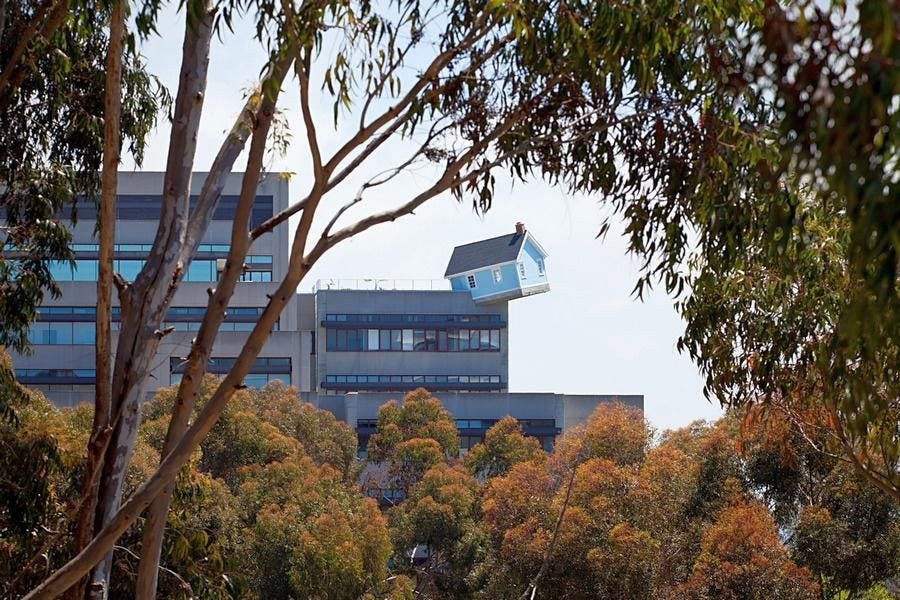
Nestled within the sprawling 1,200-acre campus of the University of California, San Diego (UCSD), the Stuart Collection is a unique assembly of site-specific artworks from celebrated international artists. Among these is Do Ho Suh’s “Fallen Star” (2012), a sculptural installation that both captivates and confounds viewers with its gravity-defying appearance and deeply evocative narrative. Perched precariously atop UCSD’s Jacobs Hall, the work looks like a small, traditional house that has been dropped onto the edge of the building—a visual metaphor for displacement, the concept of home, and the immigrant experience. Suh’s creation is not only one of the most striking works in the Stuart Collection but also serves as a thought-provoking reflection on identity and belonging.
The Stuart Collection at UC San Diego: A Space for Public Art
Before delving deeply into “Fallen Star”, it’s important to understand the Stuart Collection’s unique role at UC San Diego. Established in 1981, the Stuart Collection is renowned for its innovative approach to integrating art into public spaces. It commissions site-specific works that respond to the architectural, environmental, and social context of the campus. Each work in the collection is created by an artist who engages with the campus’ unique physical environment and student life, making art a central component of daily experience for those who work, study, and visit UCSD.
Unlike conventional art galleries or museums, where art is displayed in a controlled, curated setting, the Stuart Collection allows its artworks to exist organically within the university landscape. These works are often designed to provoke thought, discussion, and interaction. Do Ho Suh’s “Fallen Star” is one such piece, inviting viewers to reflect on their personal experiences with concepts of home, migration, and the uncanny.
Do Ho Suh’s Artistic Vision: Exploring Home and Displacement
Do Ho Suh, born in South Korea in 1962, is internationally acclaimed for his large-scale installations and sculptures that explore themes of migration, identity, and the meaning of home. As an immigrant who has lived in both South Korea and the United States, Suh’s work is often deeply personal, examining the complex feelings of dislocation and belonging that accompany the experience of living between cultures.
Much of Suh’s work draws on his own transnational experience, particularly his journey from Seoul to the United States to study art. His early years in America were marked by a sense of cultural displacement, a theme that would later become central to his artistic practice. In his work, Suh often grapples with questions of how to create a sense of home in unfamiliar environments and how memory, architecture, and personal history shape our perceptions of space.
“Fallen Star”, a pivotal work in Suh’s career, continues this exploration, offering viewers a tangible representation of the feeling of being uprooted and displaced. The installation captures the experience of moving to a new country and grappling with the emotional weight of finding one’s place in a foreign land. By placing a traditional Korean house in such a precarious position—seemingly on the verge of toppling off a modern academic building—Suh challenges our preconceived notions of stability, home, and cultural belonging.
Fallen Star: A Study in Contrast and Displacement
This abstract sculpture is a striking visual presence on the UC San Diego campus. The house appears as if it has been dropped from the sky and come to rest, somewhat miraculously, on the edge of Jacobs Hall, part of the UCSD Jacobs School of Engineering. The dissonance between the traditional, homey appearance of the house and its vertiginous location is immediately unsettling, and yet it is this very tension that gives the work its power.
The house itself is modeled after a traditional Korean-style home, the type in which Suh grew up. The exterior is meticulously crafted to resemble a typical suburban house, with details such as a chimney, a small garden, and even a pathway leading up to the front door. The interior of the house is furnished with everyday items, including a couch, table, and chairs, evoking the warmth and comfort of a lived-in space.
However, the house’s placement on the edge of the building destabilizes the sense of safety and comfort traditionally associated with the concept of home. The house is angled at a precarious tilt, as if it has been uprooted by some invisible force and violently deposited on top of the structure. This displacement evokes the anxiety and disorientation that often accompany the immigrant experience, where individuals must negotiate between different cultures, languages, and environments.
The installation’s title, “Fallen Star”, suggests a narrative of unexpected and perhaps violent displacement. The idea of a “fallen star” brings to mind something that has been dislodged from its place in the universe and now exists out of context, far from its origin. This imagery echoes the feelings of being unmoored and out of place that are often experienced by those who migrate or are forced to move from one home to another. Suh’s own experiences of leaving South Korea to live in the United States are clearly reflected in this visual metaphor, as the house—just like its creator—seems to straddle two worlds, suspended between belonging and alienation.
An Engineering and Artistic Marvel
Beyond its conceptual depth, “Fallen Star” is also an impressive feat of engineering. Installing a house on the edge of a building, particularly one that appears to defy gravity, required a high degree of technical precision. The house is securely bolted to the building, but Suh and the engineers behind the project took great care to ensure that it appears to be teetering on the edge, just barely hanging on.
To enhance this sense of instability, the house is intentionally set at a seven-degree tilt, creating the illusion that it could slide off at any moment. This careful calibration of angles and placement heightens the emotional impact of the work, drawing viewers into its narrative of precariousness and uncertainty.
The landscaping around the house, which includes a small garden and pathway, adds to the surreal nature of the installation. The juxtaposition of this intimate, domestic space with the institutional architecture of the building creates a stark contrast that forces viewers to confront the contradictions inherent in modern life—particularly the ways in which public and private spaces, tradition and modernity, and stability and displacement intersect.
Fallen Star as an Interactive Experience
While “Fallen Star” is visually arresting from the outside, it is also a highly interactive piece that invites viewers to step inside and engage with the space. Visitors are allowed to enter the house and explore its interior, which is designed to feel like a lived-in home. However, the interior is not immune to the same disorienting forces that affect the exterior; the entire space is slightly skewed, creating a sense of imbalance that subtly unsettles the viewer.
Walking through the house, one feels the disjunction between the familiar and the strange. The furniture is arranged in a way that mimics the layout of a normal house, but the angles are off, and the floor beneath your feet feels slightly unstable. This slight but constant sensation of vertigo reinforces the overall theme of displacement, reminding visitors that the concept of “home” is not as fixed or secure as we might like to believe.
By allowing visitors to physically experience the disorientation that comes with living in a space that is not entirely stable, Suh encourages empathy and understanding. The house becomes a metaphor for the experience of living between cultures, where nothing feels quite right, and one must constantly adjust to new surroundings.
The Immigrant Experience and the Idea of Home
At its core, “Fallen Star” is a meditation on the immigrant experience and the concept of home. Suh has often spoken about his personal sense of dislocation as an immigrant, and how this feeling of being in limbo informs much of his work. The house in “Fallen Star” embodies this sense of duality—it is both familiar and foreign, grounded and precarious.
For many immigrants, the idea of home is fraught with contradictions. The physical space of home—whether it’s a house, an apartment, or even a neighborhood—may provide comfort and security, but it can also be a reminder of the past and the things that have been left behind. Immigrants often find themselves caught between two worlds, trying to reconcile their memories of home with the reality of their new surroundings. In “Fallen Star”, this tension is made visible through the juxtaposition of the traditional house and its dislocated, impossible location.
The precariousness of the house also speaks to the fragility of identity in the context of migration. Just as the house seems ready to fall at any moment, the immigrant experience can often feel like a delicate balancing act, where individuals must constantly navigate between different cultural norms, expectations, and identities. The sense of instability that pervades the installation mirrors the emotional instability that often accompanies the process of adjusting to a new life in a foreign land.
A Thought-Provoking Masterpiece of Public Art
“Fallen Star” by Do Ho Suh is a remarkable addition to the Stuart Collection at UC San Diego. As both a visual spectacle and a profound meditation on the themes of home, displacement, and the immigrant experience, the installation offers viewers a powerful and thought-provoking experience. Suh’s ability to blend personal narrative with universal themes makes “Fallen Star” a work that resonates on multiple levels, inviting viewers to reflect on their own experiences of home, belonging, and identity.
The installation’s precarious position atop Jacobs Hall, combined with its interactive nature and meticulous craftsmanship, makes “Fallen Star” a standout example of public art that challenges and engages its audience. Whether viewed from afar or explored up close, the work leaves a lasting impression, serving as a reminder of the complexities of modern life and the ever-shifting nature of home.
Related Articles

The $960,000 Jacket: How Jensen Huang’s Leather Uniform Became a Collector’s Item
A worn Tom Ford jacket with a $60,000 ceiling closed at $960,000 on Friday, and […]