DRIFT AUDIO
Listen to this story
Choose a voice, then press play.
Kering has named a thirty year beauty industry veteran to run Bottega Veneta, wagering that fragrance sector discipline can steady one of luxury’s most guarded houses.
In This Story
- A Milan Handoff, Long in the Making
- From Guerlain Counters to Kering’s Boardroom
- The Numbers Behind the Appointment
- What De Meo Is Actually Asking For
- The House Spitzer Inherits
- Reading the Tea Leaves
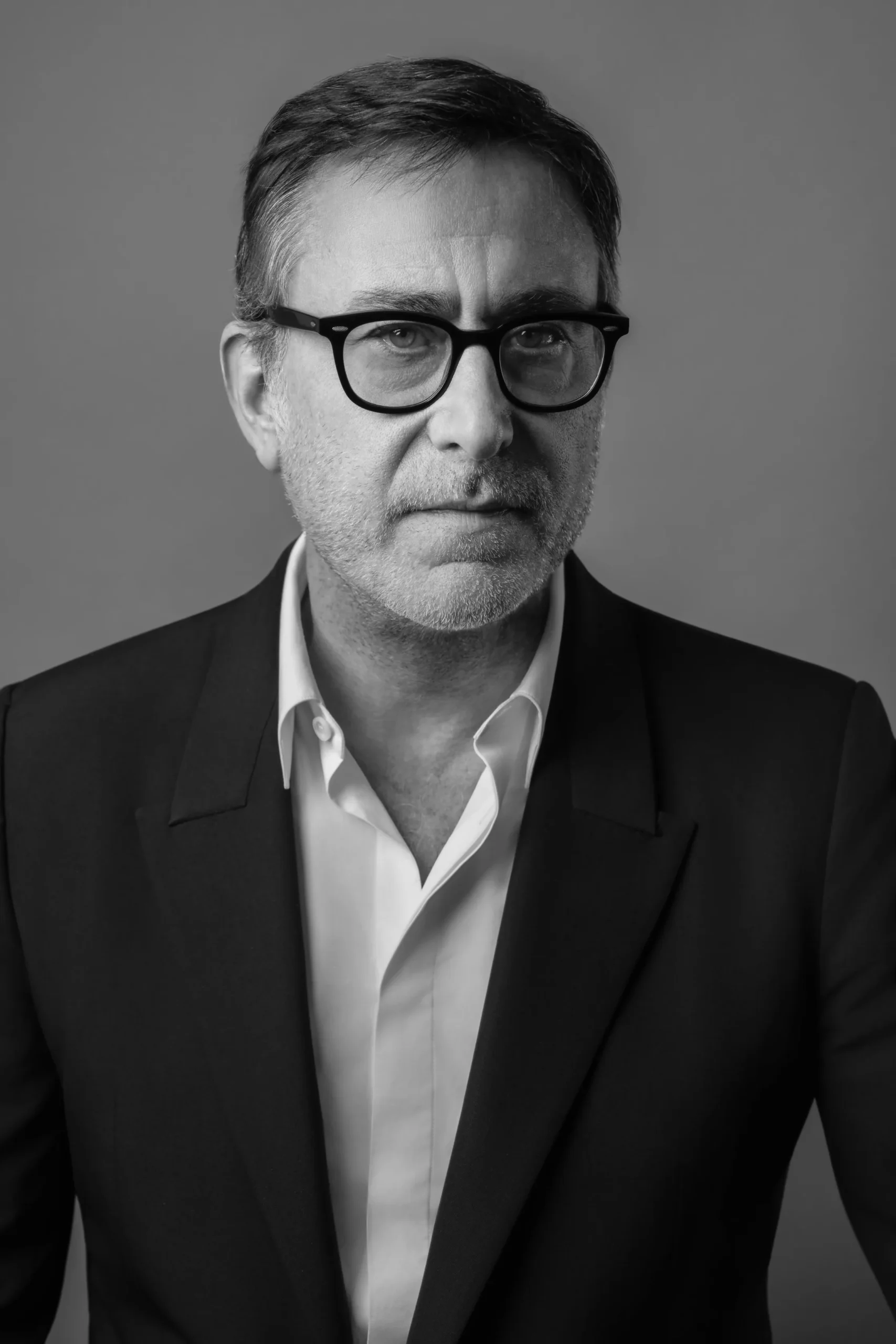
Kering confirmed the news after the market closed on Wednesday, July 15, in the flat, procedural language that haute conglomerates reserve for executive shuffles. Romain Spitzer will become chief executive officer of Bottega Veneta on September 1, relocating to Milan and reporting directly to Kering chief executive Luca de Meo. He also joins the parent group’s executive committee, a detail that matters more than it sounds. It signals that whoever runs Bottega Veneta now sits inside the room where Kering’s broader strategy gets decided, not just inside the house’s own walls on Via Privata Ercole Marelli.
The seat had been empty for months. Bartolomeo Rongone left Bottega Veneta at the end of March to take the top job at Moncler, a departure that had actually been flagged as far back as January. That gap, roughly half a year between one CEO’s exit and the next one’s confirmed start date, is unusually long for a house of Bottega Veneta’s size and vision. It suggests Kering was not simply promoting from an internal shortlist. It was searching, and searching outside fashion entirely.
Spitzer arrives from a different corner of the haute business altogether. He was, until this announcement, president and CEO of Fragrance Group LVMH Beauty at LVMH, overseeing a cluster of scent houses rather than a single ready to wear label. That is not a small pivot. Running perfume and cosmetics for a portfolio of brands is a business built on repeat purchase, retail distribution deals, and duty free counters. Running Bottega Veneta means answering for handbags that cost thousands of dollars, a single womenswear runway show a season, and a customer base that luxury analysts increasingly describe as fatigued.
The mechanics of the handoff are unusually clean by opulent industry standards. There is no interim executive, no acting CEO holding the title for a transitional stretch while Kering finishes its search, because the search itself has already concluded well ahead of Spitzer’s actual start date. Rongone left in March, the announcement landed in mid July, and Spitzer does not take the reins until September 1. That six week gap between confirmation and start gives him time to close out his responsibilities at LVMH Beauty properly rather than sprinting between two demanding roles at once, and it gives Bottega Veneta’s existing leadership team a defined runway to prepare rather than operate in limbo.
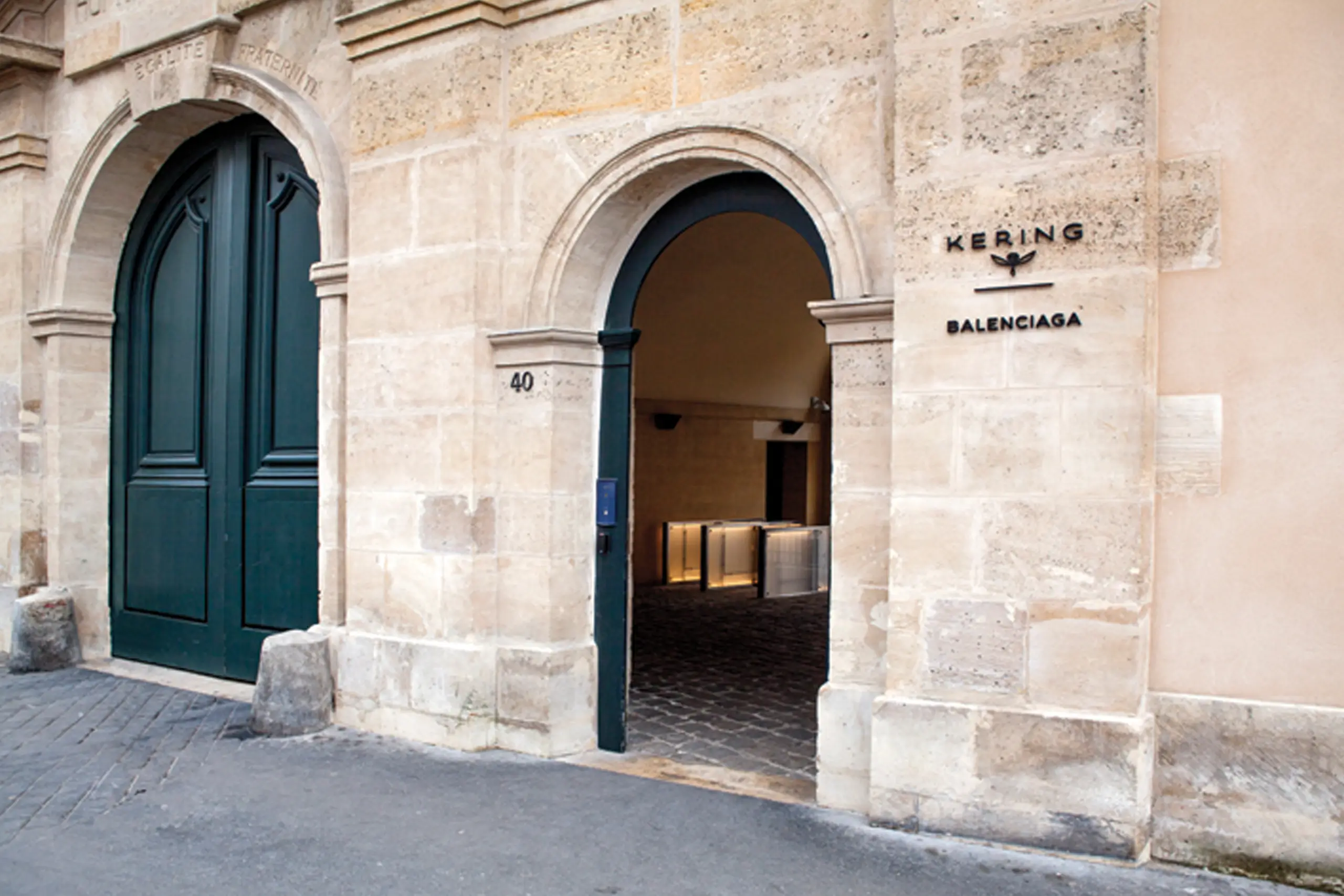
Entrance to Kering’s Paris headquarters at 40 Rue de Sèvres, where the luxury group oversees brands including Balenciaga.
transition
Spitzer’s résumé reads like a tour of the entire French perfume establishment before it circles back into fashion. According to Kering’s own release, he graduated from ESCP Business School and began his career in 1995 as a junior product manager at Guerlain. From there he moved through marketing roles at Jean Paul Gaultier Parfums and Yves Saint Laurent Parfums, eventually becoming YSL’s international marketing director. In 2006 he joined Parfums Christian Dior as head of its fragrance business unit, later taking on general manager roles for Spain and then for Europe as a whole.
The real inflection point came in 2016, when he crossed over to LVMH to run fragrance operations for Givenchy and Kenzo as president and CEO. His remit kept expanding from there. Over the following years he picked up responsibility for Maison Francis Kurkdjian, Acqua di Parma, Loewe perfumes, and Officine Universelle Buly, culminating in his most recent title atop Fragrance Group LVMH Beauty. WWD, which has tracked his career closely, has described him as an executive who commands considerable respect from the teams under him.
None of that résumé includes a single season of running a fashion house’s ready to wear business, its store network, or its runway calendar. That is precisely the point of the bet Kering is making. De Meo, who himself came to Kering from the automotive world at Renault rather than from fashion, appears to be applying the same logic to Bottega Veneta’s leadership that he has applied to his own hiring. Bring in an operator who has proven they can run a complex, brand driven consumer business, and trust that brand instincts can be learned or delegated to a strong creative director, who at Bottega Veneta remains Louise Trotter.
quant
The appointment does not arrive in a vacuum. Kering’s most recent quarterly results, covering the first quarter of 2026, showed group revenue down 6 percent year on year to roughly 3.5 billion euros. The fashion and leather goods segment, the bucket that houses Bottega Veneta alongside Gucci, Balenciaga, Saint Laurent, and Brioni, fell even harder, down 9 percent to about 2.8 billion euros. Gucci’s ongoing struggles have absorbed most of the headlines in that segment, but the read across for Bottega Veneta is the same. Kering needs every house in the portfolio pulling weight, and it is no longer content to let a smaller label coast on critical acclaim alone.
That backdrop explains the specific language Kering used to describe Spitzer’s mandate. Rather than talk about creative direction or runway ambitions, the company said his job centers on enhancing the house’s appeal, deepening client relationships worldwide, and driving retail excellence across markets. Three separate press accounts of the announcement, from Drapers, FashionUnited, and Kering’s own statement, all converge on that same trio of priorities: desirability, client relationships, and retail execution. It reads less like a brief for a fashion visionary and more like a brief for someone who can fix how stores convert foot traffic into sales.
ask
De Meo’s own quote in the announcement leans hard into continuity rather than disruption. He called Bottega Veneta one of the strongest and most distinctive houses in luxury, citing its craftsmanship and creative identity, and said Spitzer has the experience to “unlock the next phase” of the house’s growth. It is a carefully hedged statement. De Meo is not promising a turnaround or a repositioning. He is promising stewardship, someone who will not disturb what Trotter and her studio have been building since her debut collection.
That framing matters given what happened the last time Bottega Veneta changed creative hands. When Daniel Lee departed and then Matthieu Blazy took over, the house went through a period of intense scrutiny over whether its famously restrained, deliberately anti hype positioning could survive a change in the top creative seat. Trotter’s arrival triggered a similar round of anxious commentary. Layering a brand new CEO on top of a relatively new creative director, less than two years into her tenure, is a real test of institutional memory. Spitzer’s job, by every account of his mandate, is not to reinvent anything. It is to make sure the machinery around Trotter’s vision runs at full capacity: right store locations, right inventory levels, right client experience at the flagship level.
Milan itself is part of that machinery. Bottega Veneta’s headquarters sit on Via Privata Ercole Marelli, and the house has been active in refreshing its retail footprint in the city, including a widely covered store opening near Galleria Vittorio Emanuele.
Spitzer inherits a house whose products remain the clearest expression of what Kering is protecting. The intrecciato weave, the house’s signature leather technique, still anchors the bag categories that make up the bulk of Bottega Veneta’s revenue.
involve
Founded in Vicenza in 1966 by Michele Taddei and Renzo Zengiaro, Bottega Veneta built its reputation on the idea that a house could sell without shouting. That ethos hardened into policy in January 2021, when the brand deleted its Instagram, Facebook, and Twitter accounts without explanation, becoming one of the only major luxury labels with zero mainstream social media presence. Kering’s then chief executive François-Henri Pinault later confirmed the absence was deliberate, framing it as a conscious redirection of marketing spend rather than a mistake. The house dipped briefly into Weibo in 2023 to tease a runway show for the Chinese market, then went quiet again. Whether that policy survives a new CEO whose entire prior career was built around consumer facing fragrance brands, several of which maintain large, active social followings, is one of the more interesting open questions in this appointment.
Financially, Bottega Veneta reported revenue of about 1.7 billion euros in 2024, a fraction of Gucci’s scale but a meaningful contributor within Kering’s portfolio, and it now operates more than 300 stores worldwide. Its recent campaigns have leaned on a mix of recognizable names and working creatives rather than a single dominant brand ambassador, a strategy that has kept the house’s image consistent even through two creative director transitions in three years.
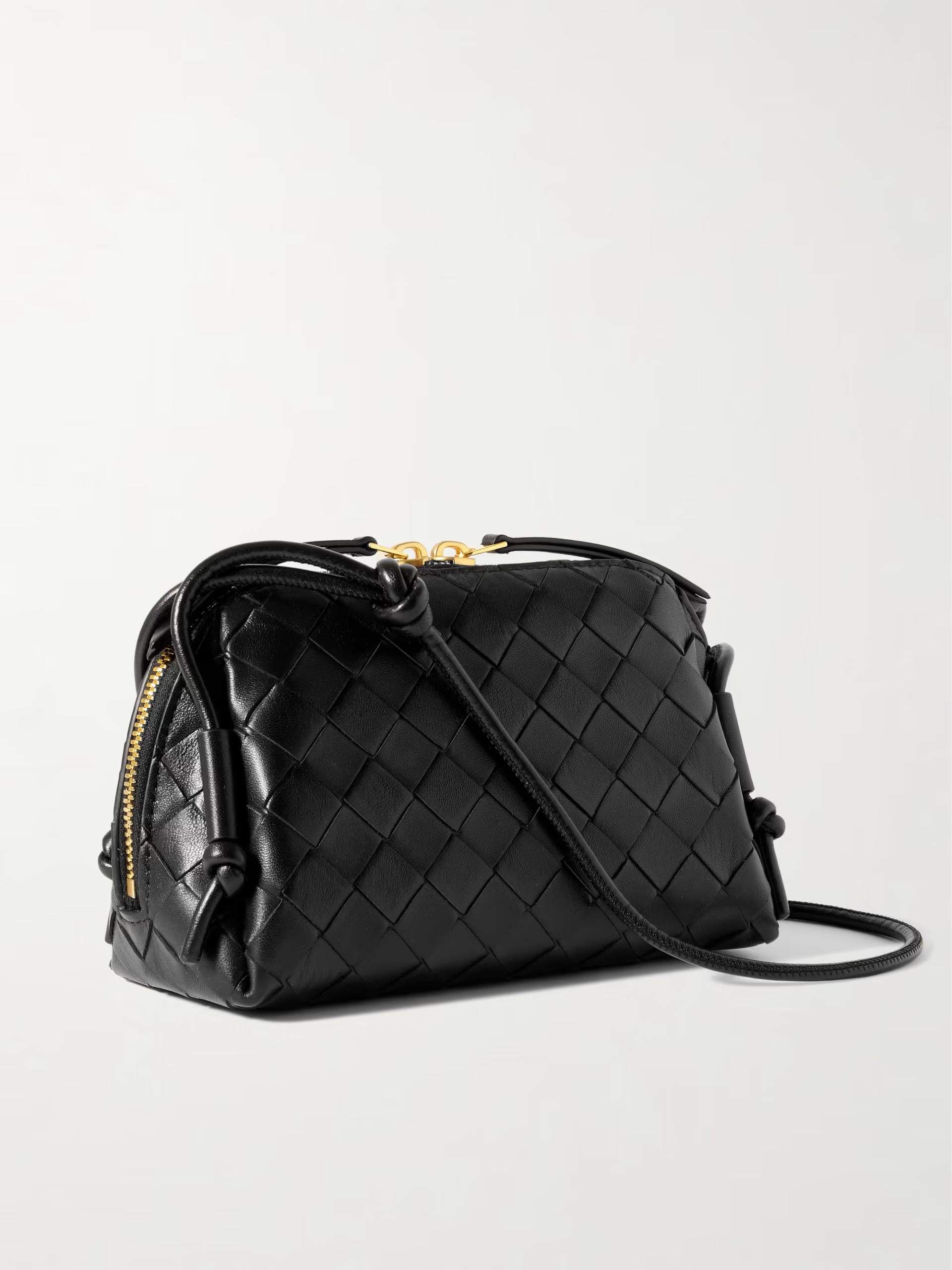
Black intrecciato leather crossbody bag featuring a compact silhouette, signature woven construction, knotted strap accents, and gold-tone zip hardware.
fin
The appointment also closes a loop for Kering that had been quietly running since January, when Rongone’s planned exit first became public. Six months is a long search for a house of this profile, and the eventual answer, an outsider from beauty rather than an internal fashion executive, tells its own story about how de Meo is thinking about Kering’s next chapter. He has now installed a former automotive executive at the top of the group and a former fragrance executive at the top of one of its most valuable houses. The through line is operational discipline over creative pedigree, a preference for executives who have run large, complex consumer businesses profitably rather than ones who have simply worked inside fashion their whole careers.
Spitzer will not touch a single collection before his official start date. Trotter’s creative direction stays untouched, at least for now, and the house’s product calendar for the rest of 2026 was almost certainly locked in before his name was ever floated. What changes, starting in September, is who answers for Bottega Veneta’s retail performance inside Kering’s executive committee, and how the house balances its famous restraint against a parent company that badly needs its smaller houses to start pulling more weight.
There is also a shh industry dynamic worth naming. Beauty and fragrance executives moving into fashion house leadership is not a new phenomenon across the luxury sector, but it tends to happen when a parent group wants operational rigor more than a fresh creative point of view, since the creative point of view already exists and simply needs protecting. Spitzer’s three decades were spent almost entirely on the commercial side of scent, negotiating retail placement, managing regional general manager roles across Spain and greater Europe, and eventually overseeing a fragrance portfolio that spanned several distinct houses under one roof. That is a very specific skill set, and it happens to map closely onto exactly what a multi brand conglomerate needs from someone tasked with fixing retail execution at a single struggling segment.
Six months from now, the clearest evidence of what Spitzer’s appointment actually meant will not be in a press statement. It will be in if Bottega Veneta’s stores start looking, feeling, or communicating any differently than they did the day before he walked in, and either Kering’s next quarterly results show the fashion and leather goods segment stabilize or continue its slide.
Related Articles

Eric Haze Stitches a Nineties Friend Into TOKYO Capsule
Five pieces carry Eric Haze's embroidered tagging for TOKYO No.1 SOUL SET, sold online and in Osaka around the band's Oct 25 BAYCREW'S FESTIVAL set.