
DRIFT AUDIO
Listen to this story
Choose a voice, then press play.
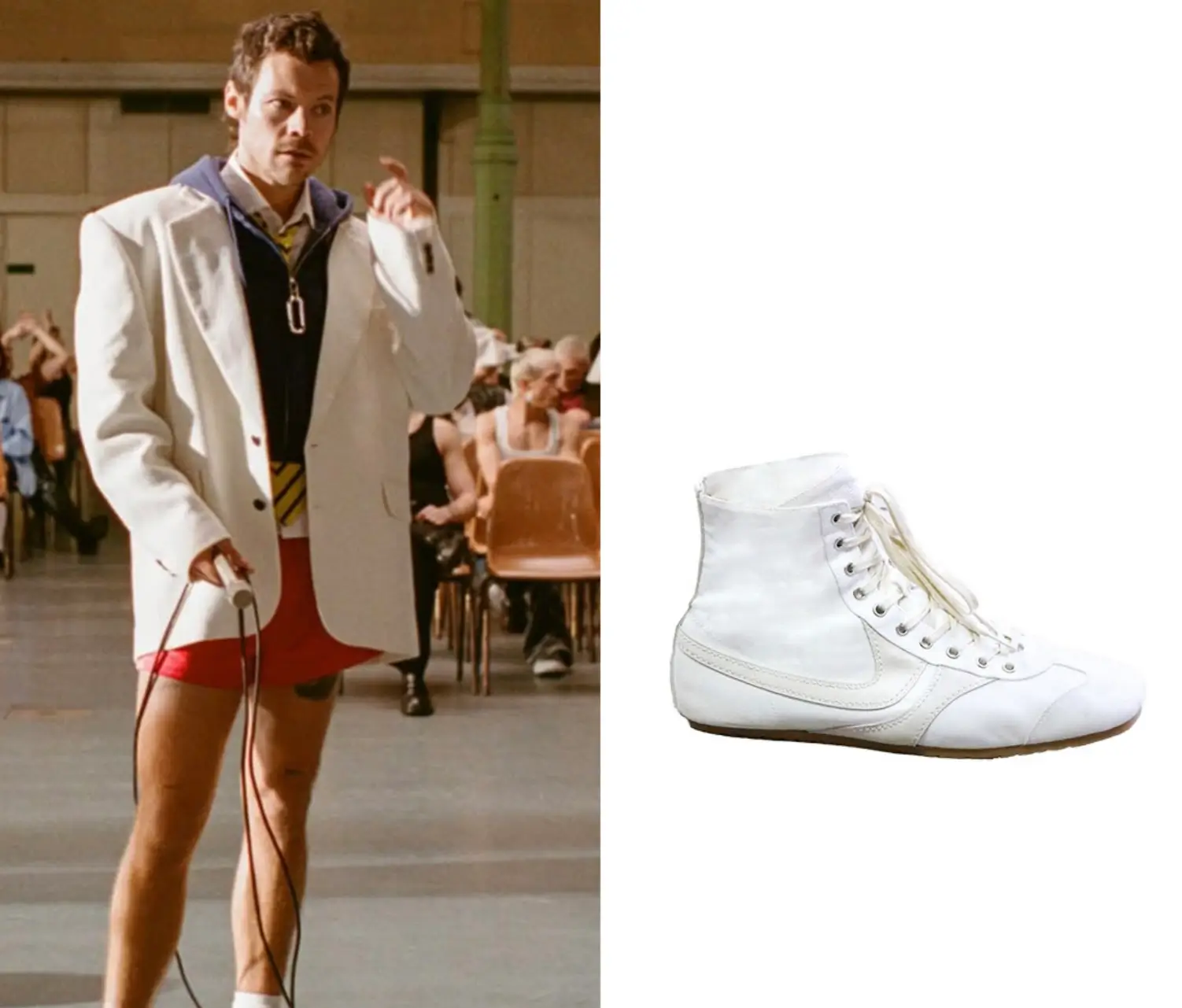
In the flickering half-light of a reimagined high school gymnasium, Harry Styles does what few contemporary pop artists dare: he moves. Not merely sways or gestures, but dances—body rolling, pelvis thrusting, sweat-slicked and unapologetic. Released on May 7, 2026, the official music video for “Dance No More,” the tenth track from his fourth studio album Kiss All The Time. Disco, Occasionally., is a three-minute-and-fourteen-second manifesto on joy, performance, and the pure physicality of being alive. Yet it is the garment anchoring this kinetic reverie that has ignited global discourse: a pair of custom Marc Jacobs micro red shorts so brief they flirt with the boundary between athleticwear and provocation.
flow
Styled by the inimitable Harry Lambert, the ensemble is a masterclass in stylistic dissonance. An oversized off-white suit jacket—sharp-shouldered, almost architectural—layers over a cropped blue zip-up hoodie, its casual athleticism clashing deliciously with the tailoring. Dries Van Noten trainers ground the look in refined sportswear, while the red shorts dominate the view lexicon. Cut high on the thigh with an inseam that barely qualifies as existent, they flash with every kick, turn, and lunge. The fabric, a lustrous technical blend, catches the light like liquid garnet, hugging the contours of Styles’ dancer’s physique without constriction. This is not gym wear repurposed for stage; it is couture masquerading as PE kit.
stir
Marc Jacobs, ever the provocateur of American fashion, has long understood the erotic charge of brevity. His runway collections have repeatedly toyed with scale—exaggerated volumes paired with abbreviated hems, masculine codes subverted through proportion. For Styles, he crafted something more intimate: a garment that weaponizes vulnerability. In an era when male celebrity style often defaults to either armored suiting or amorphous streetwear, these shorts declare the body itself as the site of fashion. The red hue evokes both danger and vitality—blood, passion, warning, celebration. Paired with the pristine white jacket, it creates a view tension that mirrors the song’s themes: the DJ who doesn’t dance, the performer who yearns to join the floor.
scope
This moment arrives at a pivotal juncture in Styles’ sartorial evolution. From the feather boas and sheer blouses of Fine Line to the gender-fluid Gucci ruffles that defined his Vogue cover era, he has consistently treated clothing as narrative device. Yet Kiss All The Time signals a maturation: less costume, more embodiment. The album’s disco-occasional ethos—fluid, hedonistic, occasionally reverent—finds a unique expression in garments that facilitate movement rather than restrict it. Where once his looks screamed “look at me,” the “Dance No More” ensemble whispers “move with me.” It is fashion in service of sensation.
claim
Critics and commentators have reached for superlatives. Some see a continuation of the 1970s athletic glamour that ran through Studio 54; others locate echoes of David Bowie’s gender-bending theatrics or Prince’s purple reign of sensual minimalism. But the true reference point may be more contemporary: the post-pandemic reclamation of the body after years of concealment. In 2026, after lockdowns and culture reckonings, Styles’ bare thighs seemingly feel like a collective exhale. They normalize male leg as aesthetic object without irony or apology. The shorts do not apologize for their shortness; they celebrate it.
theory
Lambert’s styling genius lies in the layering. The hoodie beneath the blazer prevents the look from reading as pure sportswear cosplay. The blazer itself, voluminous and slightly crumpled by movement, introduces imperfection—sweat will mark it, hems will lift. This is fashion designed for use, not preservation. In behind-the-scenes images shared by Lambert, we see the construction details: reinforced seams for choreography, breathable linings, a subtle internal drawcord that keeps the shorts secure during spins. Technical precision in service of hedonistic freedom.
min
Fashion has flirted with athletic minimalism before. Think Helmut Lang’s techno-era shorts, Raf Simons’ hybrid sport-tailoring, or Virgil Abloh’s deconstructed athleisure. Yet Styles’ version feels singular because it is worn without quotation marks. There is no wink, no meta-commentary. He simply wears them while licking the microphone, crowd-surfing energy, and inviting the audience into ecstatic participation. The video’s high school gym setting amplifies this: a space of adolescent awkwardness transformed into adult liberation. The shorts become a uniform for chosen youth—perpetual, performative, pleasurable.
show
High-end fashion has always know the power of exposure. From Yves Saint Laurent’s Le Smoking to Alexander McQueen’s bumster trousers, designers have used the revelation of flesh to challenge norms. Styles, working with Jacobs, updates this tradition for a generation raised on social media’s constant bodily surveillance. By controlling the narrative—choosing when, how, and why to reveal—he reclaims agency. These are not shorts for the beach or the club; they are shorts for the arena of culture itself.
rebel
The cultural conversation they have sparked reveals much about our discomfort with male sensuality. Comment sections oscillate between desire, mockery, and defensive posturing. “DJs don’t dance no more,” the chorus insists, yet Styles does—gloriously, sweatily, unselfconsciously. The shorts become emblematic of broader shifts: the erosion of rigid gender binaries in menswear, the rise of pleasure as political act, the refusal to age out of play at 32. In a time of algorithmic rigidity and cultural polarization, they embody joyful disobedience.
idea
Marc Jacobs himself has spoken in interviews about the connections’s emphasis on movement. The house, under his continued creative influence, has leaned into a softer, more tactile luxury—one that prioritizes how garments feel on skin as much as how they photograph. The red shorts exemplify this: silky yet structured, revealing yet supportive. They move with the body rather than against it, a rare quality in pieces destined for editorial immortality.
fin
Ultimately, “Dance No More” and its red shorts transcend mere celebrity styling. They embody a philosophy: that fashion at its best facilitates freedom rather than signaling status. In revealing the leg, Styles conceals nothing of the self. He is present—flawed, ecstatic, human. The sweat on his brow matches the sheen on the fabric. Tears and perspiration blur, as the lyrics suggest.
From the DRIFT archive: Jodie Foster Narrates Morgan Neville’s Breakdown: 1975: A Cultural Autopsy of the Most Radical Year in American Cinema · No Me Quiero Ir De Aquí — The Story of Bad Bunny and FRSH Company’s Puerto Rican Streetwear Moment