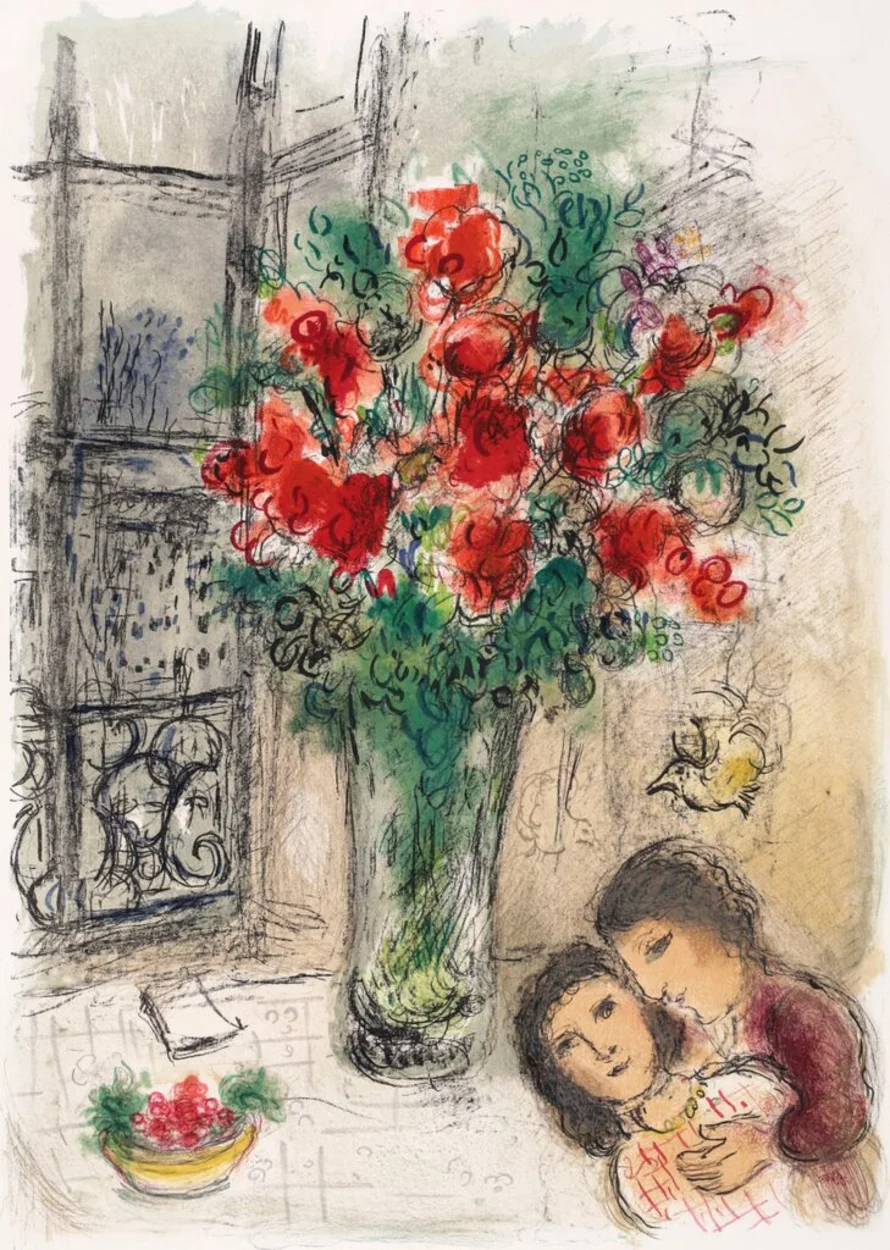
Marc Chagall, Les Fleurs Rouge (The Red Flowers), 1973 (Mourlot 705)
DRIFT AUDIO
Listen to this story
Choose a voice, then press play.
Printed by Atelier Mourlot in Paris and published by Galerie Maeght, this impression is numbered 9/50 (aside from 50 artist’s proofs), signed in pencil with the Mourlot blind stamp. It carries distinguished provenance from the Collection of Mr. & Mrs. Martin Leiter, Florida — a couple who spent over fifty years assembling exceptional Chagall and Miró prints. Currently offered as Lot 160A in Palm Beach Modern Auctions’ Spring 2026 sale with an estimate of $15,000–$25,000.
hx
In 1973, Marc Chagall was 86 years old and living a contented life in Saint-Paul-de-Vence with his wife Valentina “Vava” Brodsky. Decades after the traumas of war, exile, and the loss of his first wife Bella, his work radiated serenity and exuberance. The 1970s marked the culmination of his long collaboration with the Mourlot workshop and master printer Charles Sorlier. Chagall produced some of his boldest and most luminous color lithographs during this period, often on a grander scale that echoed the monumentality of his stained-glass windows and stage designs.
Les Fleurs Rouge belongs to a group of oversized floral compositions that prioritize still-life elements while retaining Chagall’s signature dreamlike figures. It immediately precedes the celebrated Bouquet bleu (1974) and reflects the artist’s enduring fascination with flowers as symbols of love, renewal, and life’s miracles. By centering the bouquet so prominently, Chagall shifts emphasis from narrative to pure sensory celebration — color, form, and emotional resonance.
scope
A monumental bouquet of brilliant red flowers erupts across the composition with explosive energy. Rich crimsons, magentas, scarlets, and glowing pinks dominate, their petals and stems defined by Chagall’s characteristic fluid black outlines. Translucent color layers create depth, luminosity, and the stained-glass effect for which he is renowned. The flowers appear almost weightless, floating upward in joyous profusion.
In the foreground sits a basket of fruit — apples, pears, or grapes — rendered with playful simplicity, anchoring the floral explosion in earthly abundance. Floating lovers (a couple in tender embrace) appear nearby, secondary yet essential, harmonizing with the scene rather than dominating it. Subtle background elements typical of Chagall may include fragments of a Vitebsk-inspired village, a crescent moon, or whimsical animals, all integrated into the poetic whole. The generous sheet size provides breathing room, allowing the composition to expand with a sense of freedom and generosity.
The palette is warm and passionate, centered on reds that evoke love, vitality, and the life force. Contrasting greens, yellows, and blues accent the bouquet, while the velvety blacks of Mourlot lithography give structure and drama. The overall effect is one of overflowing happiness — a visual hymn to nature’s bounty and human connection.
idea
Chagall worked directly on the stones at Mourlot with Sorlier’s guidance, approving progressive color proofs. Multiple stones were required for the rich layering of transparent and opaque inks. The Arches paper’s soft, absorbent quality captures the velvety texture and subtle tonal variations beautifully. The edition of 50 (plus 50 APs) underscores its status as a premium production — rarer and more substantial than many smaller 1960s lithographs. The blind stamp and pencil signature confirm authenticity.
This technical achievement bridges Chagall’s painterly spontaneity with the reproducibility of printmaking, making his dreamworld accessible while retaining the direct touch of the artist’s hand.
flow
Flowers recur throughout Chagall’s oeuvre as emblems of fertility, beauty, and transcendence. In Les Fleurs Rouge, the dominant red palette intensifies associations with passion, warmth, and emotional intensity. The still-life focus reflects late-life contentment: domestic joy, nature’s gifts, and quiet celebration take precedence. Lovers remain present but integrated harmoniously, suggesting love as a supporting force within a larger symphony of life.
This work embodies Chagall’s lifelong philosophy that art should uplift and affirm existence. As he famously noted, color and love provide life’s true meaning. Even in his final decades, he chose wonder over cynicism — a message that feels especially resonant today.
compare
Les Fleurs Rouge dialogues beautifully with earlier floral works (such as the 1969 Bonheur discussed previously) and later pieces like Bouquet bleu. It shares the vibrant energy of circus-themed prints and the luminous quality of his stained-glass designs for the UN, Metz Cathedral, and Jerusalem. Compared to his 1950s–60s book illustrations or smaller lithographs, the scale and confidence here mark a mature culmination. The central bouquet motif appears in paintings and other prints, but this 1973 version gives it unparalleled prominence and color intensity.
rare
Large-format 1970s Mourlot Chagall lithographs like M. 705 are highly sought after for their visual impact and condition challenges. Comparable examples have realized between $12,000 and $35,000+ at auction, with strong impressions from good provenance exceeding estimates. A similar impression (23/50) sold at Christie’s in 2008 for GBP 21,250. This Leiter Collection example benefits from excellent freshness and careful stewardship.
At Palm Beach Modern Auctions, the $15,000–$25,000 estimate positions it as a significant yet attainable acquisition in today’s market. With a 28% buyer’s premium, it represents strong value for a museum-quality Chagall graphic from a notable private collection.
consider
The work is in very good condition, with only minor soiling noted on the bottom right margin, top left corner, and bottom left edge. No major defects are reported. For long-term care: use UV-protective museum glass, maintain stable temperature and 45–55% relative humidity, and avoid direct sunlight. The unframed state allows the buyer full control over presentation — a custom frame with generous margins would enhance its presence.
relev
Chagall’s graphic work democratized his vision, allowing collectors worldwide to own fragments of his magical universe. Les Fleurs Rouge encapsulates his bridge between early modernism (Cubism, Fauvism) and later poetic figuration, influencing generations of artists who value emotion, color, and storytelling. Major museums — Museum of Modern Art, Solomon R. Guggenheim Museum, Tate, and the Art Institute of Chicago — hold his prints prominently.
In 2026, this print’s message of joyful abundance feels timely. Amid global complexities, Chagall reminds us that beauty, love, and color remain powerful acts of affirmation. This impression from a dedicated collector’s holdings offers not just ownership of a beautiful object, but a tangible connection to one of the 20th century’s most beloved visionaries.
From the DRIFT archive: London Streets Print by Arina Iastrebova Captures the Soul of a Rainy City · H.R. Giger Paris: The Biomechanical Dream Awakens at Mai 36 Galerie
Previous article
← Invader's Marlboro 2014: A Pixelated Pack of Digital ConsumerismNext article
Yoshitomo Nara: Untitled (Where Are You?), 2003 →Related Articles
Joël Andrianomearisoa Finds More Than One Black in a Square of Buttons
In La Guerre des Boutons I, a field of ordinary fasteners turns a modest textile […]