DRIFT AUDIO
Listen to this story
Choose a voice, then press play.
a new era of adaptive apparel
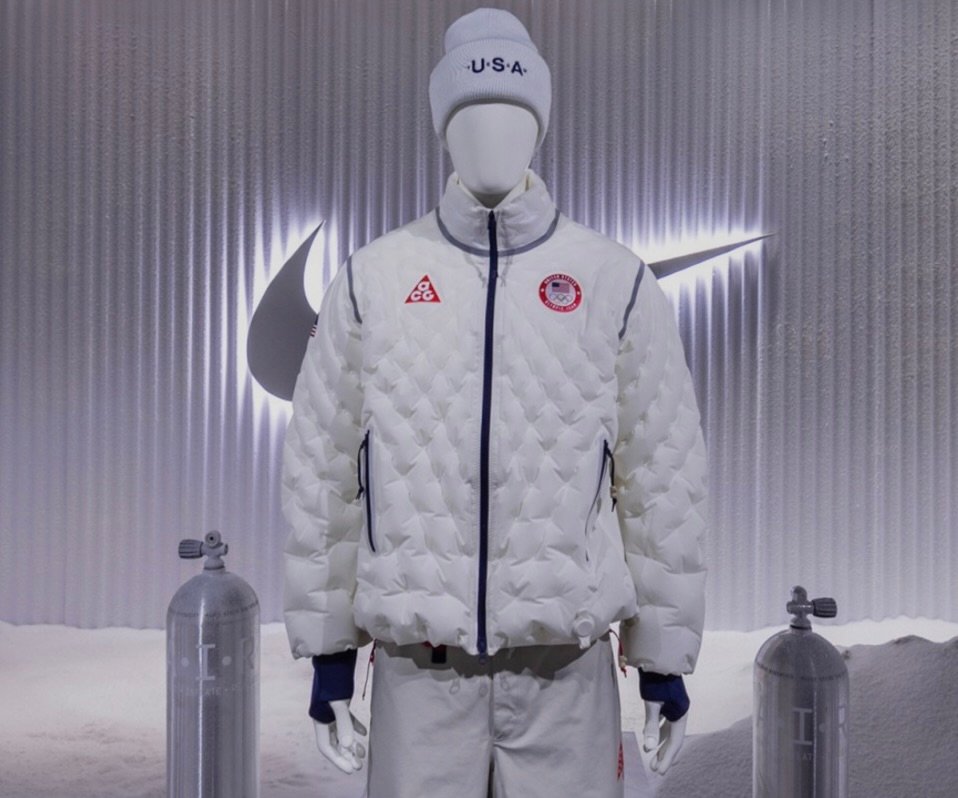
Innovation in sportswear rarely comes quietly. It arrives inflated—literally, in this case—with Nike’s introduction of the Therma-FIT Air Milano Jacket, a self-adjusting, inflatable outerwear piece designed for Team USA at the upcoming 2026 Winter Olympics in Milan and Cortina d’Ampezzo. The jacket represents an extraordinary leap: it’s not just outerwear, but a breathing system capable of regulating its own insulation through controlled air channels.
Nike calls the technology “A.I.R.”—an acronym for Adapt, Inflate, Regulate. Behind the acronym lies a vision to redefine thermal management for athletes who spend as much time waiting as they do performing. When the spotlight hits the medal stand and cold alpine air bites, the Air Milano promises warmth on demand. But more than an Olympic uniform, it’s a manifesto: that apparel, like footwear, can become intelligent, modular, and self-adapting.
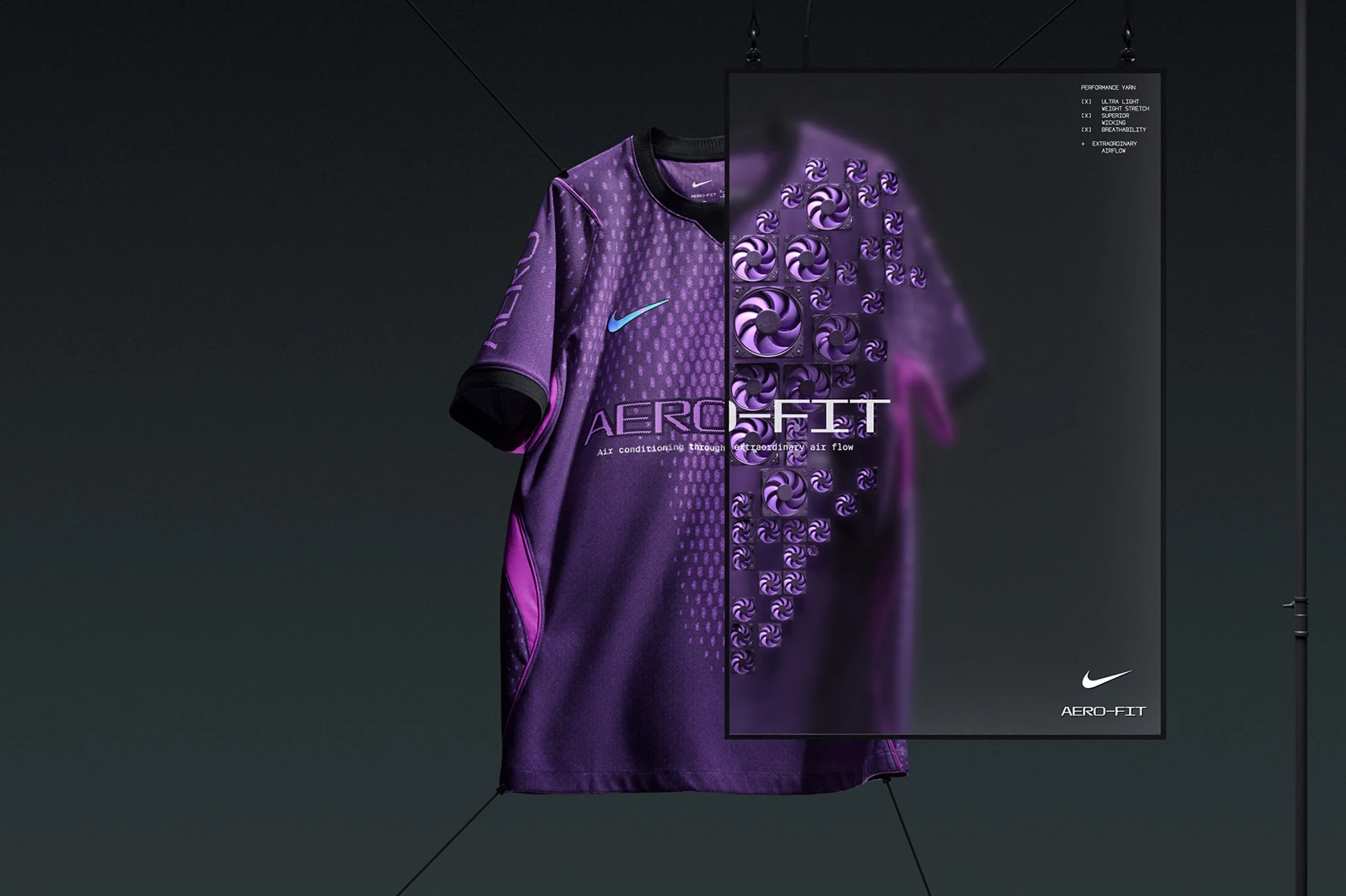
The announcement arrives alongside another milestone—Nike’s Aero-FIT kits for national football federations ahead of the 2026 FIFA World Cup. Those uniforms, designed for the world’s most global sporting event, will be 100 percent recycled from textile waste and built for extreme thermoregulation, boasting double the airflow of any prior Nike jersey. The two innovations—Air Milano for the cold, Aero-FIT for the heat—frame a single vision: adaptive performance as the new cornerstone of design.
air milano
The Air Milano jacket is more than a futuristic showpiece. It’s the logical evolution of a decades-long story that began underfoot. Nike’s obsession with air started in the late 1970s with aerospace engineer Frank Rudy, who devised the Air Sole unit for cushioning shoes. That same idea—using compressed air to deliver comfort—now resurfaces on the human body. The jacket’s layered construction and internal baffle network can be inflated or deflated by a hidden valve, allowing wearers to fine-tune warmth without adding or removing layers.
This represents a fundamental shift from static materials to dynamic performance systems. Each chamber is mapped using computational design software that determines how air should distribute around the torso for maximum insulation with minimal weight. The jacket’s two-layer composite textile—a soft, breathable exterior fused with a flexible membrane—creates a sculpted, almost architectural silhouette when inflated, earning its “Milano” name not just for the host city but for the Italian sensibility it evokes: precision tailoring meeting advanced engineering.
Nike’s design team describes the Air Milano as the convergence of function and form. It’s wearable architecture, crafted to look as compelling deflated as it does inflated. On Team USA athletes, the jacket will appear during podium ceremonies—those globally televised moments where design often speaks louder than sport. The visual drama of inflation isn’t incidental; it’s branding through movement, a kinetic expression of innovation.
View this post on Instagram
symbol
Olympic apparel carries symbolism far beyond performance. These garments act as flags rendered in fabric—emblems of national pride, technical superiority, and cultural narrative. Nike understands this better than most, and with Air Milano, the brand extends the lineage of iconic podium looks, from the silver-suited athletes of Sydney 2000 to the tailored minimalism of Tokyo 2020.
The 2026 edition, though, introduces a distinctly futuristic dimension. When Team USA athletes stand in the Italian alpine chill, their jackets will literally rise with air. The act of inflation transforms them from individuals to symbols of engineered optimism—a gesture of progress that mirrors the Olympic spirit.
Nike’s material scientists worked on airflow calibration that can adjust insulation levels by roughly 20 percent within seconds. The concept originated in Nike’s ISPA lab—known for experimental, utility-driven designs—and transitioned into what is now called the Project Amplify Innovation Engine. This initiative is aimed at embedding adaptability into all forms of Nike apparel. The Air Milano is thus not a one-off stunt but a prototype for a wider ecosystem of reactive textiles that could reshape outerwear entirely.
adaptive apparel meets environmental awareness
What makes Nike’s dual announcement remarkable is how it connects adaptation to sustainability. As the Air Milano focuses on regulating warmth, the Aero-FIT football kits for the 2026 World Cup pivot toward cooling and ecological responsibility. Both address environmental challenges from opposite temperature poles.
According to Nike’s design lead for global football, the new Aero-FIT jerseys are made entirely from recycled textile waste—a step beyond the recycled plastic bottle polyester used in prior collections. The garments feature a new weaving structure that increases airflow between fabric and skin, improving sweat evaporation and maintaining body temperature under extreme heat. It’s an elegant response to a real-world issue: climate change and the rising temperatures athletes face on the pitch.
The 2026 tournament will be played across North America, including host cities known for summer heat. Nike’s testing indicates the Aero-FIT material enables two times greater air permeability than previous Dri-FIT models, resulting in faster cooling and lighter moisture load. That might sound like marginal improvement, but in sport—especially when the margin between exhaustion and endurance is seconds—it’s enormous.
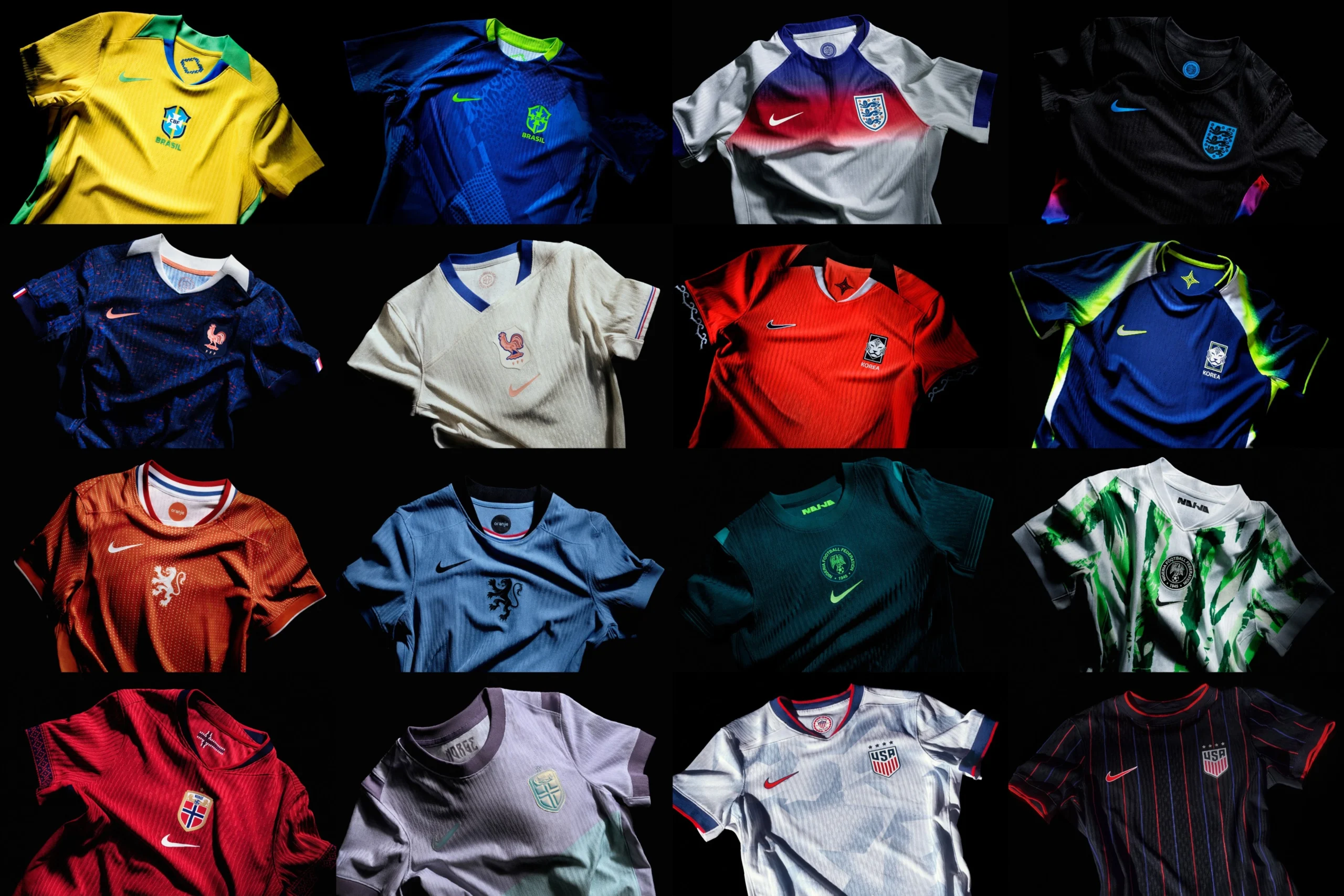
These kits, which will outfit Nike-federated national teams such as the United States, Brazil, Portugal, England, and France, mark the company’s most sustainable and technically advanced collection yet. The design language also shifts: subtle textural weaves, gradient heat-map panels, and minimalist seams all serve function first, aesthetic second. It’s sustainability as a visual code, visible even from the stands.
design
Both Air Milano and Aero-FIT reflect a growing recognition that climate is no longer background—it’s the playing field itself. Nike’s response is to make clothing that can intelligently adapt to changing conditions. Whether insulating against alpine cold or ventilating under stadium lights, the goal is resilience.
In Milan, athletes will wear jackets capable of inflating like living organisms; in Mexico City or Dallas, they’ll run in shirts that breathe faster than skin. Together, they articulate a new grammar of design: one that sees climate adaptation as performance, not compromise.
From an environmental standpoint, Nike claims the manufacturing process of Aero-FIT reduces water use by 50 percent and CO₂ emissions by roughly 30 percent compared with virgin polyester production. The company’s Move to Zeroinitiative—its global sustainability platform—uses these high-visibility launches to normalize recycled materials at the elite level. When a World Cup kit can be fully circular, the hope is that mass-market jerseys and training wear follow suit.
performance
If there’s one thing Nike never loses sight of, it’s spectacle. Air Milano’s sculptural form echoes the brand’s long-standing tension between athletic utility and fashion-forward experimentation. Its inflated geometry recalls puffer jackets from Moncler’s Genius line, or even Craig Green’s avant-garde padding sculptures—yet it remains unmistakably Nike: streamlined, technical, American.
Likewise, the Aero-FIT kits—though engineered for function—extend Nike’s design minimalism to a new aesthetic vocabulary. Texture becomes the new color, airflow the new pattern. As synthetic fashion moves toward invisible technology, these kits communicate design through sensation rather than print.
For the fan, these developments foreshadow what the next wave of consumer sportswear might look like. Imagine jackets that automatically trap or release air based on body heat, or training tops that adjust ventilation in real time. Nike’s experiments with AI-assisted design already hint at this direction, where computational models simulate comfort and energy efficiency before a single stitch is made.
heritage and horizon
Nike’s innovation cycle often returns to its origin myths—the Air unit, the athlete’s body, the marriage of science and motion—and then rewrites them with contemporary urgency. The Air Milano jacket is as much about heritage as it is about horizon. By reviving “Air” as a platform beyond shoes, Nike reinforces continuity while exploring reinvention. The lineage from Air Max to Air Milano feels deliberate: same molecule, different medium.
The broader narrative positions Nike not just as a sportswear brand but as an engineering house for the human condition. Whether dealing with altitude, temperature, or climate anxiety, the company’s proposition remains clear—human performance can be optimized by design.
Critics may note the paradox of sustainability in mass manufacturing, but Nike’s incremental steps—textile recycling, adaptive wear, modular design—at least gesture toward responsibility at scale. The more the brand’s most visible athletes wear recycled or reactive gear, the more it normalizes that future for consumers.
view
When the Winter Games open in 2026, cameras will linger on the medal podium, capturing athletes as their jackets quietly expand around them. That cinematic inflation will symbolize more than warmth—it will broadcast the idea of adaptability as beauty. For Team USA, the Air Milano becomes both armor and advertisement, uniting national pride with technological sophistication.
In contrast, the following summer will find footballers sweating under North American suns, clad in light-as-air fabrics that breathe with every sprint. Two extremes—cold precision and hot endurance—illustrate a shared thesis: apparel should move with climate, not against it.
In marketing terms, Nike’s timing is masterful. By synchronizing Olympic and World Cup innovations within the same year, it frames 2026 as its grand statement on performance design. The duality of inflate and ventilate turns into a neat brand symmetry, offering both literal and metaphorical air to the future of sport.
culture
Outside sport, Air Milano will likely enter streetwear discourse the way Nike’s ISPA line did—through its form language and potential crossover appeal. The jacket’s modular silhouette and self-inflating mechanism have already generated comparisons to wearable tech and performance art. Expect early imagery of athletes in inflated jackets to circulate widely on social platforms, feeding fashion’s hunger for hybrid objects that blur athletic and avant-garde codes.
The Aero-FIT kits will, meanwhile, influence sustainability discourse in apparel. If the world’s biggest sporting stage can feature fully recycled textiles without sacrificing aesthetics or performance, it becomes a proof of concept for the entire industry. Smaller brands can follow, using the World Cup spotlight as a moral and marketing cue.
Nike’s advantage lies in narrative control. The company doesn’t just invent materials—it crafts mythologies. “Air” was never just a cushioning system; it was an idea of lightness, freedom, futurity. By extending that mythology into outerwear and eco-engineered kits, Nike ensures the word still breathes relevance fifty years after it entered pop culture.
flow
The convergence of Air Milano and Aero-FIT technologies points to the next decade of apparel design where responsiveness becomes the defining measure of innovation. Static garments are giving way to reactive ecosystems: clothing that can sense, adjust, and even anticipate environmental change. Nike’s prototypes suggest a horizon where jackets inflate automatically based on temperature data, or football shirts adjust fiber density to direct sweat evaporation zones.
This evolution carries implications beyond sport. Urban commuters, outdoor enthusiasts, and fashion consumers alike could benefit from adaptable insulation and sustainable textiles. The challenge will be scalability—how to democratize technology designed for Olympians and World Cup players without losing performance integrity.
As machine learning and material science converge, Nike’s laboratories begin to resemble R&D hubs for wearable climate systems. Air Milano and Aero-FIT may thus be remembered not just as products but as proof points that clothing can think.
impression
The 2026 Olympic and World Cup years promise to be milestones not only in sport but in design history. Nike’s Air Milano jacket and Aero-FIT kits showcase how technology, sustainability, and aesthetics can operate in tandem, responding to the world’s extremes with elegance and intent.
From the icy peaks of Italy to the heated pitches of North America, these garments embody the same idea: the future of performance is adaptive. Whether inflated with air or engineered with airflow, Nike’s new apparel literally and figuratively breathes.
In a world where temperature, climate, and culture are all in flux, perhaps that’s the only design philosophy that makes sense—to keep moving, expanding, and adjusting with the world around us.
Related Articles
Hiroshi Fujiwara & FRGMTMINI Drop a Lightning Bolt for the Next Generation: The 2026 SS “College” Collection Is Here
Get ready to feel it — that unmistakable jolt of cool that only Hiroshi Fujiwara […]