
DRIFT AUDIO
Listen to this story
Choose a voice, then press play.
In a significant step forward for one of the most long-delayed and criticized infrastructure projects in the United States, U.S. Department of Transportation Secretary Sean P. Duffy and Amtrak have selected Penn Transformation Partners—led by developers Halmar International and Skanska—as the master developer team to overhaul New York City’s Pennsylvania Station.
The announcement, made on or around May 20, 2026, follows a competitive months-long proposal process and marks a decisive shift in how the federal government and Amtrak are approaching the transformation of the nation’s most heavily used passenger rail facility.
@USDOT Secretary Sean Duffy and the @Amtrak Board of Directors on Wednesday named Penn Transportation Partners, a partnership Halmar and @SkanskaUSA , as the master developer for the New York Penn Station renovation. https://t.co/LX33gVYSHu
— Smart Cities Dive (@smartcitiesdive) May 21, 2026
stir
Pennsylvania Station, commonly known as Penn Station, serves as the primary intercity and commuter rail hub for New York City. It handles hundreds of thousands of passengers daily from Amtrak, NJ Transit, and the Long Island Rail Road (LIRR). Despite its critical role, the current station—built in the 1960s after the demolition of the original Beaux-Arts masterpiece designed by McKim, Mead & White—has long been derided as cramped, dark, confusing, and inadequate for modern needs.
The original Penn Station, opened in 1910, was a grand architectural landmark with soaring columns, expansive waiting halls, and natural light flooding through glass ceilings. Its destruction in 1963 to make way for Madison Square Garden (MSG) and office space sparked the modern historic preservation movement in the U.S. The replacement station, largely subterranean beneath the arena, has been plagued by low ceilings, narrow concourses, poor wayfinding, and limited capacity.
Previous efforts to fix it, including Governor Andrew Cuomo’s Empire Station Complex plans and later iterations under Governor Kathy Hochul, faced delays, political hurdles, cost overruns, and debates over whether to move Madison Square Garden. In April 2025, Secretary Duffy and the Trump administration intervened, transferring oversight from the Metropolitan Transportation Authority (MTA) to Amtrak and the federal government to accelerate progress and reduce mismanagement.
Special Advisor Andy Byford, known for his work modernizing transit systems, was brought in to oversee the effort. The administration emphasized speed, public-private partnerships (P3), and delivering a “world-class” facility.
flow
Penn Transformation Partners is a joint venture primarily between New York-based Halmar International (a heavy civil construction firm and part of the ASTM Group) and Sweden-based Skanska. The team includes architecture firms HOK (managing architect) and Practice for Architecture and Urbanism (PAU, design architect), along with other partners such as Vornado Realty (a major landowner in the area) and ASTM.
They were chosen from three qualified bidders after a rigorous evaluation focused on value, capacity increases, operational efficiency, passenger experience, and revenue potential for Amtrak. The selection process was overseen by Byford and supported by advisors including Hunton Andrews Kurth (legal), KPMG (financial), and AECOM/LIRO (project/construction management).
This builds directly on earlier design concepts released in 2023 by PAU, HOK, and ASTM. Those initial plans emphasized renovating within the existing footprint without demolishing or significantly altering surrounding structures like MSG.

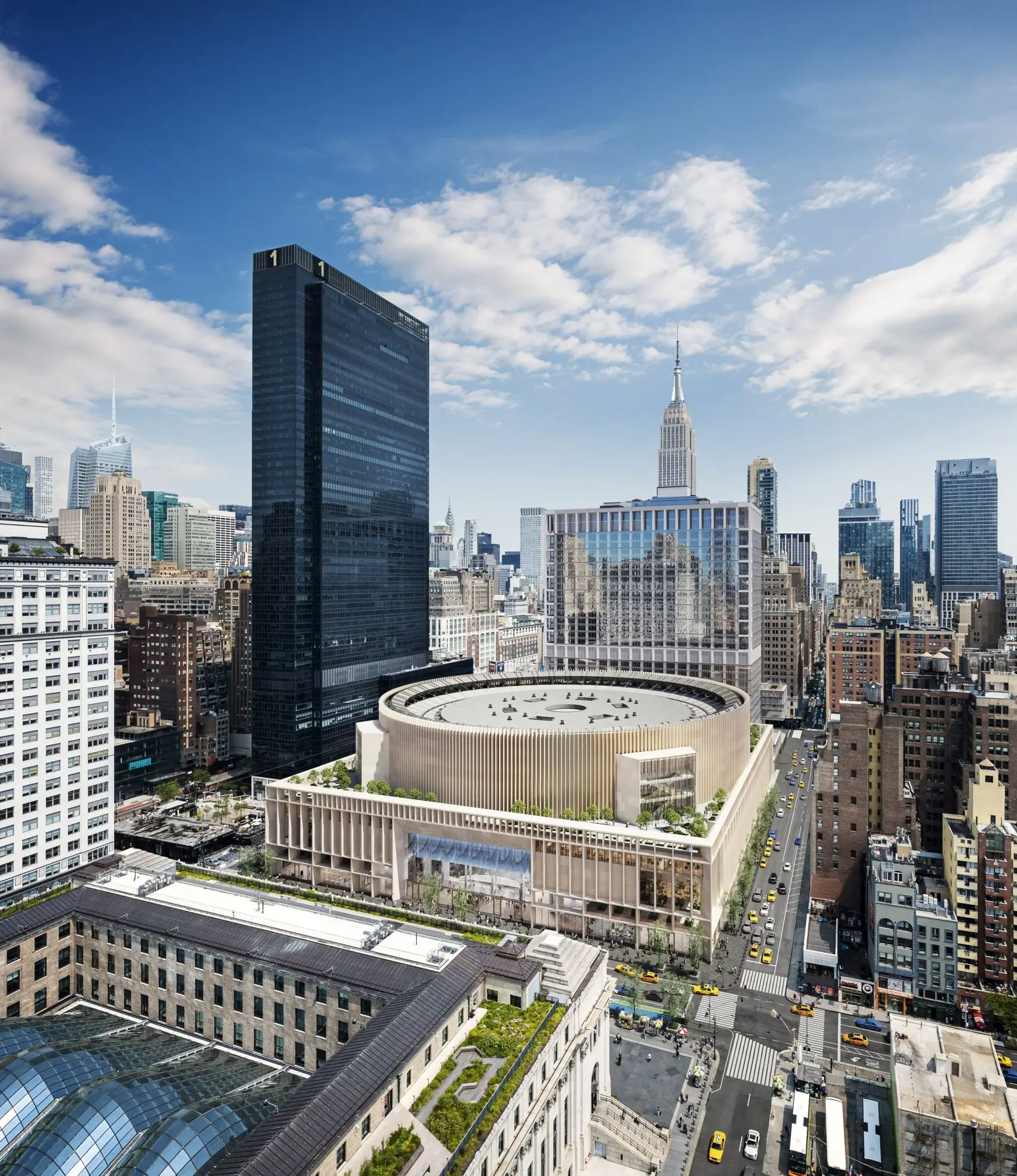
Initial 2023 renders by PAU and HOK for ASTM showed a light stone-clad exterior for the Penn Station base and MSG, echoing the classical aesthetic of the nearby Moynihan Train Hall.
view
According to Amtrak and DOT announcements, the transformation will deliver:
- A grand new entrance on Eighth Avenue leading to a new train hall with significantly higher ceilings and natural light.
- Open, beautiful concourses replacing the current cramped and decrepit walkways.
- Expanded track capacity, including provisions for at least limited through-running on the regional rail network to improve efficiency and reduce bottlenecks.
- Enhanced passenger amenities: Better wayfinding, new retail spaces, improved accessibility (ADA-compliant), and overall upgrades to the subterranean structure.
- Retention and enhancement of Madison Square Garden: MSG will remain in place but receive new cladding for a “classical look,” harmonizing with Moynihan Train Hall across the street.
The design draws inspiration from the lost original Penn Station while integrating modern functionality. It aims to create a vibrant gateway to New York City, boosting both commuter flow and the surrounding neighborhood economy.
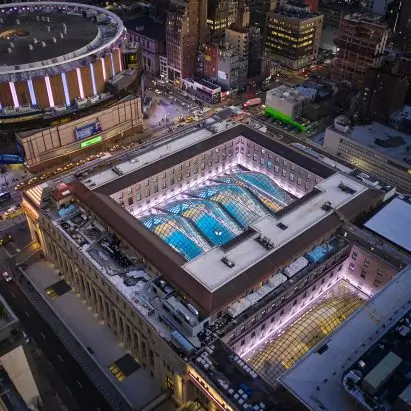
Current Penn Station interiors are often described as oppressive and inefficient by comparison.

Contrast with proposed light-filled spaces from earlier concepts.


straddle
The federal government has committed approximately $8 billion to the project, with Secretary Duffy announcing an additional $200 million through the Partnership-Northeast Corridor Program for design and permitting work. Amtrak and NJ Transit are also contributing.
Groundbreaking is targeted for late 2027, with the project advancing through final contract negotiations, permitting, design finalization, and an FRA-led Service Optimization Study. The P3 model is expected to leverage private investment for long-term maintenance and potential revenue streams (e.g., retail).
Economically, the project promises thousands of construction jobs, increased property values in the Hudson Yards and Midtown areas, and improved regional connectivity. As America’s busiest transit hub, upgrades here will have ripple effects across the Northeast Corridor, supporting economic growth, reducing delays, and enhancing resilience.
sig
Penn Station’s story is emblematic of broader American infrastructure challenges: grand ambitions undermined by short-term thinking, followed by decades of incremental fixes. The 2026 selection of Penn Transformation Partners represents a potential turning point—combining federal leadership, private expertise, and architectural ambition.
If successful, the renovated station could rival modern hubs like Grand Central’s revitalization or international examples in Tokyo or London, serving as a symbol of 21st-century American renewal. It would restore dignity to daily commutes for millions while honoring the civic importance of great public architecture.
Challenges remain: complex engineering in an active rail environment, funding certainty, stakeholder alignment (including New York state and city), and delivering on promises without excessive disruption. Yet the momentum is palpable. As Secretary Duffy noted, the days of Penn Station’s notorious shortcomings are numbered.
This project is more than a station upgrade; it is an investment in the future of American mobility, urban vitality, and national pride in its transportation gateways. Ne
Related Articles

Under Rue de Castiglione, Liaigre Gives Hôtel Costes a Spa With No Hard Corners
A 20-meter lap pool, eight treatment rooms and not one sharp angle: Studio Liaigre’s spa […]