
DRIFT AUDIO
Listen to this story
Choose a voice, then press play.
a question
At Milan Design Week 2026, where saturation is expected and spectacle is currency, Rimowa and Lehni arrive with restraint. Not absence—precision. Their collaboration does not attempt to introduce a new category, nor to exaggerate an existing one. Instead, it isolates a condition that has remained curiously unresolved: the afterlife of luggage.
Suitcases are objects of transit, engineered for durability and repetition. Yet once movement stops, they become spatial liabilities—awkward, oversized, temporarily hidden. Closets absorb them, beds conceal them, hallways tolerate them. Nowhere are they truly placed.
The Rimowa x Lehni collection begins exactly there.
struct
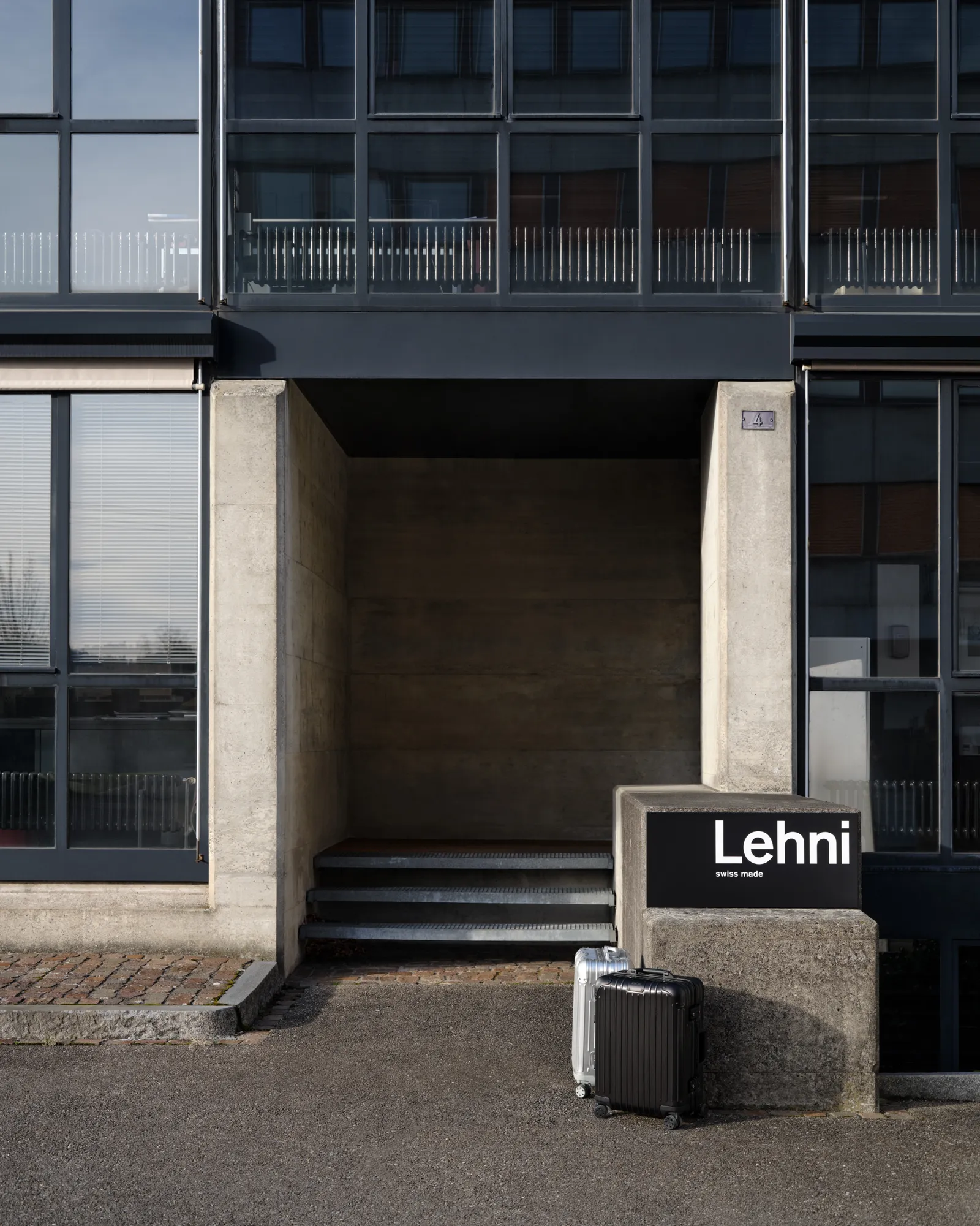
Aluminum is not introduced here—it is continued. For Rimowa, it is legacy; for Lehni, it is language. The anodized surfaces—matte black or brushed silver—do not decorate the objects but define them. Light diffuses across planes rather than reflecting sharply, emphasizing volume over sheen.
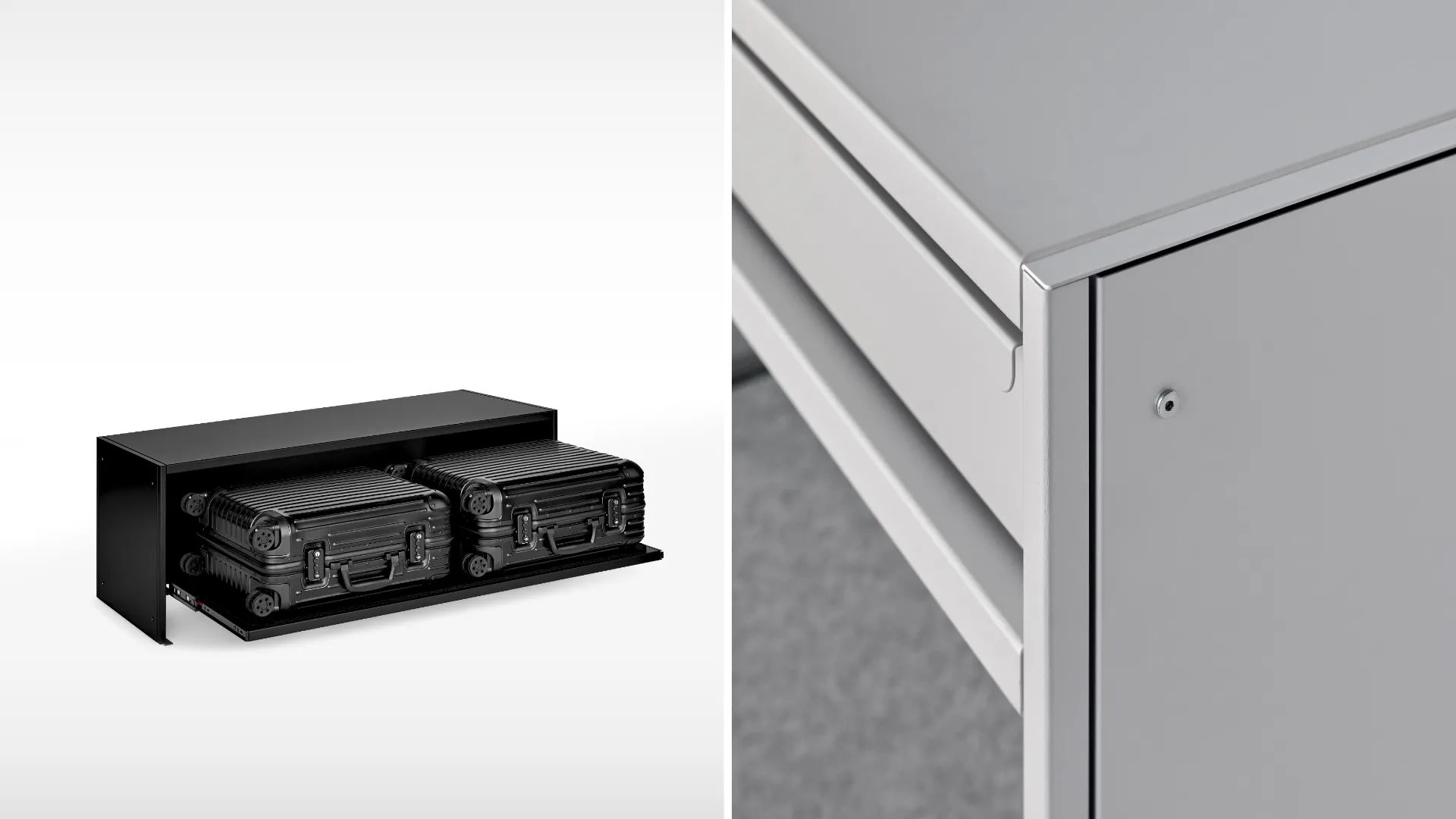
Edges are folded with clarity. Bolts remain visible, not as raw necessity but as deliberate punctuation. Each fastening point becomes a marker of assembly, a refusal to conceal structure beneath finish. This is not minimalism as absence, but minimalism as exposure—of process, of intention.
Hand-finishing at Lehni’s Zurich facility reinforces this approach. The pieces resist industrial anonymity. They retain a sense of handling, of measured completion. Precision, here, is not automated perfection but controlled resolution.
View this post on Instagram
stir
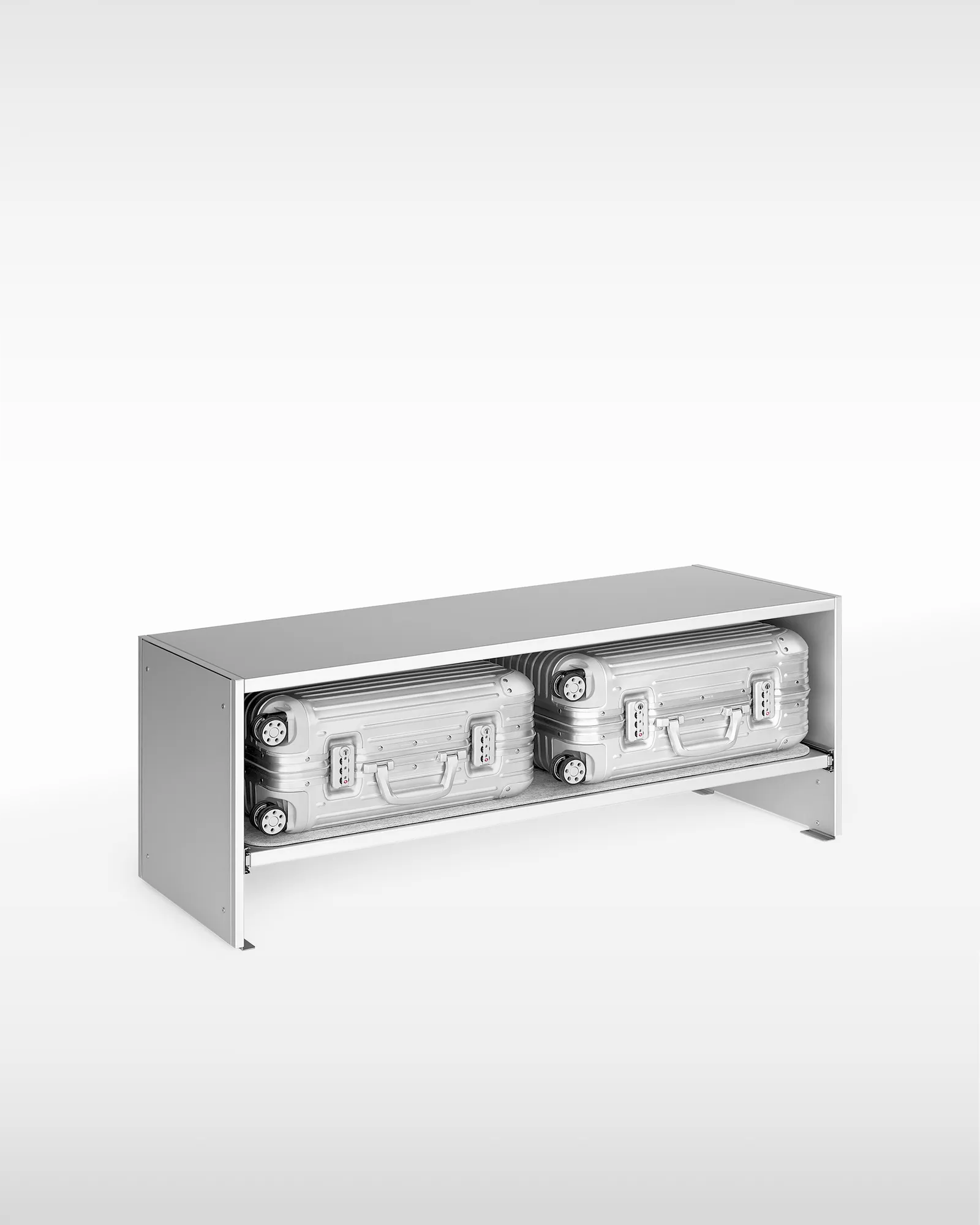
The Rimowa Lehni Bench is reductive in the most deliberate sense. A rectangular aluminum frame, open at the front, scaled precisely to hold two cabin-sized suitcases. No compartments, no segmentation, no visual interruption.
Its intelligence lies in proportion. The dimensions are dictated entirely by the luggage it houses. The furniture does not impose form—it derives it. This results in an object that feels less like a container and more like an extension of the suitcase itself.
The openness is intentional. By maintaining visibility, the Bench keeps the stored objects within the spatial narrative of the room. Luggage is not hidden; it is acknowledged, stabilized, given a place without being erased.
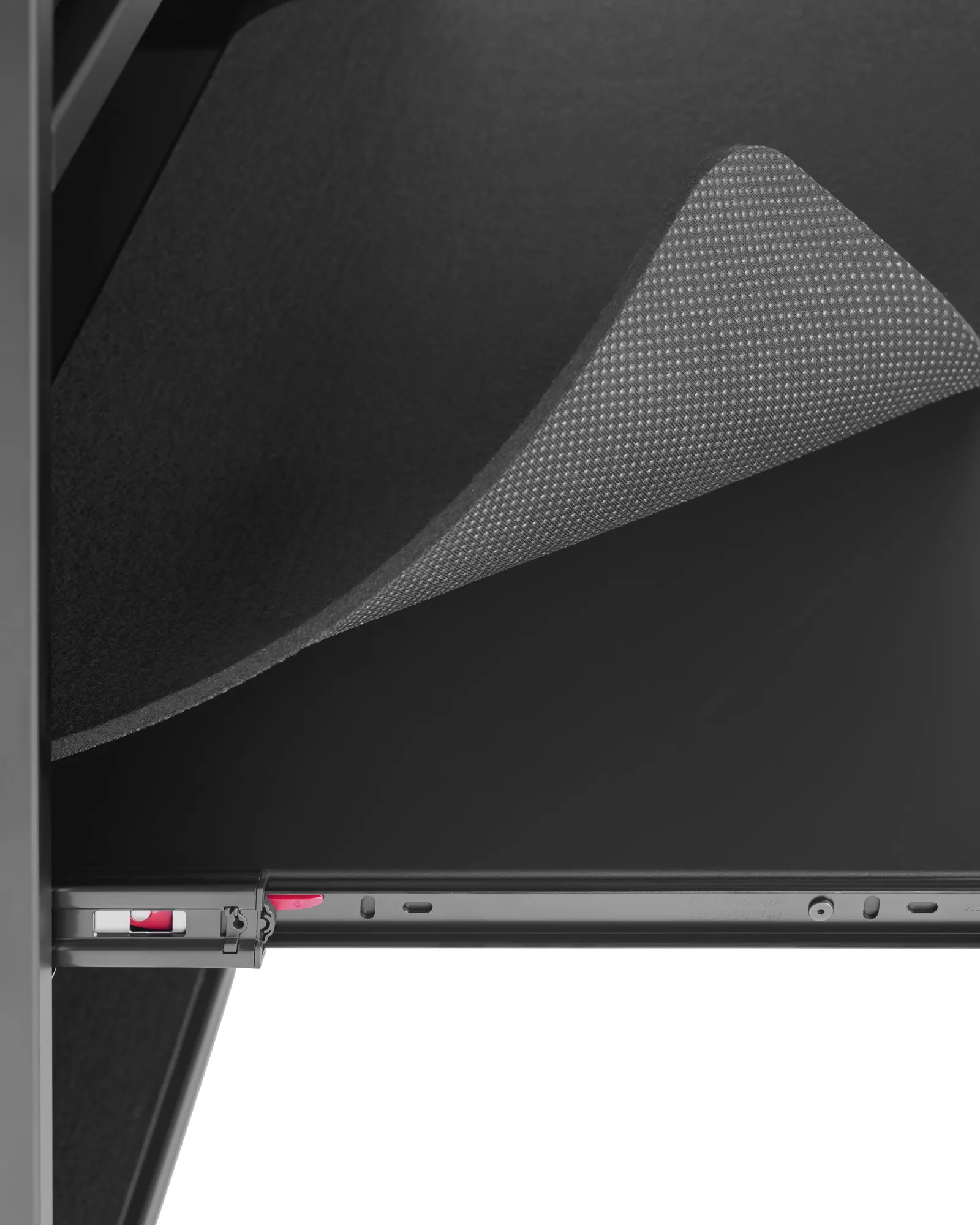
Inside, a scratch-resistant felt lining absorbs contact. It introduces tactility without altering the visual discipline of the piece, reinforcing a balance between protection and restraint.
idea
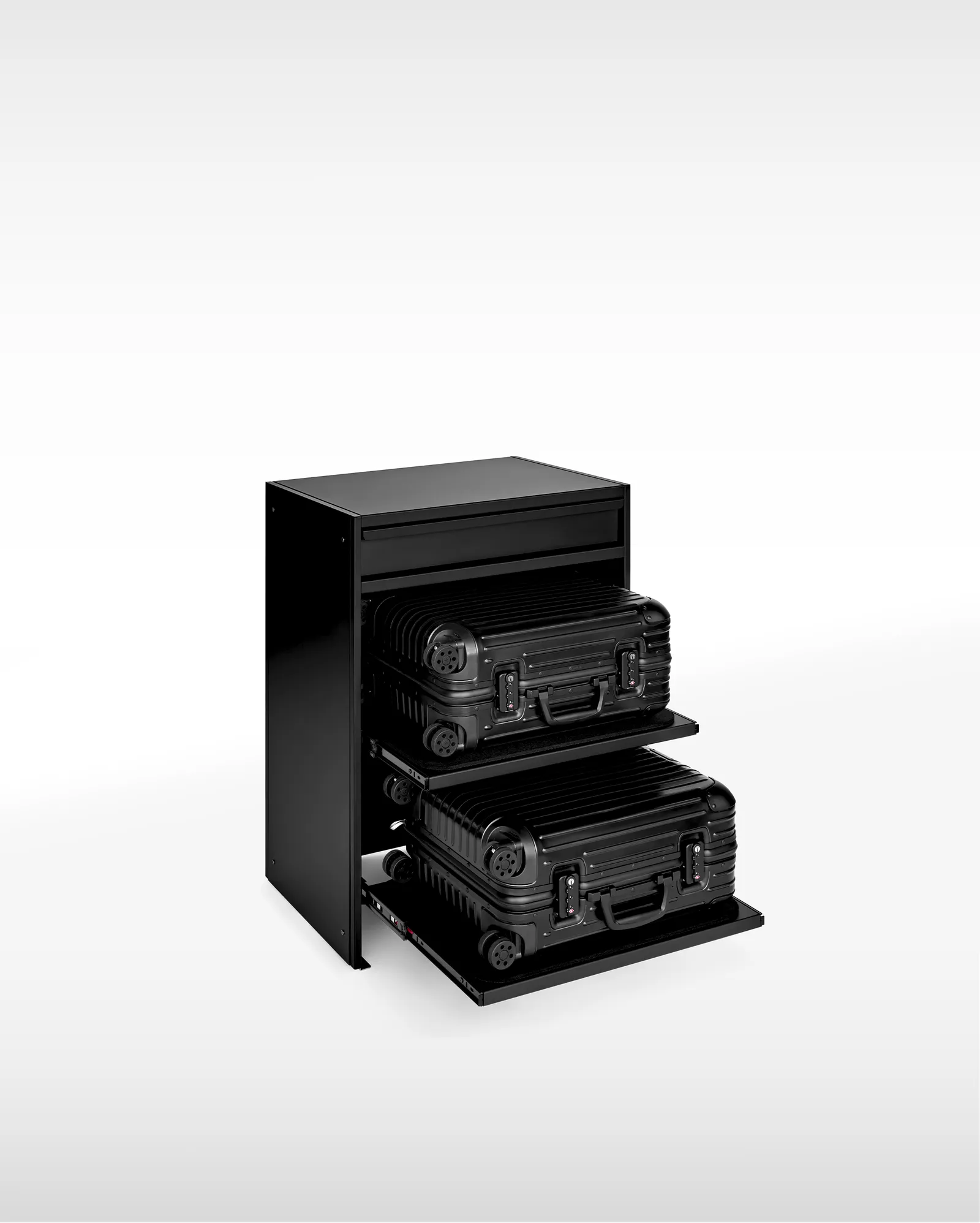
Where the Bench operates through exposure, the Drawer responds with containment. Its stacked aluminum frame introduces a layered geometry, enclosing space rather than presenting it.
The pull-out mechanism is engineered with precision. Movement is controlled and unobtrusive, allowing access without disrupting the overall form. A subtle release detail signals interaction without visual noise.
This is where smaller travel objects—documents, accessories, fragments of movement—are stored. The Drawer does not contradict the Bench; it completes it. Open and closed, horizontal and vertical, display and concealment—resolved as a system rather than separate objects.
been
Installed at the Rimowa Lehni Visitor Centre on Via Achille Maiocchi, the collection is presented without excess staging. The environment mirrors the objects: structured, quiet, and intentional.
A curated book selection, a handwritten postcard station, and a window installation by Studioutte extend the narrative beyond the furniture itself. These elements introduce slowness into a context defined by speed, reframing travel not as movement alone but as reflection.
Nothing competes. Everything aligns.
design
As noted by Mathieu Plenier, the collaboration reflects a convergence of Swiss and German design principles. Benedetta Agostini and Antonio Monaci describe it as “technology and beauty applied to aluminum.”
The language is expected. The objects, however, do not rely on it.
There is no overextension of concept, no attempt to universalize the design beyond its function. The pieces remain committed to a single purpose—storing luggage—and in doing so, avoid the dilution often seen in cross-industry collaborations.
narrow
Luxury collision often expand outward—into apparel, objects, atmospheres. This one contracts. It focuses on a single behavioral gap and resolves it with clarity.
Suitcase storage has historically existed in compromise. Temporary placements, improvised solutions, spatial inefficiencies. By isolating this function, Rimowa and Lehni remove ambiguity. They do not offer flexibility—they offer precision.
This narrowing is what gives the collection its strength.
rare
The Rimowa x Lehni pieces are not mass-produced. Their limited availability and hand-finished construction position them within collectible design, yet they resist becoming purely decorative.
Their value lies in coherence. Every detail—from exposed fasteners to felt-lined interiors—aligns with the central function. There is no ornamental drift, no deviation for visual effect alone.
They are objects designed to be used, but also to be understood.
fin
What this collision ultimately proposes is simple, but rarely addressed: that the objects we travel with deserve resolution when movement ends.
Not storage as concealment, but storage as placement.
Not furniture as backdrop, but furniture as continuation.
In a design landscape driven by constant novelty, the Rimowa x Lehni collection offers something quieter—and more exacting. A system that does precisely what it claims, and nothing it does not.
A place for the suitcase, finally considered.
From the DRIFT archive: MAVERICKS — The Inflatable Tent Engineered for the Edge of the Earth
Related Articles

The Map of Milan Fashion Week Men’s SS27
In This Story Milan Fashion Week Men’s SS27 Returns to the Global Menswear Spotlight Why […]