DRIFT AUDIO
Listen to this story
Choose a voice, then press play.
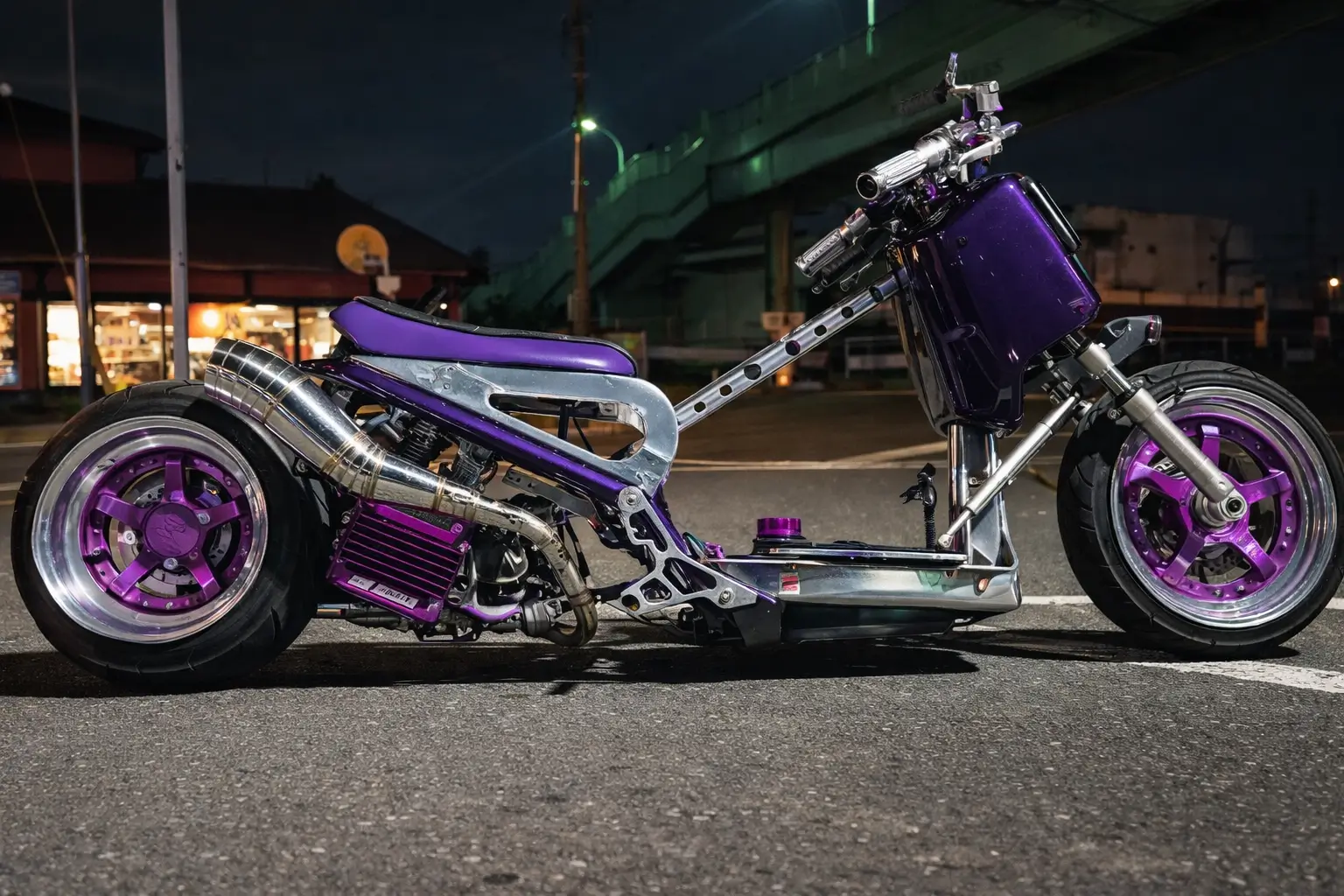
Japanese scooter culture, known as “gentsuki” (short for gensoku-tsuki jidōsha, or limited-speed motorcycles under 50cc), is a vibrant subculture that transforms everyday scooters into personalized works of art. Enthusiasts take models like the Honda Tact, Honda Super Tact AF09, and Suzuki Burgman and reimagine them with wild paint jobs, custom fairings, stretched frames, and exaggerated silhouettes that often blur the line between utility and spectacle.
Performance upgrades are equally central—engine boring to 70–82cc is common despite legal limits, alongside upgraded carburetors, reinforced crankshafts, high-compression pistons, and custom exhaust systems tuned more for presence than discretion. Neon underglow, chrome detailing, speaker systems, and LED arrays further push these machines into expressive territory, turning them into rolling statements of identity rather than simple transport.
View this post on Instagram
commune
This DIY spirit thrives across platforms like Instagram, YouTube, and legacy Japanese forums such as Mixi, where builds are documented in obsessive detail. Offline, the culture sustains itself through parking-lot meets, night rides through Tokyo’s expressways, and regional gatherings where riders display not just their scooters but their approach to customization.
Some lean toward maximalist, almost theatrical builds—layered lighting, oversized fairings, visual excess—while others pursue stripped-back precision, where every line and component is intentional. The community is tight-knit, often organized into small crews that share tools, parts, and knowledge, reinforcing a culture of collective craftsmanship rather than isolated hobbyism.
worked
The culture’s roots trace back to the British mod movement of the 1960s, where Italian scooters like Vespa and Lambrettabecame symbols of youth identity, paired with tailored suits, soul music, and a distinctly urban sensibility.
In Japan, this influence arrived through postwar cultural exchange and evolved into something distinctly local. Rather than imitation, Japanese riders reinterpreted the aesthetic—combining Western style cues with a deep respect for mechanical precision and detail. Over time, this hybrid identity branched into multiple directions: mod revivalists, aggressive street customizers, and later, luxury-oriented big-scooter builders.
show
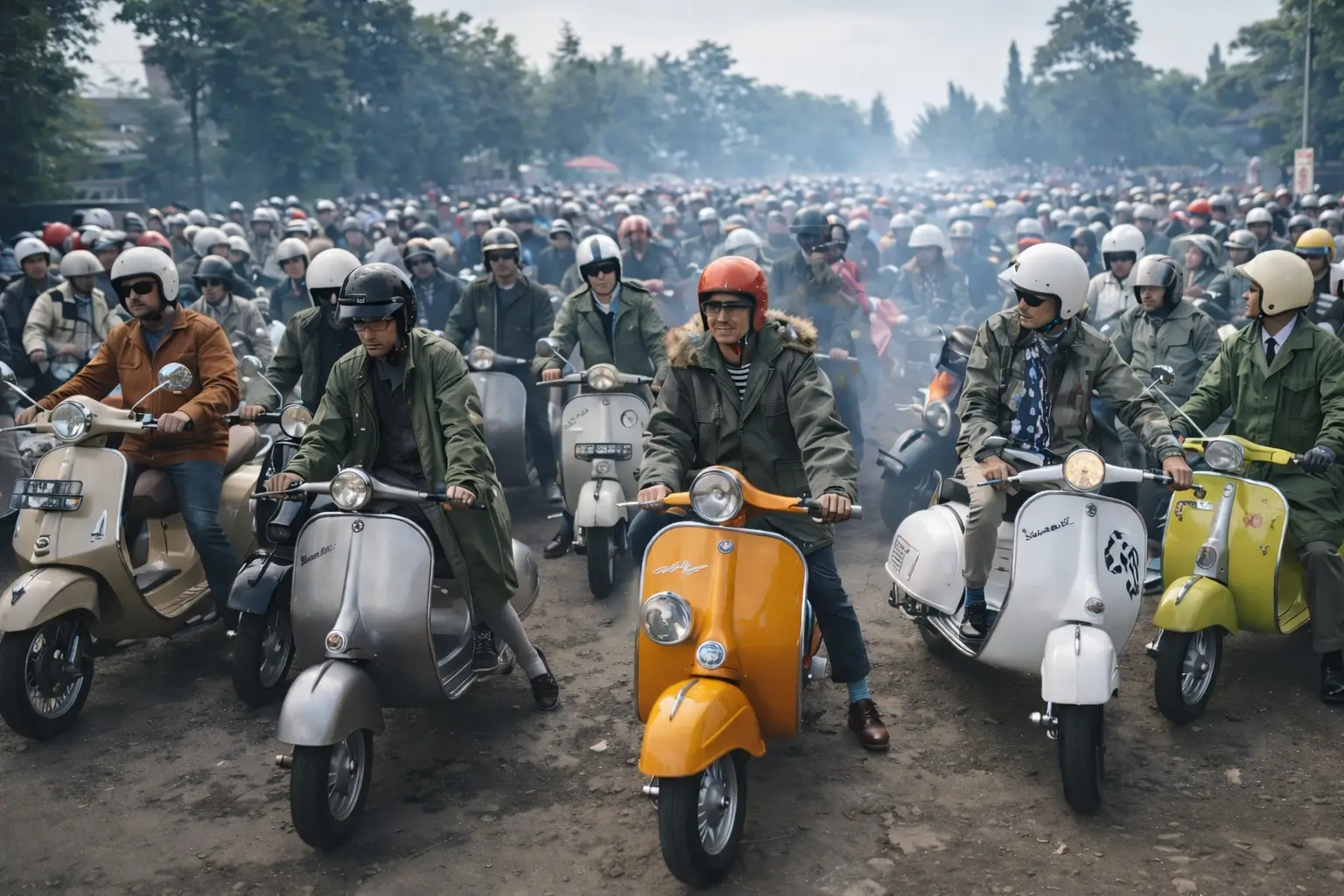
MODS MAYDAY, first held in 1981 in Kichijoji, is widely considered the founding event of Japan’s mod scooter scene. Organized annually by Manabu Kuroda and the scooter club The Numbers, it became a cultural rallying point that extends beyond scooters into fashion and music.
Participants arrive in period-informed mod attire—tailored suits, parkas—while the soundtrack draws from British beat, soul, and ska. The central ritual is the Scooter Run, a coordinated ride that transforms the city into a moving exhibition of design and identity. Though attendance has declined since its 1990s peak, the event continues to function as a cultural anchor, linking generations through shared aesthetic language.
flow
Parallel to this movement, Japan developed its own “big scooter” culture, shaped heavily by the influence of the Honda Fusion. Introduced in 1986, it departed from conventional scooter proportions with its elongated frame, low stance, and integrated bodywork.
It offered comfort and presence—qualities that made it ideal for customization. Builders extended wheelbases, added air suspension, reworked interiors, and layered high-gloss finishes to create a distinctly Japanese interpretation of a chase mobility. When Honda planned to discontinue the model in the late 1990s, sustained fan demand led to its revival in 2005, with production continuing until 2007—an example of community influence reshaping industrial decisions.
engine
Technically, the culture operates within—and often against—regulation. Japan’s strict licensing tiers for sub-50cc scooters have historically pushed riders toward creative engineering solutions. Perform is quietly expanded while maintaining outward compliance, creating a space where innovation thrives under limitation.
Lightweight materials, modular components, and compact tuning strategies have become defining characteristics. The result is a form of mechanical problem-solving that is as much about adaptation as it is about performance.
position
Today, the scene is entering a new phase defined by electrification. Builders are retrofitting classic frames with high-power electric conversion kits, typically 48V to 72V systems producing between 500W and 3kW. These setups prioritize torque and smooth acceleration while reshaping the sensory experience of riding.
At the same time, manufacturers like Honda, Yamaha Motor Company, and Kawasaki Heavy Industries are introducing connected electric scooters with Bluetooth integration, GPS tracking, and adaptive power management systems. Battery placement, wiring architecture, and digital interfaces are becoming part of the visual language of customization.
fx
Material advancements are also reshaping the category. Lightweight alloy frames, carbon-fiber panels, and modular chassis systems improve both show and flexibility in design. Safety features such as dual-channel ABS and regenerative braking are increasingly standard, aligning scooters with broader automotive trends.
Fast-charging lithium-ion batteries—capable of reaching significant charge in under an hour—respond directly to the needs of dense urban environments like Tokyo, where space efficiency and reliability are critical.
lean
Japanese scooter customization has extended far beyond its domestic origins. Riders across the United States, Europe, and Southeast Asia have adopted its visual and technical language—low stances, detailed finishes, and a balance between performance and aesthetics.
Social media has accelerated this exchange, eliciting builds to circulate globally in real time. What was once localized is now referential—an evolving dialogue between scenes rather than a single origin point.
fin
At its core, the culture remains grounded in individuality through craft. Each scooter represents a set of decisions—technical, aesthetic, personal—that reflect its builder. The balance between precision engineering and expressive design gives the scene its durability.
Even as technologies shift—from combustion to electric, from analog to connected systems—the underlying ethos remains consistent. Japanese scooter culture continues to evolve not by abandoning its past, but by reinterpreting it—moving forward through continuity rather than rupture.
Related Articles

Under Rue de Castiglione, Liaigre Gives Hôtel Costes a Spa With No Hard Corners
A 20-meter lap pool, eight treatment rooms and not one sharp angle: Studio Liaigre’s spa […]