Sam Gilliam: The Arc Maker I & II (1981) – A Masterwork of Texture, Memory, and Abstraction

June 9, 2026
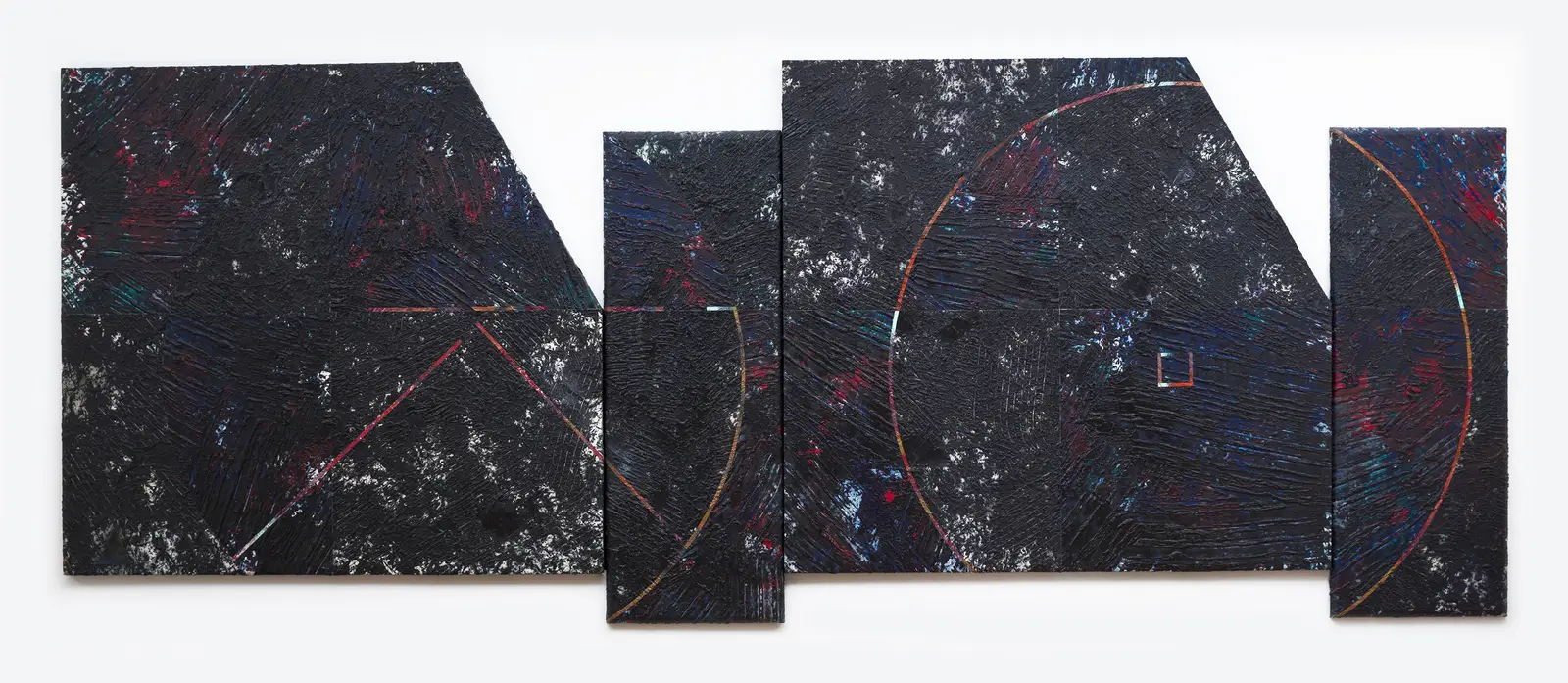
In the pantheon of postwar American art, few figures loom as large as Sam Gilliam (1933–2022). A transformative force who emerged from the Washington Color School only to shatter its conventions, Gilliam spent a lifetime expanding the very definition of painting. His 1981 diptych The Arc Maker I & II, now in the collection of the Detroit Institute of Arts, stands as a pivotal statement in this evolution. Executed in acrylic on canvas with collage elements, this monumental work—measuring approximately 75 x 213 inches overall—embodies the artist’s shift toward dense, tactile surfaces and geometric improvisation during the early 1980s.
Viewed today, the piece commands attention through its commanding scale and layered complexity. A series of irregularly shaped panels assemble into a sweeping, architectural composition dominated by deep blacks, punctuated by vibrant flashes of red, blue, white, and iridescent accents. Bold arcs, angular forms, and fragmented geometries emerge from a heavily impastoed field, evoking both cosmic movement and intimate, quilt-like domesticity. This is abstraction not as cool detachment but as lived experience—raw, physical, and profoundly human.
stir
Born in Tupelo, Mississippi, and raised in Louisville, Kentucky, Gilliam’s early life was steeped in the rich view and culture traditions of the American South. His mother, a seamstress, introduced him to the rhythms of fabric and pattern that would later inform his collage techniques. After earning B.A. and M.A. degrees from the University of Louisville and serving in the U.S. Army, Gilliam relocated to Washington, D.C. in 1962. There, amid the fervor of the Civil Rights Movement, he encountered the Washington Color School—artists like Morris Louis, Kenneth Noland, and Thomas Downing—who emphasized luminous fields of pure color and staining techniques on unprimed canvas.
Gilliam quickly distinguished himself. By the mid-1960s, he was experimenting with folding, crumpling, and draping unstretched canvases, creating his groundbreaking “Drape” paintings. These works liberated paint and fabric from the rigid stretcher, allowing gravity, chance, and the body’s movement to shape the final form. Suspended from ceilings or draped across walls like theatrical curtains or laundry on a line, they transformed painting into immersive sculpture. His inclusion as the first Black artist to represent the United States at the 1972 Venice Biennale cemented his international reputation.
Yet Gilliam was never content to repeat success. By the mid-1970s, he moved away from the fluid drapes toward more structured explorations. The late 1970s brought the “Black Paintings”—dense, somber works that reflected personal and societal introspection amid ongoing struggles for equity. Into the 1980s, his practice evolved again, embracing thick impasto, collage, and shaped canvases. The Arc Maker I & II emerges from this fertile period of experimentation.
mat
The Arc Maker I & II exemplifies Gilliam’s 1980s “quilted” or collage paintings. He began by building up multiple layers of acrylic paint and gels on canvas, scumbling, spattering, and raking the surface to create rich, encrusted textures. Once dry, he cut these painted expanses into geometric shapes—triangles, wedges, arcs, and rectangles—then reassembled them like pieces of a puzzle onto a new support. The result is a patchwork that feels both improvisational and deliberate, echoing the improvisatory spirit of jazz legends like Miles Davis and John Coltrane, whom Gilliam cited as influences.
In The Arc Maker, this process yields a dynamic tension between fragmentation and unity. The large central panels feature sweeping curved forms that suggest motion—arcs in flight, perhaps alluding to the “arc maker” of the title. A prominent circular motif on the right evokes celestial bodies or architectural vaults, while smaller rectangular insets and linear accents provide rhythmic counterpoints. The dominant black ground absorbs light, creating a nocturnal depth from which spectral colors emerge: deep reds and blues streak across the surface like comet trails, while white and metallic flecks catch the eye, suggesting stars or reflective fragments of memory.
The collage elements are not mere additions but integral to the work’s physicality. Overlapping seams and varied thicknesses give the surface a sculptural relief, projecting slightly from the wall (about 1.5 inches). This dimensionality invites viewers to circle the piece, experiencing shifting perspectives and silhouettes. Gilliam’s technique here bridges painting and sculpture, challenging the flatness of traditional modernism while honoring textile traditions from his childhood—specifically the improvisational “crazy quilts” made by African American women in the South.
hx
The Arc Maker I & II resonates on multiple levels. Created in 1981, it reflects a moment of transition in American art and society. The optimism of the Color Field era had given way to more pluralistic, materially driven practices. For Gilliam, as a Black artist navigating predominantly white art worlds, abstraction was never apolitical. His work asserts presence and complexity in the face of marginalization, using formal innovation to claim space—both literally, through scale and projection, and metaphorically, through cultural synthesis.
The title The Arc Maker evokes creation, trajectory, and perhaps the arc of history itself. Arcs suggest bridges between past and present, or the curved paths of projectiles and celestial bodies. In Gilliam’s hands, they also recall the sweep of a painter’s arm or the drape of fabric. The work’s acquisition by the Detroit Institute of Arts in 1983, as a gift from the Friends of African Art, underscores its significance in collections dedicated to amplifying underrepresented voices.
Gilliam’s practice draws from a broad well of influences: European modernism (Klee, Nolde), American Abstract Expressionism, African American vernacular traditions, and the urban fabric of Washington, D.C. His quilts connect to the Gee’s Bend quilters and broader Black artistic legacies of improvisation and resilience. At the same time, the work dialogues with contemporaries like Robert Rauschenberg (for collage) and contemporaries in the Pattern and Decoration movement, while remaining distinctly his own.
xp
Approaching The Arc Maker I & II, one is struck first by its scale—over 17 feet wide when fully assembled. The composition unfolds like a frieze or a musical score. On the left, angular forms and intersecting lines create a sense of architectural scaffolding. Moving rightward, the forms loosen into more fluid arcs, culminating in a large circular element that anchors the right side. This progression suggests narrative movement: from structure to liberation, or from darkness into emergent light.
Texture is paramount. The thick impasto catches light unevenly, revealing micro-landscapes of ridges, valleys, and drips. Collaged fragments retain traces of their original paintings, creating palimpsests—ghostly reminders of earlier gestures. Colors are not applied flatly but emerge through layering: a red line might cut across black like a wound or a vein; blue and white specks flicker like distant signals. The overall effect is one of contained energy, as if the surface is vibrating with potential motion.
This tactility invites multisensory engagement. One can almost feel the weight of the paint, the pull of the fabric, the labor of assembly. It rewards prolonged looking, revealing new details with each shift in viewpoint or lighting.
relev
Sam Gilliam’s influence has only grown since his passing in 2022. Major retrospectives, acquisitions by institutions like Dia Art Foundation, and exhibitions at Pace Gallery and David Kordansky have brought renewed attention to his oeuvre. The Arc Maker I & II exemplifies why: it refuses categorization, embodying the artist’s lifelong commitment to experimentation.
In today’s art world, where discussions of materiality, identity, and hybrid practices dominate, Gilliam feels prophetic. His fusion of painting, sculpture, and textile resonates with contemporary artists exploring similar boundaries. For fashion and design audiences, his work offers inspiration in texture, tincture blocking, and the flow reuse of materials—qualities that echo in streetwear collages, haute patchwork, and innovative fabric treatments.
The Arc Maker also speaks to themes of resilience and reinvention. Gilliam persisted through periods of critical neglect, continually evolving his language. In an era of rapid culture change, his work models creative endurance.
fin
The Arc Maker I & II is more than a painting; it is a testament to the power of abstraction to hold history, memory, and innovation in dynamic tension. Through its dense surfaces and liberated forms, Sam Gilliam invites us to see the world anew—fragmented yet whole, dark yet luminous, rooted yet boundless.
As viewers stand before it, they participate in the arc-making process: connecting view fragments into personal meaning. In the context of exploration of fashion, design, and culture, Gilliam’s masterpiece reminds us that true creativity lies in the courageous recombination of elements. It is a legacy that continues to arc forward, inspiring new generations to push boundaries and craft their own enduring forms.
Related Articles
Canton Opens the Season: Panthers and Cardinals Kick Off 2026 in the Spotlight of the Hall
Two franchises with unsettled quarterback rooms will christen the NFL’s 107th season under the lights […]