DRIFT

In a cinematic landscape littered with endless reboots, nostalgia bombs, and over-processed CGI monsters, Eli Craig’s return to the director’s chair feels like a much-needed dose of tonal clarity. Best known for his genre-subverting cult classic Tucker and Dale vs. Evil, Craig’s latest offering, Clown in a Cornfield, arrives not simply as another horror romp but as a scalpel aimed straight at the jugular of modern youth culture. A socially-charged slasher decked in greasepaint and barbed irony, the film doesn’t just aim to scare—it diagnoses, dissects, and then dances gleefully in the absurd wreckage.

At the center of this blood-soaked satire is the killer clown—a grotesque figure that has reentered the cultural bloodstream with alarming frequency. And Eli Craig, ever the wry observer, is less interested in the archetype’s primal fright factor and more fascinated by why, exactly, Gen Z can’t seem to look away.

Clowning in Crisis: The Rise of Red-Nosed Terror

“Gen Z has just gone from one mind-boggling absurdity to the next,” Craig told IndieWire, reflecting on a generational psyche molded by climate anxiety, economic precarity, political chaos, and a perpetual feed of digital delirium. “The scary clown,” he explains, “is no longer just a monster. It’s a symbol of the chaos that everyone’s pretending doesn’t exist.”

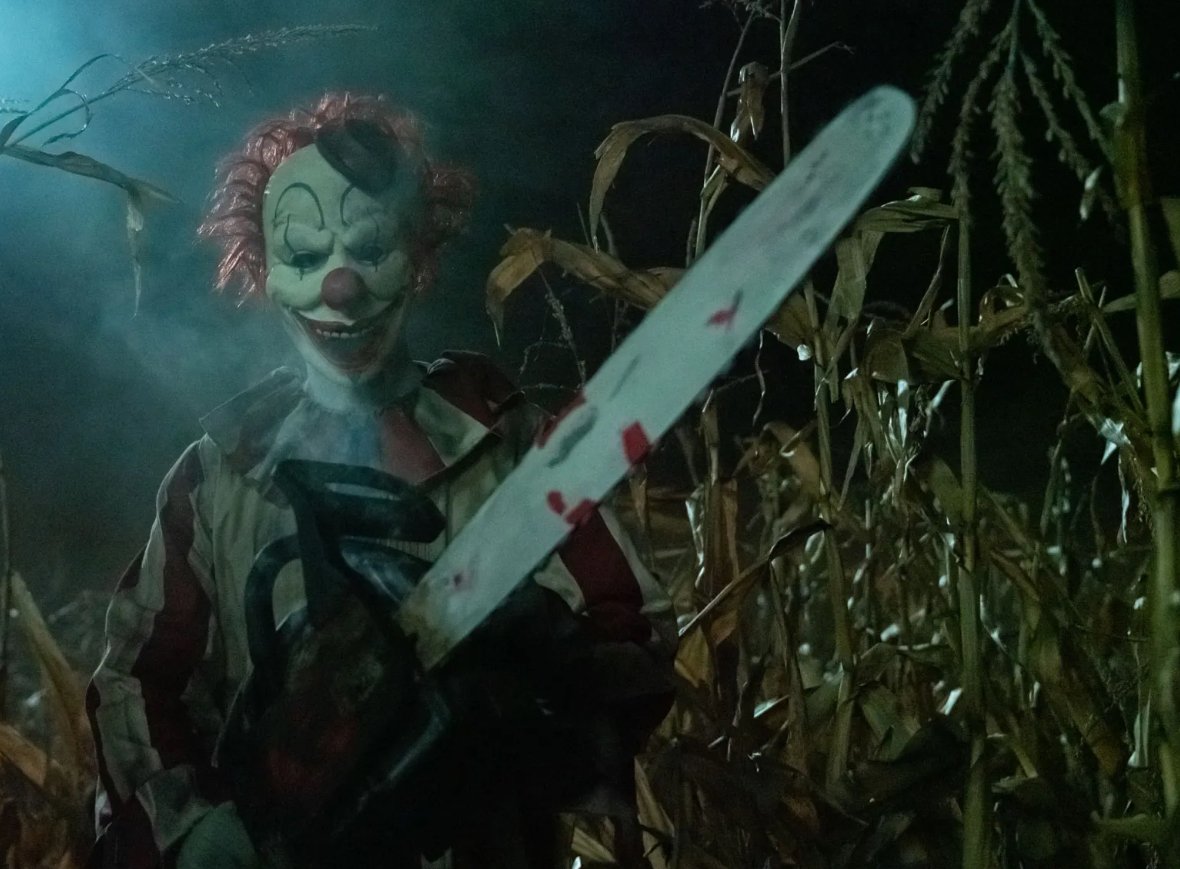
In Clown in a Cornfield, the titular menace isn’t just a slasher movie villain—it’s a metaphor for small-town performativity, rural conservatism, and the violent repression of youth-led progressivism. Loosely adapted from Adam Cesare’s YA horror novel of the same name, Craig’s take layers social commentary beneath every honk and chainsaw rev. The clown, named Frendo, doesn’t stalk victims aimlessly. He targets “wrong-thinkers,” idealists, and those refusing to conform—precisely the kinds of kids Craig believes are shaping tomorrow’s fractured society.

This is not an isolated artistic phenomenon. In recent years, clowns have undergone a cultural rehabilitation—not as figures of joy, but as instruments of critique. From Joker to Terrifier, from Pennywise’s modern revival to the viral “clown sightings” of the mid-2010s, the clown has become a vessel through which societies air their darkest contradictions.

A Genre Veteran Steps Back In

Eli Craig’s Tucker and Dale vs. Evil (2010) was a sleeper revelation—a film that lovingly skewered horror clichés while offering a warm-hearted narrative beneath the blood. The film flipped the script on “hillbilly horror,” turning the typical redneck murderers into misunderstood protagonists. That same genre literacy and empathy for outsiders pulses through Clown in a Cornfield, albeit with a much sharper edge.

Craig is no longer just reversing tropes for comedy. In this new film, he’s wielding them like scalpels.

Set in the fictional town of Kettle Springs, Missouri—a decaying caricature of Middle America—Clown in a Cornfield follows Quinn Maybrook, a teenager who moves to town with her father after a personal tragedy. What begins as typical fish-out-of-water teen drama quickly descends into carnage when the town’s mascot, a retired circus clown named Frendo, returns as a homicidal avatar of moral righteousness. Teens are punished for vaping, protesting, questioning authority—anything deemed “disrespectful” by the adult power structure.

Craig uses the horror framework not to mock these themes but to channel them. “It’s easy to forget how many horror films are fundamentally conservative,” he explains. “The teens who have sex, drink, disobey—they’re the ones who die first. I wanted to turn that on its head. What if the killer is the conservative?”

Aesthetic Duality: Americana and Absurdity

The film’s visual identity teeters between Norman Rockwell nostalgia and Lynchian distortion. Rows of golden corn stretch across Cinemascope frames while Frendo—part Ronald McDonald, part Fox News id—lurches through the fields, facepaint cracked and outfit scorched. The violence is brash and unapologetic, but rarely pornographic. Craig walks a fine line between homage and hysteria, constantly reminding viewers that horror is, above all, a performance.

This theatricality is intentional. “We’re living in an age where everything’s a spectacle,” Craig notes. “Politics, mental health, identity—it’s all played out online, like a show. So why wouldn’t horror reflect that?”

Indeed, the characters in Clown in a Cornfield live partially online, documenting their trauma and reactions in real-time. The tension between digital identity and lived experience is one of the film’s sharpest undercurrents. In one standout scene, a teenager’s livestream of the unfolding massacre is met with laugh-reacts and skepticism from viewers who assume it’s just another viral prank. It’s a brutal, brilliant commentary on desensitization and the collapse of reality into content.

Gen Z Horror: From Final Girls to Found Footage

Craig’s commentary on Gen Z as both protagonist and audience runs deeper than just aesthetics. He sees in them a complex contradiction—radically empathetic yet numb, hyper-informed yet emotionally volatile, demanding systemic change while uncertain how to survive in the system they’ve inherited.

“They’ve inherited a world full of broken institutions,” Craig says, “and horror has always been about institutional collapse. In the ’80s, it was suburbs and serial killers. In the 2000s, it was terrorism and torture. Now it’s about systemic failure—climate, governance, truth itself. That’s why horror’s resonating again.”

This, in many ways, explains the pivot from supernatural hauntings to slasher reimaginings. Ghosts don’t frighten Gen Z—inequity, fascism, and performative civility do. The clown, rebranded, becomes a living metaphor: whimsical on the outside, malignant at its core.

In Clown in a Cornfield, the survivors aren’t merely final girls—they’re digital natives, climate activists, queer teens, and marginalized voices refusing to be silenced. The kills are shocking, yes, but the greater horror is found in the normalization of extremism, the town’s casual shrug at curfews and censorship, the eerie silence of adults who believe control equals safety.

Beyond Satire: What Lies Beneath the Makeup

While the film functions as a biting satire, Craig never slips into nihilism. For all its cynicism about adults and systems, Clown in a Cornfield ultimately invests in youth resilience. The climax hinges not on brute force but on collective resistance—teenagers organizing, strategizing, and fighting back as a unified front. It’s a cathartic fantasy of youthful agency in a world where adults have failed.

And yet, even in victory, the wounds remain. Craig doesn’t let his characters off easily. Survivors are scarred—visibly, emotionally, and existentially. “There’s no reset button,” he admits. “I wanted to make a movie that ends like real life does—changed, damaged, but still moving forward.”

This narrative choice elevates the film beyond its slasher roots. It joins a growing canon of horror that refuses to compartmentalize trauma, treating fear not as a fleeting emotion but as a structural reality. The clown, then, is not simply a killer—it’s a specter of unresolved generational trauma, a symbol of the carnival-like absurdity Gen Z has been forced to normalize.

Legacy, Laughter, and the Politics of Fear

Eli Craig has always had a knack for making us laugh at our fears without trivializing them. With Clown in a Cornfield, he sharpens that talent, creating a film that entertains while ruthlessly interrogating the American moment. The humor, when it arrives, is grim and knowing. It’s a teenager cracking jokes through tears. It’s the bitter comedy of survival.

In choosing the clown as his vessel, Craig joins a lineage of artists—from Stephen King to Jordan Peele—who understand that horror is most effective when it reflects us back to ourselves in grotesque form. The clown may wear the face of a joke, but beneath it is something far more ancient and honest: our fear of systems that pretend to nurture us while quietly consuming us whole.

Closing Note: Why Now, Why Us

The horror genre has never been more democratized. With platforms like TikTok, YouTube, and micro-budget indie films shaping cultural touchstones, the gatekeepers have shifted. Craig’s film, while studio-backed, hums with the energy of DIY rebellion. It speaks to a generation fluent in memes and misrule, who understand that horror doesn’t have to be prestigious to be profound.

Clown in a Cornfield is not just a movie—it’s a dispatch from the edge of reason, a twisted fairytale for the disillusioned, and a manifesto for horror’s future: socially conscious, visually daring, and unapologetically political.

Because sometimes the only way to laugh at the madness is to paint your face, grab a chainsaw, and head for the cornfields.

Related Articles
Modern data center facility with a solar-panel-clad exterior, bright green administrative offices, and secure perimeter fencing, showcasing sustainable digital infrastructure and renewable energy integration

Lombardy’s Data Center Boom: Balancing Digital Ambition with Environmental Responsible

Lombardy has emerged as Italy’s primary hub for new digital infrastructures, particularly data centers—vast complexes […]

In a highly anticipated reunion after 24 years, Adidas Originals and Coca-Cola have joined forces once again to celebrate the FIFA World Cup 2026™. The collaboration revives their iconic 2002 partnership from the Japan-South Korea tournament, now reimagined for the biggest global sporting event of 2026, co-hosted by the United States, Canada, and Mexico. Set to launch on June 6, 2026, this collection masterfully blends Adidas' streetwear heritage with Coca-Cola's timeless branding, creating a vibrant fusion of football culture, nostalgia, and modern style. The drop arrives at a perfect moment. With the World Cup kicking off on June 11, 2026, fans worldwide are gearing up for a summer of football excitement. This collaboration isn't just merch—it's a cultural statement that merges two legendary brands under the banner of "Originals are the Real Thing," a clever twist on Coca-Cola's famous slogan. Historical Context: A Reunion 24 Years in the Making Adidas and Coca-Cola first collaborated during the 2002 FIFA World Cup, producing limited-edition pieces that captured the era's energy. That partnership helped define early 2000s football-streetwear crossover culture. Fast-forward to 2026, and the brands are back with fresh energy, leveraging Adidas' deep FIFA ties (as an official partner) and Coca-Cola's long-standing sponsorship of the tournament. The 2026 edition promises to be historic as the first 48-team World Cup, spanning three countries and generating unprecedented global hype. This collab taps into that momentum, offering fans wearable pieces that celebrate both brands' legacies while looking forward to the future of football fashion. Collection Overview and Design Philosophy The Adidas Originals x Coca-Cola collection fuses 2000s street style with classic sporting aesthetics. Expect bold reds, creams, whites, and silver accents inspired by Coca-Cola's iconic packaging—think classic script logos, droplet detailing, and can-inspired motifs. The lineup spans footwear, apparel, and accessories, divided into two visual directions: one logo-heavy and graphic-forward, the other drawing from vintage advertising aesthetics. Designs pay homage to Coca-Cola's visual language while staying true to Adidas Originals' archival roots. High-quality materials, attention to detail, and versatile silhouettes make these pieces suitable for both match-day wear and everyday street style. The campaign, featuring young football star Lamine Yamal and a diverse cast in everyday scenes building anticipation for the tournament, reinforces themes of originality and shared cultural moments. Footwear Highlights Footwear takes center stage in this collaboration, with reimagined takes on iconic 2000s Adidas silhouettes: Samba and Superstar Models: These classics get Coca-Cola treatment with white/cream/red colorways and prominent script branding. The Samba blends street heritage with football roots, while the Superstar II features weathered bases and bold side panels. Expected pricing around $110–$130. Adistar Control 5: A standout with droplet detailing mimicking condensation on a cold Coke can. This model brings performance-inspired design into lifestyle territory. Predator Sala: Indoor/hybrid style with silver-and-red accents, nodding to predatory precision on the pitch and Coca-Cola's bold energy. Climacool 1: Revived with breathable tech and Coke-inspired graphics, perfect for warm summer days. Megaride F50: A highlight paying tribute to the iconic Coca-Cola glass bottle, with unique contours and refreshing design cues. Each pair incorporates thoughtful details like embroidered logos, custom insoles, and packaging that mimics vintage Coke crates or cans. These shoes are built for durability and comfort, appealing to sneakerheads, football fans, and casual wearers alike. Apparel and Accessories Beyond kicks, the collection offers a full lifestyle range: Track Tops and Jerseys: Standout jerseys fuse retro Coca-Cola advertising from different eras into cohesive football designs. Track jackets feature signature three stripes alongside Coke branding, in vibrant reds and classic whites. Shorts and T-Shirts: Relaxed fits with graphic prints, ideal for casual wear or layering. Expect motivational football motifs blended with refreshing beverage references. Accessories: A bright red airliner bag stands out as a functional statement piece. Additional items may include caps, socks, and tote bags carrying the collaborative spirit. The apparel emphasizes comfort with premium cotton blends, mesh panels for breathability, and oversized silhouettes popular in contemporary streetwear. Unisex sizing and inclusive fits make the collection accessible to a broad audience. Cultural Impact and Fan Appeal This collaboration resonates on multiple levels. For football fans, it represents national pride and global unity ahead of the 2026 tournament. Sneaker enthusiasts will appreciate the nostalgic 2000s revival mixed with modern execution. Streetwear collectors see it as a prime example of how heritage brands can innovate through partnerships. In an era where sports and fashion increasingly intersect, Adidas and Coca-Cola deliver pieces that transcend the pitch. Wear them to watch matches at home, attend watch parties, or hit the streets in any host city—New York, Los Angeles, Toronto, or beyond. The designs are versatile enough for gym sessions, festivals, or daily commutes. The timing aligns perfectly with rising interest in football in North America, boosted by the co-hosting nations. Young talents like Lamine Yamal in the campaign help bridge generational gaps, attracting newer fans while satisfying longtime supporters. Where to Buy and Release Details The collection launches globally on June 6, 2026, via: Adidas CONFIRMED app (for early access and raffles) Adidas.com Select retailers and flagship stores worldwide Some regions may see staggered drops, with Japan and other markets getting early access. Prices are expected to range from $50–$150 depending on the item, making it relatively accessible compared to ultra-limited drops. Pro Tips for Copping: Enable notifications on the CONFIRMED app. Check local stock at Adidas stores in major cities. Monitor resale platforms post-drop for exclusive colorways, but be wary of markups. Size up slightly for oversized apparel fits. Given the World Cup hype, popular items like the Sambas and jerseys are likely to sell out quickly. International shipping is available, but factor in potential customs delays. Styling Suggestions Match Day Look: Pair a collaborative jersey with classic black shorts and Samba sneakers for effortless fan style. Streetwear Rotation: Layer a track top over a graphic tee with wide-leg pants and the Megaride F50 for a bold urban ensemble. Casual Summer: White Superstar with denim shorts and the airliner bag for a refreshing, vacation-ready vibe. These pieces mix seamlessly with existing Adidas or neutral wardrobes, maximizing versatility. Broader Context in 2026 Fashion and Sports The Adidas x Coca-Cola drop is part of a larger wave of high-profile collaborations tied to the World Cup. Adidas continues its dominance in football kit design, while Coca-Cola leverages its sponsorship with collectibles, bottles, and experiential activations like the Trophy Tour. In the sneaker industry, this collab exemplifies the ongoing trend of lifestyle reinterpretations of performance silhouettes. It also highlights how global brands use major events to drive cultural conversations around unity, originality, and joy—core values for both companies. Sustainability notes (based on Adidas' broader initiatives) suggest some pieces may incorporate recycled materials, aligning with modern consumer expectations. Looking Forward: Legacy and Excitement As the countdown to kickoff continues, this collection serves as the perfect prelude to an unforgettable summer of football. Whether you're a die-hard supporter, a fashion-forward collector, or someone seeking motivation through style, the Adidas Originals x Coca-Cola FIFA World Cup 2026 lineup delivers. Expect potential restocks, special event exclusives in host cities, and continued campaign content featuring more athletes. This isn't just clothing—it's a ticket to participate in the global celebration of the beautiful game. Mark your calendars for June 6, 2026. Refresh your wardrobe, lace up those Sambas, and get ready to cheer on your team in style. The "Real Thing" meets the Originals in what promises to be one of the most talked-about releases of the year. This collaboration captures the essence of football's universal appeal: bringing people together through shared passion, iconic brands, and unforgettable moments. As the world prepares for 2026's expanded tournament, Adidas and Coca-Cola remind us that some partnerships are truly timeless.

Adidas Originals x Coca-Cola Collection: FIFA World Cup 2026

In a highly anticipated reunion after 24 years, Adidas Originals and Coca-Cola have joined forces […]

Loewe shoulder bag crafted in brown and black leather with minimalist lion face detailing and a matching fur tail charm

180 Years Unfolded: The Full Story Behind Loewe’s New Campaign

The year was 1846. Queen Victoria was on the British throne and the telephone, the […]