DRIFT AUDIO
Listen to this story
Choose a voice, then press play.
In the world of streetwear and lifestyle accessories, few brands command the cultural cachet of Carhartt WIP. The “Theory and Practice” collection, and specifically its Soba Cup Set, represents a fascinating evolution: durable American workwear roots meeting refined, functional home objects inspired by Japanese tradition. This exploration dives into the product’s design, cultural context, brand philosophy, and why it resonates so strongly within contemporary lifestyle culture.
flow
Carhartt WIP was established in 1994 by Edwin Faeh as the European arm of the iconic American workwear label originally founded in 1889 by Hamilton Carhartt in Detroit. The original Carhartt built its reputation on “honest value for an honest dollar,” producing durable garments for railroad workers, farmers, and industrial laborers. Over time, Carhartt WIP transformed that foundation into something broader — a refined interpretation embraced by skateboarding, underground music culture, graffiti communities, and global streetwear audiences.
Rather than abandoning the original DNA, WIP reframed it. Ruggedness became aesthetic language. Utility became cultural identity. The label evolved into a uniform for creatives who valued durability without sacrificing design clarity.
The “Theory and Practice” line perfectly embodies this duality. “Theory” gestures toward conceptual thinking, design references, and cultural storytelling. “Practice” anchors everything in usable, everyday functionality. Alongside the Soba Cup Set, the broader collection includes incense, trays, and graphic apparel — objects intended not simply for display, but for ritualized use inside daily environments.
scope
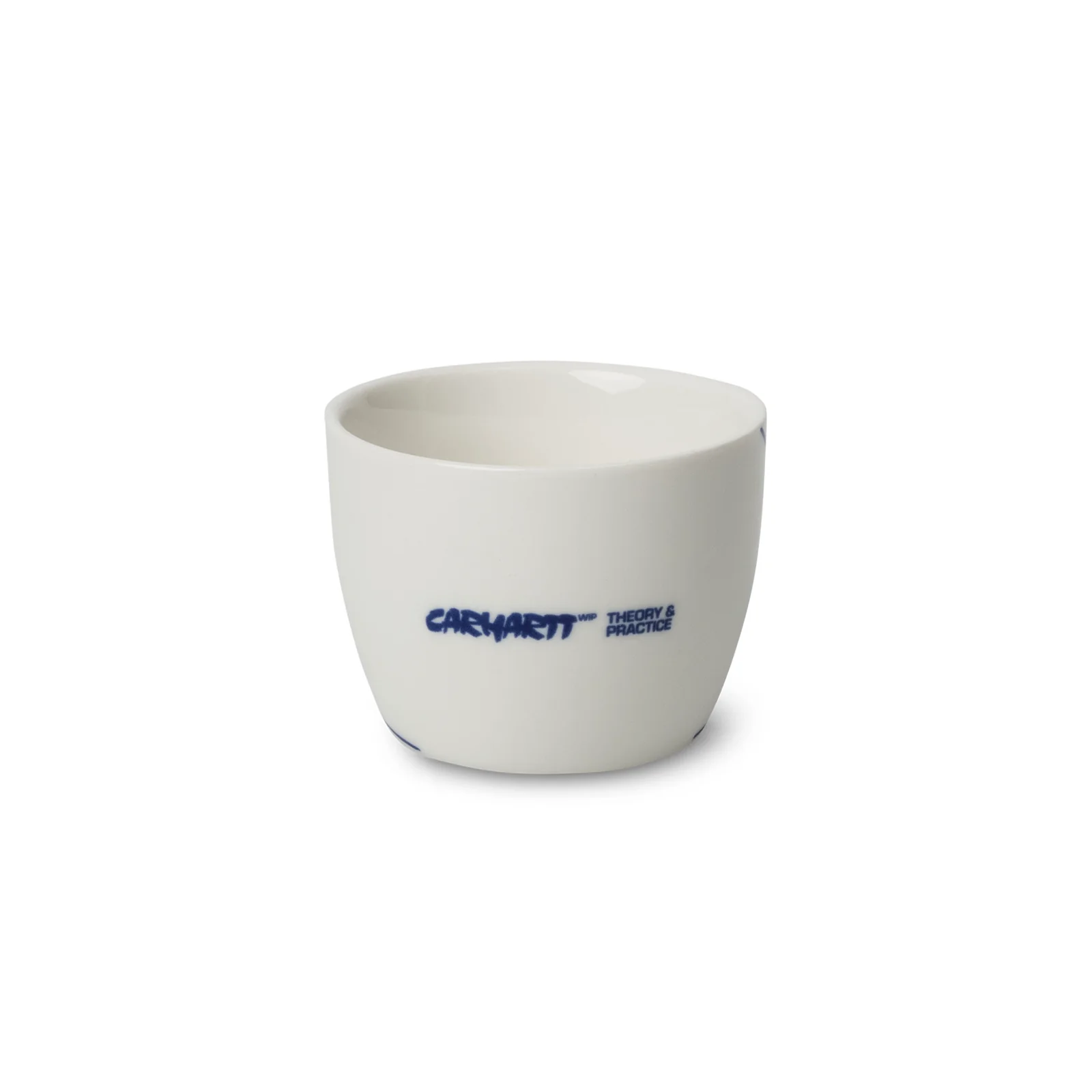
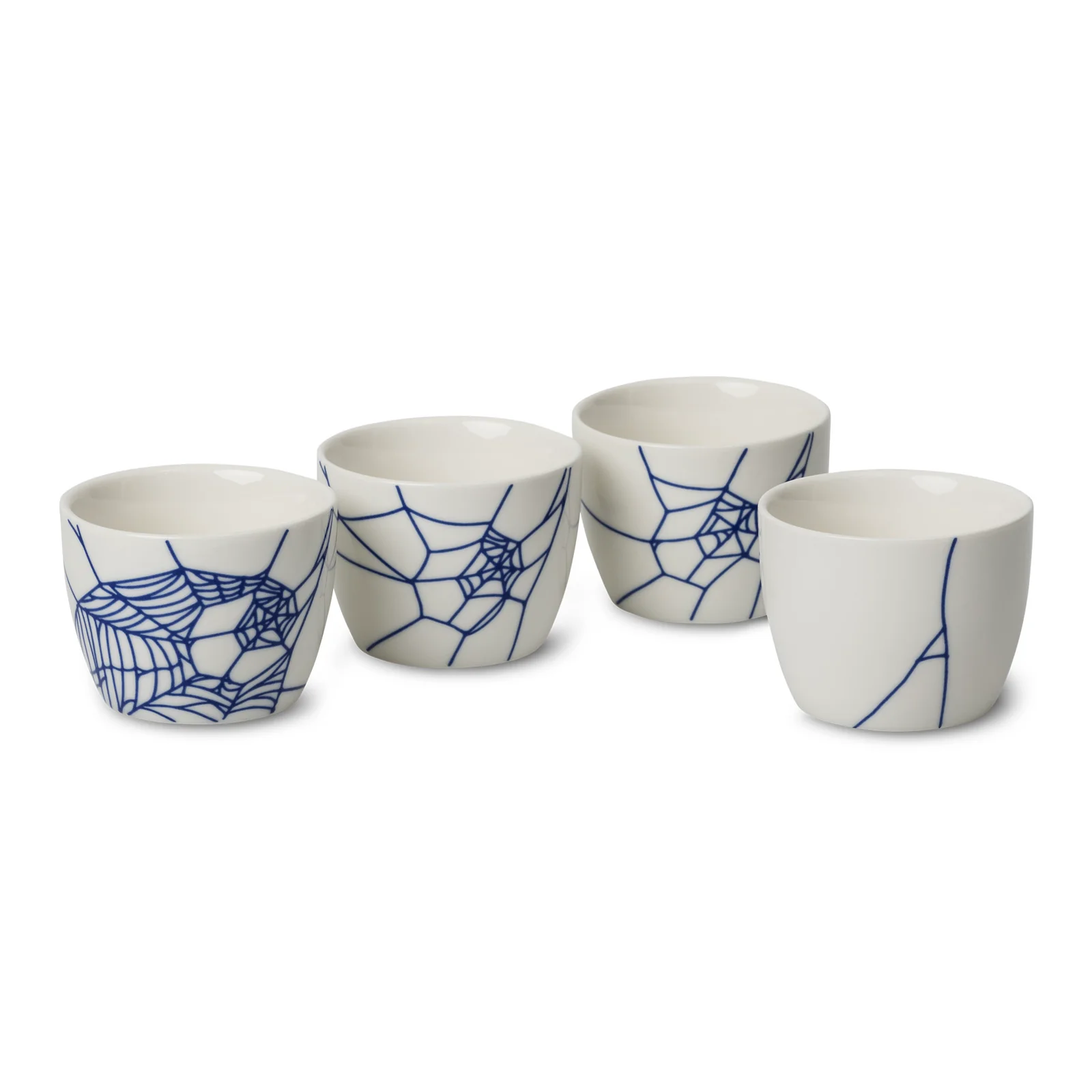
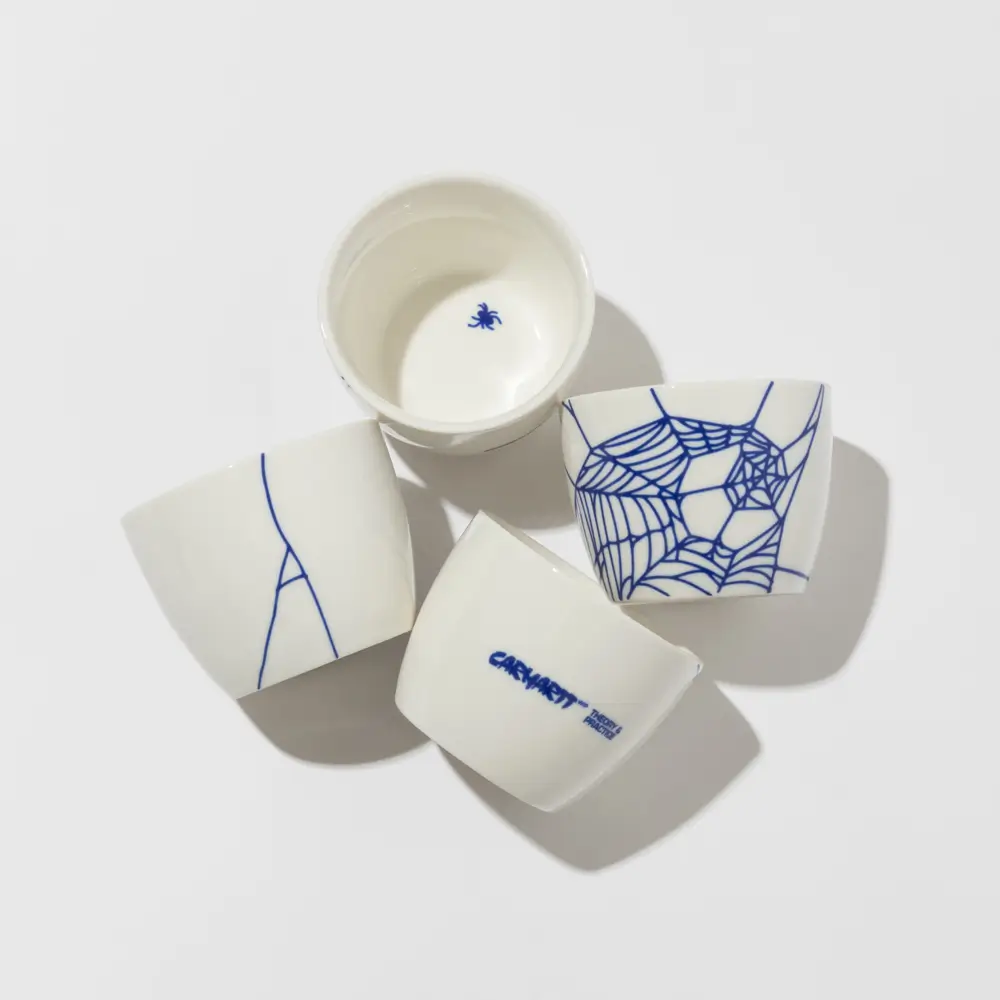
The Theory and Practice Soba Cup Set consists of four porcelain cups finished in a restrained white-and-blue colorway. Each piece measures approximately 6 x 7.8 x 5.5 cm, maintaining a compact, palm-sized structure that feels both traditional and contemporary. The cups feature subtle printed graphics alongside a discreet Carhartt WIP script logo near the base. Constructed from 100% porcelain, they are both microwave and dishwasher safe, reinforcing the collection’s emphasis on functional longevity.
What makes the object compelling is its connection to soba choko (そば猪口), traditional Japanese porcelain vessels dating back to the Edo period. Historically, these cups were used for dipping soba noodles into tsuyu sauce, though their versatility extended into tea, sake, spices, and other domestic rituals. Characterized by straight walls, compact sizing, and understated elegance, soba choko became enduring examples of Japanese functional design.
Carhartt WIP modernizes this form without overwhelming it. The blue-and-white palette subtly recalls traditional Japanese porcelain aesthetics while introducing graphic restraint associated with contemporary streetwear branding. The result is an object that feels deliberate but not precious — collectible without becoming untouchable.
style
One of the more interesting aspects of the collection is how naturally it fits into the broader evolution of streetwear itself. Over the last decade, fashion consumers have increasingly shifted toward domestic rituals and slower lifestyle experiences. Brands that once focused exclusively on apparel now extend into homeware, fragrance, ceramics, and furniture.
The Soba Cup Set exists directly within that movement.
But unlike trend-driven novelty objects, the cups feel grounded in actual utility. They are designed to be used repeatedly — for coffee, sake, tea, sauces, snacks, or even desk organization. The appeal comes from their quiet adaptability. They integrate into everyday life rather than interrupting it.
This reflects a larger cultural shift happening in 2026: consumers increasingly value objects that encourage presence. Small rituals matter again. Brewing tea, sharing sake, preparing noodles, or simply holding warm porcelain in hand becomes a form of slowing down amid digital exhaustion.
The cups therefore function as more than accessories. They become environmental design tools — subtle objects that shape mood and routine.
influ
Japanese influence has long been deeply embedded within global streetwear culture. From labels like BAPE and UNDERCOVER to the broader philosophies of wabi-sabi minimalism and utilitarian craftsmanship, Japanese design language has continuously informed how modern fashion interprets function and identity.
Carhartt WIP has spent decades building authentic relationships within those spaces. Its collaborations, retail environments, publishing projects, and community presence have consistently reflected cross-cultural dialogue rather than surface-level borrowing.
That context matters.
The Soba Cup Set does not read like random Japonisme. Instead, it feels like a continuation of shared design values: durability, restraint, utility, repetition, and tactile experience. The object aligns naturally with the brand’s existing philosophy.
Even the connection to soba itself reinforces this. Soba noodles are built around simplicity — buckwheat flour, water, technique, ritual. The act of eating them involves repetition and attention: lifting noodles, dipping sauce, steam, texture, timing. The soba choko becomes an extension of that rhythm.
The cups invite similar intentionality into modern routines, whether or not the owner ever prepares authentic soba.
fx
Another reason the collection succeeds is restraint.
The graphics remain subtle. Branding does not dominate the object. The cups avoid becoming oversized collectible merchandise disguised as ceramics. Instead, they feel proportionate and usable.
This matters because contemporary consumers increasingly reject over-designed “hype” objects that prioritize branding view over genuine function. The Soba Cup Set works because it behaves like proper tableware first.
Porcelain naturally retains heat while remaining durable enough for repeated use. Dishwasher safety removes anxiety from ownership. The stackable scale works equally well in minimalist kitchens, industrial lofts, studio apartments, or design-heavy interiors.
The object quietly adapts to environment — which is precisely why it feels sophisticated.
At roughly €35–€48 depending on retailer and region, the set also occupies an accessible range within designer lifestyle goods. It delivers a collectible experience without fully entering luxury pricing territory.
collect
The “Theory and Practice” collection ultimately reflects how heritage brands survive contemporary culture shifts: by expanding thoughtfully rather than chasing spectacle.
For Carhartt WIP, workwear is no longer confined to jackets and double-knee pants. It becomes a philosophy that extends into environments, rituals, and everyday systems.
That expansion feels especially relevant now. In a fast-fashion ecosystem dominated by disposable consumption cycles, durable domestic objects carry emotional weight. Consumers increasingly seek products that feel slower, more permanent, and more intentional.
The Soba Cup Set captures that mood uniquely.
It is small. Quiet. Functional. Repetitive. Durable.
And yet those exact qualities make it memorable.
sum
The Carhartt WIP Theory and Practice Soba Cup Set distills the brand’s broader philosophy into four compact porcelain vessels. American workwear heritage intersects with Japanese ritual minimalism. Function meets atmosphere. Utility becomes aesthetic language.
Either used for coffee, tea, sake, sauces, or simply displayed on a shelf, the cups embody a softer form of contemporary haute — one rooted not in excess, but in thoughtful repetition and day use.
That is where the collection succeeds most.
n
From the DRIFT archive: Lara Croft’s Dual Guinness Records Cement an Icon: How a Digital Explorer Became a Cultural Artifact Herself · Make It Miu Miu: UNO® Becomes a Haute Lifestyle Object