DRIFT AUDIO
Listen to this story
Choose a voice, then press play.
Champion handed its basketball archive to Domenico Formichetti. He gave it back reworked, oversized, and headed for a 1v1 tournament in Paris.
recall
- Where the Idea Actually Started
- Formichetti’s Read on the Archive
- What’s Actually in the Capsule
- The Rollout: Milan, Then Paris
- Reading the Collision in Context
Most fashion-meets-sportswear collaborations start with a mood board and end up feeling like one. This one started somewhere more specific: a pile of vintage Champion pieces pulled from the brand’s own archive, handed to Domenico Formichetti, the Italian designer behind the label PDF, and worked through his own view language rather than filtered through a generic streetwear lens. The distinction matters, because it shapes almost everything that follows. This isn’t Champion slapping its “C” logo on someone else’s silhouette, and it isn’t PDF borrowing sportswear codes it doesn’t have a real relationship to. Both brands, as it happens, trace their identities back to the same place — sport as culture, the street as a design brief — which is presumably why the pairing reads as more coherent than most capsule collections manage.
Champion’s own basketball history goes back decades, long before “heritage” became a marketing word every legacy brand reaches for. The label dressed the 1992 U.S. Olympic “Dream Team,” and that specific moment — arguably the point where basketball, celebrity, and streetwear first fully collided in the mainstream imagination — turns up more than once across this new collection, either through star prints or the language stitched onto the accessories. PDF, for its part, is a younger project, having debuted only a few years ago. Formichetti built it out of what he described, in comments reported around the label’s earlier collections, as a personal need to fill gaps in his own wardrobe — clothes that didn’t exist yet in the way he wanted to wear them. Earlier PDF collections leaned heavily on the idea of youth subcultures, drawing on high-school archetypes and the different tribes that used to define teenage style — jocks, skaters, and everything in between — and mixing their visual codes rather than picking a single lane. Basketball, in that world, has always sat somewhere close to the center, which makes a Champion collaboration feel less like a stretch and more like an inevitability the label was building toward.
View this post on Instagram
That’s a different starting point than most designer-sportswear tie-ups, which tend to begin with a licensing conversation rather than a closet problem, and it’s part of why this particular capsule leans less on logo placement and more on reworking silhouette and proportion. It also helps explain why the collaboration was framed, in the press around its unveiling, as something closer to a meeting of equals than a typical brand-plus-designer arrangement — two identities with genuinely overlapping DNA, rather than one lending the other credibility.
stir
Formichetti has been fairly direct about how the process worked, telling press around the Milan presentation that the team began with original vintage Champion garments and that what showed up at the first event represented only a fraction of the full collaboration still to come. That’s worth sitting with for a second, because capsule collections are often presented as complete statements — a tidy, closed set of pieces meant to be consumed in one drop. This one is explicitly structured as a first chapter, labeled “Capsule 1,” with the clear implication that more is coming, which shifts how the whole release should be read: less a finished product and more the opening move in a longer conversation between the two brands.
The design approach itself reads as restrained rather than maximalist, despite the loud references involved. Oversized proportions, garment-dyed finishes, and a slightly worn-in, distressed treatment across the footwear all point toward a designer more interested in giving archival pieces a lived-in second life than in reintroducing them as pristine, logo-forward reissues. That instinct runs somewhat against the grain of how most brand collide handle heritage archives, which tend to either polish vintage pieces up until they look brand-new or repackage them with minimal changes and lean entirely on nostalgia to do the selling. Formichetti’s version does neither — it treats the archive as raw material to be reworked, not a finished product to be reissued. Champion, on its side, appears to have leaned into that instinct rather than fighting it — its own language around the release frames the brand’s contribution as an archive that “doesn’t need to be reinvented, only reinterpreted,” which lines up with what actually shows up across the pieces themselves: a ’90s court sil here, a Dream Team-era star motif there, none of it presented as straight nostalgia.
in
The scope of Capsule 1 is broader than most designer collaborations attempt on a first outing: fourteen apparel pieces, two accessories, four footwear styles, and — in a detail that says a lot about how seriously both sides are taking the basketball framing — a co-branded basketball built specifically for the collaboration rather than tacked on as a promotional afterthought.
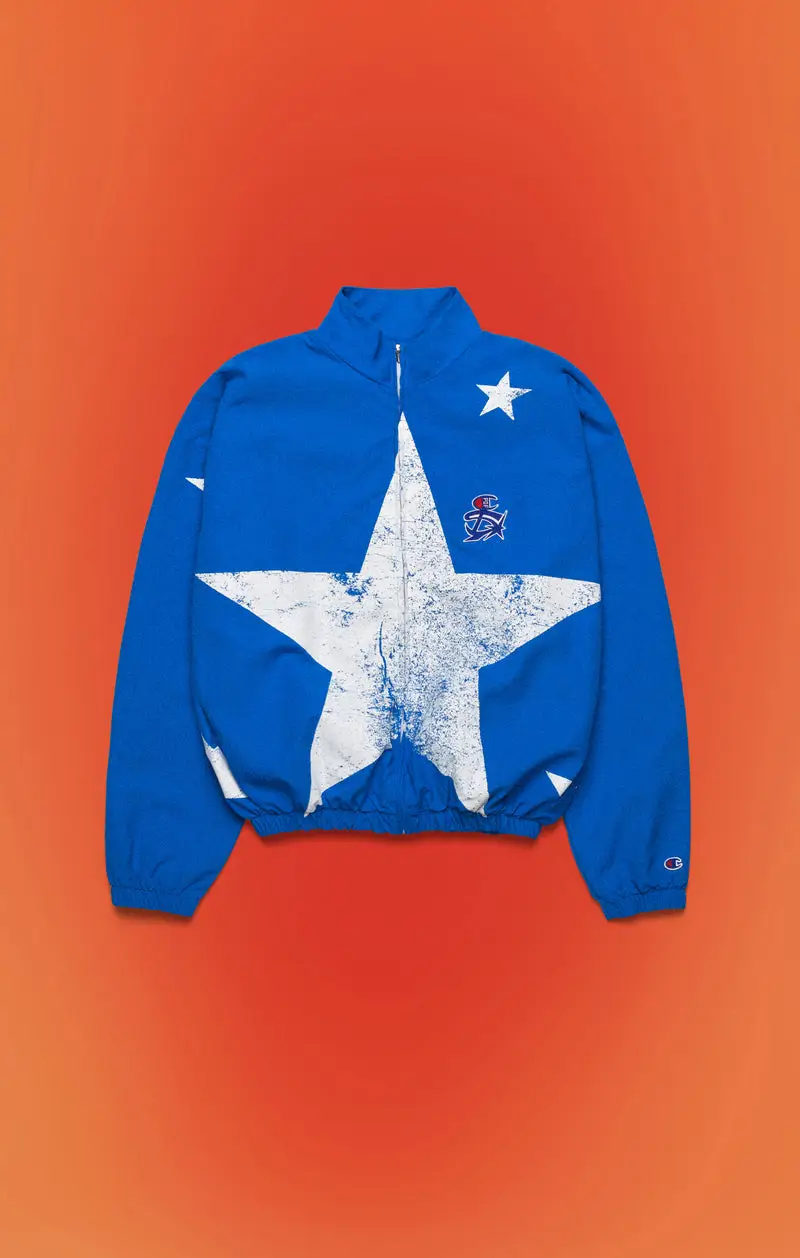
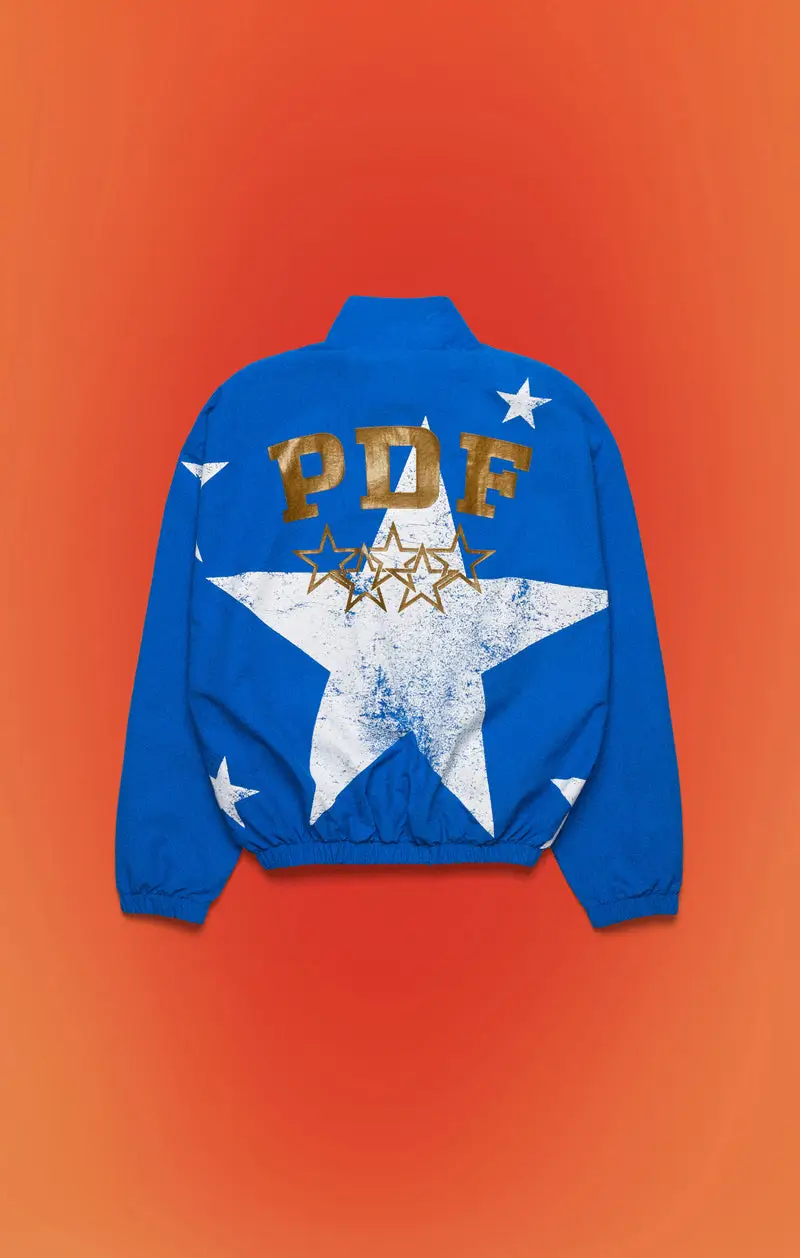
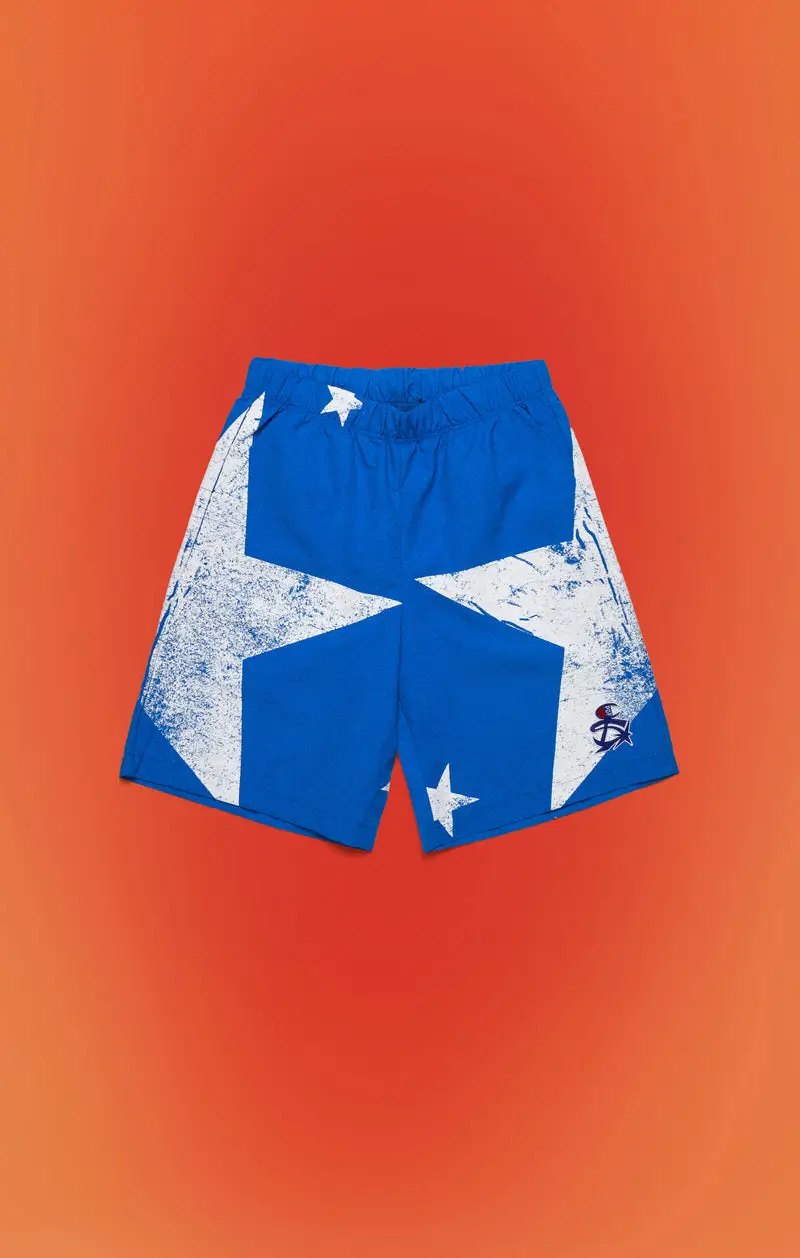
The apparel side runs through oversized T-shirts and garment-dyed fleece sets, the kind of pieces that read as comfortable staples until you notice the proportions have been pushed slightly further than a standard basketball warmup would go. Nylon tracksuits round out the athletic core of the range; one full-zip track top in the line, made in Italy from lightweight nylon with an internal lining, carries an all-over star print that directly nods to the 1992 Olympic Games and Champion’s role dressing the Dream Team that year — a reference that recurs across the collection rather than showing up as a one-off.
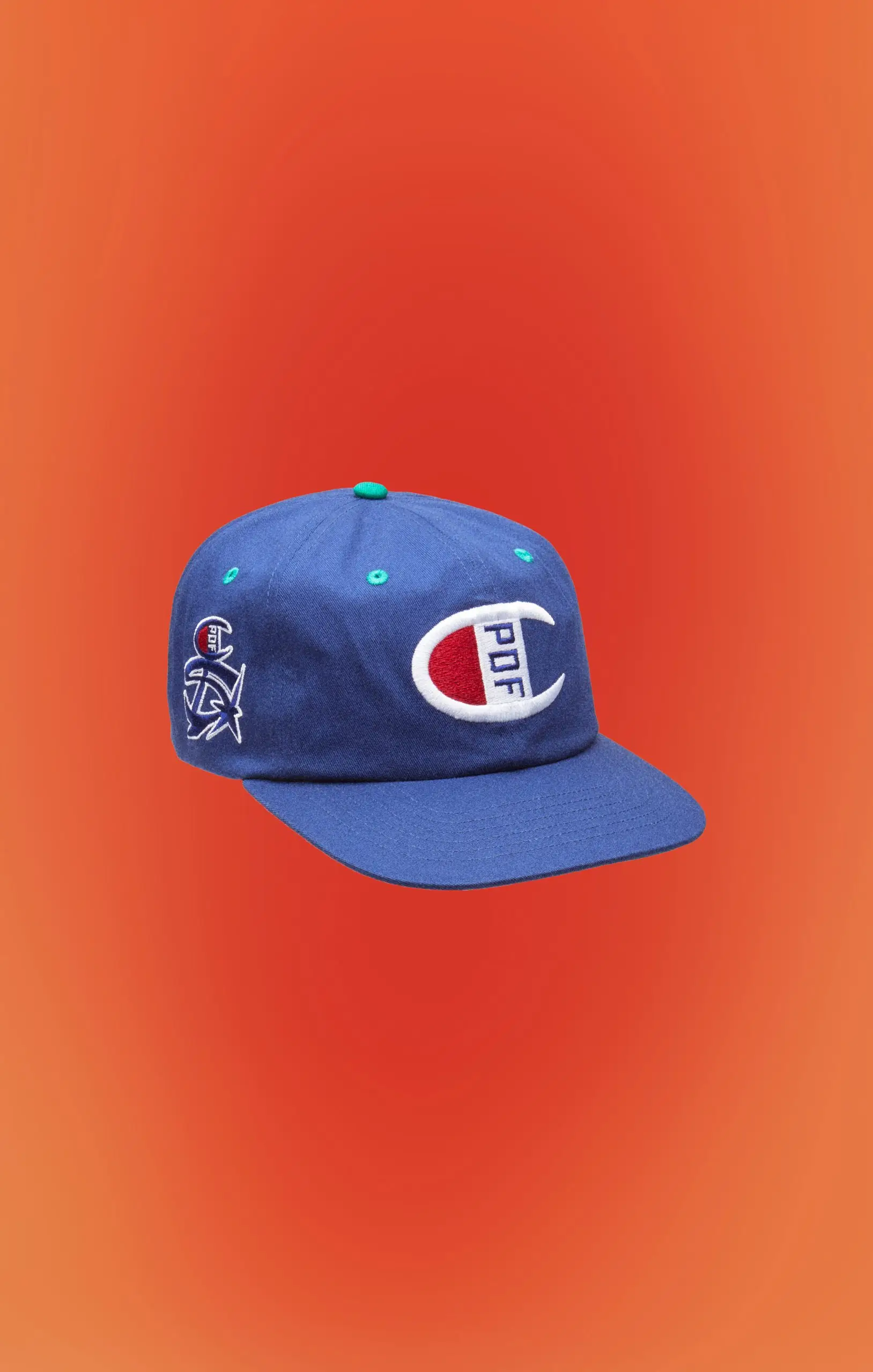
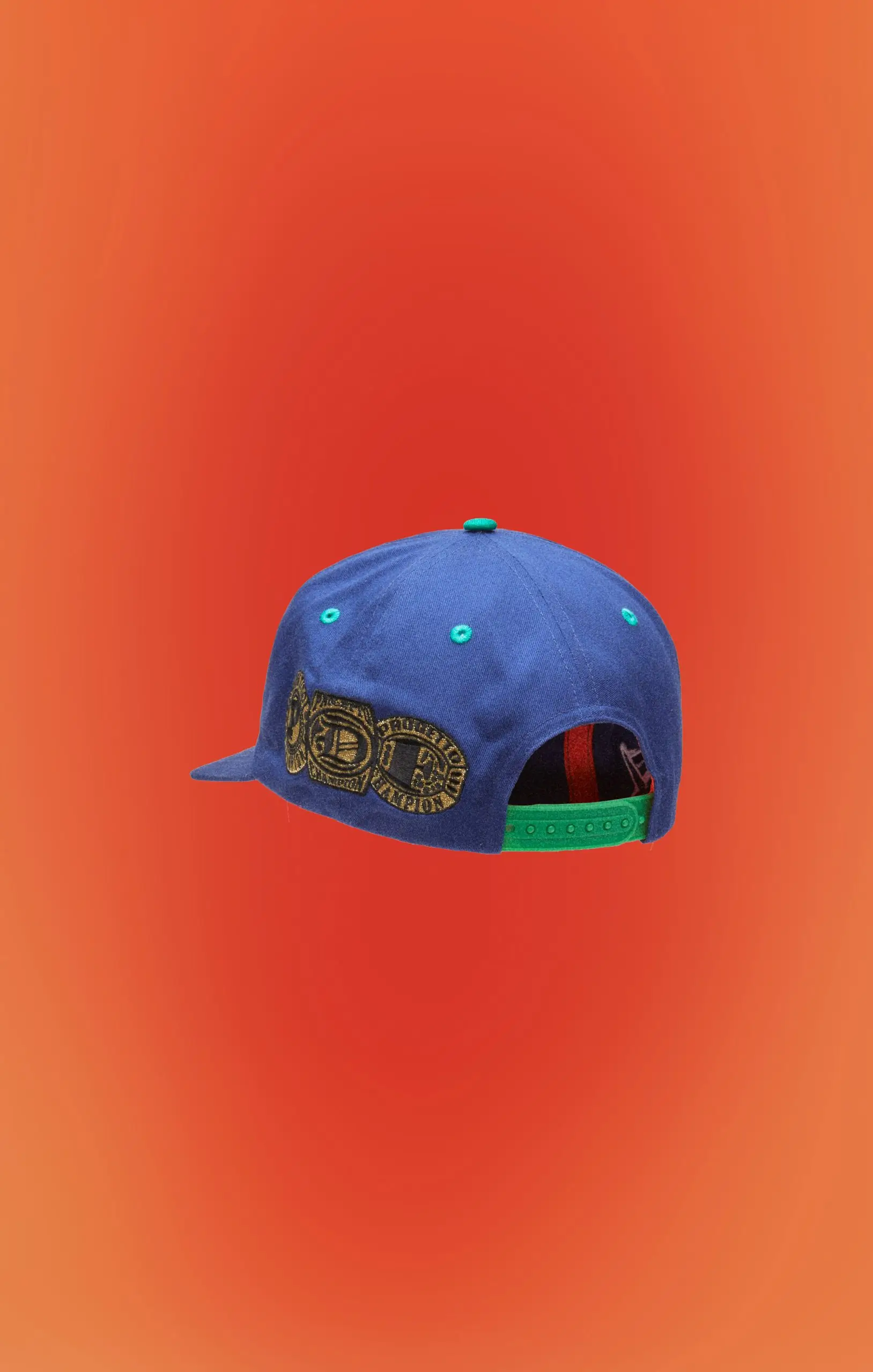
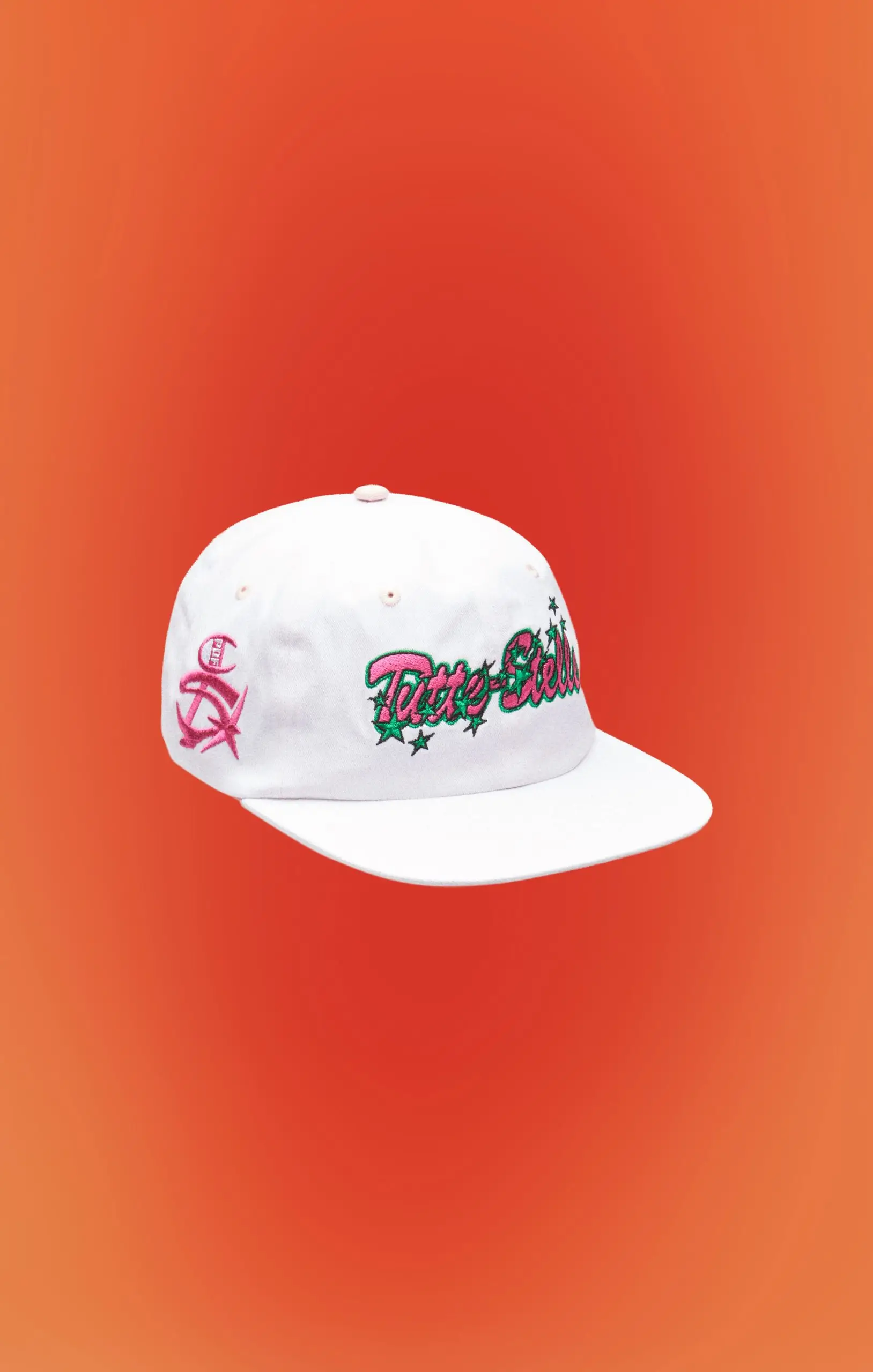
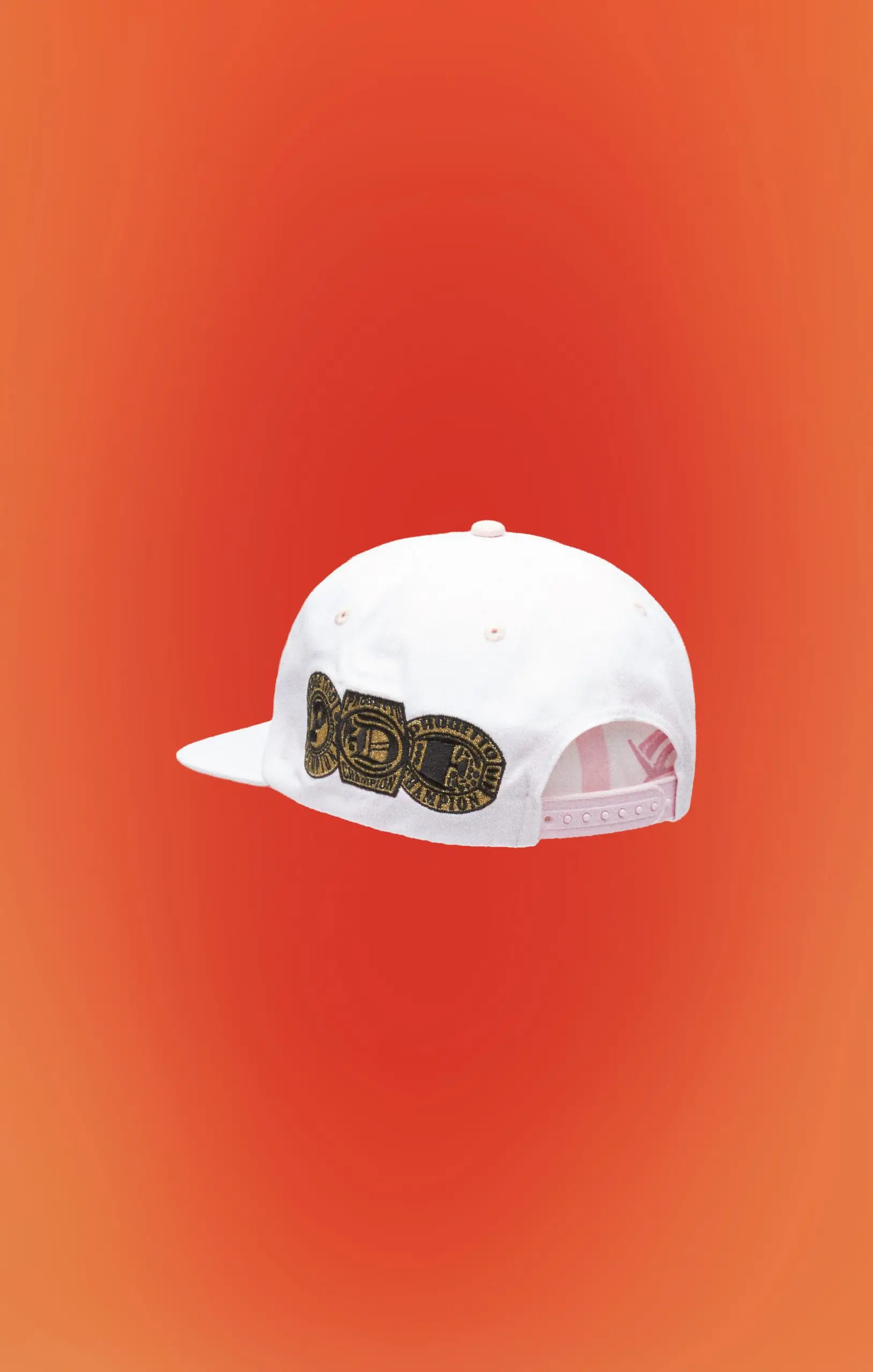
Accessories include a snapback cap built in a ’90s-inspired shape, deliberately bolder than a standard baseball cap silhouette, embroidered with the phrase “Tutte Stelle” — Italian for “All Stars” — across the front and sides. It’s a small detail, but a telling one: rather than translating the basketball reference into English for a broader audience, the collection keeps it in Formichetti’s own language, treating the Italian phrasing as part of the design rather than something to be smoothed over for export.
Footwear is where the archive digging shows up most literally. The capsule’s headline sneaker, the ZN93, revives Champion’s Zone 93 basketball silhouette from the ’90s and runs it through a distressed-effect treatment on an LWG-certified leather upper, giving what was originally a court shoe a worn-in, collectible finish. The high-top shape recalls ’90s court aesthetics fairly directly, but the wear-and-tear styling pushes it toward something closer to a piece meant to look already lived-in on day one — a treatment more commonly associated with high-end resale culture than with a brand-new release. The design carries a PDF x Champion co-brand on the tongue, Champion’s “C” logo on the side, and embroidered patches at the back — layering the collaboration’s identity onto the shoe without erasing the silhouette’s original sportswear DNA. It’s released across multiple colorways, including a fuchsia option that pushes the palette well outside anything the original Zone 93 would have shipped in, alongside quieter, more restrained tones aimed at buyers who want the sil without the loudest possible statement.
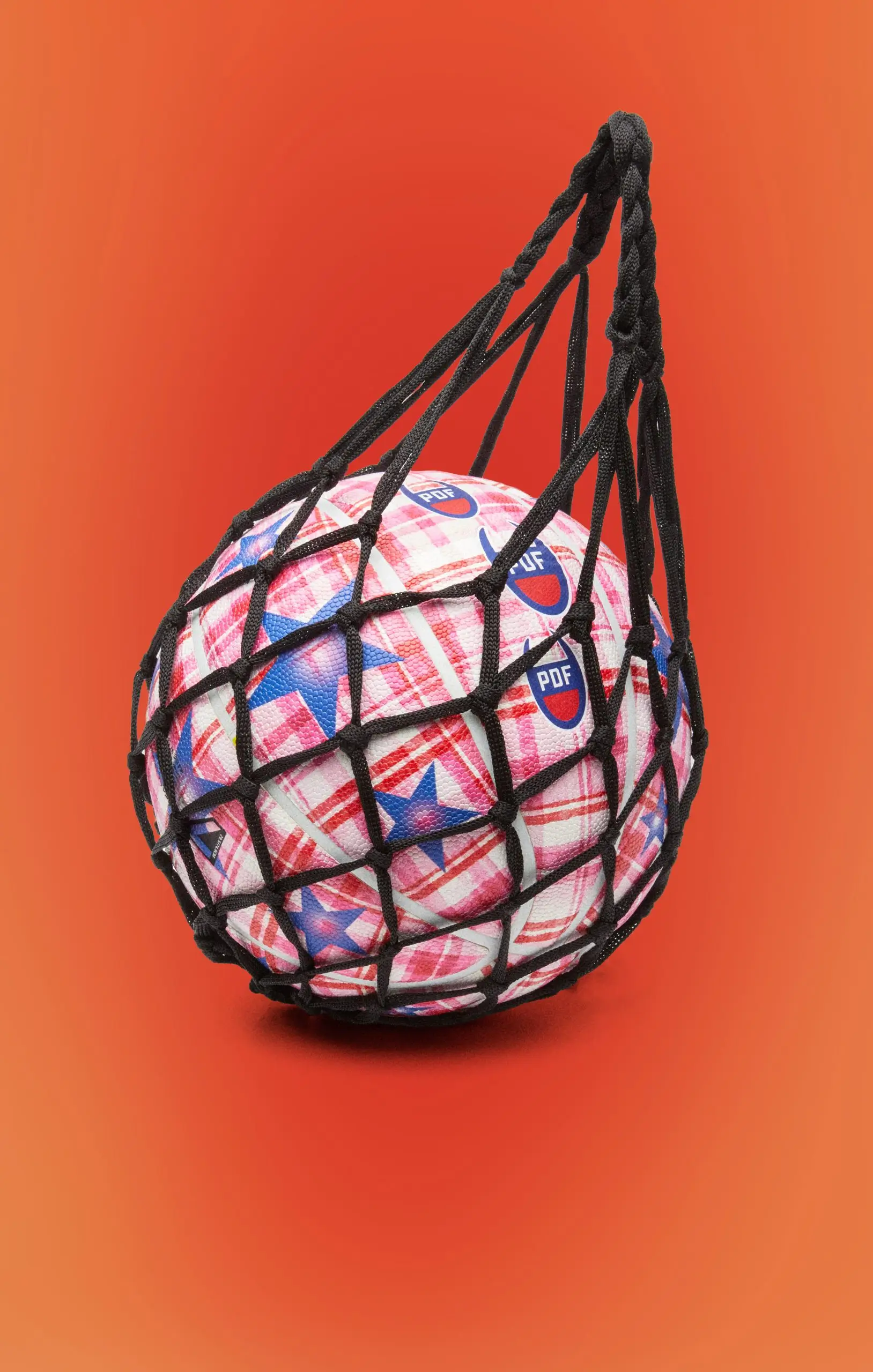
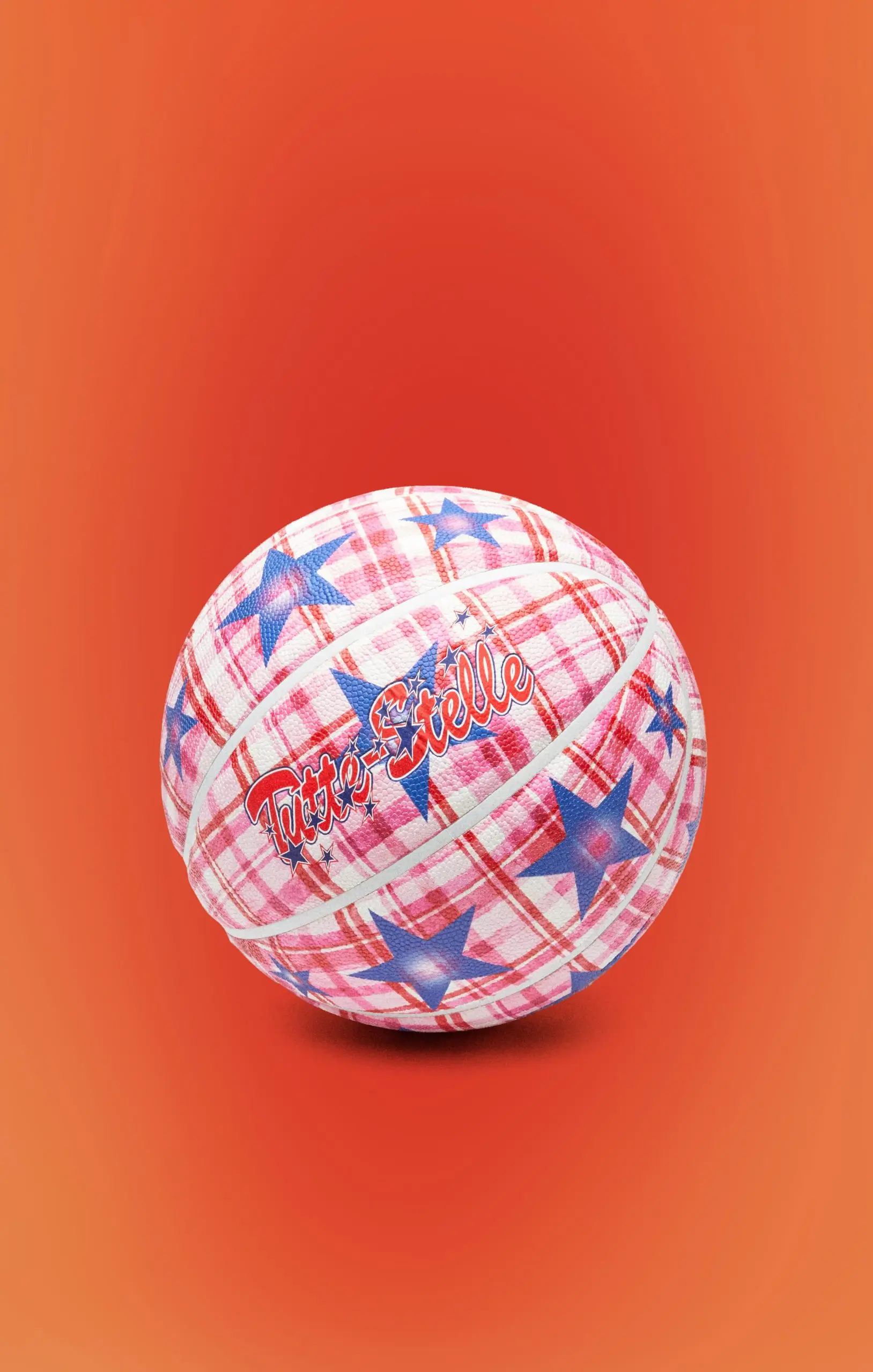
A pink plaid basketball with blue star motifs and PDF branding is paired with a black carrying net, extending the collection’s play athletic aesthetic beyond apparel.
Then there’s the basketball itself, produced in high-quality rubber and finished with a bold graphic combining basketball references, a check pattern, and a star motif — again carrying the “Tutte Stelle” branding. It’s designed to double as a display object as much as a functional ball, which fits the collection’s broader instinct: nothing here is purely performance gear, and nothing here is purely lifestyle either. Everything sits somewhere in between, on purpose.
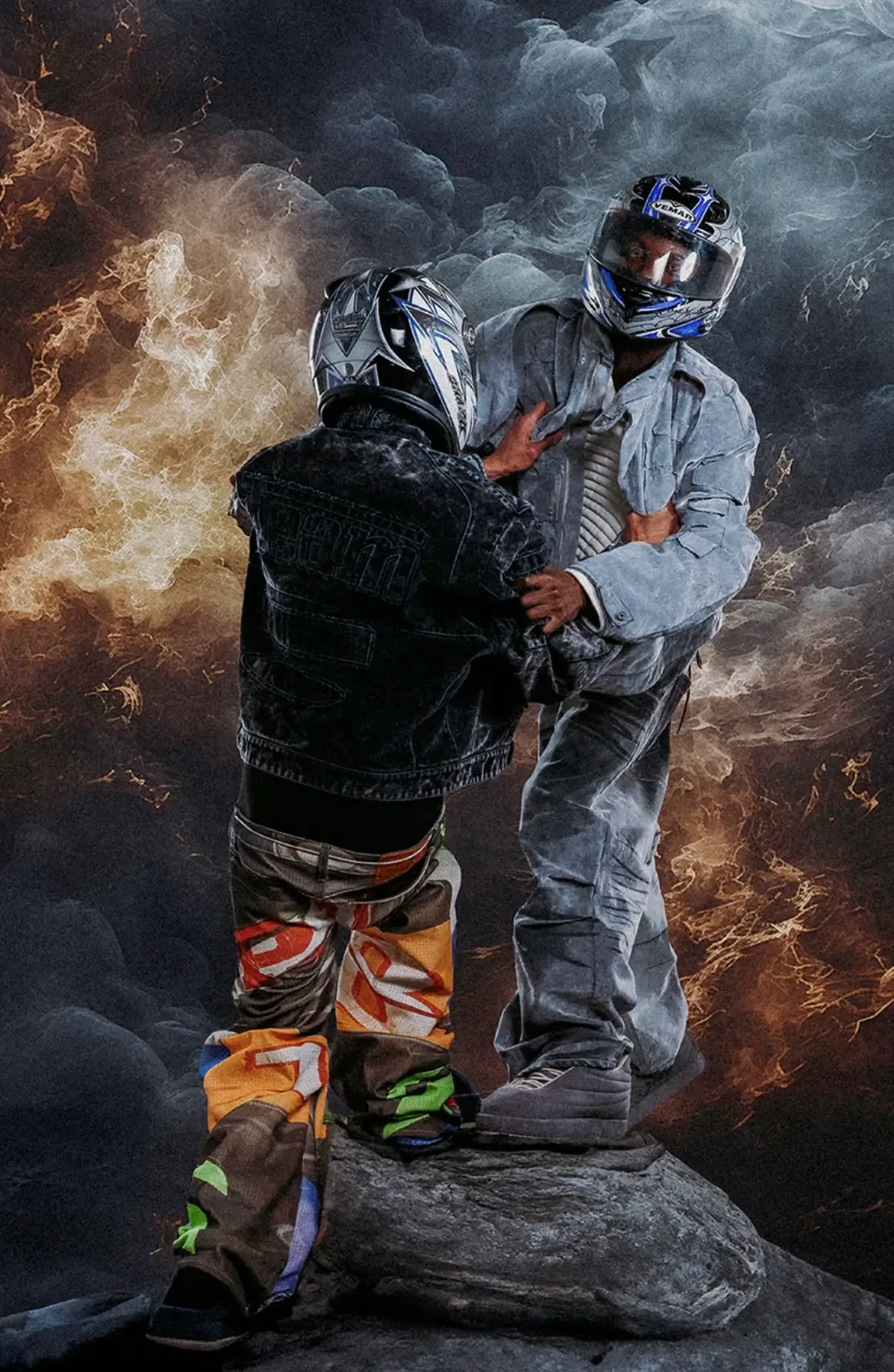
A cinematic editorial campaign pairs oversized denim silhouettes with motorcycle helmets, smoke-filled scenery, and dramatic lighting, emphasizing the collection’s rebellious, high-energy streetwear aesthetic.
roll
The capsule’s launch strategy has been built around live basketball as much as retail, which is a more literal interpretation of “sport as culture” than most fashion collaborations bother attempting. The first chapter debuted during Milan Fashion Week, with Champion’s Via Torino store in Milan transformed for the occasion into a launch space for the capsule. From there, the program moved to the Campetto della Resistenza basketball court for a public 1v1 street tournament, fronted by Matt Kiatipis — known in basketball and streetwear circles as MK, and among the more recognizable figures internationally in 1v1 basketball culture.
The second chapter of the rollout followed on June 26, timed to Paris Fashion Week, running through a near-identical structure on French soil: a capsule launch and meet-and-greet with Kiatipis at Champion’s Rue Saint-Honoré store, a second public 1v1 tournament at the basketball courts near Les Halles, and a closing celebration at Champion’s Rue de Turenne showroom marking the collaboration’s Paris debut. Champion’s own social messaging around the Paris leg leaned into the rivalry framing that basketball culture runs on naturally, describing the event as another head-to-head with Kiatipis and promising more of the same energy that had defined the Milan stop. The symmetry between the two city launches — store activation, public tournament, closing event — suggests a rollout designed to be repeated in future markets rather than treated as a one-city moment, which lines up with the “Capsule 1” framing and its implied sequel.
At retail, the capsule became available in Milan at the Via Torino store starting in late June, followed by Paris availability tied to the June 26 activation, with a wider online release through championstore.com from July 2 onward. That staggered rollout — physical stores first, e-commerce trailing by roughly a week — is a fairly deliberate choice for a brand the size of Champion, and it reads as an attempt to protect some scarcity and in-person exclusivity for the two fashion-week cities before opening the capsule up to a global online audience.
stance
It’s worth placing this within Champion’s broader run of recent partnerships rather than treating it as an isolated drop. The brand marked its hundredth anniversary with a collision involving Luka Sabbat, and has more recently paired with the dance-music label Defected on a culture-facing capsule under its “House of Champion” banner — a pattern that reads as Champion deliberately working across genuinely different cultural lanes (fashion, music, basketball) rather than repeating the same sneaker-collab formula with different names attached. The House of Champion framing in particular positions the brand as trying to spotlight a broader roster of creative talent rather than leaning on a single flagship designer relationship, which puts the PDF partnership in an interesting position: prominent enough to headline its own multi-city rollout, but still one entry in a wider portfolio strategy rather than a singular bet.
The PDF partnership fits that pattern while standing apart from it in one respect: it’s the only one of the recent run built specifically around Champion’s own sport, run by a designer who has spoken about starting from personal wardrobe gaps rather than brand-building. That distinction matters for how the capsule is likely to be judged. A music-culture blend or a celebrity-fronted anniversary drop lives or dies on cultural relevance and star power. A basketball-heritage merge, by contrast, invites a more literal kind of scrutiny — does the archive actually get honored, do the silhouettes hold up on their own terms, does the on-court activation feel like more than a photo opportunity. By that measure, running two full city-length events built around real 1v1 tournaments, rather than a single influencer appearance, suggests both brands were aware of that higher bar and built the rollout to clear it rather than skirt around it.
Related Articles
WACKO MARIA Brings Its Leopard Lining to the Big Leagues
Black nylon outside, leopard fur inside: WACKO MARIA’s first Major League Baseball collection reached Japan […]