

DRIFT AUDIO
Listen to this story
Choose a voice, then press play.
Fiat’s tiny, Italian-built electric quadricycle has landed stateside at under $14,000, reviving a nameplate from 1936 as a low-speed answer to America’s golf-cart-friendly communities.
In This Story
- Fiat’s Micromobility Bet Lands in America
- What the Topolino Actually Is
- Design, Dimensions, and the Dolcevita
- Pricing and What’s Included
- The Legal Catch: Low-Speed Vehicle Rules
- Where the Topolino Fits in the US Market
- A Name With History
- What Comes Next
Stellantis confirmed on July 7, 2026 that Fiat’s Topolino electric microcar is now available to order through select US dealers, marking the brand’s first entry into the country’s fast-growing micromobility segment. The two-seat, low-speed EV starts at $13,995 before a mandatory $990 destination fee, bringing the out-the-door price to $14,985.
Fiat brand CEO Olivier Francois framed the US arrival as more than a simple product launch, describing Topolino as a chance to bring back “a feeling, a lifestyle, a reminder that mobility can be joyful, expressive and beautifully simple.” The comment reflects how Fiat is positioning the car: not as a practical daily driver competing with the Fiat 500e, but as a lifestyle vehicle aimed squarely at coastal towns, resort communities, and gated neighborhoods where full-size cars often feel unnecessary.
stir
Despite resembling a scaled-down Fiat 500, the Topolino is not a conventional passenger car. It is classified as a quadricycle in Europe and, in the US, is being brought to market as a low-speed vehicle rather than a car that meets full federal motor vehicle safety standards. That distinction matters enormously for how, and where, it can legally be driven.
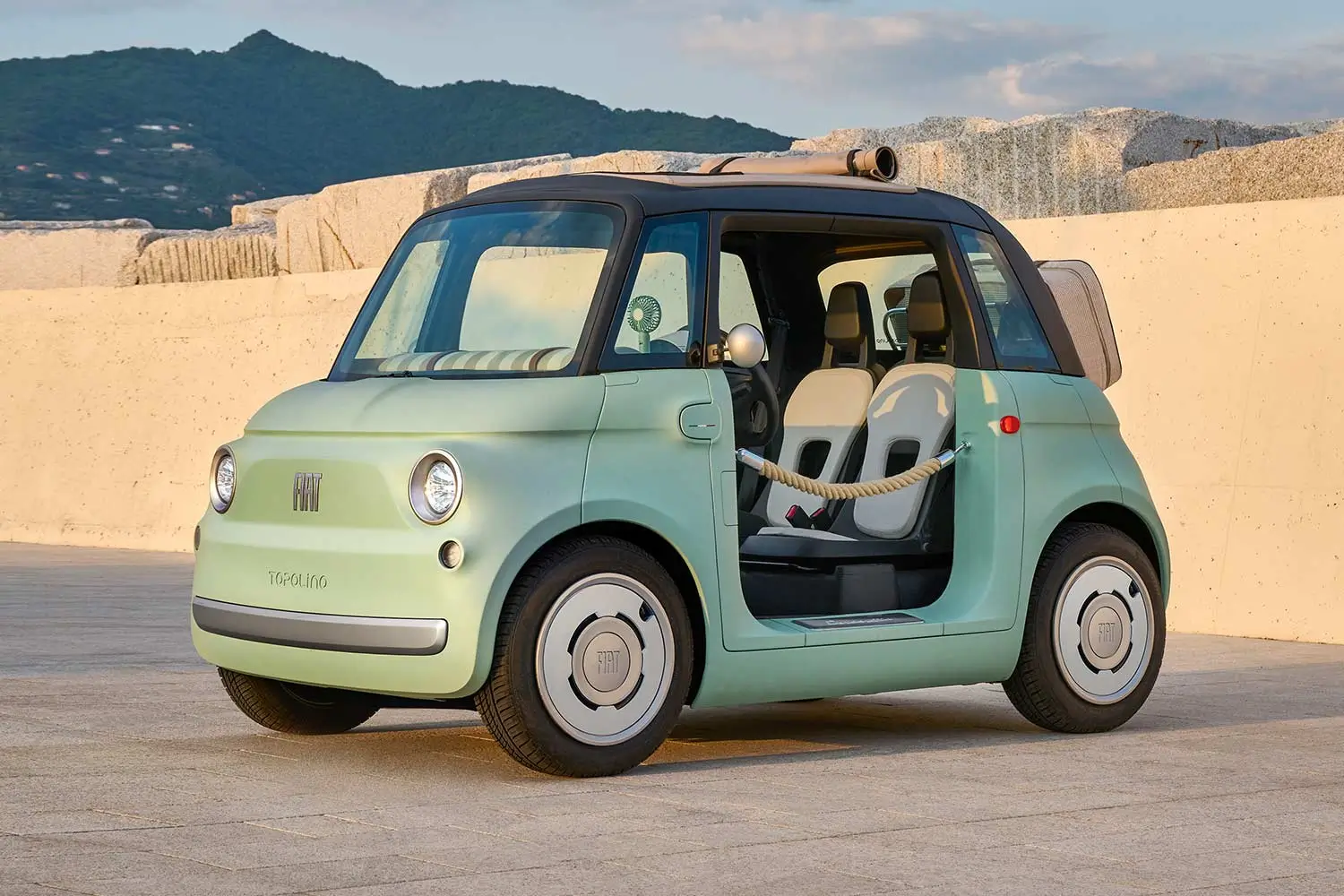
The Fiat Topolino Dolcevita pairs retro-inspired styling with an open-air design, minimalist cabin, and compact electric city-car proportions finished in a soft mint-green exterior.
The Topolino is built on a 5.4-kWh lithium-ion battery paired with an 8-horsepower electric motor, giving it a base top speed of 19 mph and up to 46 miles of range on a full charge. Stellantis says a low-speed vehicle conversion kit, expected by the end of summer 2026 and included at no additional charge, will raise the top speed to 25 mph and make the car street legal on public roads posted at 35 mph or below.
Curb weight comes in at just 1,073 pounds, with a maximum combined weight rating of 1,570 pounds. The car seats two and is built in Morocco, part of Stellantis’s broader manufacturing footprint for smaller, cost-sensitive vehicles.
flow
At 99.6 inches long, 56.4 inches wide, and 61.2 inches tall, the Topolino is dramatically smaller than anything else currently sold under the Fiat badge in the US: it is roughly 43 inches shorter than the standard 500e. That scale is central to the car’s appeal and to its limitations in equal measure, positioning it closer to a golf cart or neighborhood electric vehicle than to a subcompact car, even though its styling borrows heavily from Fiat’s retro design language.
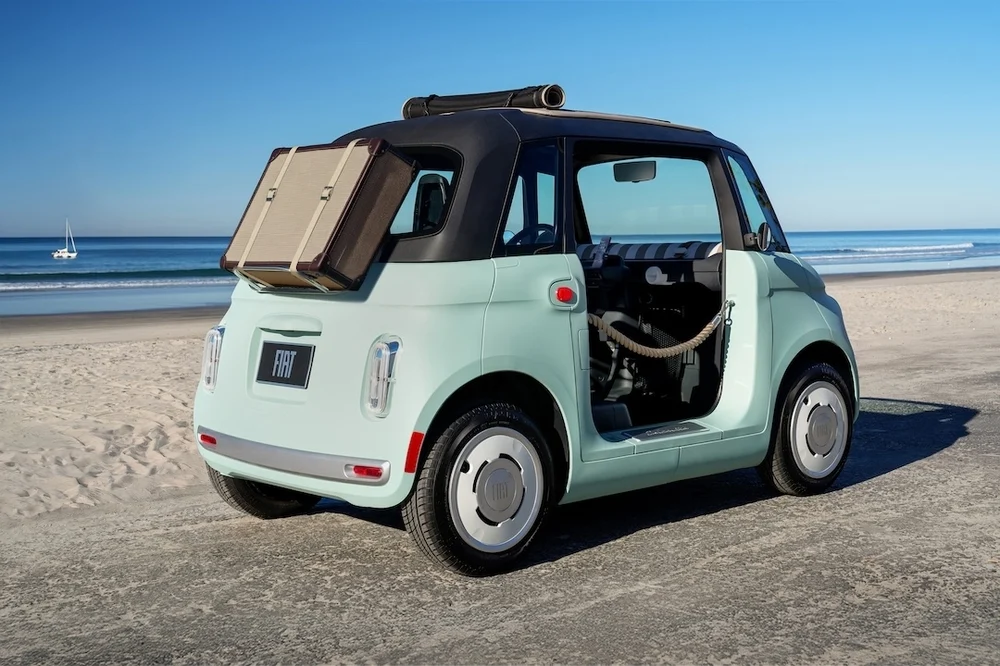
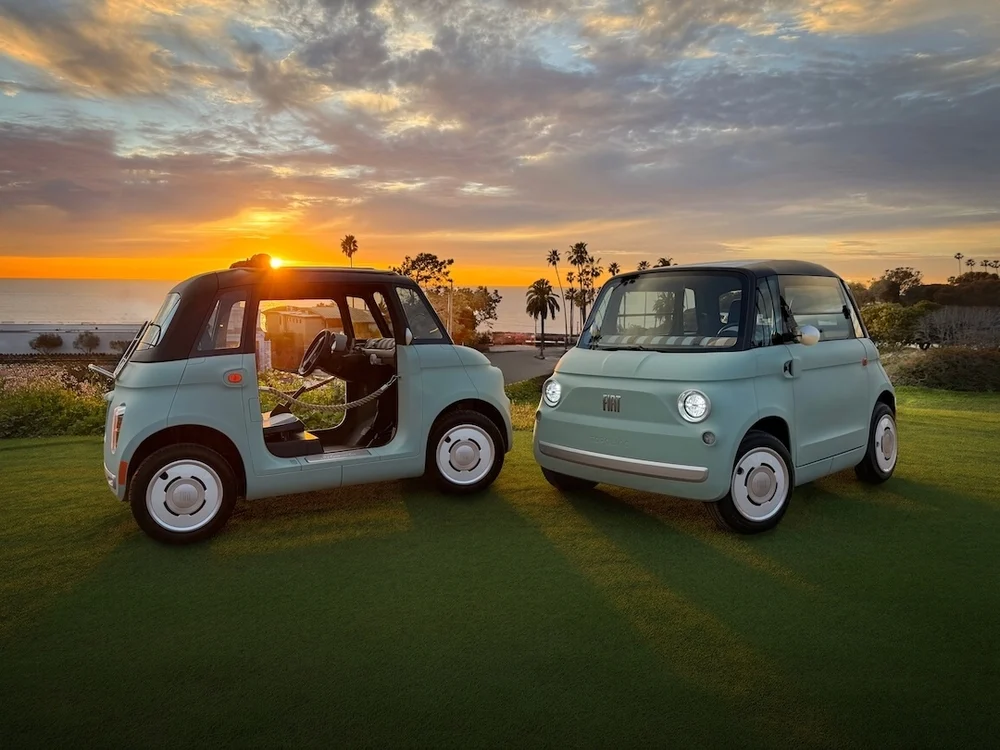
Two body styles are available at launch. The standard Topolino features a panoramic sunroof and conventional hinged doors, while the Topolino Dolcevita, whose name translates to “sweet life,” swaps in a roll-back soft top and uses rope in place of solid doors for a more open-air, beach-town feel. Both versions share a Verde Vita exterior color, vintage-inspired 14-inch wheel covers, LED lighting front and rear, and a symmetrical, minimalist body design.
Inside, the cabin keeps things simple: a digital gauge cluster, small storage compartments, a mobile device holder, and a windshield defroster on the standard model. There is no infotainment touchscreen or advanced driver-assistance suite of the kind found on Fiat’s full-size EVs; the interior is built around basic functionality rather than technology-forward features.
Fiat has also partnered with Motori & Customs, an aftermarket customization specialist, to offer curated and bespoke Topolino editions for American buyers, ranging from lightly modified trims to fully one-off builds. That partnership gives the car a secondary identity as a personalization platform, similar to how some scooter and micromobility brands have used customization programs to build enthusiast communities around otherwise utilitarian vehicles.
in
At $13,995 before destination fees, the Topolino undercuts nearly every other new vehicle sold in the US, electric or otherwise. Stellantis has said the car will be available in limited quantities for the 2026 model year, with deliveries expected through late summer and into fall.
View this post on Instagram
The pricing lands the Topolino well below its closest direct competitor, the Amble One, a similarly positioned electric buggy from Apple design veteran Julian Hoenig’s startup Amble. The Amble One costs roughly $25,000, nearly double the Topolino’s starting price, but offers a longer body at close to 10 feet, a higher top speed of around 40 mph, and roughly 60 miles of range, arriving already configured as street legal rather than requiring a separate conversion kit.
That comparison underscores the trade-off at the center of Fiat’s pitch: the Topolino is cheaper and smaller, with meaningfully less range and top speed, but it carries design pedigree and brand recognition that few other micromobility entrants in the US can match.
scope
The most important thing prospective US buyers need to understand about the Topolino is that it is not legally equivalent to a car, and where it can be driven depends heavily on local rules. In the United States, the car is being classified as a low-speed vehicle, a category the National Highway Traffic Safety Administration defines as a four-wheeled motor vehicle with a top speed between 20 and 25 mph. That is a distinct regulatory bucket from the quadricycle classification the Topolino uses in Europe, which does not have a direct federal equivalent in the US.
Without the optional conversion kit, the Topolino is best suited to private roads, gated communities, and other settings where public road registration is not required. With the low-speed vehicle kit installed, expected by the end of summer 2026, the car gains a rearview mirror, a backup camera, and a pedestrian alert system, and becomes eligible for use on public roads with posted speed limits of 35 mph or less. Even then, it remains barred from highways and from roads with higher speed limits, meaning buyers in rural areas or places without low-speed corridors may find it impractical, or simply unregisterable, as a primary vehicle.
Stellantis has described the Topolino as meeting NHTSA’s low-speed vehicle requirements around lighting, reflectors, and vehicle identification, and the base model already includes LED headlamps and taillamps, turn signals, a horn, seatbelts, a windshield, side mirrors, and a parking brake. The company has been direct in its own marketing about where the car is meant to live: coastal drives, resort communities, and private neighborhoods, rather than commuter routes or highway-adjacent suburbs.
extent
Low-speed vehicles and golf-cart-style EVs are not new to the US market on their own; retirement communities, coastal towns, and planned developments across the Sun Belt have supported a steady aftermarket for neighborhood electric vehicles for years. What makes the Topolino notable is that it represents one of the first times a mainstream, full-line automaker has brought a factory-built micro-EV of this size and price directly into that space, rather than leaving it to specialized golf-cart manufacturers and smaller EV startups.
Stellantis has tied the launch to its FaSTLAne 2030 strategy, under which Fiat is positioned as the group’s entry point for accessible, design-driven mobility. Bringing the Topolino to the US fits that framing: it is a low-cost, design-forward product that expands Fiat’s American lineup downward in price and size rather than competing directly against the 500e or other subcompact EVs on daily-driver practical.
The launch also arrives at a moment when new-vehicle affordability has become a persistent theme in the US car market. Three-year-old used vehicles averaged $31,548 in the first quarter of 2026, according to Edmunds data, the second-highest first-quarter figure on record. Against that backdrop, a factory-new EV priced under $15,000, even one with significant use-case limitations, gives Fiat a distinctive value story to tell, even if the car is aimed at a narrow slice of buyers rather than the broad market.
That value story also plays into a wider conversation about vehicle size and cost that has been building in the US for several years. As new cars have grown larger, heavier, and more expensive on average, driven in part by consumer demand for trucks and SUVs and by the cost of adding battery packs to larger EV platforms, a car like the Topolino represents an explicit rejection of that trend. It strips away the size, the range, and much of the technology that has come to define the modern car in exchange for a dramatically lower price and a narrower, more specific use case. Whether that trade-off resonates with American buyers accustomed to larger vehicles is a genuinely open question, and one that Fiat’s limited initial allocation for 2026 suggests the brand itself is still testing.
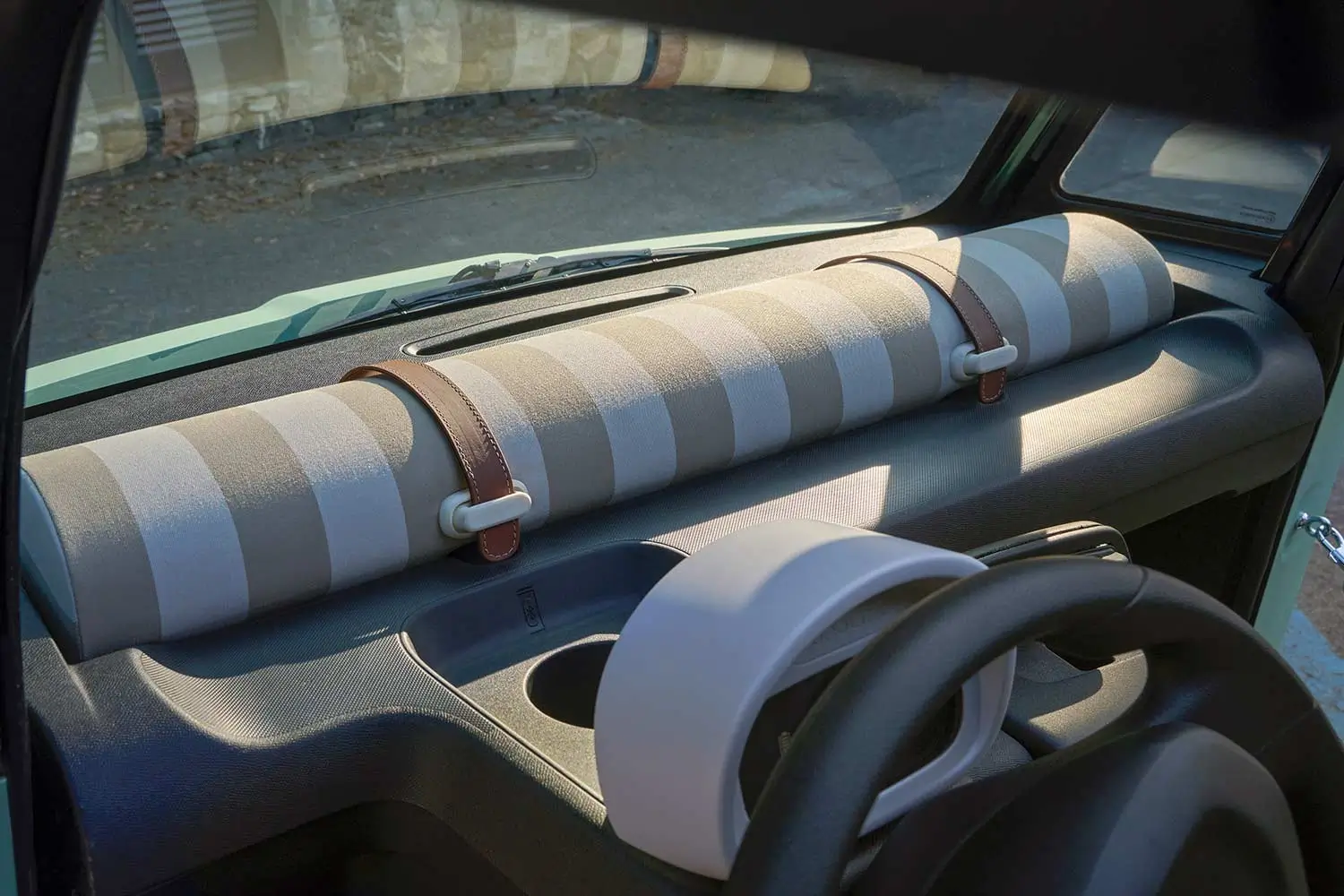
The Fiat Topolino Dolcevita’s minimalist dashboard features a striped fabric storage roll inspired by beach loungers, paired with simple controls and practical storage for an airy, coastal-inspired cabin.
name
Topolino is Italian for “little mouse,” and the name carries genuine weight in Fiat’s history rather than functioning as a marketing invention. The original Fiat 500 Topolino debuted in 1936 as one of the most affordable cars available in Europe at the time, designed explicitly to put ordinary Italian buyers behind the wheel. That original Topolino displaced just 569cc, produced around 13 horsepower, and became one of the most recognizable small cars of its era, laying much of the design groundwork that would later reappear in the modern Fiat 500.
Reviving the name for a modern electric microcar is a deliberate callback to that history, letting Fiat frame the new Topolino as a spiritual successor rather than simply a new nameplate. The car has already been on sale in Europe since 2023, where it has carved out a niche as an ultra-compact urban runabout in cities built around narrow streets and tight parking, a use case that maps only loosely onto the American suburbs and resort towns where Fiat is positioning the car domestically.
hint
With deliveries expected through the end of summer and into fall 2026, the immediate next milestone for the Topolino in the US is the rollout of the low-speed vehicle conversion kit that will unlock public road use in low-speed zones. Fiat has not yet detailed the full compliance documentation buyers will need in every state, and rules governing low-speed vehicle registration vary significantly by state and even by municipality, meaning interested buyers should confirm local eligibility before ordering.
Fiat has also teased the Multiplina concept alongside the Topolino’s US arrival, suggesting the brand sees this launch as the opening move in a broader micromobility push rather than a single standalone product. Whether American buyers embrace a nearly 90-year-old nameplate reborn as a golf-cart-adjacent EV remains an open question, but the combination of Italian design heritage, a sub-$15,000 price tag, and Stellantis’s willingness to bet a mainstream brand on the category marks a genuinely new entry point into the US micromobility conversation.
How the rollout performs over its first full season will likely shape whether Stellantis expands the Topolino program further, whether that means additional colorways and customization tiers through the Motori & Customs partnership, a wider dealer footprint beyond the initial “select dealers” launch, or eventually a push into other Stellantis-owned brands looking for their own entry into the low-speed vehicle category. For now, the car exists as a narrow but distinctive bet: a small, charming, and legally limited EV aimed at exactly the kind of low-speed, low-stakes driving environments where its size stops being a compromise and starts being the point.
Related Articles

Blown Spheres On An Extruded Bar
Luce Sferica by Ronan Bouroullec for Flos. Modular suspension. Glass spheres ~180 mm. Dual LED strips. Touch dimmer. Three lengths.