DRIFT AUDIO
Listen to this story
Choose a voice, then press play.
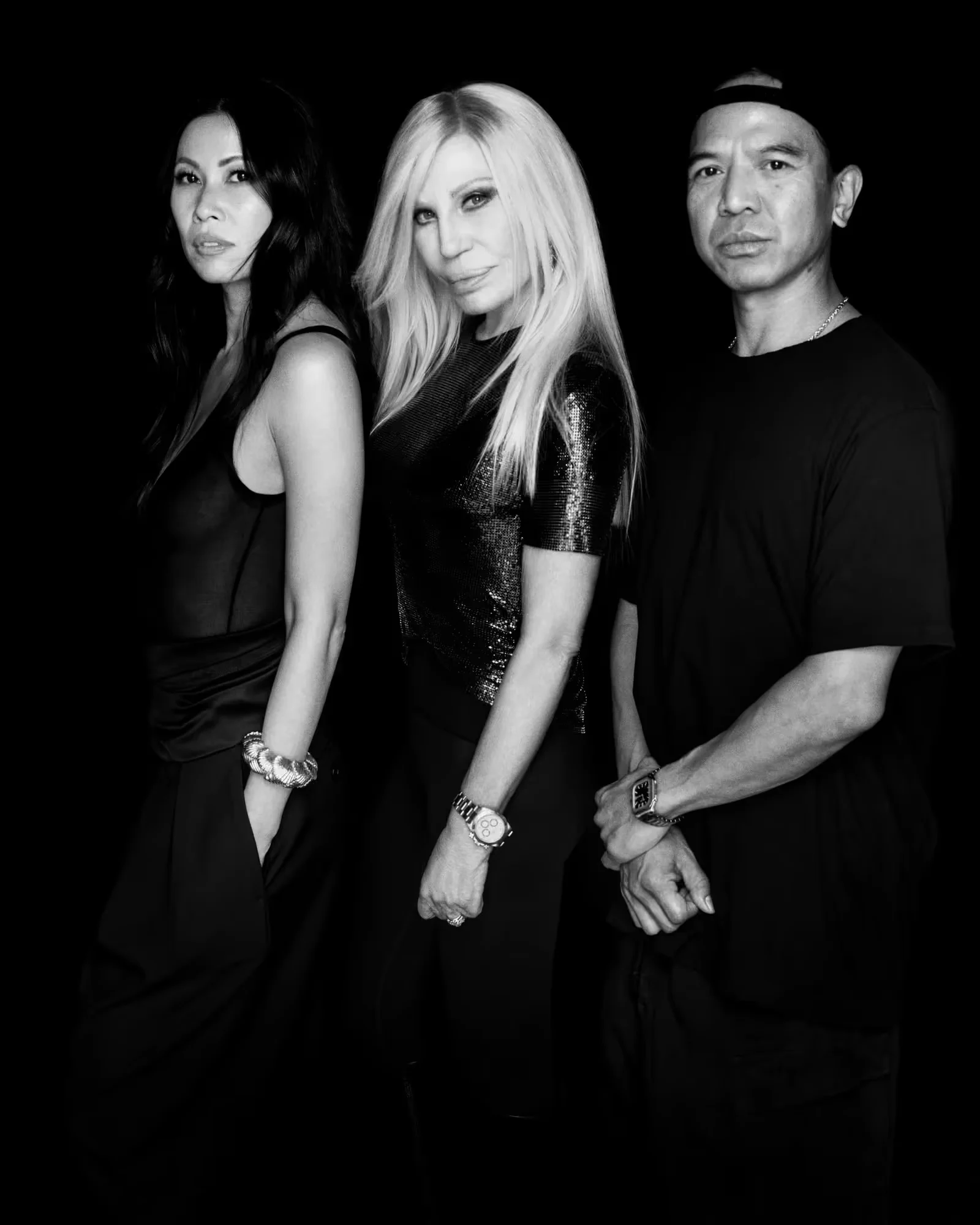
No surname on the door, no logo yet, and beauty before clothes. Donatella Versace’s first project since leaving Versace is built from scratch with Revolve.
The announcement landed on Monday, September 21, 2026, in the middle of Milan Fashion Week, and it arrived without the one thing fashion announcements usually lead with: a name. Donatella Versace and Revolve Group, the Los Angeles-based retailer listed on the New York Stock Exchange as RVLV, confirmed a joint venture span beauty and fashion, with Donatella as chief creative officer. The official release, datelined Milan and Los Angeles, describes an independent business built around her personal creative vision rather than a licensing deal or a capsule. Everything else, from the label’s name to its first product, has been held back.
Signal. What happened: Donatella Versace and Revolve Group announced a joint venture to build a new, independent beauty and fashion brand, with Donatella as chief creative officer and Revolve running commerce, technology, operations, marketing and community. Exact object: an as-yet-unnamed brand and a new online platform, with the first launch confirmed to be a beauty product. When and where: announced September 21, 2026; initial markets are the United States, Latin America, Asia-Pacific and the Middle East, with the name, creative view and first launch to be revealed in the coming months according to the rel, and no firm date or price given. Source: Revolve Group’s own press rel via PR Newswire, corroborated by WWD, CNBC and Daily Front Row. Why it matters: it is Donatella’s first creative leadership role since she handed over Versace’s design studio in 2025, and it is the largest name yet to pass through Revolve’s growing model of founder-led joint ventures. Earlier DRIFT: A September 2026 coverage of Dario Vitale’s appointment at Emporio Armani traced the designer who first succeeded Donatella at Versace.
The structure is worth reading slowly. Revolve’s rel says Donatella will shape the venture’s identity, product, collaborators and what it calls a cultural world, while Revolve supplies the machinery: digital commerce, consumer data, operations and marketing. In her own statement, Donatella frame the partner around a younger audience, saying she wanted to speak to that generation in a new and personal way, and that she and Revolve share a belief that “culture comes from connection.”
stir
The timeline behind this moment is short but crowded. On March 13, 2025, Versace announced that Donatella would step down as chief creative officer, effective April 1, after 28 years running design at the house, moving into a role as chief brand ambassador. Her successor was Dario Vitale, recruited from Miu Miu. Within weeks, the Prada Group revealed it would acquire Versace from Capri Holdings, a deal WWD valued at an enterprise value of 1.25 billion euros. It closed in early December 2025, and Vitale left days later after a single collection.
That makes the Revolve announcement land roughly eighteen months after Donatella left the studio, a gap FashionNetwork described as a year and a half. It is the first time since 1997 that she has been in charge of a design direction that is entirely hers to set.
Her history with that role is well documented. Donatella grew up as muse and adviser to her brother Gianni Versace, and launched the diffusion line Versus in 1989. After Gianni was killed in Miami in July 1997, she became artistic director and led the house’s creative vision for nearly three decades. Revolve’s own biographical note on her leans hard into the pop-culture résumé: the long list of musician friends including Prince, Elton John, Lady Gaga, Madonna and Dua Lipa, and the Jungle Print dress Jennifer Lopez wore to the Grammy Awards in 2000, which is widely credited with prompting Google to build its image search. The same note lists the younger designers she has worked closely with over the years, among them JW Anderson, Anthony Vaccarello, Christopher Kane and Kim Jones.
The ownership story matters here too. In September 2018 the Versace family sold the company to Michael Kors Holdings, which renamed itself Capri Holdings shortly afterward, and Donatella stayed on as creative lead under the new owner. The Revolve venture is the first time in that whole period that a business has been built around her rather than around the family name she inherited from her brother.
It also notes her honors, including the Fashion Awards’ Fashion Icon Award and Italy’s Grand Ufficiale dell’Ordine al Merito della Repubblica Italiana, and her philanthropic roles, which include co-chairing The Rocket Fund for the Elton John AIDS Foundation. Grazia USA added a more recent credit to the list: a cameo in The Devil Wears Prada 2.
The Marble Inscription: A Study in Civic Permanence
flow
On paper, the pairing surprised some observers. Marie Claire’s coverage called it one of the year’s most unlikely matches, noting that Revolve built its name as an online retailer for Millennial and Gen Z shoppers rather than as a luxury house. But Revolve has spent the past few years turning itself into something closer to a brand incubator, and the Donatella deal fits a pattern.
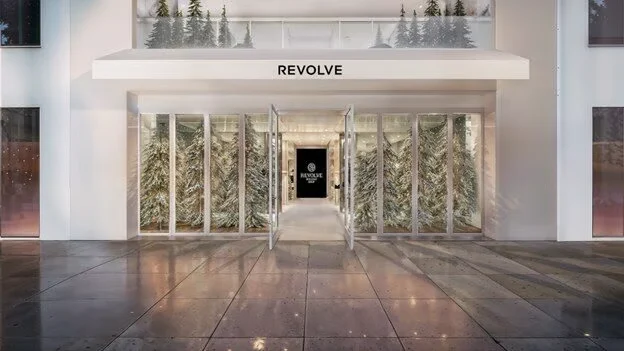
The company was founded in 2003 by co-CEOs Michael Mente and Mike Karanikolas. According to its own corporate description, it operates two segments on one platform: REVOLVE, which sells premium apparel, footwear, accessories and beauty, and FWRD, its curated luxury storefront. Revolve says its platform connects millions of consumers, thousands of fashion influencers and more than 1,600 emerging, established and owned brands.
The rel is explicit that Donatella’s own audience is part of the asset. It describes her as one of the most recognized designers in the world and one of fashion’s most followed figures on social media, with a community built around confidence and self-expression. Revolve’s pitch is that it can turn that kind of cultural attention directly into sales.
That owned-brand side is where the Donatella venture sits. CNBC reported that the deal follows two earlier celebrity partnerships: a joint venture with Cardi B that launched in April 2025, and SRG, the first fashion brand from Sofia Richie Grainge, which arrived in autumn 2025. The Cardi B project became Grow-Good Beauty, a vegan and cruelty-free line, per Marie Claire’s reporting. Karanikolas said in the rel, as quoted by CNBC, that the goal with Donatella was to create something distinctive and “build it for the long term,” lang that separates this venture from the limited connection fashion houses run every season.
Mente, for his part, called Donatella “one of the defining creative voices of our time,” according to Daily Front Row, and described the partnership as a chance for her to build something from the ground up. Raissa Gerona, Revolve Group’s president of brand and partnerships, pointed to Donatella’s instinct for what younger shoppers want and her ability to link fashion to culture as the reason the deal excited the company.
everything
The most concrete detail in the whole announcement is the order of operations. Revolve’s release says the first launch will begin in beauty, and WWD reported the same from Milan. Clothing follows at an unspecified point.
That sequencing tracks with how Revolve has approached its other founder partnerships, and with the economics of starting a label from nothing. Beauty launches can reach a wide audience at lower price points, and they give a new brand a way to establish a view identity before committing to seasonal collections and production runs.
The release goes further than product, though. It describes the venture as a digital-first world that people can take part in rather than simply buy from, bringing together fashion, beauty, entertainment, talent, creators and community through content, experiences and commerce. Grazia USA characterized the planned online platform as a digital space where fans can join the conversation as well as shop. Donatella’s own statement lists music, film and art alongside fashion as the fields where she finds inspiration in younger people, which suggests the entertainment component is intended to be more than a marketing layer.
What that looks like in practice has not been shown. There are no renderings, no product imagery and no named convincer in any of the published material, and the rele closes with a single line promising that this is only the start.
show
Part of what makes the timing notable is how much has changed at Versace itself since Donatella stepped back. Under Prada Group ownership, Lorenzo Bertelli became Versace’s executive chairman. After Vitale’s exit, the house ran its design studio under chief executive Emmanuel Gintzburger until a permanent appointment was made.
That appointment came on February 5, 2026, when Versace and the Prada Group named Pieter Mulier chief creative officer, effective July 1, 2026. Mulier arrived from Alaïa, where he had been creative director since 2021, and before that spent years as Raf Simons’ right hand at Jil Sander, Dior and Calvin Klein. Dazed reported in July that his debut Versace collection is not expected until February 2027, and that the house released an unattributed Autumn/Winter 2026 campaign, shot by Steven Meisel, to bridge the gap.
Vitale’s one runway outing, the Spring/Summer 2026 show in September 2025, split opinion. Some critics read it as a smart modernization of the house’s sensual codes; others felt it diluted the maximalist glamour that defined the Donatella years. Luxus Plus noted at the time that Donatella, by then chief brand ambassador, was not at the show, an absence that was widely read as a comment in itself.
Mulier’s brief is different. Lorenzo Bertelli said when announcing him that the Prada Group had identified Mulier as the right designer for Versace while it was still weighing the acquisition, and reporting around the appointment suggested a move back toward the glamorous, body-conscious codes associated with Gianni and Donatella rather than away from them. Mulier trained in architecture at Institut Saint-Luc in Brussels before joining Simons, and his five years at Alaïa were marked by sculptural tailoring and a run of hit accessories that turned the brand into a commercial success.
Vitale’s lone season still left a Japan-market footprint. His Spring/Summer 2026 debut in Milan included a collide with Onitsuka Tiger on the TAI-CHI shoe, produced at the brand’s factory in Tottori with Italian materials and a studded Medusa on the tongue, which went on sale in April 2026. Vitale himself has since moved on again, named creative director of Emporio Armani in September 2026.
So when Donatella returns to design, she does it in parallel with a Versace that is being reshaped by someone else, with no stated role for the house or its codes in her new business. Revolve’s rel refers to her time at Versace only as leading the creative vision at “the House,” without naming it.
fin
The launch territory is specific: the United States, Latin America, Asia-Pacific and the Middle East, with the release adding that other markets may be considered as the venture develops. Europe, Donatella’s home market, is not on the initial list, a gap Daily Front Row flagged in its own coverage. Asia-Pacific is named as a region, but no individual countries within it, Japan included, have been confirmed.
Some commentary around the announcement has pointed to 2027 for the brand’s name and first products. Revolve’s own release does not commit to a year, saying only that the name, creative vision and first launch will be revealed in the coming months. The rel also contains a standard forward-looking statement that refers to the negotiation and execution of definitive agreements, which indicates the paperwork behind the joint venture is still being finalized.
Financial terms, ownership split and pricing have not been disclosed. Revolve Group has not said how much capital it is committing, and no team members beyond Donatella have been named.
What is on record is the shape of the thing: a designer with nearly three decades of experience running a global house, starting again without her surname on the label, backed by a retailer that has spent twenty years building direct relationships with young shoppers online. The first object to come out of it will be a beauty product, and its name is still being kept off the table.
Related Articles
The Frankie Shop Takes Milan: Oversized Suiting Moves Into the Quadrilatero
Eleven years after a Lower East Side boutique, Gaëlle Drevet’s label opens its first Italian […]