DRIFT AUDIO
Listen to this story
Choose a voice, then press play.
In This Story
- The Sticker That Started It
- Starface’s Cultural Playbook
- Rhode Joins the Party: Spotwear and the Bieber Effect
- Beyond the Blemish: Wellness Patches Go Decorative
- The Fragrance Sticker Question
- Why Skincare-as-Accessory Works Right Now
- What’s Next for Wearable Beauty
stir
There was a time, not even a decade ago, when a pimple patch had exactly one job: disappear. Hydrocolloid dressings borrowed from wound care were sold clear, round, and matte, designed to vanish under concealer until the blemish underneath did the same. The product worked. The messaging, though, was pure damage control — the visual language of something to be corrected, not worn.
That premise has been almost completely inverted. Walk through a Sephora aisle, scroll a TikTok GRWM, or look closely at a runway beauty look this year, and you’ll find star-shaped, heart-shaped, and character-shaped patches sitting proudly on cheeks and foreheads, color-matched to outfits rather than hidden from view. Two brands did more than anyone to engineer that flip: Starface, the original “zit sticker” upstart that turned acne into a punchline-proof accessory starting in 2019, and Rhode, Hailey Bieber’s skincare line, which spent years building anticipation before finally entering the category this spring. Together, they’ve helped pull pimple patches out of the medicine cabinet and into the same mental category as a phone charm or a temporary tattoo — and in doing so, they’ve cracked open a much bigger conversation about what “wellness” is allowed to look like on your face.
View this post on Instagram
It’s worth sitting with how recent this shift actually is. As recently as the late 2010s, the entire acne-patch category was built around invisibility as the selling point — clear dots, skin-tone packaging, marketing copy that promised no one would ever know. That the category’s two most culturally dominant entrants now sell the opposite promise, openly and at scale, says less about hydrocolloid chemistry and more about how quickly the rest of beauty has been forced to catch up to a generation that simply stopped hiding its skin.
flow
Starface’s origin story is, by now, beauty-industry lore. Former Elle.com beauty director Julie Schott and entrepreneur Brian Bordainick co-founded the brand in 2019 after Schott — who had struggled with her own acne while reporting backstage at fashion shows — wondered why pimple patches couldn’t be decorative instead of invisible. The debut Hydro-Star, a yellow, star-shaped hydrocolloid patch, wasn’t a new chemistry; it was a new attitude. Where the rest of the acne aisle leaned clinical and corrective, Starface leaned into a bright, smiley, almost mascot-driven identity that treated breakouts as something to display rather than disguise.
The bet paid off. Starface’s stars have since been spotted on Justin Bieber, Dua Lipa, Bella Hadid, Charli D’Amelio, and Addison Rae, and the brand became, by some industry estimates, a roughly $90-million-a-year business. It has pushed the idea of pimple patches as fashion further than perhaps any beauty brand: its Black Star patches walked New York Fashion Week on designer Ashley Williams’ runway, making Starface the first pimple patch to appear in a runway show, and the brand has since returned to Williams for an “I Heart Me” collaboration timed to Valentine’s Day. Collaborations with Hello Kitty, Snoopy, and Miffy turned the format into something closer to collectible merch, while a 2026 partnership with musician Beabadoobee introduced a fully customizable, 20-shade Hydro-Star pack built around the idea of matching your patch to your personal aesthetic — fashion logic, applied directly to a breakout.
That runway moment with Ashley Williams wasn’t a one-off either; Starface patches have since shown up in Marc Jacobs’ Heaven campaign imagery and on the faces of a wider rotation of Gen Z-aligned names including Iris Law, Tate McRae, PinkPantheress, and Central Cee. Charli XCX wore the brand’s black patches in her 2024 mockumentary The Moment, a project steeped enough in zeitgeist signaling that the cameo functioned almost as a stamp of cultural relevance. Schott and Bordainick have been candid in interviews about the thinking behind all of it: rather than positioning Starface as a corrective product with a “before and after,” they built a brand around the idea that nearly everyone gets pimples and that the existing acne aisle profits by making customers feel like something is broken. That reframing extended into retail strategy, too — Starface has steadily expanded from direct-to-consumer into Target, Walmart, CVS, and, as of 2025, Ulta, while also launching internationally into markets including the U.K., Canada, and Australia.
The brand has occasionally leaned into novelty formats well outside its signature star, including nail-sized flash-tattoo-style patches, cloud and smiley shapes, and seasonal gingham prints, all while keeping its bright, mascot-forward visual identity — anchored by an in-house character nicknamed “Big Yellow” — consistent across every drop. The strategy of treating each new release as a limited, hype-driven event, rather than a standard restock, borrowed directly from streetwear and sneaker drop culture, training a loyal customer base to show up and sell out a launch within days.
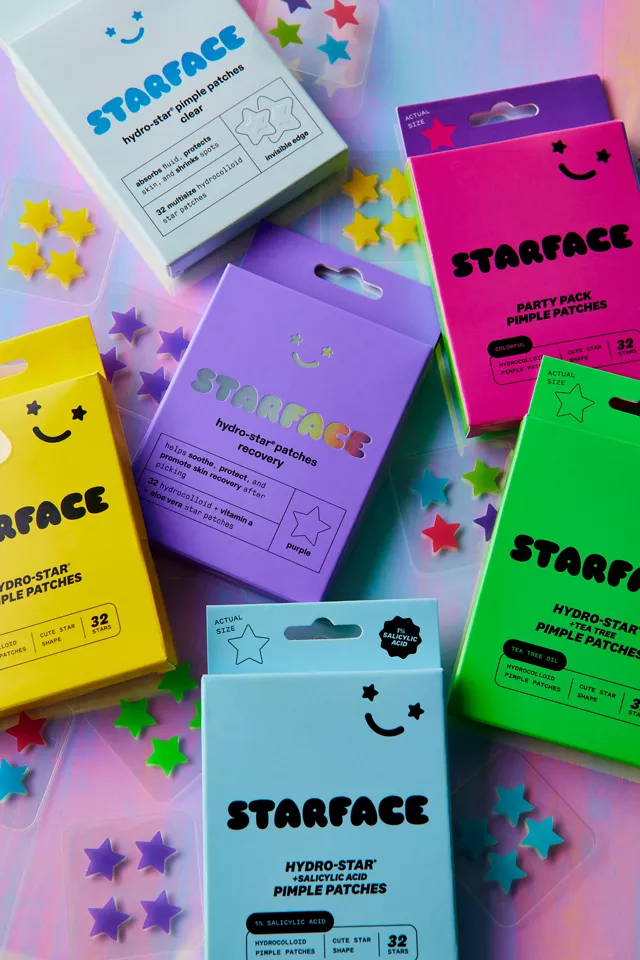
🌟 STARFACE Hydro-Star Patches
Cute star-shaped blemish patches that actually work. Oil-absorbing, skin-soothing, and party-ready in every color.
.starface-popout {
max-width: 420px;
margin: 40px auto;
perspective: 1000px;
}
.popout-card {
background: white;
border-radius: 16px;
overflow: hidden;
box-shadow: 0 10px 30px rgba(0,0,0,0.1);
transition: all 0.4s cubic-bezier(0.4, 0, 0.2, 1);
cursor: pointer;
}
.popout-card:hover {
transform: scale(1.04) rotate(1deg);
box-shadow: 0 20px 40px rgba(0,0,0,0.15);
}
.popout-content {
padding: 20px;
text-align: center;
}
.popout-content h3 {
margin: 0 0 10px;
color: #5e17eb;
font-size: 1.35rem;
}
.popout-content p {
font-size: 0.95rem;
color: #555;
line-height: 1.5;
}
.popout-btn {
display: inline-block;
margin-top: 12px;
padding: 10px 24px;
background: #5e17eb;
color: white;
border-radius: 50px;
text-decoration: none;
font-weight: 600;
transition: all 0.3s;
}
.popout-btn:hover {
background: #7b3dff;
transform: translateY(-2px);
}
scope
Rhode took its time. Hailey Bieber’s skincare brand had spent years fielding requests for a pimple patch before finally answering this past April with Spotwear, a $16 hydrocolloid sticker line developed with creative input from her husband, Justin Bieber. The launch arrived as part of a broader “Rhode x The Biebers” drop, nicknamed Bieberchella for its desert-festival styling, which also included a limited-edition Peptide Lip Treatment in a banana-inspired flavor and a matching Peptide Eye Prep design.
Spotwear’s whole premise borrows directly from Starface’s playbook while putting Rhode’s minimalist spin on it: five novelty shapes — daisy, bubble, mushroom, curve, and jelly bean — built specifically so wearers can, as the brand puts it on its product pages, mix and match shapes and colors to complement an outfit or a makeup look. That’s a notable shift in framing for a brand that built its early identity on clinical-feeling, barely-there skincare; Spotwear is the most overtly decorative, “wearable” product Rhode has released to date, following the brand’s earlier MagSafe-compatible Lip Case as part of a growing lineup of skincare designed to be seen as much as used. The drop sold out quickly online and is also available at Sephora.
The framing matters because Rhode built its reputation, and its early billion-dollar-adjacent valuation, on the opposite instinct: glazing milks, skin tints, and lip treatments designed to look effortless and almost absent, in line with the brand’s “glazed skin” aesthetic. Spotwear is a deliberate departure, and the choice to make it a Bieber-couple collision — rather than a standard product drop — signals how much Rhode is leaning on personality and narrative, not just formula, to sell this particular category. The brand has framed the patches explicitly around wearable skincare’s appeal to its community’s desire to visibly signal a connection to the brand itself, a strategy that mirrors Starface’s own community-first growth model even as the two brands occupy different price tiers and aesthetics — Rhode’s pastel minimalism against Starface’s primary-color maximalism. Online reaction to the launch leaned enthusiastic, with beauty press and fan accounts framing it as a long-rumored product finally arriving rather than a surprise pivot.
well
The acne patch isn’t the only sticker getting a fashion upgrade. A parallel category of transdermal wellness patches — adhesives loaded with magnesium, melatonin, B12, or adaptogens instead of hydrocolloid — has been growing alongside it, and several of the buzziest entrants have borrowed the same logic Starface pioneered: make it pretty enough to wear in the open. Barrière, a vitamin-patch brand that relaunched in 2024, designs its products to look like temporary tattoos, while newer entrants like Half Past 8 (Deep Sleep, Energy & Focus, Stress & Mood) and longer-running names like The Good Patch have built entire product lines around the idea that a daily supplement ritual can also be a small piece of self-decoration.
It’s the same underlying shift that made Starface and Rhode’s patches work: as patches replace pills and gummies for a generation that’s increasingly skeptical of swallowing more capsules, the format itself becomes an opportunity for branding and personal style, not just a delivery mechanism. Dermatologists and nutrition experts have raised legitimate questions about how much of any active ingredient actually absorbs through skin, and that skepticism is worth taking seriously before treating a patch as a medical fix — but on the question of aesthetics and cultural appetite, the wellness-patch boom is moving in exactly the same direction as the acne-patch one: visible, collectible, and styled.
quest
Fragrance is the next logical place for this logic to land, and there are early signs it’s already happening — just not yet through one breakout brand the way Starface owns pimple patches. On one end, there’s a straightforward nostalgia play: scratch-and-sniff stickers, the genuine ’80s artifact, have been resurrected by their original manufacturer for a new generation of collectors, riding the same Y2K-maximalist sticker trends — translucent finishes, scratch-revealable formats, play illustration — that are shaping sticker design more broadly this year. On the other end is a more grown-up version of the same idea: “functional fragrance,” scents formulated to shift mood or support focus rather than simply smell appealing, has been named one of the year’s defining wellness trends, with brands explicitly marketing fragrance as a self-care tool rather than a finishing touch.
Neither of those is, strictly, a wearable sticker patch in the Starface or Rhode sense yet — there isn’t currently a dominant “fragrance patch” brand occupying that exact lane. But the appetite both trends point to is the same one acne and wellness patches have already proven out: people want their self-care products to double as visible, personality-driven accessories, scent included. Given how quickly Starface-style decorative logic has spread from acne to vitamins, a wearable scent sticker feels less like a stretch and more like a matter of time.
now
None of this happens in a vacuum. It’s landing during a broader culture turn against “flawless,” undetectable beauty standards and toward visible authenticity — something brand analysts have tied directly to Gen Z’s documented preference for honesty over polish. TikTok’s relationship to skin texture has flipped in the same window: the platform’s #Acne tag has accumulated more than a billion views, transforming a once-hidden condition into openly shared content, while Starface’s own UGC ecosystem has generated well over a million user videos celebrating, rather than concealing, a breakout.
There’s a structural piece to this, too. Decorative patches are inherently shareable in a way that serums and moisturizers aren’t — a star on someone’s cheek photographs well, reads instantly on a small screen, and invites comment in a way that “I used a new toner” never will. Starface built its early growth almost entirely on organic creator content rather than paid influencer deals, and Rhode’s Spotwear launch leaned on the same dynamic, generating immediate unboxing and try-on content the moment it shipped. For both brands, the patch isn’t just treating a blemish — it’s generating a piece of content, a small wearable proof of personality, in a beauty landscape where personality increasingly outperforms perfection.
fin
Starface’s own success has created a strange position for the brand it built: pimple patches are now so normalized and so widely imitated — by direct competitors and by Rhode alike — that the category Starface invented no longer belongs exclusively to Starface. Industry analysts have noted that the brand’s next moves likely involve doubling down on collaborations, pushing further into adjacent skincare, or finding new “yellow star” culture touchpoints beyond the original product. Rhode, for its part, has only just entered the category, and given how the brand has steadily expanded its “wearable skincare” line — from the MagSafe Lip Case to Spotwear — further novelty shapes, colorways, or collision feel like a safe bet.
The bigger story is the format itself. What began as a clever rebrand of a wound-care product has become a template the rest of the beauty and wellness industry is now applying everywhere: vitamins, calm, focus, and — eventually, probably — fragrance, all delivered through something small, sticky, and meant to be seen. The line between treatment and accessory, in other words, isn’t blurring by accident. It’s being designed that way, one sticker at a time.
Related Articles

WACKO MARIA Brings Its Leopard Lining to the Big Leagues
Black nylon outside, leopard fur inside: WACKO MARIA’s first Major League Baseball collection reached Japan […]