DRIFT AUDIO
Listen to this story
Choose a voice, then press play.
In This Story
- A New Address on Meiji-dori
- Pink Hub: The Idea Behind the Move
- Curves Over Corners: Inside the New Interior
- The Sock Bar: A First for the Brand
- From a Former WEGO Storefront to a Streetwear Landmark
- Reopening Day Details
new
Atmos pink is moving its Harajuku flagship exactly one door down the block. On July 4, the brand will close out the current run of Atmos Pink Flagship Harajuku, sited along Meiji-dori near the Jingumae crossing, and reopen on the ground floor of the building immediately next to it — a short walk for regulars, but a full reset for the shop itself.
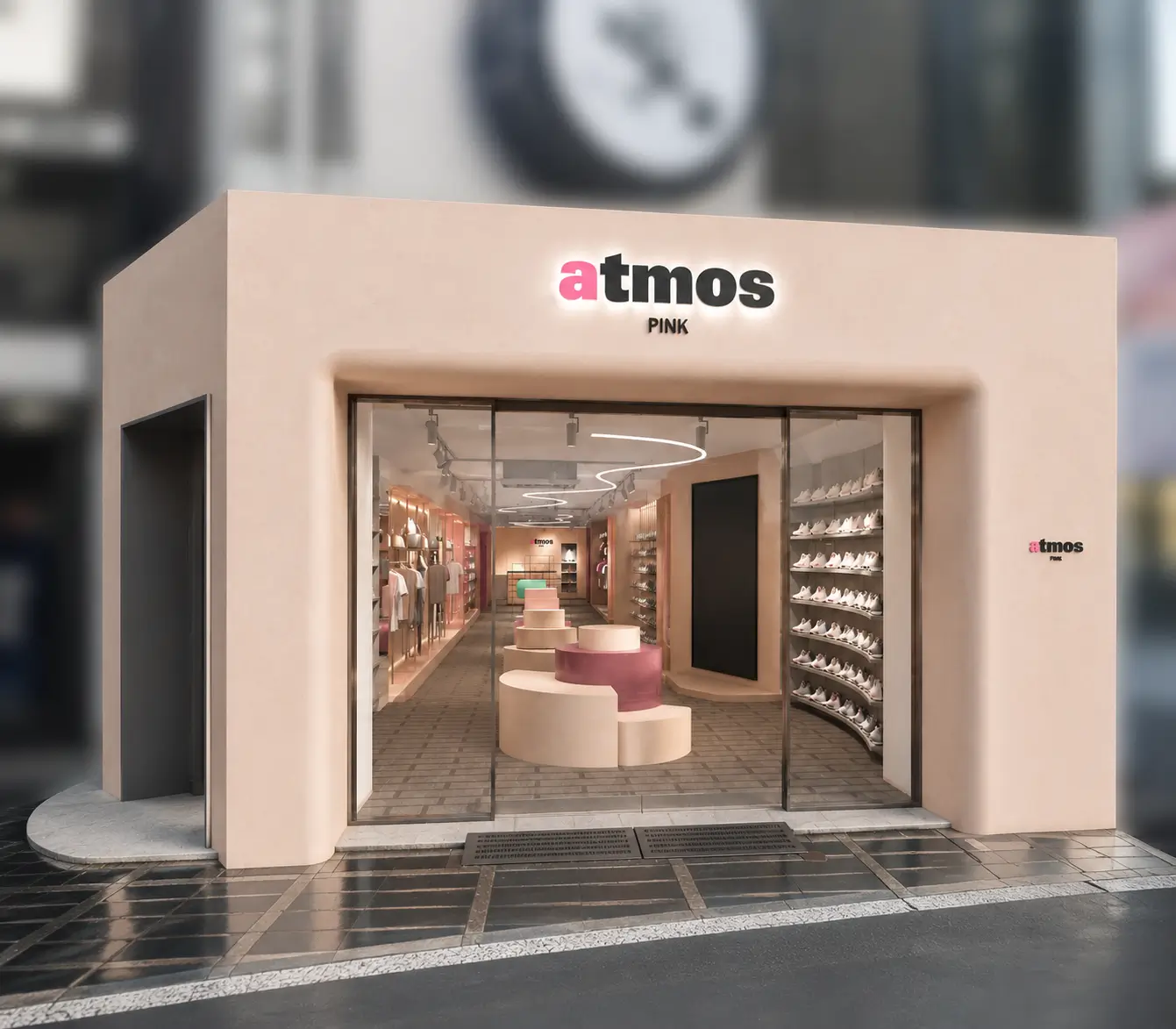
[IMAGE PLACEHOLDER: Exterior rendering of the new Atmos Pink Flagship Harajuku storefront on Meiji-dori — suggested alt text: “Exterior of the reopened Atmos Pink Flagship Harajuku store”]
The new address is 6-5-6 Jingumae, Shibuya-ku — a few doors from the old 6-5-3 spot that housed the shop inside the Iberia Building. It is a small jump on a map but a meaningful one in Harajuku, where storefronts along Meiji-dori turn over constantly and a few meters of frontage can mean a completely different flow of foot traffic from Omotesando Station toward Jingumae. For a shop that has spent close to seven years building name recognition on this stretch, relocating rather than leaving the neighborhood altogether signals that Atmos Pink still sees Meiji-dori as its anchor, even as the format inside changes substantially.
Atmos pink operates as the women’s-focused offshoot of Atmos, the sneaker-select chain that has been one of Tokyo’s most recognizable streetwear retail names since the early 2000s. Where the main Atmos banner skews toward a broad, often male-leaning sneakerhead audience, Atmos Pink narrows its focus to women between 16 and 29 — squarely Gen Z — building a retail experience around sneakers, original apparel, and the surrounding culture of music, art, dance, and sport rather than treating footwear as a standalone category.
View this post on Instagram
flow
The new store is being framed internally as a “Pink Hub” — less a straightforward shop relocation than a repositioning of what the Harajuku flagship is supposed to do. The brand describes the space as a base where sneaker culture and fashion are meant to visibly intersect, rather than two separate aisles under one roof. In practice, that likely means the kind of cross-merchandising Atmos Pink has leaned into for years — pairing a sneaker wall with apparel, accessories, and lifestyle product designed to be worn together rather than browsed separately — but pushed further into the store’s actual layout and identity.
It’s a logical next step for a brand that has spent the past several years trying to differentiate itself from straightforward sneaker retail. Since its February 2018 launch, Atmos Pink has consistently positioned itself less as “Atmos, but for women” and more as a standalone lifestyle brand that happens to sell sneakers — running in-store dance workshops, partnering with stylists, and treating its physical locations as content and community spaces as much as points of sale. The Pink Hub concept reads as a continuation of that thinking: an attempt to make the Harajuku flagship function as a cultural anchor first, with retail as the mechanism that funds it.
That ambition also tracks with where Atmos Pink’s customer actually shops. A Gen Z audience raised on resale apps, group chats, and short-form video doesn’t necessarily need a physical store to find a specific sneaker — but it does respond to spaces worth visiting, photographing, and returning to. A flagship rebuilt around “hub” language, in a neighborhood as saturated with flagship stores as Harajuku, is as much a bet on dwell time and repeat visits as it is on any single product drop.
It’s also worth reading the timing against the broader Harajuku retail landscape, where Meiji-dori in particular has seen heavy turnover over the past several years as fast-fashion chains, sneaker brands, and standalone flagships have rotated in and out of storefronts near the Jingumae crossing. In a stretch of street where a shop’s relevance can be measured in how often it gives people a reason to stop rather than just walk past, repositioning around a “hub” identity functions as a defensive move as much as an offensive one — a way of staying differentiated from the dozen other sneaker-adjacent storefronts within a five-minute walk, several of which have themselves been rebuilt or rebranded in just the past two years.
in
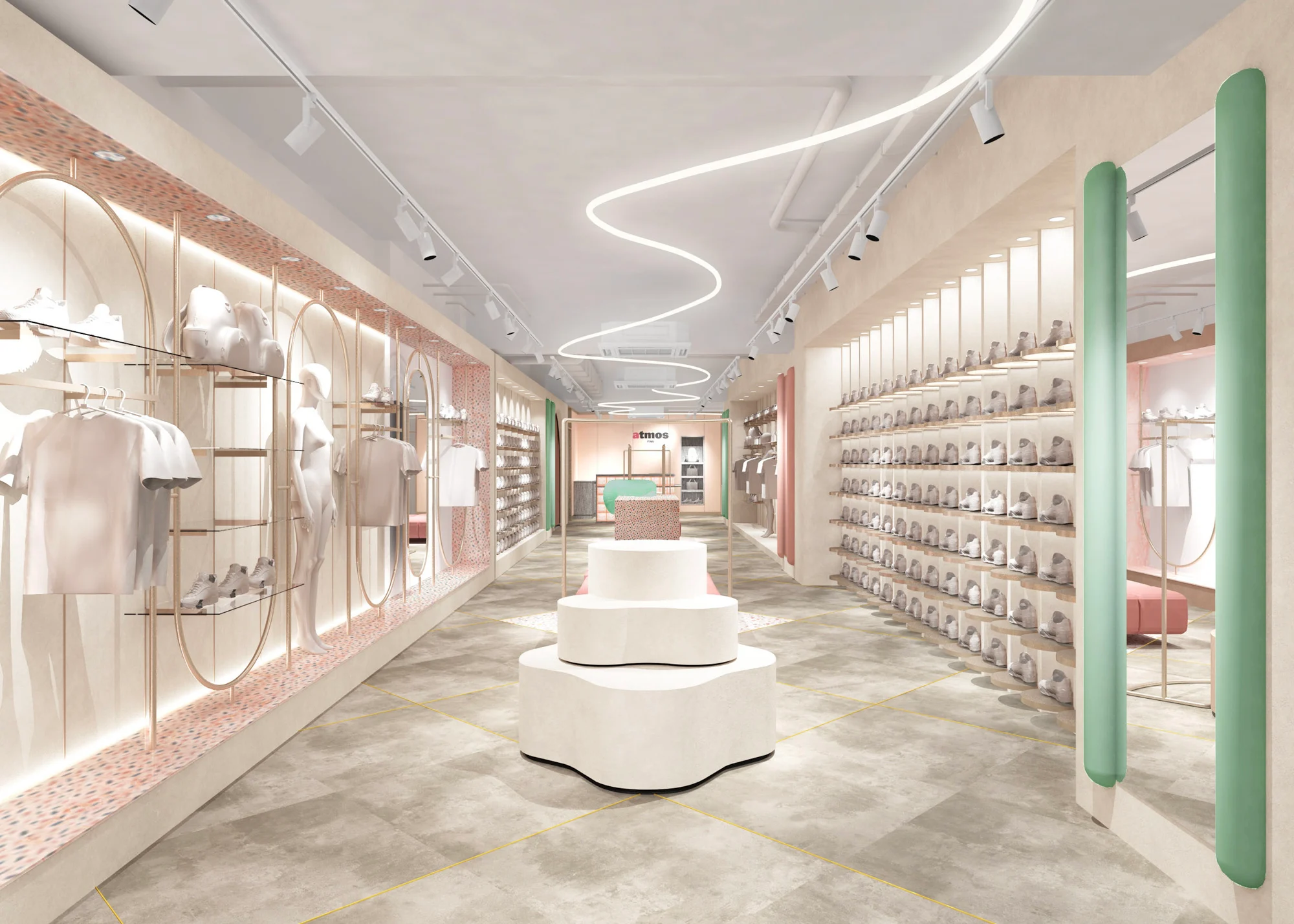
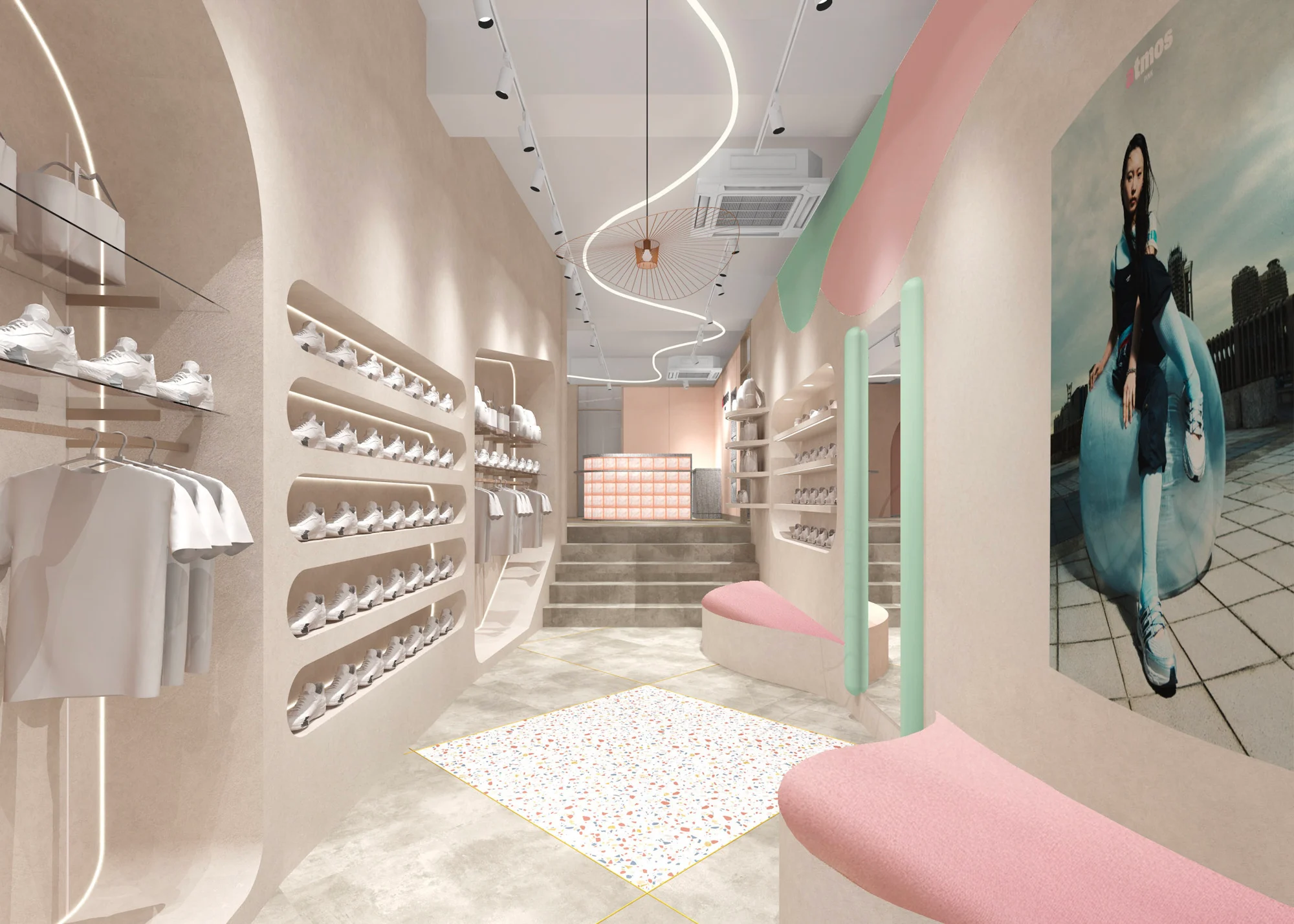
Where the outgoing flagship leaned into the angular, signage-heavy look common to large-format sneaker retail, the new store takes a deliberately softer approach. Atmos Pink describes the interior as built around the idea of a “community lounge for women,” translated into a design language of curves rather than straight lines, with fixtures and materials chosen specifically to read as soft and approachable rather than hard-edged.
It’s a shift that puts Atmos Pink in step with a broader move among sneaker and streetwear retailers away from the warehouse-adjacent, industrial aesthetic that defined the category through the 2010s, toward something closer to a hospitality space — soft seating, rounded display units, lighting designed for lingering rather than just product visibility. For a brand whose customer base skews younger and increasingly treats shopping as a social activity, a lounge-coded interior does double duty: it’s a backdrop suited to being filmed and shared, and it lowers the temperature of a category — sneakers — that can otherwise feel competitive or intimidating to newer shoppers.
This isn’t the first time Atmos Pink has rebuilt a Harajuku interior around a specific lifestyle concept rather than a straightforward retail layout. The same flagship was overhauled once before, in February 2022, when the brand added what it billed as the first dance studio inside a Japanese select shop — a free practice space for dancers built alongside matching studios at its Shibuya and Shinsaibashi (Osaka) locations. The new “community lounge” framing reads less like a reversal of that thinking and more like its logical extension: where the 2022 renovation built one specific activity-based space into the shop, the 2026 rebuild applies that same lounge-first logic to the entire footprint.
first
The single most distinctive addition to the new flagship is a dedicated sales corner the brand is calling the “Socks Bar” — its first standalone sock-focused retail space. The stated intent is straightforward: let customers style their entire foot, not just the shoe sitting on top of it, treating socks as a category worth its own real estate rather than an impulse buy stacked near the register.
It’s a small addition on paper that says something larger about where sneaker culture has drifted. Socks have spent the last several years quietly graduating from afterthought to statement piece inside sneaker styling — crew socks worn deliberately visible above low-top silhouettes, branded ribbing treated as a coordinating element with a sneaker’s colorway, and a steady stream of collaborative and graphic sock releases timed alongside marquee footwear drops rather than bundled as throwaway extras. A women’s-focused retailer building an entire bar-style display around the category is a reasonably clear signal that Atmos Pink’s merchandising team sees real revenue and real styling intent in a product that, for most of retail history, got folded into bins by the checkout counter.
There’s also a practical retail logic at play. Socks are low-cost, high-margin, easy to display in volume, and — unlike sneakers — don’t require the same depth of sizing inventory to feel fully stocked. A dedicated sock corner is the kind of addition that can make a sales floor feel busier and more colorful without the capital outlay of expanding footwear SKUs, while giving customers a lower-friction way to walk out with something even if the sneaker wall doesn’t have their size or grail in stock that day. For a flagship explicitly built around encouraging repeat visits rather than one-off purchases, a frequently refreshed, low-price-point category like socks is a sensible anchor — it gives shoppers a reason to swing back through even between sneaker releases.
move
Atmos Pink’s relationship with this stretch of Meiji-dori goes back to September 2019, when the brand opened its first large-format flagship on the site of WEGO’s former Harajuku honten, just off the Jingumae crossing. At roughly 290 square meters, it was the largest store the young brand — then barely two years removed from its February 2018 launch as Atmos’s women’s-focused concept shop — had attempted, built around a sweeping, wave-shaped sneaker wall holding several hundred pairs alongside an apparel mix that, notably, expanded beyond pure sportswear into labels like Levi’s and Carhartt.
That flagship became something of a proving ground for the brand over the following years. In February 2022, it underwent its first major renovation, reopening with a built-in dance studio — described at the time as a first among Japanese select shops — offering free practice space to dancers and tying the Harajuku location together with sister stores in Shibuya and Shinsaibashi that received matching studios. The renovation reframed the shop around three zones: a shopping area, a community space built for content and photo opportunities, and the studio itself, all unified under a graffiti-inspired design concept meant to evoke the brand’s three pillars of dance, music, and art.
The brand operates under Text Trading Company, the operator behind the broader Atmos retail network, and has since expanded its women’s-focused footprint beyond Harajuku into Shibuya, Shinsaibashi in Osaka, Fukuoka, and a separate Takeshita-dori location — making the Harajuku flagship one node in a wider chain rather than a standalone outpost, even as it has typically been treated as the brand’s most experimental and highest-profile location. That network-level context matters for how a single-store relocation should be read: a change at the Harajuku flagship rarely stays contained to Harajuku for long, given how often the brand has used this specific address to trial concepts — the dance studio chief among them — before extending them to its other cities.
The upcoming move continues that pattern. Rather than treating the 2019 flagship as a fixed, finished format, Atmos Pink has periodically used the Harajuku store as a place to test new ideas about what a women’s sneaker retail space should feel like — first by adding a dance studio in 2022, and now by relocating entirely into a smaller, softer-edged format built around the Pink Hub concept and the new Socks Bar.
open
The relocated Atmos Pink Flagship Harajuku opens July 4 at 6-5-6 Jingumae, Shibuya-ku, on the ground floor of the Sampo Sogo Building, with regular hours of 11:00 a.m. to 8:00 p.m. To mark the reopening, customers spending ¥15,000 or more before tax will receive a free novelty gift — a choice between an original-design folding fan or a phone accessory — while supplies last.
For Harajuku regulars, the move is close enough that it barely disrupts the usual route past the Jingumae crossing; for Atmos Pink, it’s a chance to reset what its flagship is supposed to represent without losing the foot traffic and brand recognition built up on this stretch of Meiji-dori since 2019. Between the Pink Hub framing, the lounge-coded interior, and a sock category finally getting real estate of its own, the new store reads as a brand quietly rewriting its own playbook rather than simply changing addresses.
Related Articles

Inside the Ferrari Line Where V12s, Hybrids and the Electric Luce Share One Workforce
In Maranello, the electric Luce, a hybrid V8 and a twelve-cylinder Purosangue now share one assembly line and one workforce.