DRIFT AUDIO
Listen to this story
Choose a voice, then press play.
The recurring bag collide reproduces GREGORY’s rarest early-’90s tagging era in a faded red-and-purple two-tone, arriving July 17
In This Story
- A 50th-Anniversary Throwback
- The Purple Tag Era, Explained
- Design Details: A Two-Tone Fade Built to Look Decades Old
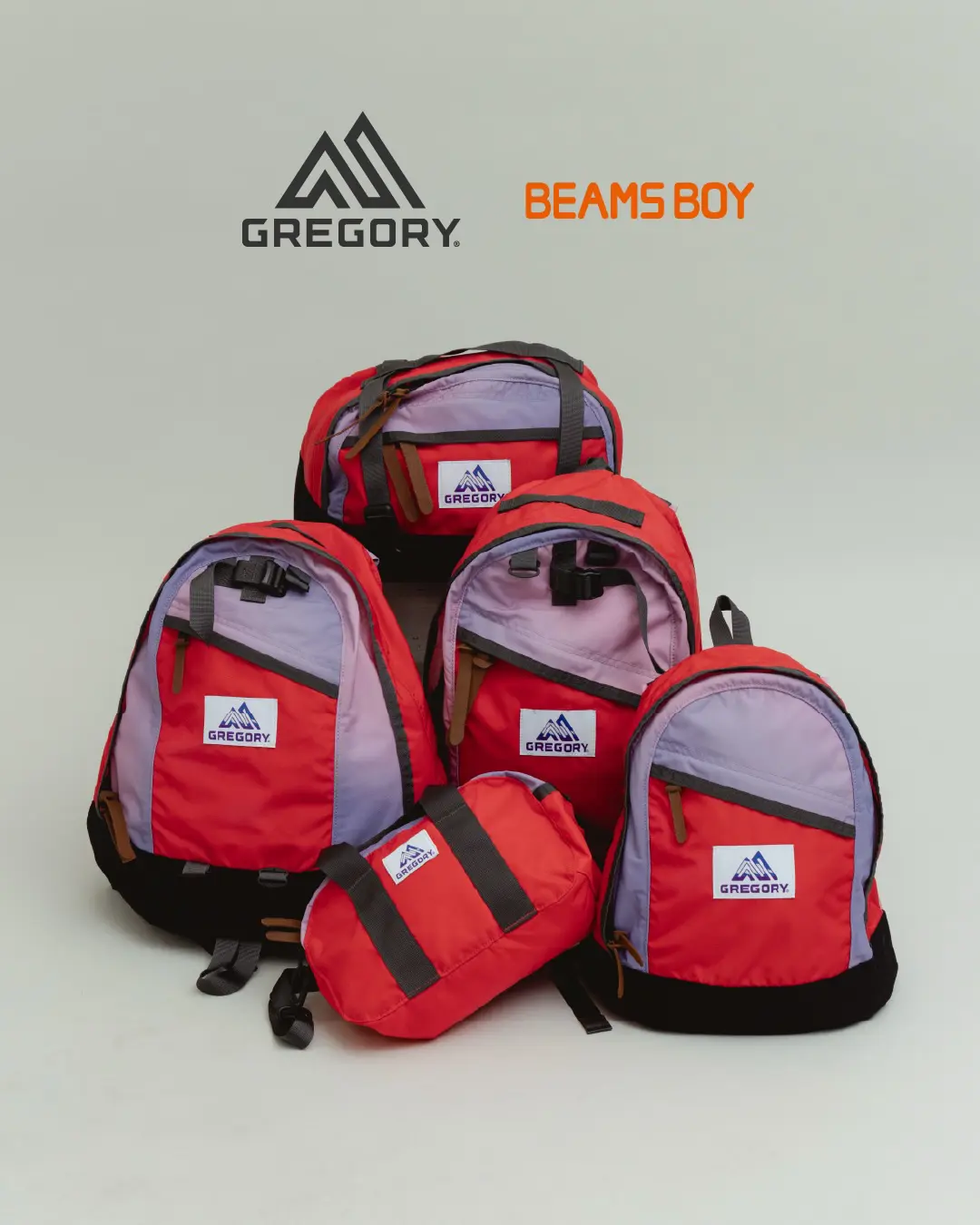
- The Five-Piece Lineup
- Release Details and Where to Buy
- Launch Event at BEAMS BOY Harajuku
- A Collision That Keeps Coming Back
- Where This Fits Into BEAMS’ 50th-Anniversary Year
- Styling Notes
BEAMS BOY is returning to one of its longest-running collisions for a milestone year. To mark BEAMS’ 50th anniversary, the label’s ongoing bag project with GREGORY is reviving the so-called “purple tag” era — a three-year stretch of GREGORY production so short-lived that it has become one of the most chased footnotes in the brand’s archive. The new “Vintage Collection” release lands July 17, 2026, at BEAMS BOY label stockists nationwide (excluding a handful of stores) and through the BEAMS official online store.
GREGORY was founded in 1977 in San Diego, California, by designer Wayne Gregory, and has spent the decades since building a catalog that spans technical mountaineering packs and the more casual, city-oriented bags that made it a fixture in Japanese streetwear and vintage circles. That crossover between outdoor-gear pedigree and day utility is a large part of why GREGORY’s older bags — and the specific tags stitched into them — have become collectible in Japan in a way that doesn’t always track with how the brand is perceived elsewhere.
Where past seasons of this collide have reproduced GREGORY’s “blue tag” and “brown tag” periods — including a green-toned blue-tag revival last July and a checked reissue the summer before that — this drop goes further back into the archive, and further into obscurity, by resurrecting a tag color that GREGORY used for a comparatively brief window before moving on.
View this post on Instagram
exposit
GREGORY’s internal tag colors function as informal dating markers for collectors, the way runners of Air Jordans are dated by box labels or Nike Air soles are dated by tongue tags. The “purple tag” designation refers specifically to bags produced between 1990 and 1993 — a three-year run, according to BEAMS BOY, that makes purple-tag pieces scarcer on the resale and vintage market than the blue-tag bags that followed and that BEAMS BOY has repeatedly revisited in prior seasons.
This kind of tag-based dating has become its own subculture within Japan’s vintage and Americana-adjacent fashion scene, where collectors track era-specific production details — fabric weights, printed logos, stitching patterns, tag colors — the same way shoe collectors track box codes or shoe tongue tags. GREGORY bags in particular have accumulated a loyal following among Japanese buyers who prize the brand’s late-1980s and 1990s output for construction quality and a look that reads as authentically American workwear rather than costume-y reproduction. BEAMS BOY’s Vintage Collection has effectively built a business model around that niche, translating archival tag eras into new product on a rotating basis.
That scarcity is part of the appeal for a collide that has built its identity on translating hard-to-find vintage GREGORY into new, purchasable product — letting shoppers buy into an archival look without hunting resale listings or dealing with the wear of an actual 30-plus-year-old bag.
flow
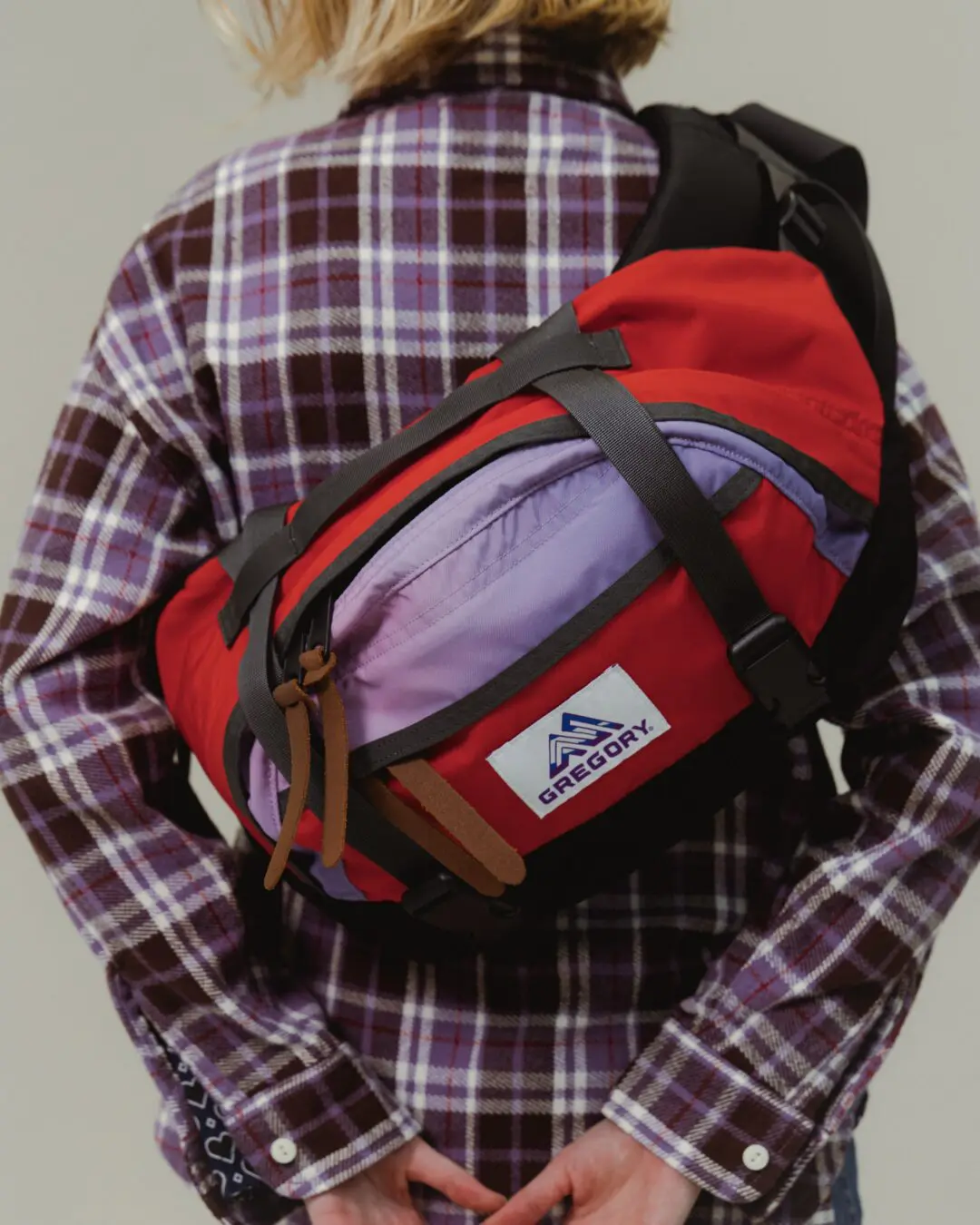
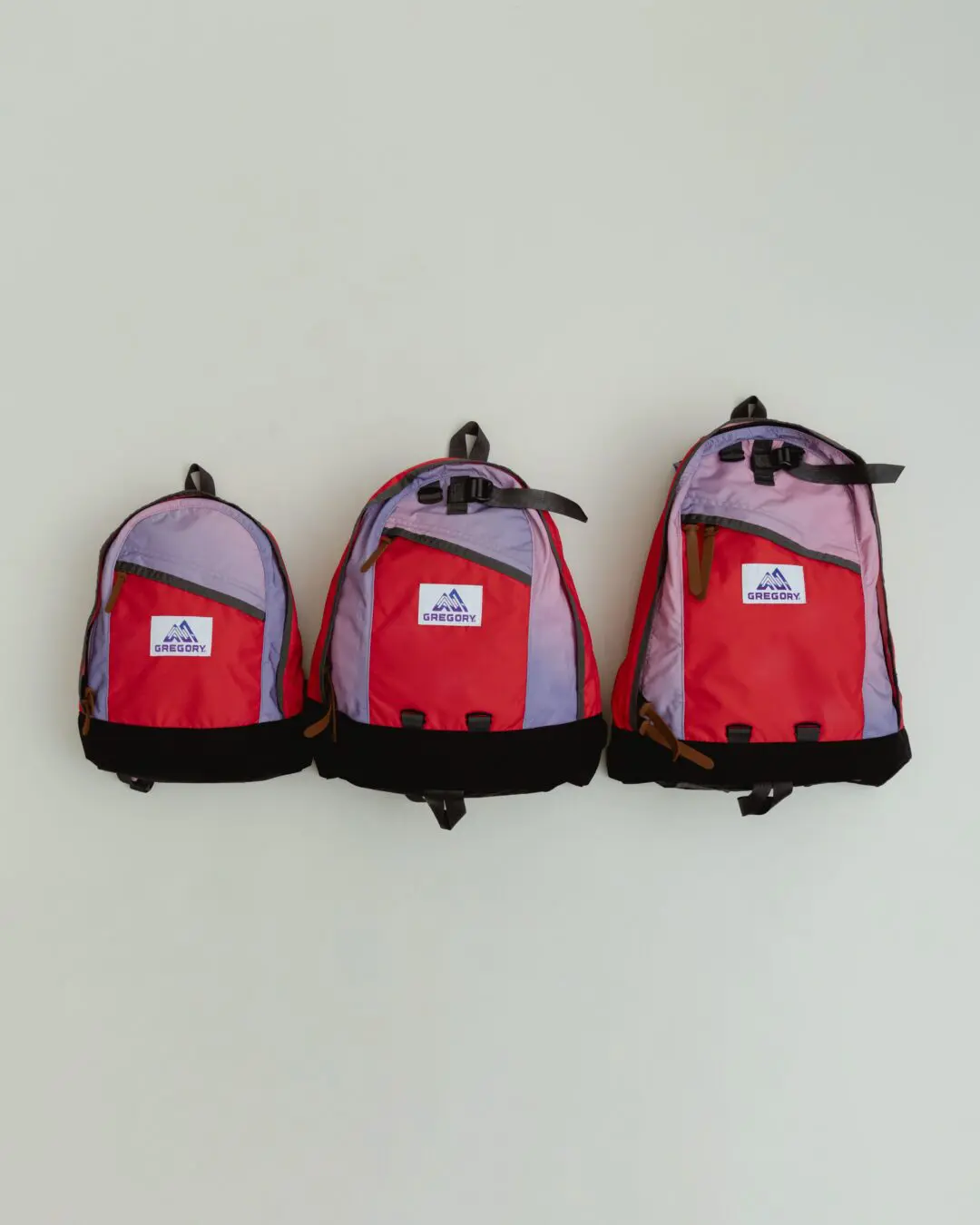
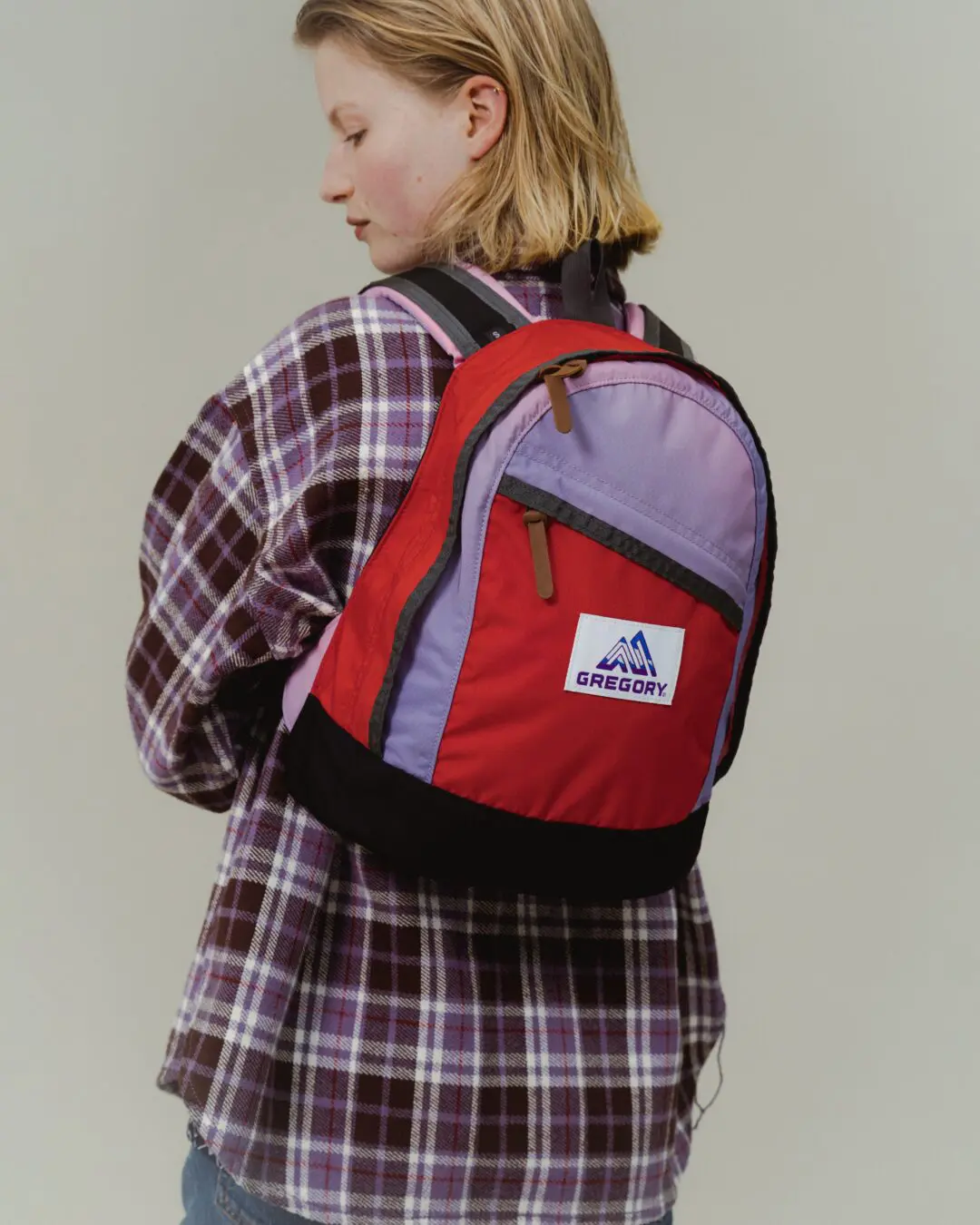
The new collection’s signature is a red-and-purple two-tone colorway, developed with specific attention to how GREGORY’s period-correct dyes aged differently depending on the color. Rather than applying a uniform vintage wash, BEAMS BOY engineered the fade to vary by panel, mimicking the uneven, sun-bleached patina that real purple-tag bags have picked up over three decades of use. The shoulder straps carry the effect furthest, finished in a deliberate gradient that strips color out toward the ends — a detail meant to read as accumulated handling rather than a printed pattern.
The approach continues a technique BEAMS BOY has refined across earlier entries in the Vintage Collection line, where fading and unevenness have been rendered through print rather than genuine material aging, allowing the label to reproduce a decades-old look on brand-new nylon construction. Earlier seasons of the collection have applied the same logic to different color stories — a blue-toned release from prior years, for instance, was designed to simulate the way blue nylon on original GREGORY bags gradually shifted toward pink and purple hues with sun exposure, a transformation BEAMS BOY reproduced through gradient printing rather than actual UV aging. The purple-tag release extends that same print-based aging technique to a red-and-purple base, with the fade intensity and placement calibrated to each panel rather than applied uniformly across the bag.
Beyond the colorway itself, the collide has generally kept true to GREGORY’s original hardware and construction on each reissued silhouette, preserving branded zipper pulls, GREGORY’s signature drawcord-and-toggle closures on applicable models, and the brand’s characteristic boxy panel construction, rather than reworking the shapes themselves. The changes are concentrated almost entirely in surface treatment and colorway, which keeps each release legible as a specific GREGORY model even as the finish changes season to season.
View this post on Instagram
five
The July 17 release spans five styles, including two models that are new additions to the Vintage Collection rather than reissues of existing GREGORY shapes:
Rough House (¥17,600) — A new addition to the collide, built from a silhouette originally offered in women’s and kids’ sizing that GREGORY produced from the late 1990s into the 2000s. BEAMS BOY has scaled and reworked the shape specifically for this release, making it the collection’s most compact full-bag option alongside the Pony Bag.
Rumpus Room (¥19,800) — The second new model in the lineup, carrying a 14.7-liter capacity that positions it as a mid-size daily option, sitting between the smaller Nice Day and the larger Day Pack in overall carrying volume.
Nice Day (¥19,250) — The BEAMS BOY–exclusive silhouette that has anchored past seasons of this collaboration, returning here in the purple-tag treatment. As a bag developed specifically for the BEAMS BOY collaboration rather than pulled directly from GREGORY’s existing catalog, the Nice Day has historically been one of the collection’s fastest-selling styles.
Day Pack (¥31,900) — GREGORY’s signature backpack shape and the collection’s largest and most expensive offering, rendered here in the same two-tone fade. The Day Pack has served as something of a flagship for the broader GREGORY x BEAMS BOY partnership across multiple past seasons, typically anchoring each collection’s lineup.
Pony Bag (¥10,450) — The smallest and least expensive piece in the lineup, a crossbody-style bag that has been a recurring, frequently sold-out entry across nearly every past season of this collision.
All five carry the fade-gradient shoulder strap treatment and the red-and-purple colorway drawn from the original 1990–1993 tag era, giving the collection a consistent visual identity across sizes and use cases despite the range in capacity and price point.
rel
The collection arrives July 17, 2026, at BEAMS BOY label stockists across Japan, with the exception of select stores, alongside the BEAMS official online store. As with prior Vintage Collection drops, individual pieces — particularly the Nice Day and Pony Bag — have historically sold out quickly given the collaboration’s standing popularity, and BEAMS BOY has not indicated whether this release will include a restock window.
flow
BEAMS BOY is marking the release with a dedicated event at its Harajuku location, running July 17 through 19. Customers who purchase from the collection during the event window gain access to a limited slate of extras: a workshop for customizing an original leather zipper pull, a claw-machine game, and GREGORY-branded novelties, all offered in limited quantities. Details on exact stock levels or how the workshop and claw-machine activations will be run were not specified in the initial announcement.
linger
The GREGORY x BEAMS BOY partnership has run for years at this point, cycling between reproductions of GREGORY’s tag-era archive and more conceptual takes on the brand’s catalog. Recent installments have included a checked reissue of the blue-tag years, a green-toned blue-tag revival, and — going back further — a project that imagined what a GREGORY bag might look like had BEAMS BOY supplied gear to the U.S. military, stripped of branding and finished in solid sage green. The throughline across nearly all of these releases has been GREGORY’s internal tag-color history, which BEAMS BOY has treated less as a footnote and more as a recurring design brief.
That consistency has made the collaboration one of the more reliable recurring drops on the BEAMS BOY calendar, typically arriving in the summer and drawing on a specific slice of GREGORY’s decades-long catalog each time. The choice to spotlight the purple-tag years for this installment — the shortest and least-revisited of the tag periods BEAMS BOY has worked with so far — suggests the label is now moving deeper into GREGORY’s less obvious archive rather than repeating its most familiar reference points.
position
BEAMS has built out an extensive slate of anniversary collisions and special releases throughout 2026 to mark its 50th year, spanning collaborations across its various labels and a dedicated anniversary campaign running under the #BEAMS50th banner. The company traces its roots to a roughly 21-square-meter shop that opened in Harajuku in 1976, and this year’s anniversary programming has leaned heavily on that origin story, pairing new collaborations with archival references across BEAMS’ full roster of labels — BEAMS BOY, BEAMS JAPAN, and the core BEAMS line among them. Recent anniversary-tied releases have included a joint collection between BEAMS JAPAN and the disposable-camera brand Utsurun Desu, timed to that product’s own 40th anniversary, illustrating the kind of dual-milestone framing BEAMS has used repeatedly across its 2026 calendar.
style
The red-and-purple fade gives this release a warmer, more saturated read than the green-toned blue-tag reissue that preceded it last summer, positioning it closer to a statement accessory than a neutral daily bag. The gradient-faded shoulder straps in particular read as the most deliberately “worn-in” detail across the lineup, and are likely to be the feature that most clearly signals the bag’s purple-tag reference to anyone familiar with GREGORY’s archive. For shoppers newer to the brand’s tag-dating history, the appeal is more straightforward: a faded, sun-bleached look achieved without the wear, sourcing difficulty, or price premium that comes with hunting down an actual 1990s GREGORY bag on the resale market.
As with previous entries in the Vintage Collection, the five-piece spread covers a range of use cases — from the compact Pony Bag through the full-size Day Pack backpack — meaning the purple-tag treatment is available across sizes rather than confined to a single flagship model. Given how quickly past seasons of this collaboration have moved, particularly the Nice Day and Pony Bag styles, shoppers interested in specific pieces may want to track BEAMS’ online store directly ahead of the July 17 date.
For a collide now several seasons deep, the purple-tag release also functions as a small test of how far into GREGORY’s archive BEAMS BOY is willing to go. The blue-tag and brown-tag eras it has drawn on previously cover longer production windows and, by extension, a larger surviving pool of original bags for collectors to reference and compare against. A three-year tag era leaves comparatively little to work from, which puts more weight on BEAMS BOY’s own research and print development to get the fade, color balance, and hardware details right. Whether that translates into another strong seller in the mold of past Nice Day and Pony Bag releases, or a slower-moving entry aimed more narrowly at collectors already fluent in GREGORY’s tag history, should become clear once the July 17 release meets the sales floor.
From the DRIFT archive: Y-3 Sets the Tone for Its Spring/Summer 2026 Collection
Related Articles

WACKO MARIA Brings Its Leopard Lining to the Big Leagues
Black nylon outside, leopard fur inside: WACKO MARIA’s first Major League Baseball collection reached Japan […]