DRIFT AUDIO
Listen to this story
Choose a voice, then press play.
A restored São Paulo football court and Colm Dillane’s own history with the game sit behind Havaianas’ strangest collide in years.
Havaianas doesn’t usual share shelf space with a brand known for claymation runway shows and hand painted patchwork suits, but that is exact the pair behind the Brazilian sandal maker’s new four piece collection with KidSuper. The capsule centers on the Havaianas Top KidSuper Turf Pitch, a full green velvet reworking of the brand’s classic Top six, built to look and feel like a freshly cut football pitch underfoot. Havaianas, founded in Brazil in 1962 and known for selling more than 250 million pairs of its rubber flip-flop every year across over 100 countries, handed its most recognizable shape to Colm Dillane, the Brooklyn designer behind KidSuper, and let him rework it in material rather than just print.
The brand’s own account of its history helps explain why handing its signature shape to an outside convincer is notable at all. Havaianas traces its name to the Portuguese word for “Hawaiians,” a nod to the tropical, endless summer feeling the brand has cultivated since the sandal launched in 1962, inspired by tradition Japanese zori sandals. The now-sig rainbow of colors was not the original plan either: by the brand’s own account, an early production error produced a batch of green sandals that sold well enough that Havaianas built its colorful Top style around the accident. By 1998, football was already part of the product line directly, when Havaianas released a Brazilian flag branded flip-flop to mark that year’s World Cup, a design that remains one of its best sellers decades later. Havaianas’ own marketing also points to a different kind of credibility: the brand notes that its flip-flop has found its way into the design store at New York’s Museum of Modern Art, alongside the beach stalls and airport kiosks where most people actually encounter it.

A portrait of a surprised woman with voluminous curly brown hair, wearing a black floral top, holding a pair of green velvet flip-flops in front of her against a plain background.
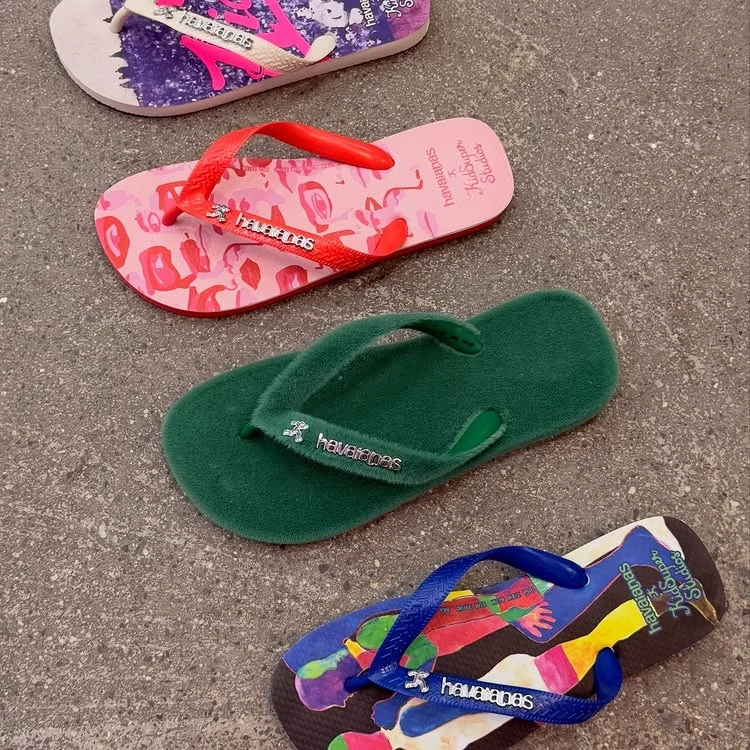
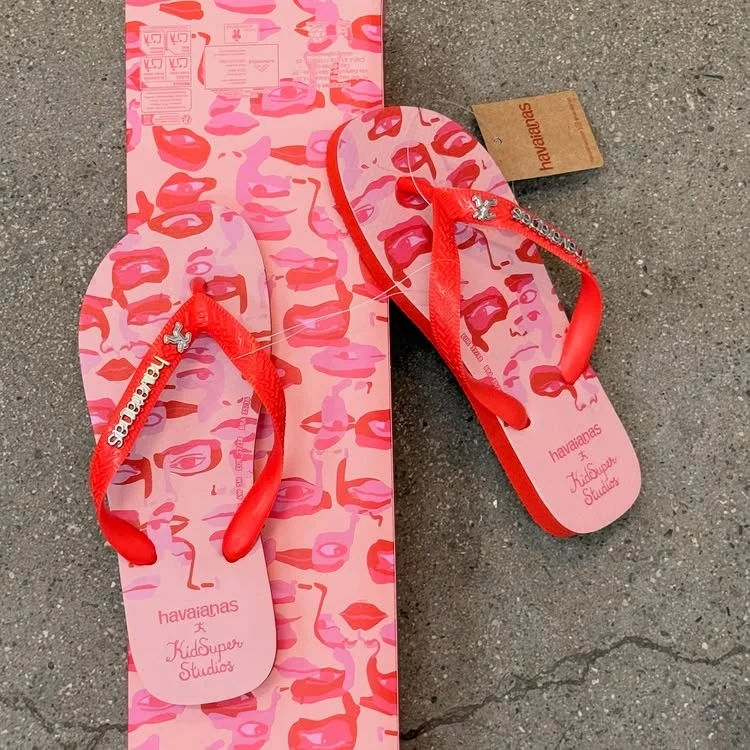
Three additional styles round out the collection, and KidSuper’s own product listings describe each one distinctly rather than treating them as interchangeable colorways. The Havaianas Top KidSuper Runner reimagines Havaianas’ own long-running “little man” logo, redrawn by Dillane in the brand’s vibrant colors and set into a print built around dynamic, running-figure movement. The Havaianas Top KidSuper Camo takes one of KidSuper’s own most recognizable graphics, its all-over camouflage print with hidden faces and eyes worked into the pattern, and renders it in an exclusive pink and red colorway made specifically for this collaboration. The Havaianas Top KidSuper Futebol keeps closest to the project’s stated theme, described on KidSuper’s site as united by the passion of “Futebol Arte,” with a neon logo detail on the sole aimed at what the brand calls people who express themselves through statement pieces.
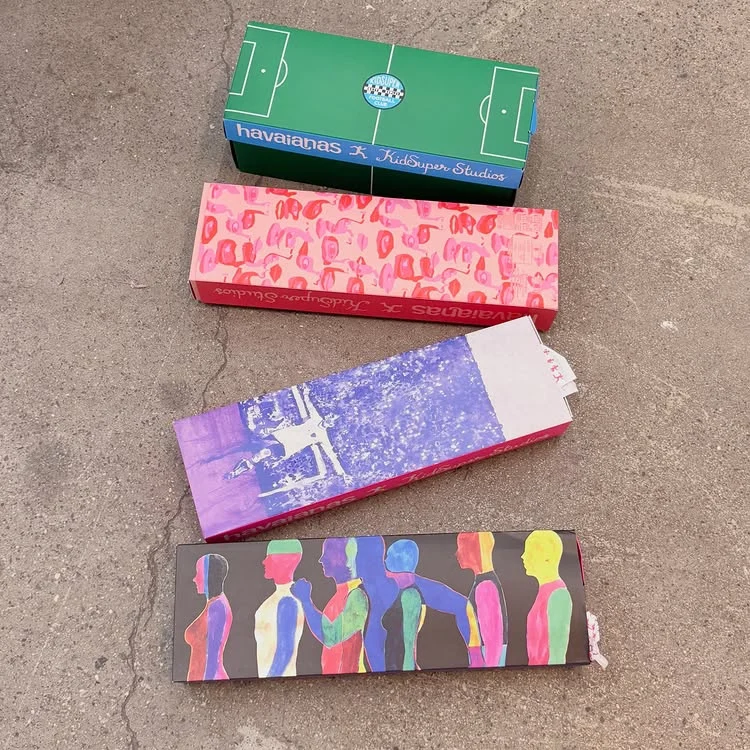
All four pairs, including the Turf Pitch, retail for $120, a sharp step up from the roughly $24 to $48 range that covers most of Havaianas’ regular flip-flop lineup, positioning this release as a collectible collaboration rather than a beach staple. That pricing puts the collection closer to the collectible sneaker market than to the beach bag impulse buy Havaianas is usually associated with, treating the four styles as objects meant to be kept in a box rather than worn until the rubber wears through. Every pair ships with a silver metallic KidSuper pin and Havaianas logo detail on the strap itself, plus a custom cardboard box, a paper hanger, a KidSuper branded gym sack carrying the artwork, and a separate customization card holding four metallic “little man” pins for personalizing the straps further.
The Turf Pitch first appeared on the runway during KidSuper’s FW26 show, where it was gifted to front row guests ahead of the wider collection’s announcement. nss magazine described the pair as finished with metallic branding from both labels and framed the reveal as part of Havaianas’ ongoing effort to push a famously cheap, ubiquitous object into genuine fashion territory. The full collection is already live on KidSuper’s own site, where the Turf Pitch had already sold out at the time of writing while the Runner, Camo and Futebol pairs remained in stock, a fair signal that the velvet runway piece is drawing the most attention so far. A dedicated Havaianas x KidSuper page on Kith carries at least the Futebol style at the same $120 price, listed with a rubber upper and outsole, unisex sizing based on men’s fit, and a limit of two pairs per customer, a restriction retailers commonly use to slow resale on a high-demand drop. A wider release through Havaianas’ own channels and additional select retailers lands the same day, September 8.
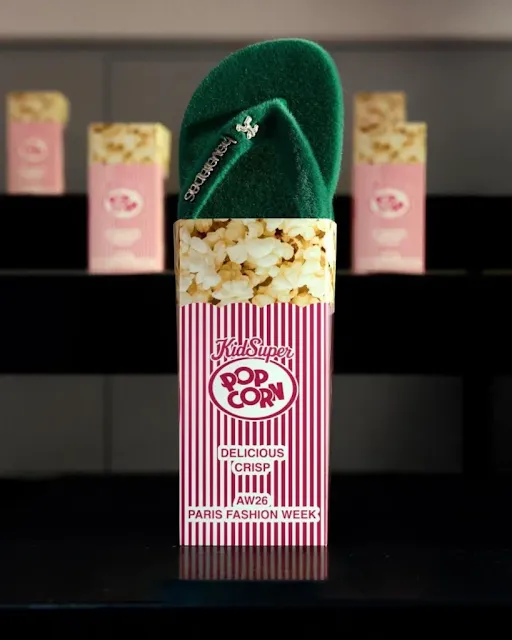
A green KidSuper velvet flip-flop displayed inside a red and white striped popcorn box, with the words “KidSuper POP CORN”, “DELICIOUS CRISP”, and “AW26 PARIS FASHION WEEK” printed on the front, set against a dark background.
hx
The football references aren’t a costume Dillane put on for one rel. Multiple outlets covering the collide, include Sneakers Cartel, describe him as a longtime football fan and former player who previously lived in Brazil and spent time around Esporte Clube Vitória, the Salvador, Bahia club nicknamed Leão da Barra. That personal history separate the project from a brand simply borrowing football’s current culture momentum for a season.
Dillane’s own path into fashion started with a school project rather than a business plan. As a teenager he built on a mechanics class assignment inspire by American cartoonist Rube Goldberg, layer a Che Guevara image over the design, then began sell the resulting Tee to classmates and passersby around SoHo. That instinct for turning a personal, slight odd reference point into a wear product follow him to New York University, where he founded KidSuper as a student in the early 2010s while still selling clothes out of his dorm room near Barclays Center.
The label’s breakout moment came at Paris Fashion Week in 2020, after Dillane had been turned down twice for a runway slot. Once KidSuper was finally accept, he stag a claymation show for the “Everything’s Fake Until It’s Real” collection, sending clay versions of figures including Salvador Dalí, Naomi Campbell, Stephen Hawking and Pelé down the runway in place of live models, a detail that in hindsight previewed how naturally football references would sit inside his work. The show drew comparisons to early Raf Simons and Elsa Schiaparelli’s surrealist sensibility, and helped set up the run of high-profile collaborations, including Puma, Bose, McDonald’s and Mercedes-Benz, along with a Louis Vuitton menswear collection Dillane guest designed in 2023, the first outside designer invited to do so since Virgil Abloh’s death, that eventually led to Havaianas.
Dillane has talked about the Havaianas collide in similar terms, describing the shared love of football that he and the brand brought into KidSuper’s world through color, art and, in his words, “a little bit of the unexpected.” KidSuper’s aesthetic generally runs toward bright, play tinctures, hand paint graphics and whimsical, slightly cartoonish characters rather than the minimalism common to most streetwear, which is part of why a straightforward logo swap onto Havaianas’ straps would have undersold what the label usually does with a collide.
KidSuper’s standing in Paris now extends beyond a single well received show, too. The Fédération de la Haute Couture et de la Mode, the body that oversees the official Paris fashion calendar, lists KidSuper among its recognized maisons, a formal marker inside an industry Dillane entered without any formal training. He is a graduate of Brooklyn Technical High School, where he first sold the Tee that eventually became KidSuper.
Football specifically keeps surfacing in KidSuper’s collaboration history well beyond this Havaianas project. The brand’s own site lists past capsules built around the Brazilian icon Ronaldinho and pieces tied to the Club World Cup, alongside collection with Puma, Bose, Mercedes-Benz and McDonald’s. That collaboration list sits inside a wider KidSuper universe that now stretches beyond clothing into a video arm, a physical creative space in Brooklyn and even a self-produced television project, evidence that Dillane treats the brand as a creative studio first and a clothing label second.
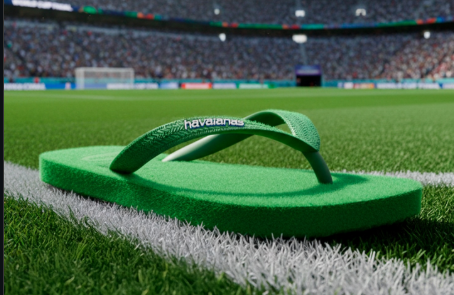
A bright green Havaianas flip-flop resting on the edge of a green football pitch with white lines, set against a blurred background of a packed stadium.
store
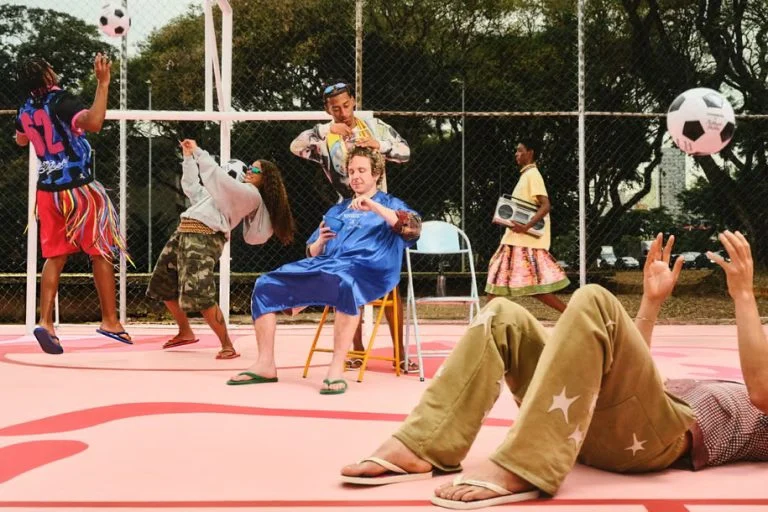
The collection’s roots go back further than this specific four piece rel. According to Retail Gazette, the rel marks a second chapter in Havaianas and KidSuper’s partner in Brazil, following an earlier project in which the two brands repaired a public football court in São Paulo. Dillane covered the restored court in his own original artwork, and that same court later became the setting for the new collection’s campaign photography.
Shooting the campaign on a public court rather than a studio set fits the wider argument several outlets made about the rel: that football in Brazil functions as a cultural and artistic language as much as a sport. Numéro Netherlands framed the project around the concept of futebol arte, a phrase used in Brazil to describe a style of play built on creativity and improvisation rather than pure athletic efficiency, and treated football less as a subject the two brands were referencing than as a culture they were celebrating together. The phrase has a specific history in Brazilian football culture beyond marketing copy, describing a flair-driven, individual expressive approach to the game that has shaped how the country presents football as a cultural export as much as a competitive one. Building the campaign around a restored public court, rather than a professional stadium or a studio backdrop, keeps that idea grounded in the kind of everyday pitch where the style actually gets played, rather than treating it as an abstract concept for a press release.
Havaianas has form with football beyond this specific partner. The brand’s collide history already includes a capsule built around Real Madrid and Brazil national team forward Vinícius Júnior, released under the Vini Jr. name, alongside partner spanning Rio based label FARM Rio, Disney and Marvel. Pairing its flip-flop with football is closer to house habit than a one-off marketing swerve, even if changing the shoe’s material rather than just its branding, as the KidSuper project does, is a newer move for the brand. That broader collide strategy treats the flip-flop as a canvas for partners ranging from individual athletes to entertainment franchises, rather than restricting the shape to beachwear, and the KidSuper project pushes that approach further than most by reworking the Turf Pitch’s material entirely instead of limiting the collaboration to a new print on the familiar sole.
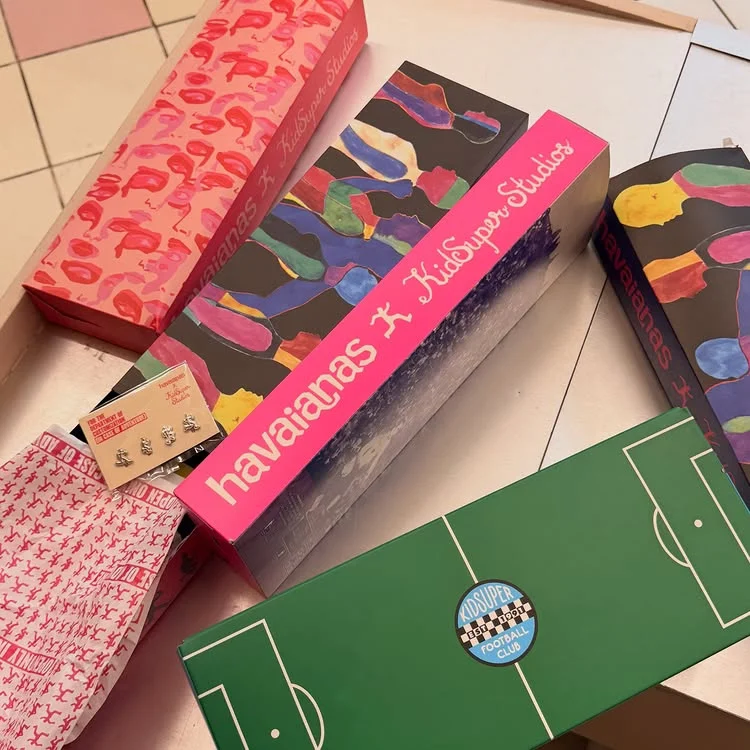
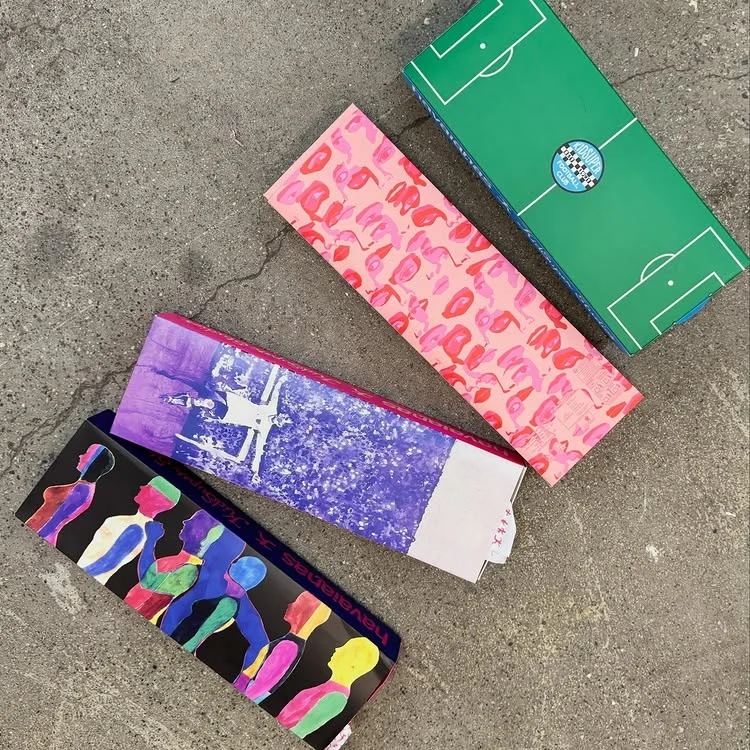
An overhead shot of several Havaianas x KidSuper Studios shoeboxes and packaging, including pink, hue abstract, and green football-themed boxes, along with a card of novelty charms, resting on a tiled floor.
look
Havaianas isn’t alone in mining a utilitarian, mass market shoe for high fashion credibility. Crocs and Birkenstock have run comparable playbooks in recent years, turning famously unglamorous silhouettes into runway and collaboration fodder precisely because their plainness makes any creative reinterpretation land as more dramatic by contrast. What separates the Havaianas x KidSuper project from most of those examples is the personal history behind it: Dillane’s own football background and his brand’s existing ties to Brazil give the collaboration a specific point of origin rather than a purely opportunistic pairing between an unglamorous silhouette and a hot streetwear name.
A restored public court also carries weight beyond the campaign photography. Courts like the one Havaianas and KidSuper repaired function as neighborhood hubs in Brazilian cities, hosting pickup games and informal training long after any brand’s cameras have left, which is part of why covering it in Dillane’s original artwork reads as a more permanent contribution than a pop-up activation would. That instinct toward public art fits a role Dillane took on closer to home earlier this year, when Brooklyn Borough President Antonio Reynoso named him the borough’s first Arts Ambassador, a position built around mentorship and public art programs for emerging Brooklyn creatives. Reynoso specifically credited Dillane’s path, starting KidSuper without formal training before it reached Paris Fashion Week, as the reason for the appointment. A restored football court on the other side of the world sits comfortably next to that same idea: public space treated as a canvas rather than a backdrop.
Havaianas has not said whether the Turf Pitch will return once the current run through its own channels and KidSuper’s site sells out.
Related Articles
Christopher Kane and Mulberry Are Betting on Each Other’s Comeback
On September 20, a designer whose own label collapsed into insolvency in 2023 will unveil […]