DRIFT AUDIO
Listen to this story
Choose a voice, then press play.
A hybrid built from two Air Jordan legends gets its first ever retro, and it is returning exactly as it left.
In This Story
- A Shoe That Never Got a Second Chance
- Built From Two Different Air Jordans
- The Blue Comes From Denver, Not Chapel Hill
- A Kid From Myrtle Avenue
- What Actually Comes Back in 2027
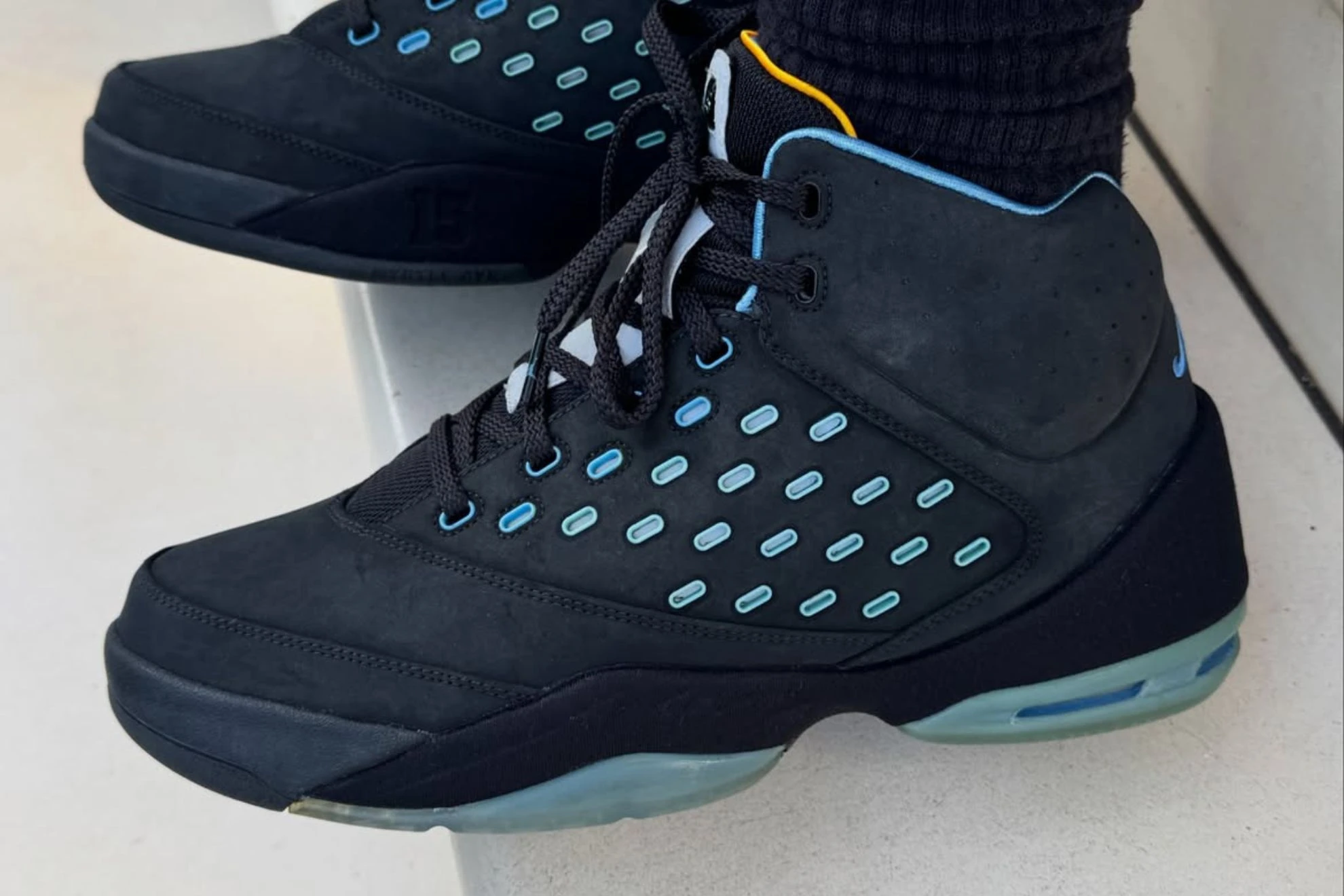
Jordan Brand has spent the last few years digging through its own archive, but the Melo 5.5 kept getting passed over. It was Carmelo Anthony’s second signature shoe, released on Black Friday in 2005, and by most accounts it is the strangest and most interesting model he ever wore. Now, more than two decades later, it is finally getting a retro treatment, and it is coming back exactly the way it launched, in black nubuck with University Blue accents, under the style code JA9035-001. This will be the first retro release the Melo 5.5 has ever received. Jordan Brand has priced it at $155, with a Summer 2027 window and distribution through Nike and select retailers.
stir
What made the Melo 5.5 stand out in the first place was that it was not trying to be its own sil. Jordan Brand’s design team pulled directly from the Air Jordan 5 and the Air Jordan 6, stitching the two together into something that read as familiar and new at once. The full grain leather upper carries an eyestay system built for lockdown fit, perforations across the forefoot for breath, and a reflective tongue that nods back to the mid 2000s Jordan play. Underneath, a view heel Air Sole unit pairs with an encapsulated forefoot unit and a fabric wrapped Phylon midsole that climbs up into the heel, while an internal shank plate adds torsional support through the midfoot. None of that is retro flourish. It is closer to a genuine show build from an era when signature shoes still had to survive an 82 game season.
View this post on Instagram
Half a decade into Jordan Brand’s existence beyond Michael Jordan himself, the Melo 5.5 also mattered for a different reason. Anthony had signed with the company in 2003, right around Jordan’s third and final retirement, and became the brand’s first signature athlete who was not named Michael Jordan. LeBron James had already gone to Nike directly, and Jordan wanted someone of his own. Anthony, freshly drafted third overall by the Denver Nuggets, got the call, reportedly on a six year deal worth somewhere around three and a half million dollars a year, a figure that made him the highest paid athlete Jordan Brand had signed up to that point.
The Melo 5.5 was not his debut shoe. That distinction belongs to the Melo 1.5, itself a hybrid built from the Air Jordan 1 and Air Jordan 2, which means the 5.5 actually continued a pattern rather than starting one. Jordan Brand kept leaning on that hybrid concept throughout Anthony’s run, and it is part of why his signature line reads so differently from LeBron’s or Chris Paul’s, both of whom got shoes designed from scratch. Thirteen signature models followed across roughly a decade and a half before the line shh wound down in 2017, but the 5.5 has stayed the one collectors bring up first, likely because it landed early enough in Anthony’s career to feel tied to a specific moment, his rookie and sophomore seasons in Denver, rather than to the journeyman stretch across four more franchises that followed.
huh
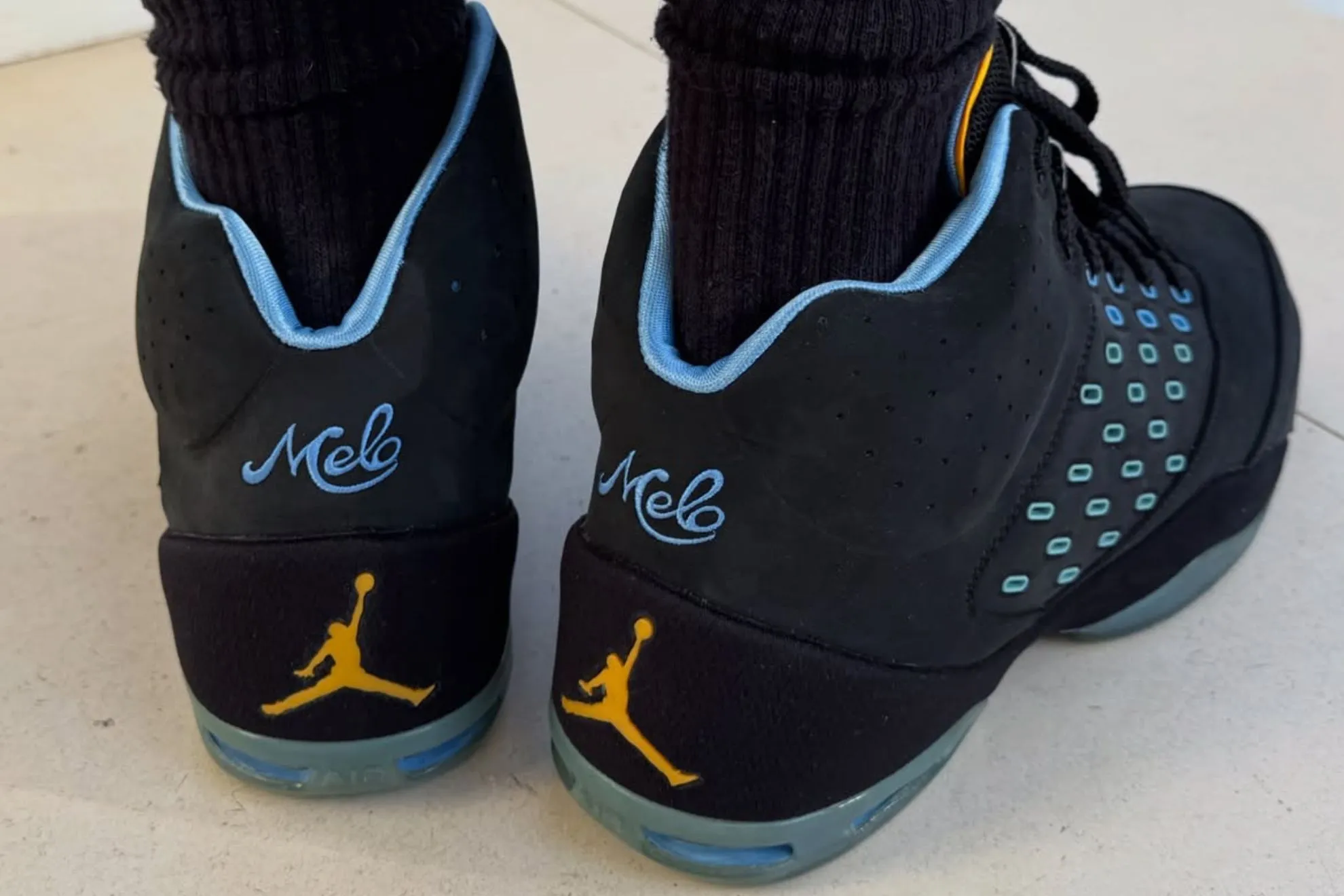
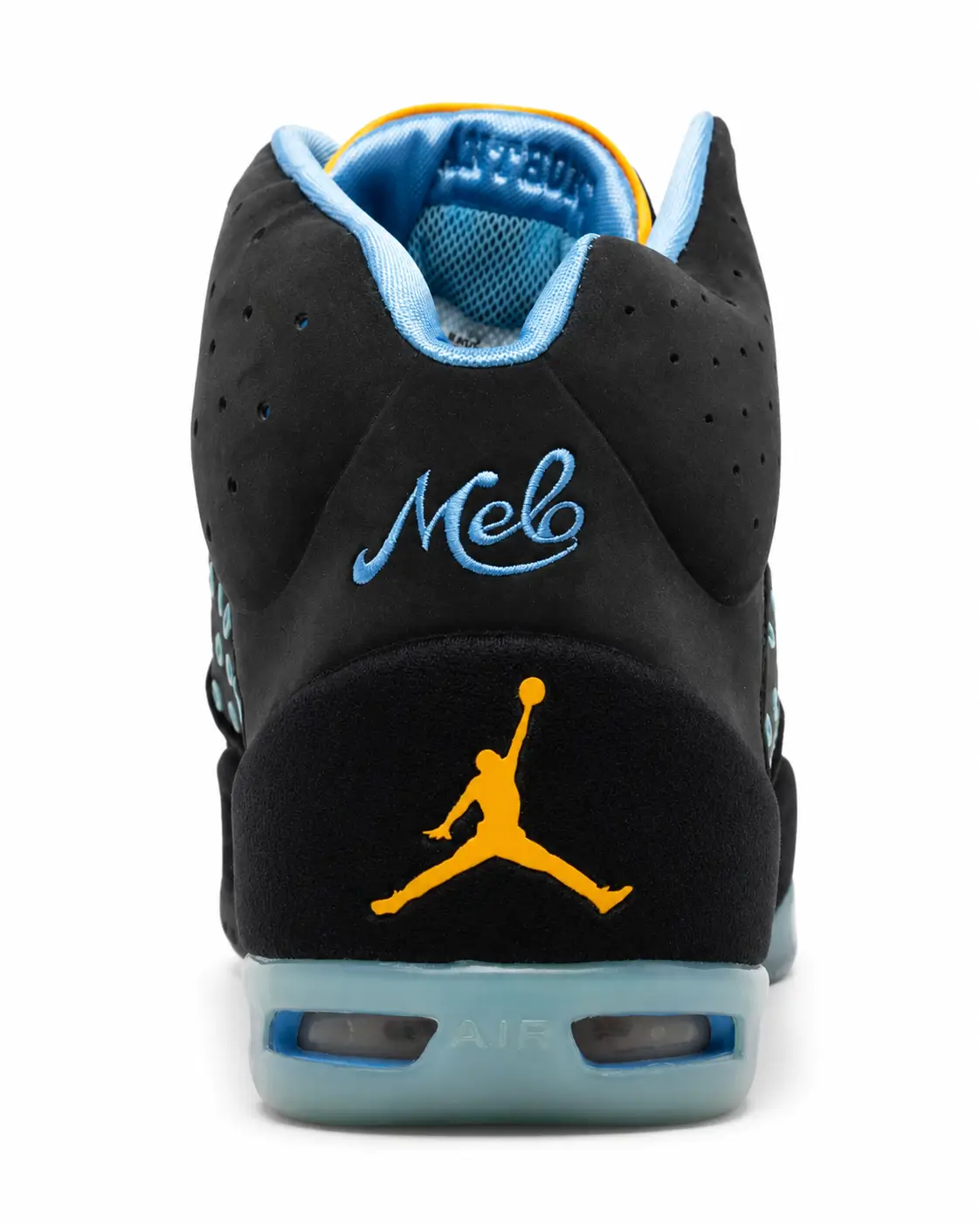
It is easy to assume any black and university blue Jordan release traces back to Michael Jordan’s University of North Carolina days, since that pairing has defined some of the most collected Nike Air Jordan 5 colorways in the line’s history. The Melo 5.5 is the exception. Here, the blue is Anthony’s, not Jordan’s, pulled straight from the Denver Nuggets’ own tincture identity during his rookie years with the franchise. University Blue runs through the outsole, the midfoot windows, the interior lining, and the Melo script logo embroidered on the heel. Taxi yellow shows up behind the tongue and across the heel Jumpman, another nod to the Nuggets’ early 2000s look, while a metallic silver hangtag opens into a small collectible booklet that laid out the shoe’s design story at retail. It is a rare case of a signature athlete’s team colors, rather than Jordan’s own history, driving the palette of a genuinely collectible release.
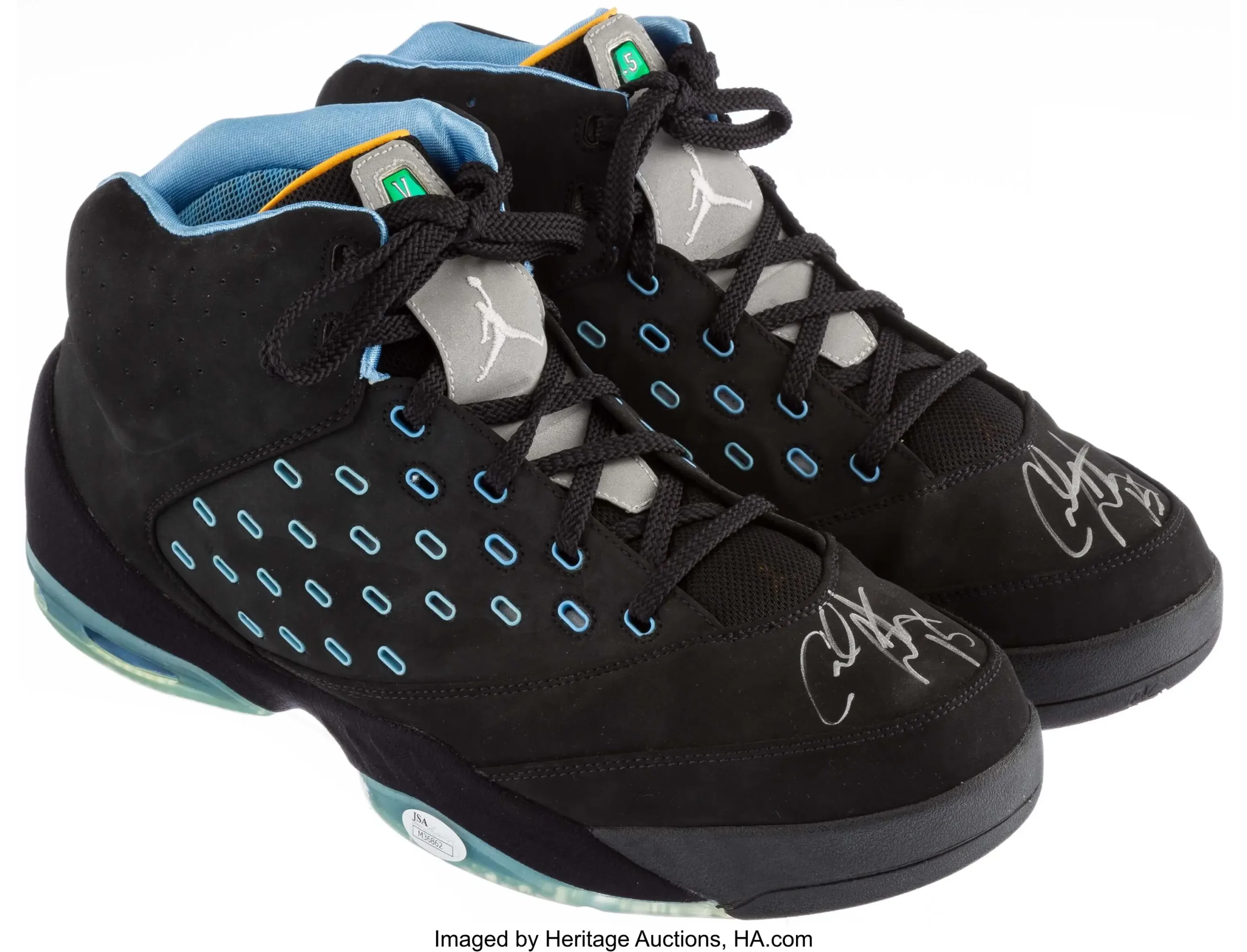
Rear view of the Jordan Melo basketball shoe highlighting signature heel branding and translucent Air cushioning.
narr
The original 2005 campaign for the shoe leaned hard into Anthony’s own biography rather than basketball spectacle. A commercial built around the launch followed him walking down Myrtle Avenue in West Baltimore, past rowhomes and a police helicopter overhead, with the shoe itself almost an afterthought in the frame. Anthony had moved to that stretch of West Baltimore at age eight, and it shaped nearly everything about how he has since talked about his career, long after leaving the Nuggets for the New York Knicks and beyond. He returned to that same neighborhood story in 2025, when Baltimore’s Enoch Pratt Free Library opened a permanent exhibit called House of Melo, tracing his path from Myrtle Avenue through the NBA and into the Basketball Hall of Fame. The Melo 5.5’s retro announcement lands into a moment where that origin story is already back in public view, which is likely no accident from a brand perspective.
hint
Jordan Brand and its retail partners, including Foot Locker, Shiekh, Hibbett, and DSG alongside Nike, have confirmed the Melo 5.5 “Black/Taxi, University Blue, Metallic Silver” for a Summer 2027 arrival at $155 a pair, matching the model’s original retail era rather than pricing it as a premium archival drop. Jordan Brand has also indicated more colorways of the model are planned for the same year, suggesting this will not be a one and done nostalgia play but the start of an actual retro run for a shoe that never got one before. For a signature line that produced thirteen models across Anthony’s run with the company before it wound down in 2017, the 5.5 has long stood out among collectors precisely because it almost never resurfaced, unlike the mainline Air Jordan 5 and 6, both of which have cycled through dozens of colorways over the same period.
That scarcity is part of why the announcement has generated more conversation than a typical archival re-release might. Jordan Brand has spent much of 2026 focused elsewhere, on soccer product, current era show basketball, and a steady run of mainline Air Jordan retros, so a signature athlete model returning at all is notable on its own terms. Whether the wider sneaker market responds to a hybrid built from two other shoes’ DNA the way it has to more overt Air Jordan 5 or 6 retros is the open question heading into next summer. But the timing, arriving between Anthony’s Basketball Hall of Fame induction, a hometown museum exhibit built around his own biography, and his continued view through his podcast and his son Kiyan’s own rise in the sport, gives Jordan Brand about as clean a culture moment as it will get to bring the 5.5 back.
From the DRIFT archive: The Jordan MVP 92 ‘Black Infrared’: A Hybrid Built On Legacy, Engineer
Related Articles
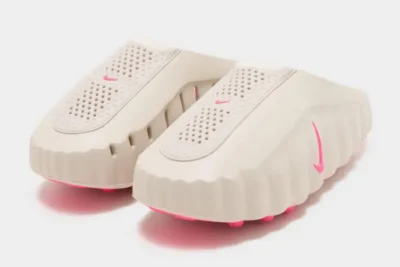
Nike’s Mind 001
A cream shade Nike has used only as a supporting tone on two women's Mind 001 pairs takes over the whole mule in January 2027, with pink nodes underfoot.