DRIFT AUDIO
Listen to this story
Choose a voice, then press play.
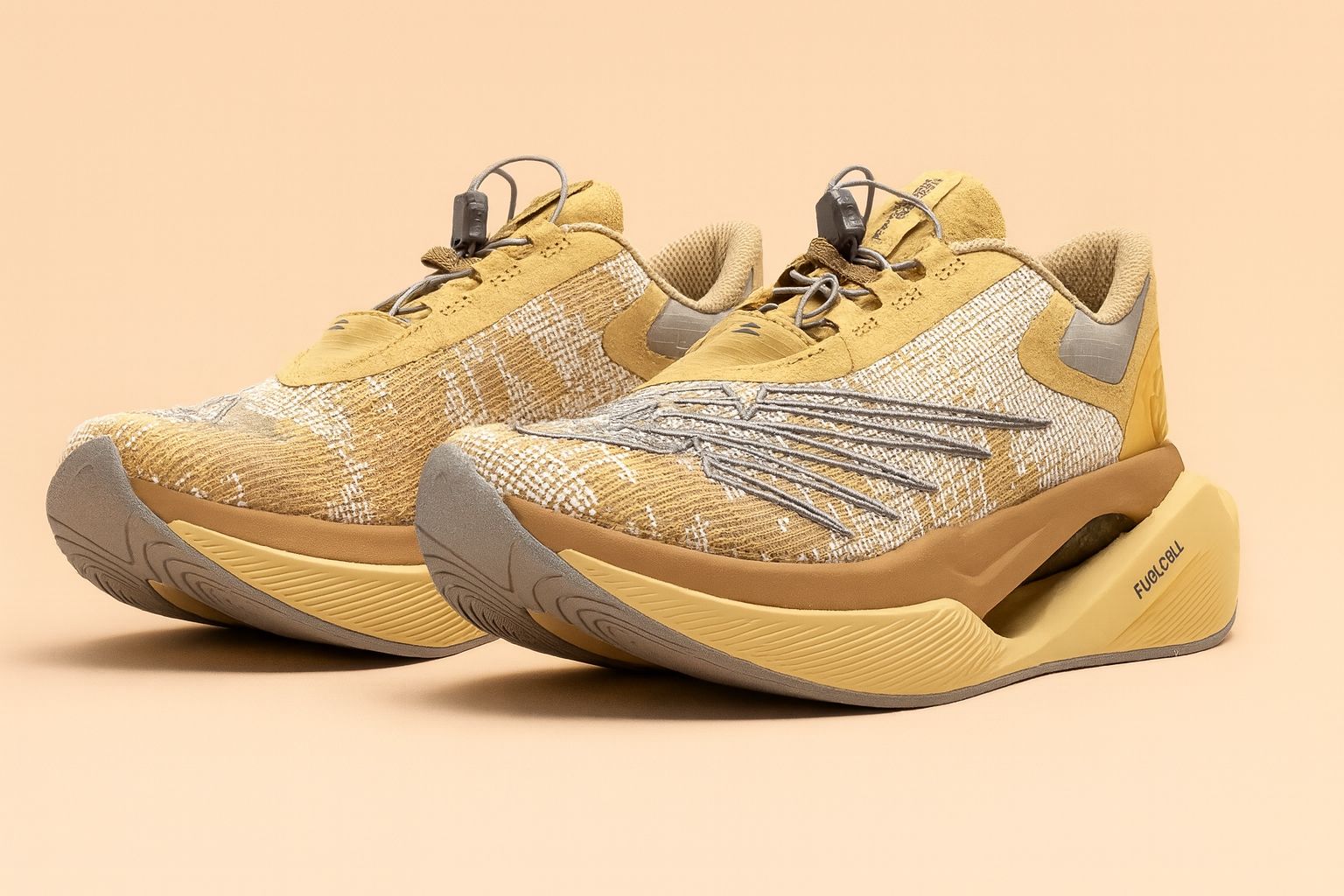
Few blends feel as intellectually composed as the one between New Balance and Stone Island. Each stands as a paradigm of meticulous design—one rooted in New England athleticism, the other in Italian technical mastery. The Tokyo Design Studio (TDS), New Balance’s in-house laboratory of innovation, serves as the point of convergence between these philosophies. Together, they have conceived a silhouette that is both functional artifact and cultural statement: the FuelCell C_1.
This shoe is not simply a runner; it is an industrial sculpture born from the science of motion. Its design borrows equally from laboratory precision and urban tactility—bridging worlds that rarely meet without tension. Yet here, that tension becomes beauty.
the design
The FuelCell C_1’s aesthetic is unorthodox. The knit upper feels alive—textured, breathable, and algorithmic in its patterning. Engineered from a synthetic-cotton hybrid developed between Stone Island’s material labs and New Balance’s Tokyo division, it embodies both Italian textile intellect and Japanese discipline.
A magnetic speed-lacing system replaces conventional loops, offering a seamless tightening mechanism that clicks into place with mechanical satisfaction. The absence of loose laces reinforces the silhouette’s sculptural fluidity; every component appears deliberately locked into form.
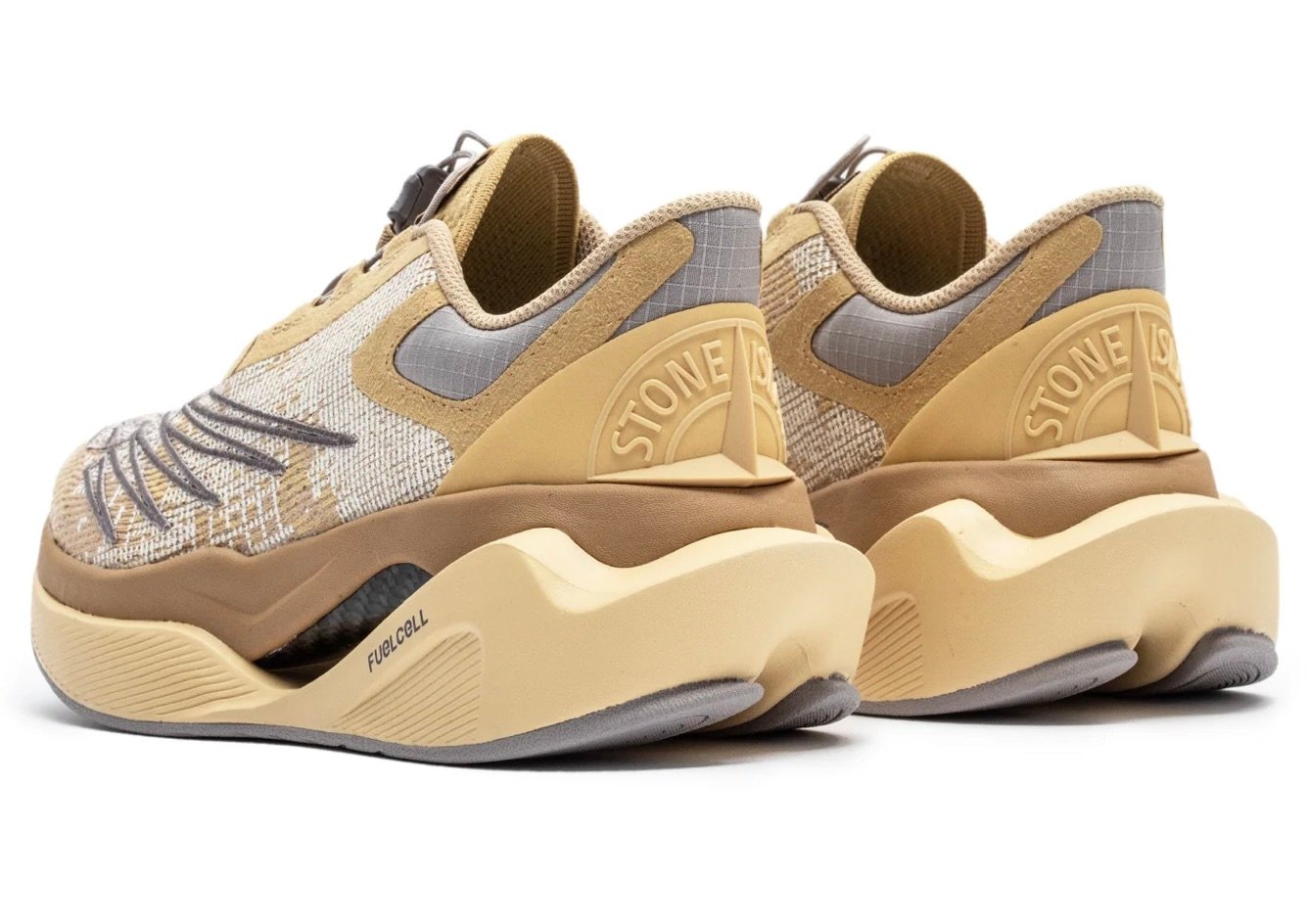
Stone Island’s Compass badge, re-molded as a raised medallion on the heel, grounds the shoe’s identity. Meanwhile, New Balance’s signature “N” is subtly embedded in the side panel, its understatement more akin to a designer’s signature than a brand stamp. The result is a shoe that carries authority not through branding, but through restraint.
The colorways—tan, brown, olive, and muted purple—recall Stone Island’s archival camouflage from AW 1990, yet feel distinctly modern under current streetlight. The tones seem to shift under motion, much like oxidized metals, reflecting the shoe’s position between natural material and synthetic artifice.
the engine beneath: fuelcell meets carbon
At the sole of the matter lies New Balance’s FuelCell foam, a high-rebound compound typically reserved for elite racing models. Here, it’s paired with a full-length carbon fiber plate, creating a kinetic system that propels each stride forward while maintaining remarkable stability.
The outsole extends dramatically beyond the heel—an architectural flourish with real purpose. The extended form acts as a counterbalance, optimizing push-off mechanics and distributing landing force across the midfoot. While this may appear ornamental to the casual eye, its geometry is engineered with mathematical precision.
It’s the rare instance where performance innovation is not dressed in minimalism but celebrated through exaggeration. The C_1 looks fast even when standing still, embodying what the Tokyo Design Studio calls kinetic architecture: design that visualizes motion even in rest.
View this post on Instagram
between laboratory and street
Where most collaborations flirt with novelty, this one studies it. The TDS FuelCell C_1 sits at the intersection of luxury and function, much like Stone Island’s garments that blur the line between military engineering and streetwear.
New Balance’s Tokyo Design Studio, since its inception, has aimed to reinterpret Western sportswear through an Eastern lens of refinement. The C_1 marks one of its boldest attempts to merge performance running with design-driven experimentation. The result is not a sneaker meant merely for athletes or collectors, but for those who treat footwear as both discipline and discourse.
In practice, the shoe feels like a paradox. It’s cushioned yet rigid, stable yet propulsive, avant-garde yet pragmatic. The fit hugs the foot like a tailored jacket, while the rigid carbon chassis reminds the wearer that every step is an engineered act.
Those accustomed to the flexibility of everyday trainers might find the C_1’s ride firm, almost stubborn—but that firmness carries intentionality. It reflects Stone Island’s devotion to durability and the Tokyo studio’s fascination with performance tension.
View this post on Instagram
the science of street prestige
In the broader fashion ecosystem, the C_1 symbolizes something significant: the union of technical research and street consciousness. Stone Island’s legacy in material science (thermo-sensitive dyes, resin coatings, reflective nylons) meets New Balance’s manufacturing rigor. Together, they construct a narrative about future fashion—not one dictated by trend cycles, but by curiosity.
Wearing the C_1 feels less like participating in sneaker culture and more like performing an experiment in motion. It’s footwear that communicates intelligence and intent—a choice made by those who appreciate design language as much as design function.
The collaboration also deepens the evolving dialogue between sportswear and avant-garde luxury, the same conversation driving labels like A-COLD-WALL, Salomon, and Hoka’s performance-luxury hybrids. Yet, the difference here is depth: the C_1 doesn’t mimic innovation; it is innovation—engineered, tested, and designed by the same teams who build Olympic runners’ shoes.
In the end, the C_1 succeeds not because it’s perfect, but because it’s intellectually brave. It reminds us that in the age of algorithmic design and mass iteration, there’s still power in the experimental—especially when two masters of craft decide to build a shoe that looks, feels, and thinks like the future.
Related Articles
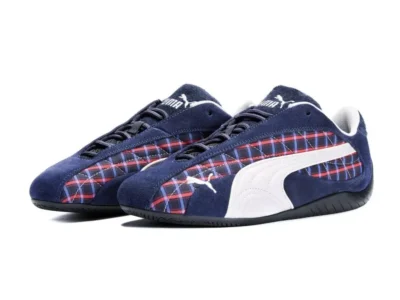
Atmos, Against Lab And Puma Plaid Seat Fabric On The Speedcat Plus
PROJECT: PLAID. 410472-01. Navy suede. Woven plaid. Textured Formstrip. Seatbelt webbing. BASE 3, Kuala Lumpur, […]