Noga Erez Stops Mid-Set at Coachella: “I’m Just Heartbroken and Sad”

April 13, 2026
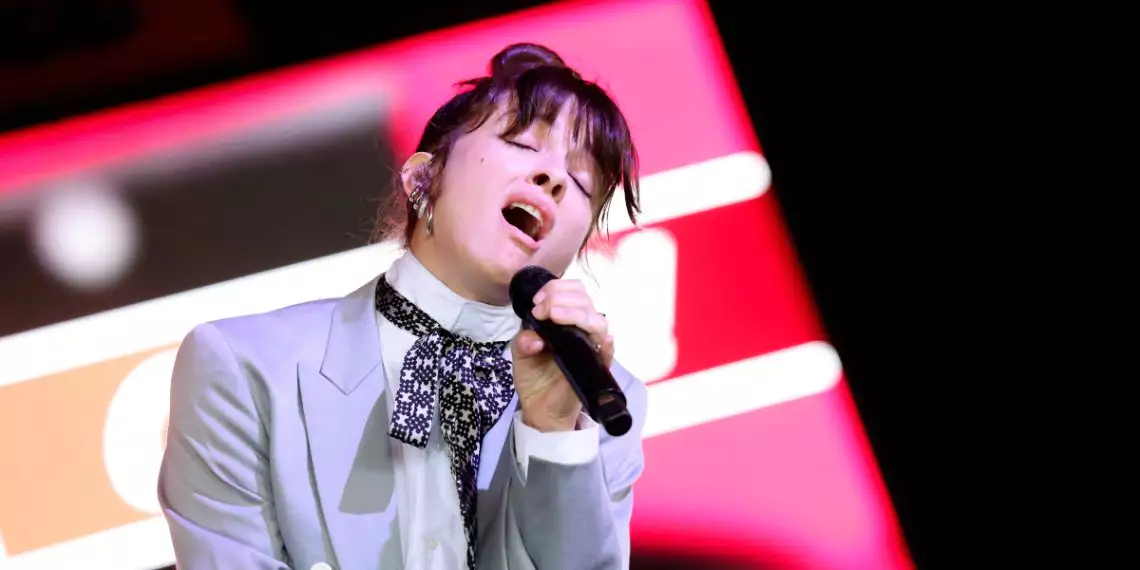
Coachella has long positioned itself as a global convergence point—a place where music, fashion, and cultural momentum intersect under a kind of curated neutrality. But neutrality, especially in 2026, is increasingly difficult to maintain.
When Noga Erez took the stage, the expectation was performance—precision, control, delivery. What unfolded instead was something more exposed. Mid-set, she paused, addressing the audience not as a performer maintaining distance, but as a person navigating something unresolved.
“I’m just heartbroken and sad,” she said. The words landed without theatrics. Not amplified, not dramatized—just stated.
In a festival environment designed for spectacle, the moment felt almost out of place. Which is exactly why it held.
show
Live performance has always carried a dual function. It is both presentation and projection—a space where artists translate internal states into shared experience. But in recent years, that translation has become more complicated.
Artists no longer exist in isolation from their context. National identity, political realities, cultural affiliations—these are not background details. They travel with the artist, shaping how they are seen before they even step onstage.
For Noga Erez, this context is particularly charged.
“I come from a very, very, very complex part of this planet,” she continued, acknowledging what could not be separated from the moment. The repetition of “very” wasn’t rhetorical—it felt like an attempt to compress something too large into something speakable.
And then:
“To get us all here doing this was kind of like forces that I didn’t know that I had.”
The phrasing matters. It reframes the performance not as a scheduled appearance, but as something that required effort beyond logistics—something closer to endurance.
View this post on Instagram
bulwark
Noga Erez’s music has always operated within a hybrid space—electronic, pop-adjacent, rhythmically sharp, lyrically pointed. It is structured, but not static. There is tension built into it.
At Coachella, that tension extended beyond the music itself.
Pop performance typically relies on control: timing, transitions, pacing. Emotion is often integrated, but within boundaries. It is shaped, contained, delivered.
What happened during Erez’s set disrupted that structure.
The pause—her statement—did not align with the expected rhythm of a festival performance. It interrupted flow. It introduced uncertainty.
And yet, it did something else: it redefined the performance as something happening in real time, not just something being executed.
witness
Festival audiences are conditioned to respond—cheer, move, engage. Their role is participatory, but within a known framework.
Moments like this shift that role.
When an artist steps outside performance mode and into direct expression, the audience is no longer just responding to music. They are witnessing something less defined.
This creates a different kind of attention.
Not louder, but quieter.
Not reactive, but focused.
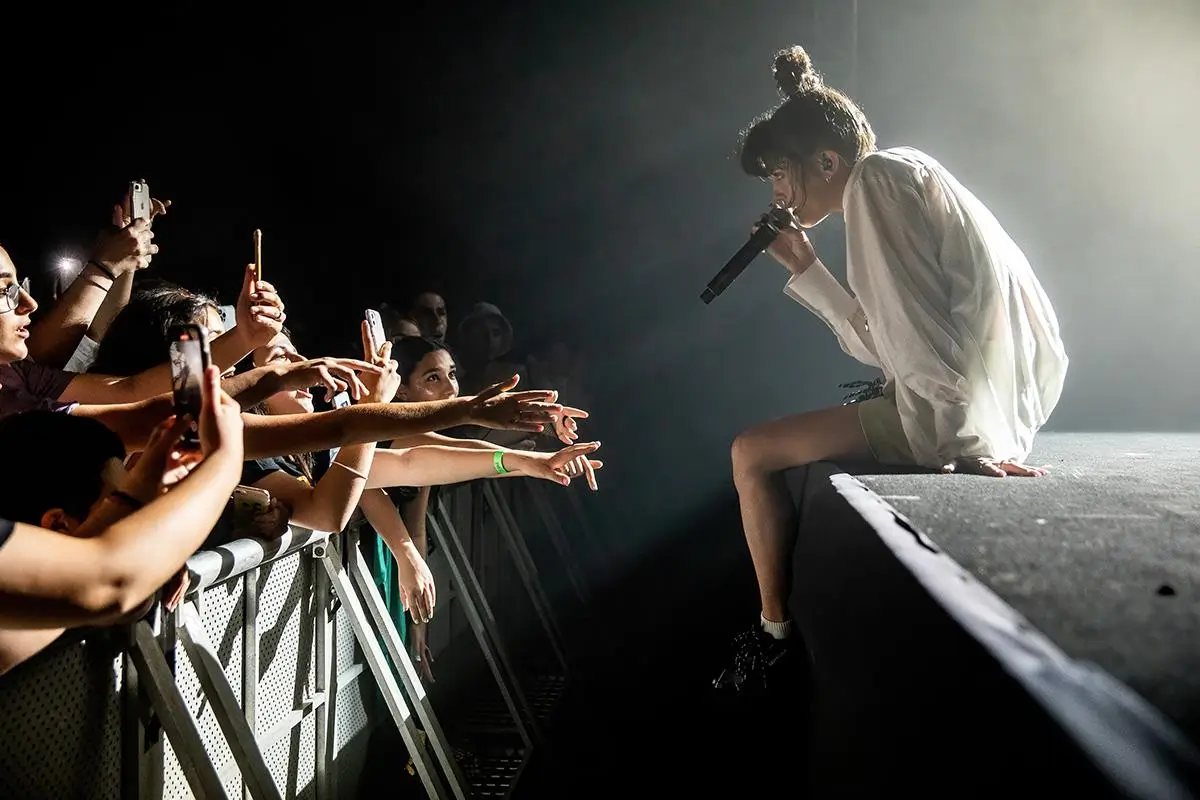
Reports from the set describe a crowd that did not erupt, but held. The energy didn’t dissipate—it condensed.
In that condensation, the relationship between artist and audience changed. It became less about exchange and more about presence.
rep
For artists from regions defined by conflict or political tension, the act of performing internationally carries additional layers.
Representation is never neutral.
Every appearance becomes, intentionally or not, a form of view tied to broader narratives. The artist is seen not only as an individual, but as a point of reference.
Noga Erez’s acknowledgment of her background does not attempt to resolve this tension. It simply places it in the open.
This matters because it resists simplification.
There is no attempt to condense complexity into a singular statement. Instead, the complexity remains intact—unresolved, visible, present.
emotive
“I’m just heartbroken and sad.”
The statement is notable for what it does not include.
There is no explanation.
No directive.
No conclusion.
In a media environment that often demands clarity and position, this kind of open-ended expression can feel incomplete. But that incompleteness is part of its honesty.
Not all emotions resolve into statements.
Not all situations allow for articulation beyond feeling.
By leaving the statement as it is, Noga Erez avoids turning it into something performative. It remains personal, even within a public space.
stance
Coachella operates as more than a festival. It is a global media node. What happens on its stages does not stay within the desert—it circulates.
Moments are captured, clipped, shared, reframed.
This amplification changes how performances are constructed. Artists are aware that they are not just conjuring to a crowd—they are contributing to a larger narrative that will extend beyond the event.
In this context, vulnerability becomes more complex.
To express something personal on such a stage is to accept that it will be interpreted, circulated, and potentially reduced.
That risk is part of what gives the moment weight.
shh
Festivals are built on volume—sound, movement, vew intensity. Silence, or even partial silence, disrupts that structure.
When Noga Erez paused, the absence of music became part of the performance.
Silence, in this context, is not empty. It holds attention in a different way. It removes distraction.
This shift can be uncomfortable. It asks the audience to engage without the usual cues.
But it also creates space—space for something unscripted to exist.
move
The timing of this moment matters.
2026 is not a neutral cultural moment. Across industries—music, fashion, art—there is an increasing awareness of global interconnectedness and the impossibility of separating creative output from context.
Artists are navigating not just their work, but their position within a larger system.
This has led to a shift in how performances are received.
Audiences are no longer only evaluating the music. They are reading the moment—its context, its imply, its authenticity.
In this environment, statements like Erez’s resonate differently. They are not interruptions. They are part of the performance’s meaning.
forward
After the statement, the performance continued.
This continuation is important.
It suggests that expression and execution are not mutually exclusive. The moment of vulnerability did not end the set—it became part of it.
This integration reflects a broader shift in live performance.
Artists are increasingly incorporating real-time experience into structured formats. The boundary between planned and unplanned is becoming more fluid.
In Erez’s case, the emotional statement did not replace the performance. It reframed it.
challenge
Public expression carries a paradox.
To speak openly is to invite understanding—but also misinterpretation.
Statements are extracted, quoted, reframed. Context can be lost. Intent can be reshaped.
For Noga Erez, this risk is amplified by the context in which she exists.
To say “I’m heartbroken and sad” may seem straightforward, but within a global discourse, it can be read in multiple ways.
This multiplicity cannot be controlled.
Which raises the question: why say it at all?
The answer may lie in the need to acknowledge feeling, regardless of outcome.
grounds
Festival performances are often evaluated through metrics:
Crowd size
Energy
Setlist impression
Visual production
Moments like this introduce another metric—presence.
Not how loud the response was, but how focused it became.
Not how many songs were played, but what was communicated between them.
This shift does not replace traditional measures. It complicates them.
A performance can be technically strong and emotionally distant—or structurally disrupted and deeply resonant.
Erez’s set suggests that these categories are not fixed.
idea
Artists operate within systems—labels, festivals, audiences, media cycles. But they are also individuals navigating personal realities.
The tension between these roles is not new, but it is becoming more visible.
Noga Erez’s statement brings that tension into focus.
She is performing within a global system, but she is also responding to something personal and immediate.
The two do not cancel each other out. They coexist.
impression
Live performance is often framed as an escape—a temporary suspension of reality. But increasingly, it is becoming a site where reality is acknowledged, even if only briefly.
Noga Erez’s Coachella moment does not redefine performance. It reframes it.
It suggests that the stage is not separate from the world, but part of it.
And that sometimes, the most impactful thing an artist can do is not to resolve tension—but to hold it, even for a moment, in front of an audience that wasn’t expecting it.
Related Articles

Rose Byrne and Mary Bronstein Are Doing It Again, and This Time They Brought Jenna Ortega
A coach and her prodigy are about to become the most dangerous relationship in a […]