The Heart Association Just Told Millions of Coffee Drinkers to Relax a Little

July 21, 2026
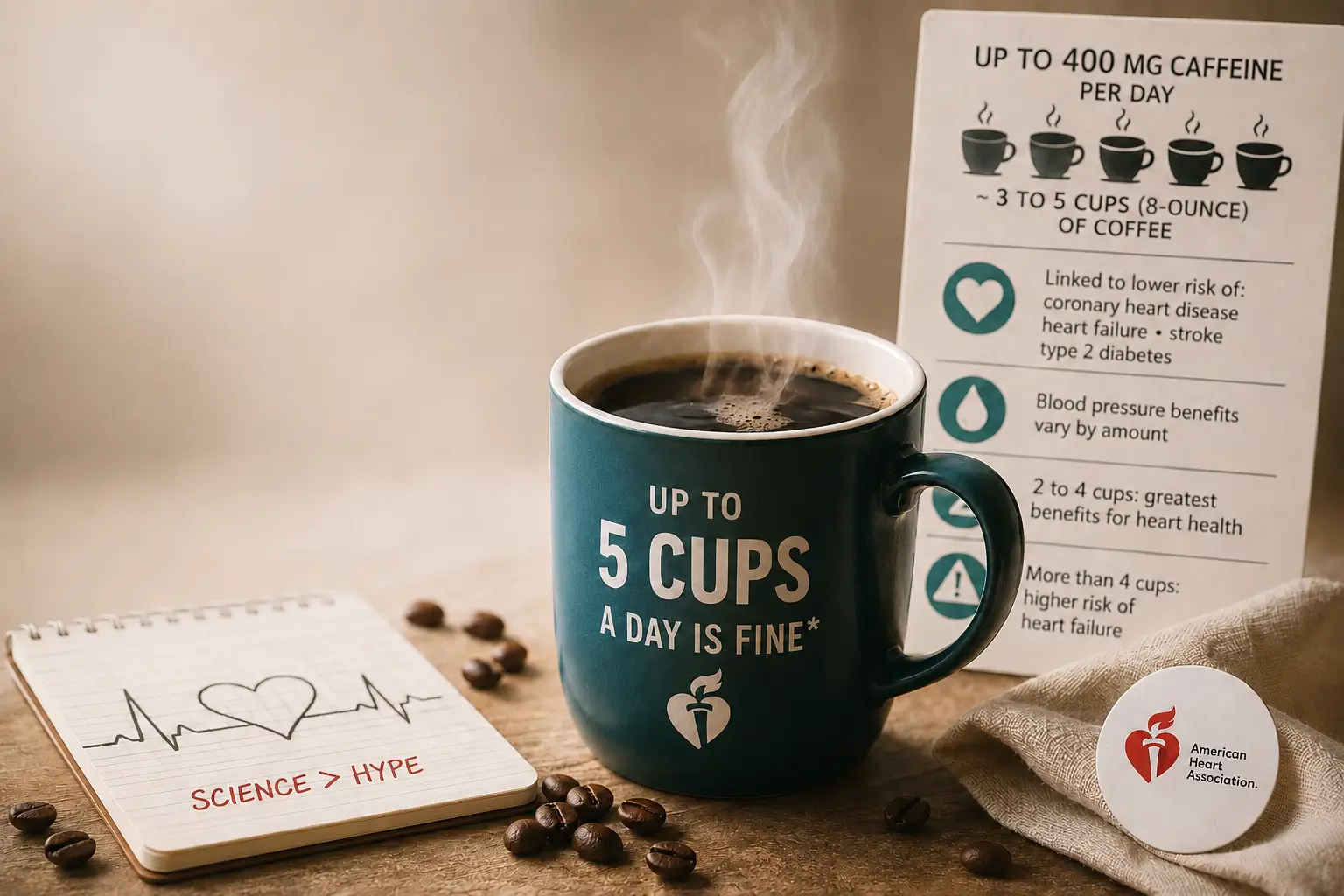
New guidance from the American Heart Association says up to five cups a day is fine for most adults, with a catch buried in the fine print.
Somewhere around two thirds of American adults drink coffee every day, according to survey data cited by the National Coffee Association, and the average cup count sits at roughly three. For a habit that widespread, the medical guidance around it has stayed remarkably inconsistent for decades: cut back if you have a heart condition, avoid it if you’re pregnant, watch it if your blood pressure runs high, and otherwise a shrug.
The American Heart Association tried to close some of that gap on Monday, July 20, publishing a scientific statement titled “Caffeine and Cardiovascular Disease” in its flagship journal, Circulation. The topline finding: consuming up to 400 milligrams of caffeine a day, which works out to roughly three to five 8 ounce cups of regular black coffee, is generally safe for most adults and appears linked to a lower risk of several cardiovascular conditions, including coronary heart disease, heart failure, stroke, and Type 2 diabetes.
Caffeine and Cardiovascular Disease https://t.co/Q3pACwXFNo
— Circulation (@CircAHA) July 20, 2026
Gregory Marcus, a cardiologist at the University of California, San Francisco, chaired the volunteer writing group behind the statement. Marcus said the review of recent research found that moderate coffee intake without added sugar or fillers does not raise cardiovascular risk for most people, a conclusion he framed as reassuring given how central caffeine is to daily life for millions.
The number itself is not new. Three to five cups has floated around nutrition guidance for years as a rough ceiling. What is new is the AHA compiling the evidence into one document and attaching specific cardiovascular outcomes to specific consumption ranges, rather than leaving the topic as a general “everything in moderation” footnote.
twist
The most counterintuitive finding in the statement involves blood pressure, an area where research has historically pulled in different directions depending on the study. Here the AHA offers a more granular breakdown than most previous guidance: in people who currently have optimal blood pressure readings, drinking one to three cups a day was associated with a slightly increased risk of developing high blood pressure. Drinking more than three cups a day, by contrast, was associated with a lower risk.
Coffee and heart health: How many cups of caffeinated coffee are safe to drink each day? https://t.co/5EsY6Tpqib
— American Heart News (@HeartNews) July 20, 2026
That U shaped pattern does not have a fully settled explanation yet. The statement’s authors note that most of the underlying research is observational, meaning it can show an association without proving what is causing it, and that the cardiovascular effects credited to caffeine may in some cases trace back to other compounds naturally present in coffee rather than caffeine itself. Experimental work has pointed to antioxidant and anti-inflammatory properties in some of coffee’s bioactive compounds as one possible explanation for benefits that show up even when caffeine alone doesn’t fully account for them.
The heart disease and stroke data follows a similar shape to the blood pressure finding, though the peak sits a bit lower. Two to four cups a day was linked to a reduced risk of heart disease, heart failure, and stroke. Cross the four cup mark, though, and the statement notes a rising risk of heart failure specifically, even as the other benefits appear to hold. In other words, the safe zone and the beneficial zone overlap for most of the range but start to diverge again right around the upper end of what the AHA still calls safe.
why
Coffee brewing method turns out to carry more weight than most casual drinkers probably assume. The statement flags cafestol, a compound found in both caffeinated and decaffeinated coffee, as a contributor to higher LDL cholesterol, the kind commonly labeled bad cholesterol. Cafestol shows up in unfiltered brewing methods: espresso, French press, Turkish coffee, and boiled coffee all fall into that category. Coffee brewed through a paper filter, along with most instant coffee, does not carry meaningful cafestol levels, which means two people drinking the same number of cups a day could be looking at meaningfully different cholesterol exposure depending on how their coffee was made.
View this post on Instagram
Heart rhythm data adds another layer of nuance rather than a clean verdict. One to three cups a day was not associated with a higher risk of atrial fibrillation, the most common form of irregular heartbeat, according to the statement’s review of recent research. That same range was linked to a slightly higher rate of premature ventricular contractions, a less serious type of extra heartbeat that many people never notice and that generally does not require treatment on its own. Randomized trials, considered the more rigorous form of evidence compared to the observational studies that make up most caffeine research, showed a similar split: lower atrial fibrillation risk paired with higher PVC rates.
None of this comes with a universal add on rule, since the statement is explicit that adding sugar, flavored syrups, milk, or cream likely cuts into whatever cardiovascular benefit plain coffee carries. The research behind that particular note is thinner than the research on caffeine itself, so it reads more as a caution than a settled finding, but it is consistent enough across the reviewed studies that the writing group chose to include it as a standalone point.
huh
Energy drinks get singled out for a different kind of warning entirely, one with far less ambiguity attached to it. Energy shots specifically can carry three to four times more caffeine per fluid ounce than a standard brewed coffee, and the statement links high dose caffeine products to elevated blood pressure and irregular heart rhythm, including in healthy adults under 30 who would otherwise be considered low risk. That age detail matters because most of the coffee focused findings in the statement come from studies skewing toward older adults, making the energy drink data one of the few places where the statement speaks directly to a younger population.
Tea gets a brief mention as well, with the statement noting that although fewer studies exist on tea specifically, the available research points to reduced risk of atrial fibrillation, heart failure, and stroke that roughly mirrors what shows up in the coffee data. Soda, energy bars, gels, and caffeine supplements are grouped together as a category needing more dedicated research, since those products often carry additional ingredients that can change how quickly caffeine is absorbed and how strongly it acts on the body.
One detail that surprised some outlets covering the release: caffeine itself did not make it into the AHA’s separate 2026 Dietary Guidance to Improve Cardiovascular Health, the Association’s broader nutrition document published earlier this year. The writing group behind the caffeine statement said that omission came down to a lack of the kind of rigorous, standardized data needed to build formal dietary recommendations around caffeine specifically, even though there was enough evidence to support the more descriptive scientific statement published this week.
fin
Caffeine metabolism varies enough from person to person that the statement spends real space cautioning against a one size fits all reading of its own numbers. Caffeine is processed primarily by a liver enzyme called CYP1A2, and how fast that enzyme works differs based on genetics, age, medication use, and how much caffeine someone already consumes regularly. People who drink coffee daily tend to build some tolerance to its effects over time, while someone who rarely drinks it might feel a stronger reaction, including heart palpitations or sleep disruption, from an amount that would barely register for a regular drinker.
Marcus addressed that variability directly, noting that what counts as a reasonable amount for one person could trigger unwanted effects such as heart palpitations, anxiety, or sleep disruption in someone else, and that paying attention to individual response matters more than chasing a specific cup count. The statement was prepared on behalf of three AHA groups: the Council on Lifestyle and Cardiometabolic Health, the Council on Clinical Cardiology, and the Stroke Council, and its co-authors include researchers from Harvard, the National University of Singapore, Northwestern, the University of California San Francisco, the University of Kentucky, Uppsala University, the University of Colorado, and New York University.
What the statement does not attempt to settle is the office kitchen scenario that tends to come up whenever this kind of research makes the rounds: what happens to everyone else’s blood pressure when a colleague has visibly worked through four or five cups before the 9 a.m. meeting. That variable sits well outside the scope of a document built on decades of population level research, and the AHA’s own guidance stops firmly at the individual level, coffee cup in one hand, genetics and daily habits in the other.
Related Articles

The $960,000 Jacket: How Jensen Huang’s Leather Uniform Became a Collector’s Item
A worn Tom Ford jacket with a $60,000 ceiling closed at $960,000 on Friday, and […]