Tradition On Ice: The 2026 Iditarod Launches from Anchorage to Nome

March 7, 2026
flow
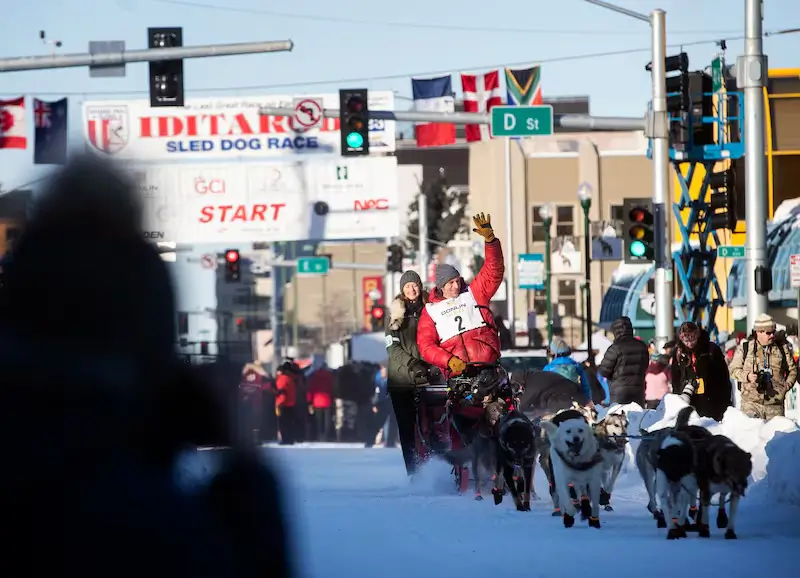
Each March, Alaska hosts one of the most demanding endurance events on Earth. The Iditarod Trail Sled Dog Race is not simply a sporting competition—it is a ritual of survival, history, and stubborn perseverance. In 2026, the race once again begins with its ceremonial kickoff in Anchorage, where crowds gather along snow-lined streets to witness mushers and their teams glide through the city before heading north toward the true starting line.
The official race begins Sunday in Willow, Alaska, where 37 mushers and their dog teams will launch into the wilderness. From that moment onward, the competitors and their dogs will spend roughly eight days traversing a 1,000-mile trail across some of the harshest terrain in North America. Their destination: the coastal town of Nome, on the edge of the Bering Sea.
This year’s edition of the race brings familiar images—lean huskies, frost-covered sled runners, and determined athletes bundled in parkas—but it also introduces something entirely new: a controversial “Expedition Class” participant, Norwegian billionaire Kjell Inge Røkke, whose presence has sparked debate about money, tradition, and the meaning of participation in one of the world’s most iconic endurance races.
anchorage
The ceremonial start is one of the most beloved traditions of the Iditarod. It transforms downtown Anchorage into a temporary winter arena, where spectators pack sidewalks and snowbanks to watch the mushers parade through the city.
Unlike the official race, the Anchorage segment is largely symbolic. Mushers guide their teams through a short urban route, allowing fans to see the dogs up close and celebrate the start of the journey. For many Alaskans, it serves as a reminder that the race belongs not only to the competitors but also to the communities that line the trail.
Children reach over barricades to pet excited huskies. Volunteers shovel fresh snow onto city streets so sleds can glide across asphalt. The atmosphere feels almost festival-like—yet beneath the cheer lies the knowledge that what follows is anything but festive.
Within hours, mushers will be heading north toward Willow, where the race officially begins.
epicenter
Willow, Alaska, is a small community surrounded by forest and open wilderness. On race day it becomes the gateway to a legendary route that cuts across the state.
From here, mushers begin the real challenge.
The trail winds across frozen rivers, mountain passes, and vast stretches of tundra. Temperatures can plunge far below zero, winds whip across open landscapes, and storms sometimes bury sections of the route under fresh snow.
Along the way, competitors must pass through more than 20 checkpoints, including historic settlements such as:
-
Rainy Pass
-
McGrath
-
Ruby
-
Galena
-
Unalakleet
-
Shaktoolik
Each checkpoint offers brief respite—food for dogs, supplies for mushers, and moments of rest before continuing toward the west coast.
But the clock never stops.
The race is a constant balancing act: pushing forward fast enough to remain competitive while preserving the strength and health of the dogs that make the journey possible.
athlete
Though the dogs provide the power, the mushers provide strategy, endurance, and leadership.
Modern Iditarod mushers are a diverse group. Some come from long Alaskan dog-sledding families, while others discovered the sport later in life and trained for years to qualify.
In the 2026 race, the field of 37 competitors includes veterans and newcomers alike. Some are returning champions chasing another victory. Others are rookies hoping simply to reach Nome.
Each musher typically starts with a team of 14 dogs, though only a minimum of five must cross the finish line. The dogs themselves are extraordinary athletes—Alaskan huskies bred for endurance, speed, and resilience in extreme cold.
During the race, mushers must manage:
-
feeding schedules for the dogs
-
rest cycles across checkpoints
-
navigation in blizzard conditions
-
equipment repairs in the field
Sleep often comes in short bursts—sometimes just two or three hours at a time.
stir
The Iditarod route is rooted in history.
It follows parts of the Iditarod Trail, a network of winter routes once used by Indigenous communities, mail carriers, and gold prospectors traveling across Alaska in the late 19th and early 20th centuries.
But the race’s modern legend is tied to a dramatic event in 1925: the Nome serum run.
When a diphtheria outbreak threatened the isolated town of Nome, a relay of sled-dog teams carried life-saving antitoxin across nearly 700 miles of frozen wilderness. The relay became a symbol of courage and cooperation under impossible conditions.
The Iditarod race, first held in 1973, was created partly to commemorate that heroic journey.
Today, the competition keeps that heritage alive while showcasing the enduring bond between humans and sled dogs.
pace
No aspect of the race captures attention quite like the dogs themselves.
Alaskan huskies are not a standardized breed but a specialized working dog developed over generations for long-distance sled racing. They combine the endurance of northern sled dogs with the speed and agility of racing breeds.
A typical dog on the Iditarod team may run 80 to 100 miles in a single day.
Their diet during the race is astonishingly caloric—sometimes 10,000 to 12,000 calories per day, consisting of high-fat meat, fish, and specially formulated dog food designed to fuel their intense workload.
Despite the brutal conditions, mushers often emphasize that their dogs are eager to run. Many handlers describe the animals as athletes who become restless if they remain at rest too long.
The partnership between musher and dog team is built through months, sometimes years, of training before the race ever begins.
time
For the fastest mushers, the journey from Willow to Nome takes just over a week.
During those eight days, competitors face a rotating set of challenges:
new
The 2026 race introduces a new category that has sparked significant discussion.
For the first time, organizers are allowing an “Expedition Class” participant, Norwegian billionaire Kjell Inge Røkke.
Unlike the competitive mushers, Røkke will travel portions of the trail without formally competing for race placement. His participation stems from a long-standing relationship with the race.
Since 2018, companies associated with Røkke have sponsored the Iditarod. This year, he contributed more than $300,000toward the race’s prize fund and initiatives supporting pediatric healthcare in rural Alaskan communities along the route.
Supporters argue that his donation provides critical financial support for the race and the communities it touches.
Critics see the arrangement differently.
To them, allowing a wealthy sponsor to participate outside the competitive field raises uncomfortable questions about whether access to iconic experiences can be purchased.
The debate reflects a broader tension: how to sustain a costly event like the Iditarod without compromising its traditions.
show
Endurance sports have long attracted wealthy patrons.
Mountaineering expeditions, ocean racing campaigns, and polar explorations often depend on significant funding. Sponsors, benefactors, and enthusiasts sometimes participate directly in these adventures.
But the Iditarod occupies a unique cultural space.
It is both a sporting event and a symbol of Alaskan heritage. For many residents, the race represents grit, independence, and respect for the wilderness.
Introducing a non-competitive billionaire participant inevitably raises questions about the line between sponsorship and participation.
Yet organizers argue that financial support is essential to sustaining the race.
Prize money, logistics, veterinary support, and checkpoint operations all require substantial funding.
Without sponsors, the race could struggle to survive.
eco
Running a 1,000-mile race through remote Alaska is extraordinarily expensive.
The race organization must coordinate:
-
aircraft delivering supplies to isolated checkpoints
-
veterinarians monitoring the health of dog teams
-
volunteers maintaining sections of trail
-
safety crews and communications infrastructure
Prize purses have fluctuated in recent years as sponsorships have changed. Donations like Røkke’s can significantly impact the race’s financial stability.
For many mushers, competing in the Iditarod is not financially lucrative. Training dog teams, maintaining kennels, and traveling the trail require significant personal investment.
Victory brings prestige and prize money, but many participants race primarily for the challenge itself.
fwd
At the far end of the trail waits Nome.
The town’s iconic burled arch finish line marks the end of the journey. When mushers arrive—often under floodlights in the Arctic night—crowds gather to cheer them across the line.
The winner typically reaches Nome first, but the celebration continues for days as additional teams arrive.
For rookies completing their first race, crossing the finish line can feel as meaningful as victory.
Each team that arrives has survived one of the most demanding races in the world.
culture
Beyond sport, the Iditarod holds deep cultural resonance in Alaska.
It celebrates traditions of sled travel that long predate modern racing. Indigenous communities and early settlers relied on dog teams to traverse winter landscapes where no roads existed.
Though snowmobiles and aircraft eventually replaced sled dogs for transportation, the Iditarod preserves that heritage.
For communities along the trail, the race remains a rare moment of connection with the outside world. When mushers arrive at remote checkpoints, local residents gather to watch, volunteer, and celebrate.
In this way, the race links modern sport with historic lifeways.
sum
As the ceremonial start unfolds in Anchorage and the official race begins in Willow, the essence of the Iditarod remains unchanged.
A musher stands on a sled.
A team of dogs leans forward in harness.
Snow stretches endlessly ahead.
For the next thousand miles, the only path forward is through cold, exhaustion, and determination.
Some competitors chase victory.
Others chase personal limits.
And this year, one billionaire will experience the trail from a different vantage point—raising questions about privilege even as the race celebrates endurance.
But once the teams leave Willow, the wilderness imposes the same rules on everyone.
Cold does not care about wealth.
Wind does not recognize sponsorship.
And the trail to Nome remains exactly what it has always been: a test of will, partnership, and the ancient rhythm of sled runners carving lines through snow.
Related Articles

The $960,000 Jacket: How Jensen Huang’s Leather Uniform Became a Collector’s Item
A worn Tom Ford jacket with a $60,000 ceiling closed at $960,000 on Friday, and […]