Un Volo Scarlatto by Cesare Reggiani: An Emotional Flight Beyond Canvas

July 7, 2025
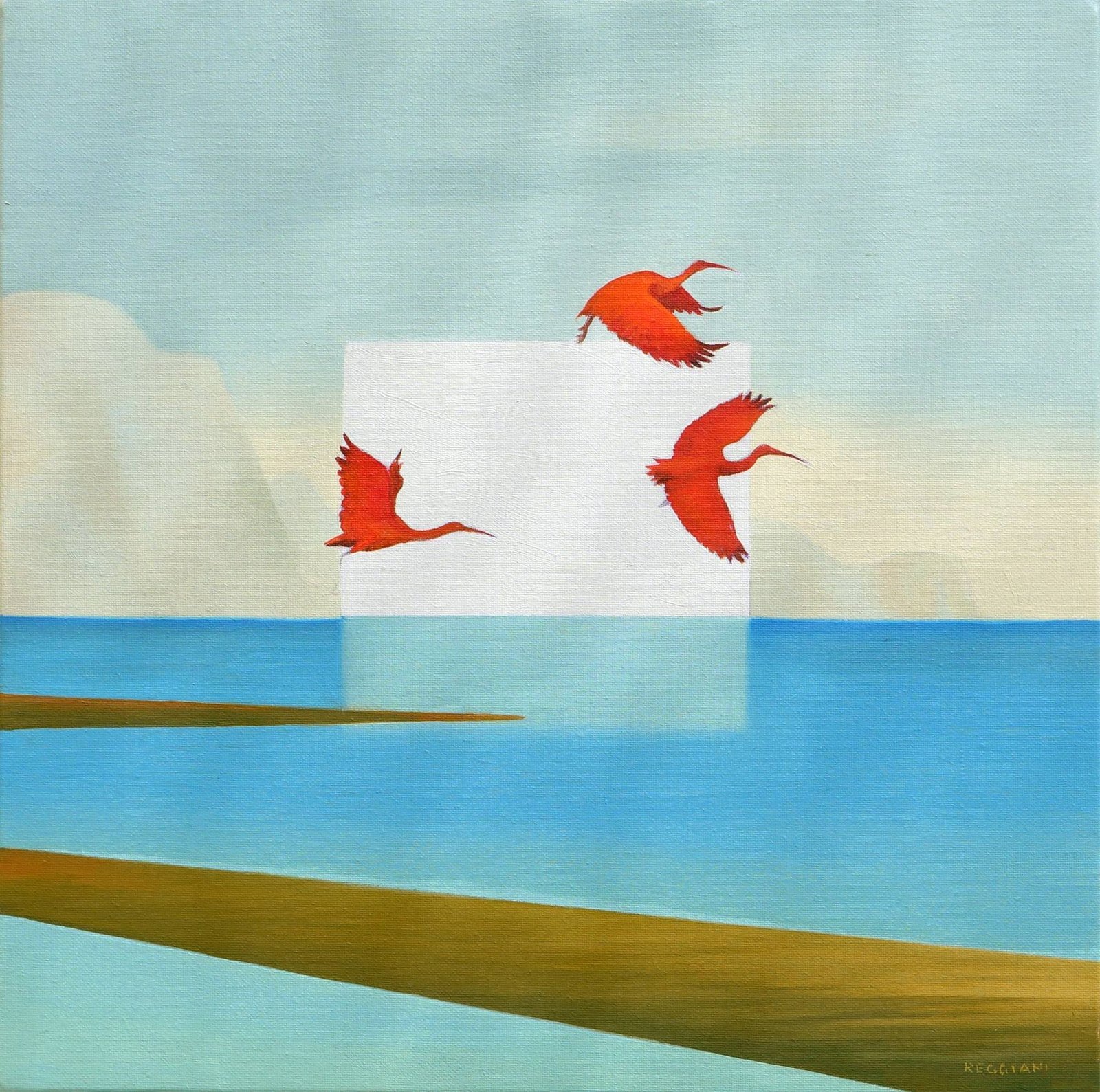
Art is often described as a window into the artist’s soul, a glimpse of their hidden fears, dreams, and inner landscapes. In Un Volo Scarlatto, Cesare Reggiani offers more than a window — he hands the viewer wings, inviting us to soar alongside him in a vivid, scarlet-tinted dream.
Born and raised in Ravenna, Italy, Reggiani has long been celebrated for his emotionally charged, deeply layered paintings. While much of his earlier work dwells in earthy palettes and contemplative figurative studies, Un Volo Scarlatto marks a dramatic and almost rebellious departure: a bright, unrestrained embrace of color, movement, and symbolic storytelling.
The Essence of the Scarlet Flight
The title, Un Volo Scarlatto (“A Scarlet Flight”), sets the tone before the eye even lands on the canvas. Scarlet, a color steeped in passion and danger, immediately suggests urgency and raw emotionality. Flight, meanwhile, evokes liberation, transcendence, and perhaps escape. Together, they form a conceptual tension that defines the piece: a struggle between freedom and vulnerability, desire and fear.
Upon first glance, the viewer is engulfed by a swirl of red — not a single, flat tone but an ocean of crimsons, maroons, and vermilions that seem to vibrate against each other. Reggiani’s brushwork is loose yet purposeful, guiding the eye in sweeping arcs and sudden, almost violent gestures. It’s an effect reminiscent of both Renaissance drapery and the impulsive energy of Abstract Expressionism.
Beneath this sea of red, subtle hints of figure-like shapes emerge: a curve of a shoulder, the suggestion of a wing, a fleeting profile. These ghostly forms invite the viewer to question whether we’re seeing a literal flight or a psychological one. Is the subject breaking free, or are they being consumed by the very color that defines them?
Technique and Materiality
Reggiani has always been meticulous in his choice of materials, and Un Volo Scarlatto is no exception. The painting is rendered primarily in oil, but with carefully integrated layers of wax and dry pigment, giving it a textured, almost sculptural quality. Under certain light, the surface appears to ripple, mirroring the turbulence suggested in the subject matter.
He employs a layering technique similar to the Venetian old masters, building depth slowly and painstakingly. Yet, unlike those serene works of old, Reggiani uses this depth to evoke dissonance rather than calm. The viewer is drawn in and pushed away, mesmerized and unsettled all at once.
Symbolism and Interpretation
While much of Reggiani’s earlier work leaned heavily on classical and religious iconography, Un Volo Scarlatto feels more introspective and modern. The scarlet hue, a symbol of martyrdom in medieval art, is repurposed here as a symbol of transformation and rebirth. The ambiguous wing-like shapes speak to freedom, yet their fragmented nature hints at struggle and fragility.
Some critics have interpreted the work as a commentary on contemporary human isolation — the desire to break free from digital echo chambers and the weight of modern expectations. Others see it as a deeply personal exploration of the artist’s own metamorphosis, moving away from tradition towards a raw, more instinctual mode of expression.
Reggiani himself remains characteristically elusive about the painting’s “true meaning,” insisting in interviews that the piece is meant to be experienced, not explained. He believes that each viewer brings their own emotional palette to the work, and that interaction is the final, crucial layer.
A New Chapter for Reggiani
Un Volo Scarlatto represents more than just a single painting in Reggiani’s portfolio — it signifies a pivotal moment in his career. After decades of working within the bounds of figurative representation, this painting pushes him closer to abstraction, allowing gesture and color to take precedence over recognizable forms.
In many ways, it parallels the trajectories of artists like Gerhard Richter, who oscillated between realism and abstraction, or Cy Twombly, whose scribbles carried the weight of ancient epics. Reggiani’s scarlet flight is not just an experiment; it is a declaration that the artist is willing to let go of control, to let intuition guide the brush.
Reception and Legacy
Since its first public showing at the Palazzo delle Esposizioni in Rome, Un Volo Scarlatto has provoked passionate responses. Some viewers have stood in front of it for hours, visibly moved, while others recoil, unable to confront the emotional turbulence it embodies.
Collectors and critics alike have praised Reggiani’s boldness, citing the painting as a highlight of contemporary Italian art. Younger artists in particular have been inspired by his willingness to embrace vulnerability, viewing it as a permission slip to explore their own emotional landscapes.
It’s not just a painting but an event, a conversation starter that extends beyond the walls of the gallery into social media feeds, art publications, and intimate dinner table debates. In a world inundated with hyper-polished, instantly digestible images, Un Volo Scarlatto demands patience, engagement, and emotional honesty.
The Power of Emotional Flight
Ultimately, Un Volo Scarlatto is less about what it depicts and more about what it evokes. It is a call to embrace imperfection, to find beauty in the tumultuous, and to recognize that true freedom often requires confrontation with our deepest fears.
In its swirling reds and shifting shapes, the painting holds a mirror to our inner lives, asking us to acknowledge both the soaring highs and the perilous drops. It is at once deeply Italian in its romantic intensity and universally human in its emotional resonance.
Reggiani’s scarlet flight may not offer easy answers, but it offers something far more valuable: an invitation to feel, to question, and perhaps, to take flight ourselves.
Related Articles

Sherwin-Williams Announces ‘The Loneliest Color’ of 2026, Giving an Outcast Its Limelight
Sherwin-Williams has once again turned the paint industry’s spotlight on the overlooked, announcing Offbeat Green […]