DRIFT AUDIO
Listen to this story
Choose a voice, then press play.
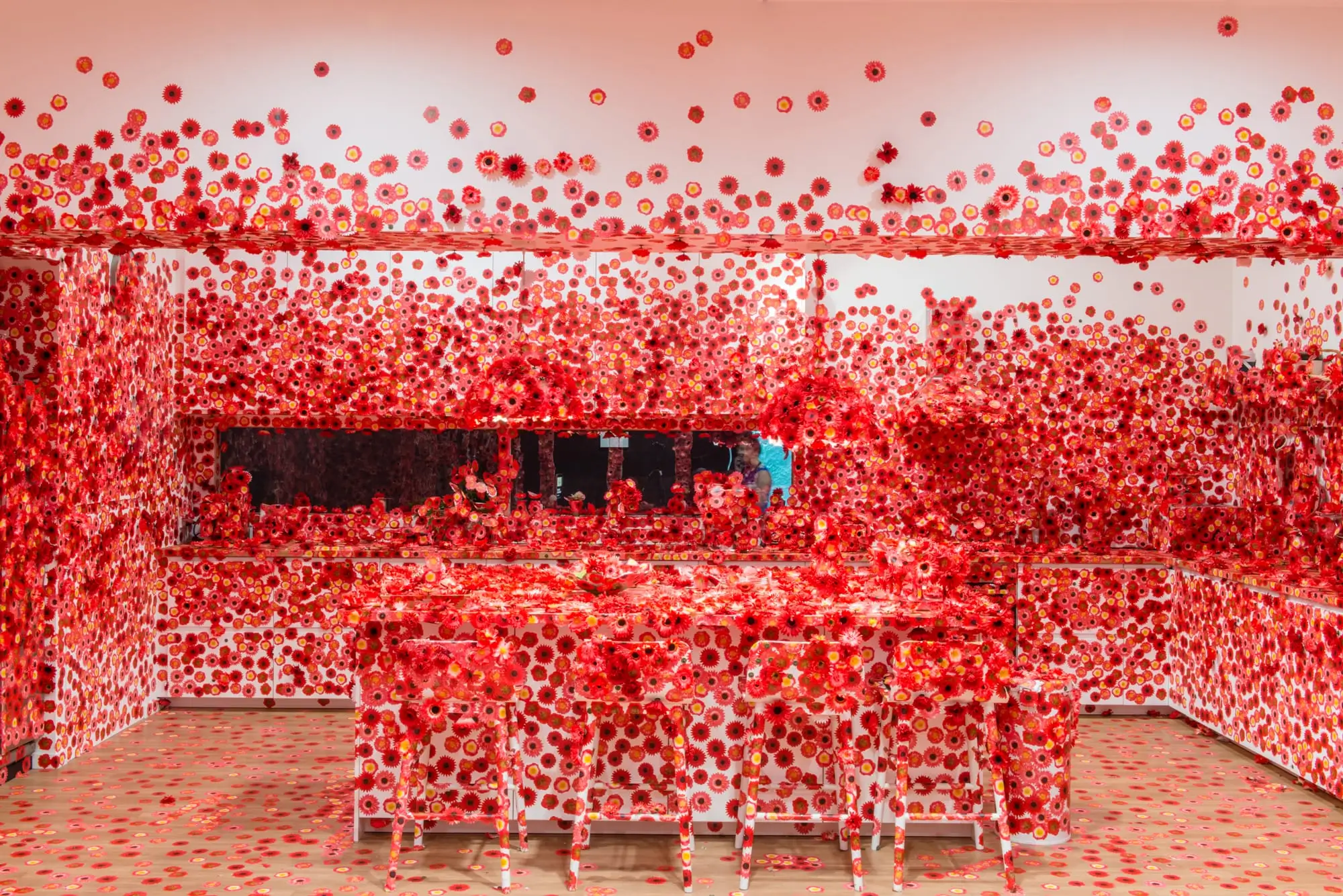
Yayoi Kusama, born in 1929 in Matsumoto, Japan, remains one of the world’s most celebrated living artists. Her practice spans painting, sculpture, installation, performance, and literature, unified by motifs of repetition, infinity, polka dots, pumpkins, and flowers. Among her most interactive and beloved works is Flower Obsession (2016–2017), originally commissioned for the inaugural National Gallery of Victoria (NGV) Triennial in Melbourne, Australia.
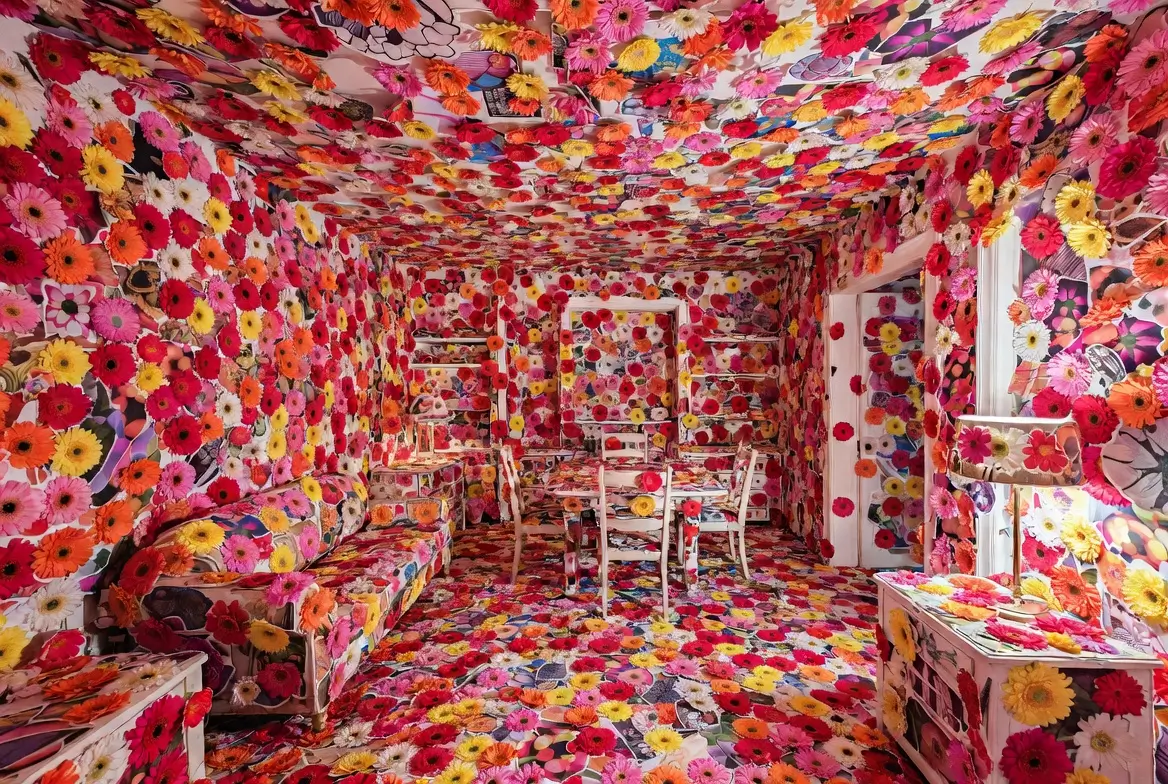
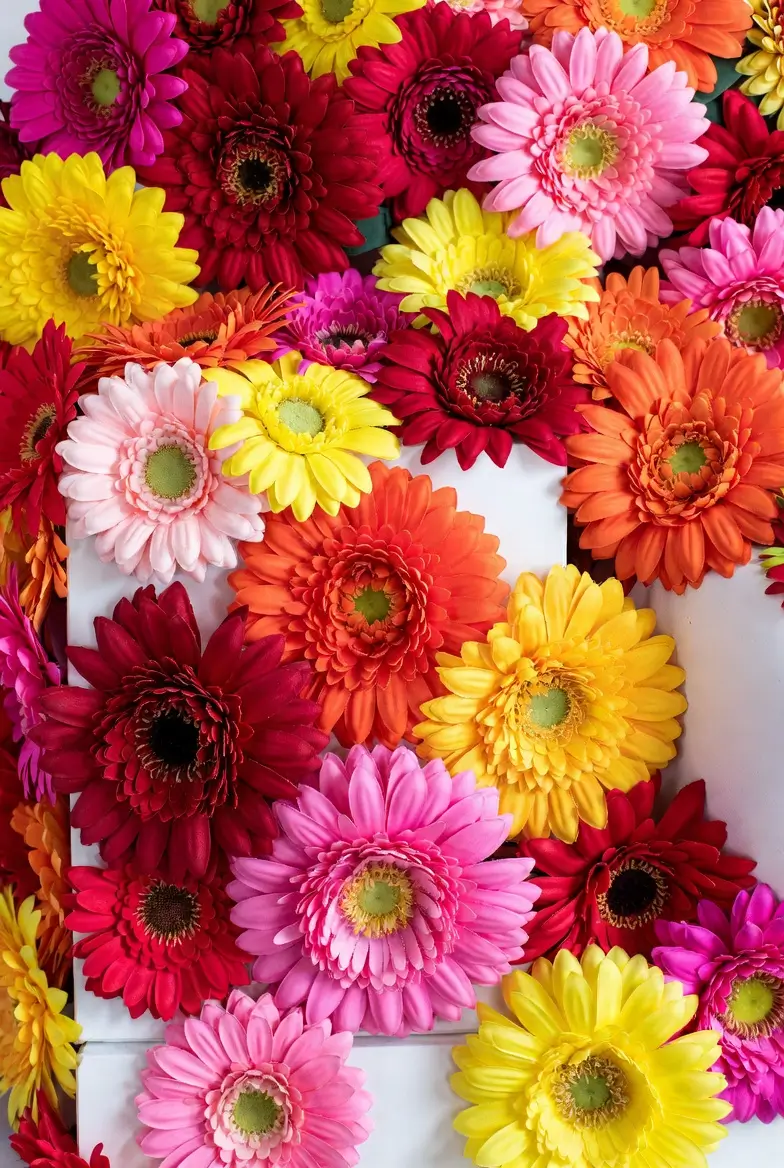
This time-based installation transformed a fully furnished, pristine white domestic interior into an ever-evolving floral environment. Visitors received artificial gerbera daisies (primarily in vibrant reds, pinks, yellows, and oranges) and adhesive flower stickers to place anywhere they chose—on walls, ceilings, furniture, floors, lamps, and everyday objects. Over the exhibition’s run from December 15, 2017, to April 15, 2018, the space evolved from sparse accents to near-total obliteration, embodying Kusama’s core themes of obsession, accumulation, and the dissolution of self into the infinite.

flow
The work’s conceptual foundation traces directly to a formative childhood experience. Growing up amid her family’s plant nursery and seed business, Kusama was immersed in flora. Around age ten, she suffered intense hallucinations. Staring at a red floral pattern on a tablecloth, the motif suddenly multiplied, spreading across the ceiling, windows, columns, her own body, and eventually the entire universe.
Kusama described the moment vividly:
“One day, after gazing at a pattern of red flowers on the tablecloth, I looked up to see that the ceiling, the windows, and the columns seemed to be plastered with the same red floral pattern. I saw the entire room, my entire body, and the entire universe covered with red flowers, and in that instant my soul was obliterated … This was not an illusion but reality itself.”
These views—often involving speaking flowers or endless dots—were terrifying yet compelling. They intertwined with her lifelong struggles with mental health, including obsessive-compulsive tendencies and depersonalization. Art became Kusama’s method of coping: through obsessive repetition, she could “obliterate” fear and merge with the cosmos. Flower Obsession democratizes this process, inviting the public to enact her personal reality.
evolve
Flower Obsession extends Kusama’s earlier Obliteration Room series, which began in 2002 at the Queensland Art Gallery. In those works, a white domestic space was provided with colorful dot stickers for visitors to apply freely. The concept proved wildly popular and was restaged globally.
For the NGV commission, Kusama shifted from abstract dots to a specific floral motif, referencing her childhood directly. The installation recreated a furnished apartment-like setting with sofas, tables, chairs, lamps, and household objects—all starting white. Participants could affix one or more flowers per visit, leading to organic, unpredictable growth. By closing day, the room had become a tactile, multi-layered floral landscape where original furniture outlines blurred beneath the accumulation.
xp
The experience was profoundly immersive. Early visitors encountered a clean, expectant space; later ones navigated a sensory overload of color, texture, and scent from the fabric flowers. The act of placing a single flower encouraged mindfulness—choosing the perfect spot on a lampshade, under a table, or high on the ceiling became a personal ritual.
Social media amplified its reach. Thousands shared progress photos and timelapses, turning the installation into a global digital conversation. Families, children, and adults collaborated unknowingly, each contribution merging into a collective whole. This mirrors Kusama’s philosophy: individual actions dissolve into unity, much like her Infinity Mirror Rooms where reflections multiply the self into infinity.
Participants often described catharsis. The repetitive sticking motion felt meditative, transforming personal anxieties into shared joy. The domestic setting added intimacy—covering everyday objects (a toilet, kettle, or bed) with flowers subverted ordinary life into something extraordinary and alienating.
sig
Flower Obsession encapsulates key elements of Kusama’s oeuvre:
- Self-Obliteration: Covering surfaces (and metaphorically the self) dissolves ego boundaries.
- Repetition as Meditation: The accumulation of flowers echoes her dot and net paintings.
- Feminine Domesticity Reclaimed: The apartment setting explodes traditional gendered spaces with vibrant, uncontrollable growth.
- Mental Health as Universal Experience: By sharing her hallucinations, Kusama normalizes them, turning private struggle into public celebration.
The work also captured 2010s cultural shifts toward participatory and Instagram-friendly art. In an age of digital isolation, it offered tangible community and physical creation. Its success contributed to the NGV Triennial becoming one of the gallery’s most visited exhibitions in its 157-year history.
later
Following the Triennial, the NGV acquired Flower Obsession through the NGV Women’s Association for its permanent collection. Dimensions are listed as approximately 330 × 1890 × 1480 cm (variable), using flower decals, fabric flowers, furniture, and found objects.
The work has been displayed in subsequent exhibitions. Notably, it featured in the major 2024–2025 Yayoi Kusama retrospective at NGV (December 15, 2024 – April 21, 2025), Australia’s largest-ever Kusama show, which included over 180 works and infinity rooms. As of 2026, it remains a highlight of the NGV’s holdings, though not always on permanent view.
consider
Maintaining the piece poses unique challenges. The layered flowers create a fragile, three-dimensional collage susceptible to dust and wear. Conservation involves detailed documentation, careful storage, and decisions about future “activations.” Some iterations of Kusama’s participatory works are reset; others preserved in their final state. The NGV’s approach balances authenticity with longevity.
bequest
At nearly 97 years old, Kusama continues creating from her studio in Tokyo. Her influence permeates contemporary art, fashion (Louis Vuitton collaborations), and public installations worldwide. Flower Obsession stands as a landmark of participatory practice, inspiring artists exploring interactivity, mental health, and collective authorship.
In today’s AI-saturated, virtual world, the work’s analog tactility feels even more vital. It reminds us that art can be joyful, communal, and healing. By handing over the tools of creation, Kusama empowers viewers to confront their own “obsessions” and find beauty in obliteration.
The installation also prompts philosophical questions: Where does authorship end? When thousands contribute, does the work belong to Kusama, the public, or both? Its democratic nature challenges traditional notions of the singular artistic genius.
scope
Comparisons to other Kusama works enrich understanding. Her Infinity Mirrored Rooms use light and reflection for similar boundary dissolution. Monumental pumpkin sculptures and polka-dotted inflatables share the playful yet profound repetition. Flower Obsession bridges her early hallucinatory drawings to large-scale public engagement.
Critically, the piece subverts expectations of “high art.” Its accessibility—free entry during the Triennial—drew diverse crowds, proving immersive art’s power to engage beyond elite circles. Yet its depth rewards repeated viewing and scholarly analysis.
reason
For many visitors, placing a flower became an act of empathy—stepping into Kusama’s childhood reality. The final room, completely engulfed, evoked both overwhelm and liberation. As one participant noted in accounts, it felt like being “inside her mind.”
This resonance persists. In 2026, amid global challenges, Flower Obsession offers escapism and connection. Flowers symbolize transience and renewal—ephemeral yet powerful when multiplied.
Kusama’s art affirms that personal pain, when translated creatively, can become a gift to the world. Flower Obsession is not merely decoration or entertainment; it is a profound invitation to lose oneself in pattern, community, and the infinite.
n
From the DRIFT archive: Between Walls and Silence: Nuno Viegas’s Street Artist (2018)
Related Articles
Winter Ran Down A Plywood Panel In Gaeta
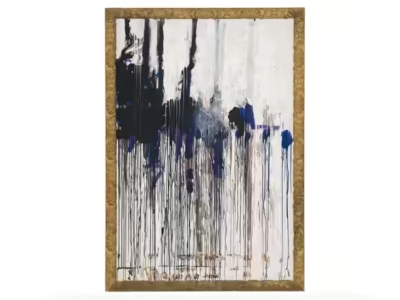
Cy Twombly, Untitled (Winter Picture), 2004. Acrylic on plywood in the artist’s frame. Gagosian, Madison […]