Harland Miller’s Don’t Let the Bastards Cheer You Up (2009): A Sardonic Penguin in the Landscape of Modern & Contemporary Editions

June 2, 2026
Harland Miller (b. 1964, Yorkshire, UK) stands as one of the most distinctive voices in contemporary British art, seamlessly blending his dual identities as a novelist and painter. His practice, particularly the iconic Penguin book cover series that began in earnest around 2001–2002, explores the interplay between text and image, nostalgia and subversion, high culture and day vernacular. Among these works, Don’t Let the Bastards Cheer You Up (2009) emerges as a quintessential example—witty, melancholic, and deeply resonant with Miller’s Northern English roots and broader artistic influences. This essay examines the artwork in depth: its creation, formal qualities, culture context, market presence in Modern & Contemporary Editions sales, and its significance within Miller’s oeuvre and the wider art world.
stir
Born in 1964 in Yorkshire, Miller grew up in an industrial town amid the social and economic challenges of 1970s Britain, including power outages and the backdrop of the Yorkshire Ripper. Books became both escape and anchor. His father collected them obsessively, hoping for rare first editions. This early immersion in literature profoundly shaped Miller, who later published novels like Slow Down Arthur, Stick to Thirty (2000), a semi-autobiographical tale involving a David Bowie impersonator.
Miller studied at Chelsea College of Art, earning his BA and MA. His early travels—to New York, New Orleans, Berlin, and Paris—exposed him to American Pop Art, Abstract Expressionism, and Color Field painting. He adopted the persona “International Lonely Guy,” reflecting a restless, peripatetic spirit. Upon returning, he fused his literary sensible with view art, creating large-scale paintings that mimic worn Penguin paperbacks. These works feature invented titles that are often sardonic, self-deprecating, or provocatively humorous, paired with the iconic Penguin logo.
Influences are clear and generously acknowledged: Ed Ruscha’s marriage of text and image; Mark Rothko’s color bands; Robert Rauschenberg’s materiality; and even medieval illuminated manuscripts for their typographic reverence. Miller treats books as objects with histories—dog-eared, stained, loved, and discarded—imbuing his surfaces with painterly tactility that evokes time and use.
flow
Don’t Let the Bastards Cheer You Up originated as part of Miller’s 2009 solo exhibition at BALTIC Centre for Contemporary Art in Gateshead, also titled Don’t Let the Bastards Cheer You Up. The show featured paintings and works tailored to the North East of England, including titles with regional resonance like Gateshead Revisited. The exhibition marked a significant moment, showcasing Miller’s ability to localize universal sentiments through wit.
The phrase itself is a play inversion of the common adage “Don’t let the bastards get you down.” By flipping “get you down” to “cheer you up,” Miller injects irony and dark humor. In a world of relentless positivity or schadenfreude, the title suggests that external forces (the “bastards”) might perversely try to lift your spirits—or that one should resist false cheer. It epitomizes Miller’s mischievous take on self-help tropes, motivational clichés, and the absurdities of human resilience. As Miller has noted, titles come from “everywhere, anywhere,” inviting personal interpretation rather than imposing fixed meaning.
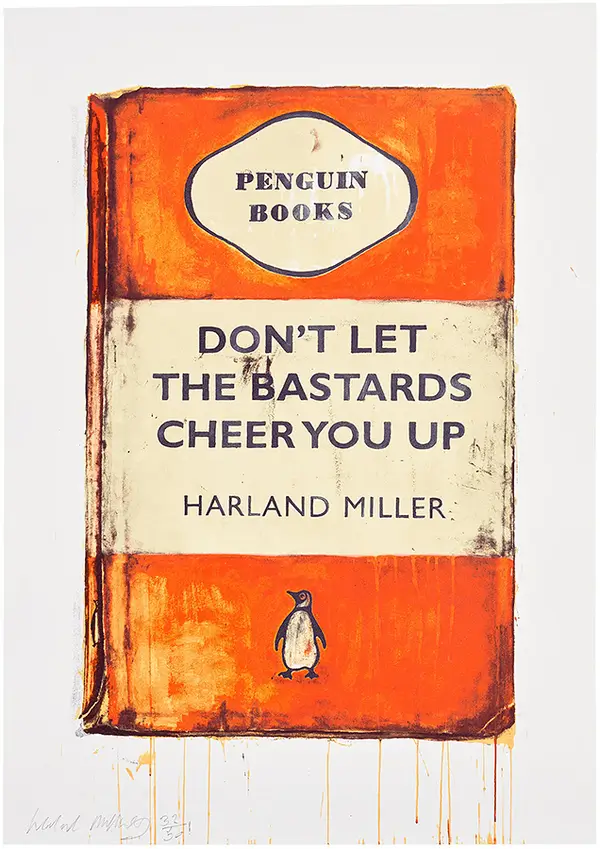
The editioned prints derive from an original watercolour. Produced in 2009 and published by White Cube, London, the screenprint exists in an edition of 50, with signed and numbered examples on wove paper. Dimensions are approximately 59 x 42 cm (23 ⅜ x 16 ½ inches), making it intimate yet impactful—evoking the scale of an actual paperback while suitable for wall display.
lang
Don’t Let the Bastards Cheer You Up replicates the classic mid-20th-century Penguin design: bold orange and white bands, the Penguin colophon, and sans-serif typography. The title appears prominently, often with “HARLAND MILLER” listed as author, collapsing creator and creation. Miller’s brushwork introduces painterly imperfections—faded edges, smudges, creases, and subtle tonal variations—that simulate a well-thumbed volume. This trompe-l’œil effect heightens nostalgia while underscoring the work’s status as a painted object, not a mere reproduction.
Tincture plays a critical role. The orange evokes Penguin’s fiction branding, conveying energy and accessibility, while white space provides contrast and gravity. Influences from Rothko manifest in these horizontal bands, creating emotional fields. Ruscha’s impression appears in the textual integration, where words become compositional anchors. The surface invites close viewing: one notices the screenprint’s flatness layered with hand-finished qualities in some variants (unique or hand-painted editions exist alongside standard prints).
This tension between mechanical reproduction (screenprint) and artisanal touch mirrors broader themes in Miller’s practice: the democratization of art via editions versus the aura of the unique object. In Modern & Contemporary Editions contexts, this positions the work perfectly—accessible yet collectible, bridging print culture and fine art markets.
straddle
Miller’s humor is rarely lightweight. Rooted in Northern stoicism—“where humour replaces or does instead of stoicism”—it often masks deeper melancholy or critique. Don’t Let the Bastards Cheer You Up comments on resilience amid adversity, the commodification of emotion, and the gap between representation and reality. In 2009, post-financial crisis, such sentiments resonated: economic “bastards” (banks, systems) offering hollow cheer or false recovery narratives.
The work fits into Miller’s broader exploration of language’s power and limitations. Words “offer a way into what you’re looking at,” yet create imbalance. Viewers project personal experiences—workplace cynicism, political disillusionment, or private struggles—onto the phrase. This openness aligns with his self-help series (Immediate Relief… Coming Soon, Reverse Psychology Isn’t Working), where ironic titles critique simplistic solutions to complex human conditions.
Gender, class, and regional identity subtly inform the piece. Miller’s Yorkshire voice challenges London-centric art world elitism, using popular literary formats to democratize discourse. The “bastards” could reference authority figures, critics, or societal pressures, with the inversion suggesting defiant optimism or weary acceptance.
scope
In auction houses like Phillips, Christie’s, and Sotheby’s, Miller’s prints thrive in “Modern & Contemporary Editions” sales. These evenings group blue-chip and emerging printmakers, highlighting accessibility and investment potential. Don’t Let the Bastards Cheer You Up has appeared in such contexts, with strong results.
Estimates typically range £8,000–£16,000 for standard signed prints, with unique hand-finished variants fetching higher (e.g., £25,000–£35,000+). Auction records show sales like £17,500 (Tate Ward, 2019) and hammer prices fluctuating with market conditions. MyArtBroker values signed examples at £10,500–£16,000, noting 10+ in demand and appearances in prominent collections.
Factors driving value include:
- Edition size (50): Scarce enough for exclusivity.
- Provenance: White Cube publication and BALTIC exhibition link.
- Cultural cachet: Penguin nostalgia appeals to literary collectors.
- Broader Miller market: Large paintings command six figures; prints offer entry points.
In 2022–2026 sales, Miller’s works benefited from renewed interest in text-based art amid digital overload. Editions democratize his practice, allowing wider audiences to engage with themes of literature and irony. Variants (e.g., 2016 hand-finished with acrylic, glitter) show evolution, commanding premiums in later sales.
leg
Critics praise Miller for reviving painting’s narrative potential in a conceptual age. His works bridge Pop Art’s immediacy with abstraction’s emotional depth. Influences on younger artists—like The Connor Brothers, with their retro-ironic style—are evident. Exhibitions at White Cube, York Art Gallery (York, So Good They Named It Once, 2020), and international venues affirm his stature.
Don’t Let the Bastards Cheer You Up encapsulates Miller’s know: art as conversation between word and image, past and present. It resists easy cheer while offering visual and linguistic pleasure. In an era of curated positivity (social media, wellness culture), its wry warning feels prescient.
imply
Miller’s Penguin series comments on publishing’s decline and art’s commodification. By monumentalizing paperbacks, he elevates the ephemeral. Editions extend this: prints circulate like books, entering homes and collections globally. In Modern & Contemporary Editions sales, they exemplify how printmaking sustains artist careers and market liquidity.
Comparisons to Ruscha or Christopher Wool highlight shared text-image concerns, but Miller’s literary authenticity and regional humor distinguish him. His work anticipates meme culture’s ironic captions yet retains painterly craft.
reason
For many collectors, these prints evoke personal libraries or formative reading experiences. The title might resonate with anyone facing adversity—artists battling rejection, individuals navigating bureaucracy, or societies confronting polarization. Miller invites this: “abstracted, disembodied language… can mean something entirely different, something personal.”
fin
Don’t Let the Bastards Cheer You Up (2009) is more than a print; it is a culture artifact. It distills Harland Miller’s genius: transforming nostalgia into critique, humor into profundity, and literature into view poetry. In Modern & Contemporary Editions, it exemplifies how editions bridge accessibility and connoisseurship, allowing collectors to own a piece of Miller’s sardonic worldview.
As Miller continues evolving—through Letter Paintings, Hell series, and abstractions—early Penguins like this remain foundational. They remind us that in art, as in life, words matter, surfaces deceive, and a well-placed quip can both wound and uplift. Far from letting the bastards cheer us up, Miller equips us with the ironic tools to face them—and perhaps smile anyway.
Related Articles
Chasing the Sort Sol: Inside Søren Solkær’s Six Year Pursuit of Europe’s Starling Clouds
A Danish portrait photographer spent six years following a bird nobody photographs on purpose, and […]