DRIFT AUDIO
Listen to this story
Choose a voice, then press play.
recall
- A brutal twelve months
- The numbers behind the headline
- Where the bleeding is coming from
- Mayhoola, Kering, and the cost of staying afloat
- A new CEO walks into the fire
- Is Alessandro Michele the problem?
- Early signs of a course correction
- What happens next
stir
It’s hard to think of a opulent house that has had a rougher stretch than Valentino. Founder Valentino Garavani passed away in January 2026, days before creative director Alessandro Michele’s first haute couture show for the house — a coincidence of timing that turned what should have been a debut into something closer to a memorial. Before that, there had been months of chatter about friction between Michele’s studio and Valentino’s commercial leadership, then the abrupt exit of CEO Jacopo Venturini in August 2025 amid reports of burnout, and finally the arrival of industry veteran Riccardo Bellini as his replacement.
Now the financial picture has caught up with the headlines. According to a company filing reviewed by Reuters, Valentino closed 2025 with revenue of €1.12 billion, a 15% drop from the year before. Core profitability collapsed even faster than sales, and the group’s debt load — already a concern — pushed higher still. Shareholders have had to step in twice in roughly a year to keep the business stable, and they’ve already signaled they’ll need to do so again in 2026.
None of this happens in a vacuum. Money demand has been sliding across the board for two years running, and almost every major house — independent or conglomerate-owned — is nursing some version of the same wound. But Valentino’s combination of a leadership reshuffle, a creative transition still finding its footing, and a balance sheet under real strain makes its 2025 results a useful stress test for how fragile mid-tier haute houses have become when several problems hit at once.
View this post on Instagram
flow
The topline figures are stark. Revenue fell to €1.12 billion, down 15% year-on-year. EBITDA — earnings before interest, tax, depreciation and amortization, generally the cleanest read on a fashion house’s underlying health — dropped 41% to €174 million, a far steeper decline than revenue alone would suggest, pointing to cost structures that didn’t shrink as fast as sales did.
Operating profit told the most dramatic story of all. Valentino had posted a €31 million operating profit in 2024. In 2025, that swung to an operating loss of €103 million — a swing of well over €130 million in a single year. Net debt, measured under IFRS 16 accounting (which folds in lease obligations for stores and offices), climbed to €1.13 billion from €1.08 billion the year before. Strip out those lease liabilities and the picture is somewhat less alarming but still moving in the wrong direction: debt excluding leases rose to €472 million from €377 million.
It’s worth noting that 2024 wasn’t exactly a strong year either — Valentino had already reported a 3% revenue decline and a 22% drop in EBITDA that year, alongside the brand’s first full year with Michele at the helm. What 2025 shows is that the slide didn’t stabilize; it accelerated.
The filing also disclosed that Valentino had breached certain loan covenants earlier in 2025, which triggered a renegotiation with its lending banks. That renegotiation reset the financial covenants tied to the company’s leverage ratio and added quarterly reporting requirements — a level of oversight that signals just how closely banks are now watching the house’s cash position.
huh
The sales decline wasn’t isolated to one market or one product line — it hit every region Valentino operates in, according to the filing. Japan and Asia-Pacific, two markets that had been reliable growth engines for European luxury houses for the better part of a decade, saw the sharpest contractions. That regional weakness lines up with the broader haute sector’s well-documented struggles in China and the wider APAC region, where a mix of slower local consumption, currency effects, and shifting tourist spending patterns has hit nearly every major house, not just Valentino.
By category, the picture is more mixed. Fashion jewelry and fragrances — typically the more accessible, higher-volume parts of a luxury brand’s portfolio — held up comparatively well, acting as something of a buffer. Leather goods and footwear, on the other hand, posted weaker results, which matters a great deal for a house where accessories have historically driven a large share of profitability.
Women’s ready-to-wear, the category most tied to Valentino’s couture identity, also lost ground as a share of total revenue, slipping to roughly 24% of sales from about 25% the year before. The filing attributed part of that softness to weaker show in directly operated stores — Valentino’s own boutiques, as opposed to wholesale or franchise channels — which suggests the brand is struggling to convert footfall into purchases even where it controls the entire retail experience.
expend
Valentino’s ownership structure has become almost as important to this story as its creative direction. Qatar-backed investment group Mayhoola owns 70% of the house, while French luxury conglomerate Kering holds the remaining 30%, a stake it acquired in 2023 for roughly €1.7 billion. As part of that deal, Kering holds an option to eventually take full ownership — reported variously as 2028 or 2029 depending on the source, so treat the exact year as unconfirmed pending Kering’s own disclosures — with the final purchase price expected to be linked to how the brand performs between now and then. That detail gives Kering a direct financial stake in seeing Valentino’s numbers improve, separate from whatever strategic interest it has in the brand itself.
With the business burning cash, both shareholders have had to open their wallets. The filing disclosed that €100 million in capital injections were made in 2025, on top of a previously agreed facility of up to €150 million tied to the covenant renegotiation. Mayhoola and Kering have also confirmed further financial commitments for 2026, though the filing didn’t specify an exact figure. As the document put it, capital injections totaling €100 million were made in 2025 and additional commitments for 2026 have already been formalized.
That’s a notable amount of shareholder support for a single fiscal year, and it underscores that Valentino isn’t simply weathering a soft patch — it’s currently dependent on its owners actively propping up its balance sheet rather than funding growth purely from operations. For Kering specifically, the timing is awkward: the group has its own well-documented struggles at Gucci and is simultaneously trying to execute a turnaround under new leadership, all while financing a second turnaround at a house it doesn’t yet fully own.
switch
Riccardo Bellini officially became Valentino’s CEO on September 1, 2025, stepping into the role from his prior position as managing director of Mayhoola, Valentino’s majority shareholder. His résumé reads like a checklist for exactly this kind of assignment: he was CEO of Maison Margiela from 2017 to 2019, working alongside John Galliano, then ran Chloé from 2019 to 2023, where he pushed the brand toward a more exclusive positioning and shut down its lower-priced See by Chloé line. Earlier in his career he held marketing roles at Diesel and Procter & Gamble.
He replaced Jacopo Venturini, who had returned to Valentino in 2020 and stepped down in August 2025 after months of speculation about strain in the role. Valentino’s chairman, Rachid Mohamed Rachid, framed the appointment as an effort to accelerate the brand’s trajectory, pairing Bellini’s commercial and operational background with Michele’s creative direction.
It’s a genuinely difficult brief. Bellini has to stabilize a balance sheet that’s currently dependent on shareholder injections, rebuild confidence with lending banks under new covenant terms, and do all of this while a multi-year creative repositioning is still being absorbed by the market — all without the luxury of time that a healthier balance sheet would buy him. His experience steering Chloé through a brand elevation strategy suggests he understands how to sharpen a house’s positioning, but Chloé never had to manage a near-€1.2 billion revenue base with this much debt attached.
View this post on Instagram
hmm
This is the question circulating across the industry, and it doesn’t have a clean answer. Michele was named Valentino’s creative director in March 2024, succeeding Pierpaolo Piccioli after a 25-year run, and his first collections leaned heavily on the maximalist, vintage-inflected aesthetic he’d spent nearly a decade building at Gucci. Critics and longtime Valentino clients noticed the overlap immediately, and some of the online response to his earliest shows was openly hostile — Michele himself has acknowledged seeing the backlash on social media, while pushing back on the idea that experimentation should be treated as some kind of transgression.
It would be too simple to pin Valentino’s full financial slide on one designer’s aesthetic choices. The broader luxury slowdown has hit houses with far more aesthetic continuity than Valentino’s, and Kering’s own flagship brand, Gucci, has posted its own steep declines under entirely different creative leadership. Transforming a house with eighty years of codified identity takes time, and two years is a short runway by historical standards — Tom Ford needed several seasons at Gucci before sales caught up with critical momentum, and even then under very different market conditions.
That said, the timeline doesn’t fully let Michele off the hook either. When Bellini’s appointment was announced last August, both Mayhoola and Kering publicly reaffirmed confidence in the creative direction despite the swirling rumors of internal friction. Ten months later, results haven’t just failed to improve — they’ve gotten meaningfully worse, with the operating loss nearly matching the entire previous year’s profit in reverse. Michele has spoken about needing to “build a bridge” between the house’s legacy and his own creative instincts, and has acknowledged that earlier collections leaned more heavily on replication of his Gucci-era signatures than the house’s own codes — a dynamic that, by his own admission, has shifted in more recent seasons.
potential
There’s reasonable evidence that Michele’s approach has been evolving in a more Valentino-specific direction, even if the financials haven’t caught up yet. His spring 2026 collection, shown under the title “Fireflies,” was noted for a more restrained hand than his earlier shows — fewer overt callbacks to his Gucci-era signatures and a tighter focus on embroidery and embellishment rather than full maximalist spectacle. His January 2026 haute couture show, staged inside an immersive circular structure inspired by 19th-century optical devices, was widely read by critics as a more deliberate, reverent engagement with Valentino’s own history rather than an import from elsewhere — a tone that took on extra weight given that it followed Garavani’s death by only days.
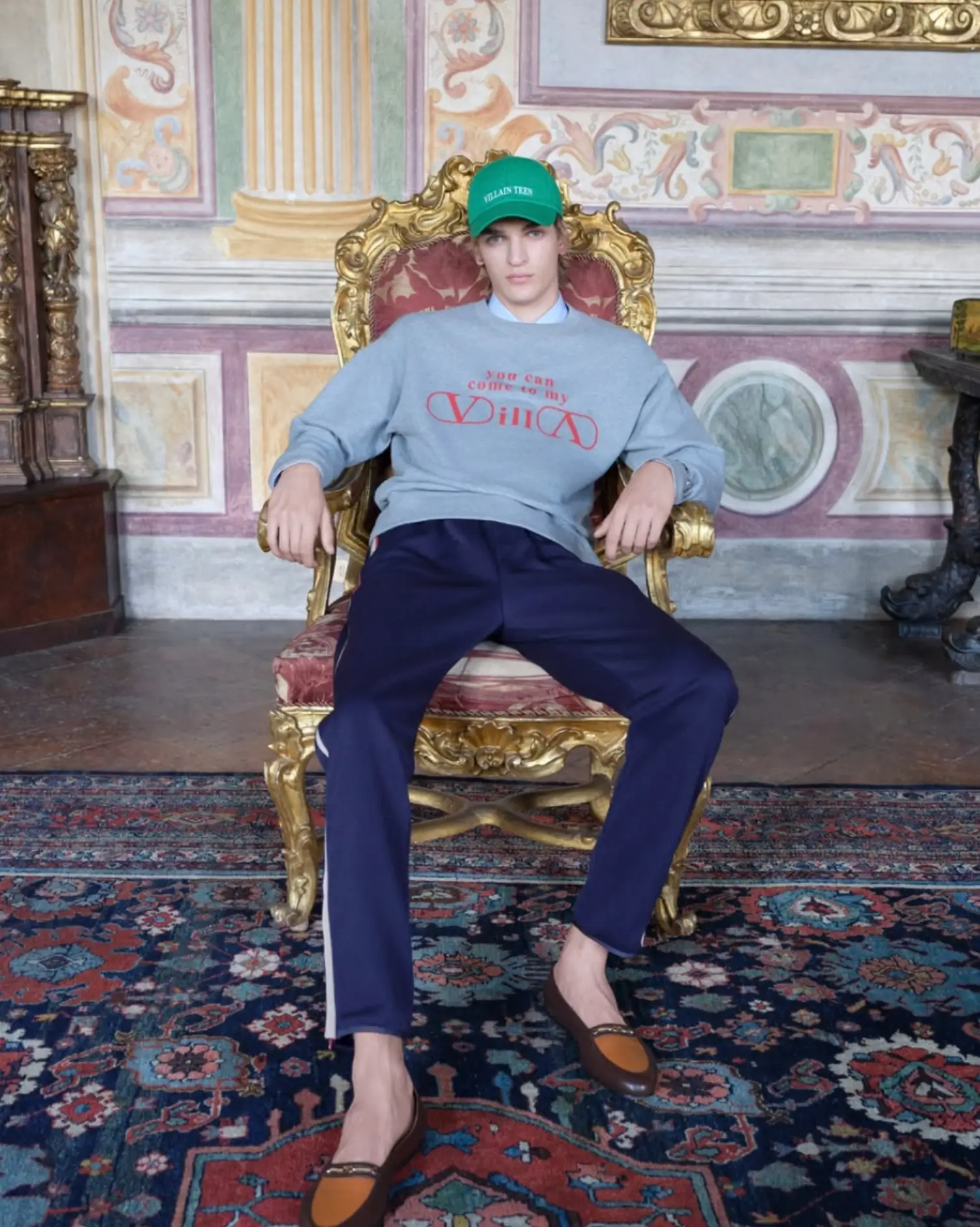
Commercially, the most telling signal has been the renewed push behind hero accessories like the Rockstud, the stud-embellished line that has been one of Valentino’s most recognizable and consistently profitable designs since the Garavani era. Bringing a flagship product like the Rockstud back to the center of campaigns and pre-fall collections is a fairly direct signal that the house is trying to rebuild bridges with a customer base that, for nearly two decades under Pierpaolo Piccioli, came to associate Valentino with a very different visual language than the one Michele is currently shaping.
fin
Realistically, nothing about Valentino’s situation resolves quickly. The renegotiated bank covenants and quarterly reporting requirements mean the house is now operating under far closer financial scrutiny than before, and shareholders have already signaled more capital will be needed in 2026. Bellini’s task is to convert his operational track record into measurable stabilization within a window that’s likely to be judged in quarters, not years, given how exposed Kering already is on its own turnaround timeline at Gucci.
Michele, for his part, appears to be threading a more careful needle between his own creative identity and Valentino’s historic codes than he was eighteen months ago — but aesthetic goodwill and balance-sheet recovery move on very different timelines. Whether the more restrained, hero-product-led direction translates into a real sales rebound likely won’t be visible until at least the back half of 2026, when the current round of shareholder support and covenant terms will be tested against actual results rather than promises.