DRIFT AUDIO
Listen to this story
Choose a voice, then press play.
Amelia Cross stitches real thread into painted linen, building shirts and collars that trick the eye into hunting for the seam between fabric and paint.
In This Story
- A Painter Who Never Stopped Being a Tailor
- What a Sewn Painting Actually Is
- The Underground as a Studio
- Discipline and Display, and the Uniforms Underneath It
- Where This Sits in a Longer Lineage
There is a certain-different kind of person who notices the small things clothing tries to hide. Not the obvious signals, the tailored blazer or the shined shoe, but the accidental ones: a nametag gone soft and curled at the corners after too many wears, the faint blue bruise of a pen that has bled through a shirt pocket, a collar pressed so hard it starts to look like armor rather than fabric. Amelia Cross has built an entire practice around exactly that gap, the space between what an outfit is meant to say and what it accidentally lets slip.
Cross trained first as a tailor, earning a degree in bespoke tailoring from the London College of Fashion before going on to a master’s in painting at the Royal College of Art, where she graduated in 2025 after being awarded the President and Vice Chancellor’s Scholarship. That order of operations matters more than it might sound. Most painters who eventually turn to clothing as subject matter arrive at it from the outside, treating garments the way any other still life object gets treated, something to be observed and rendered. Cross arrived from the inside, having spent years learning to cut, drape, and construct clothing by hand before she ever picked up a brush with the intention of painting it. That background shows up in almost everything she now makes.
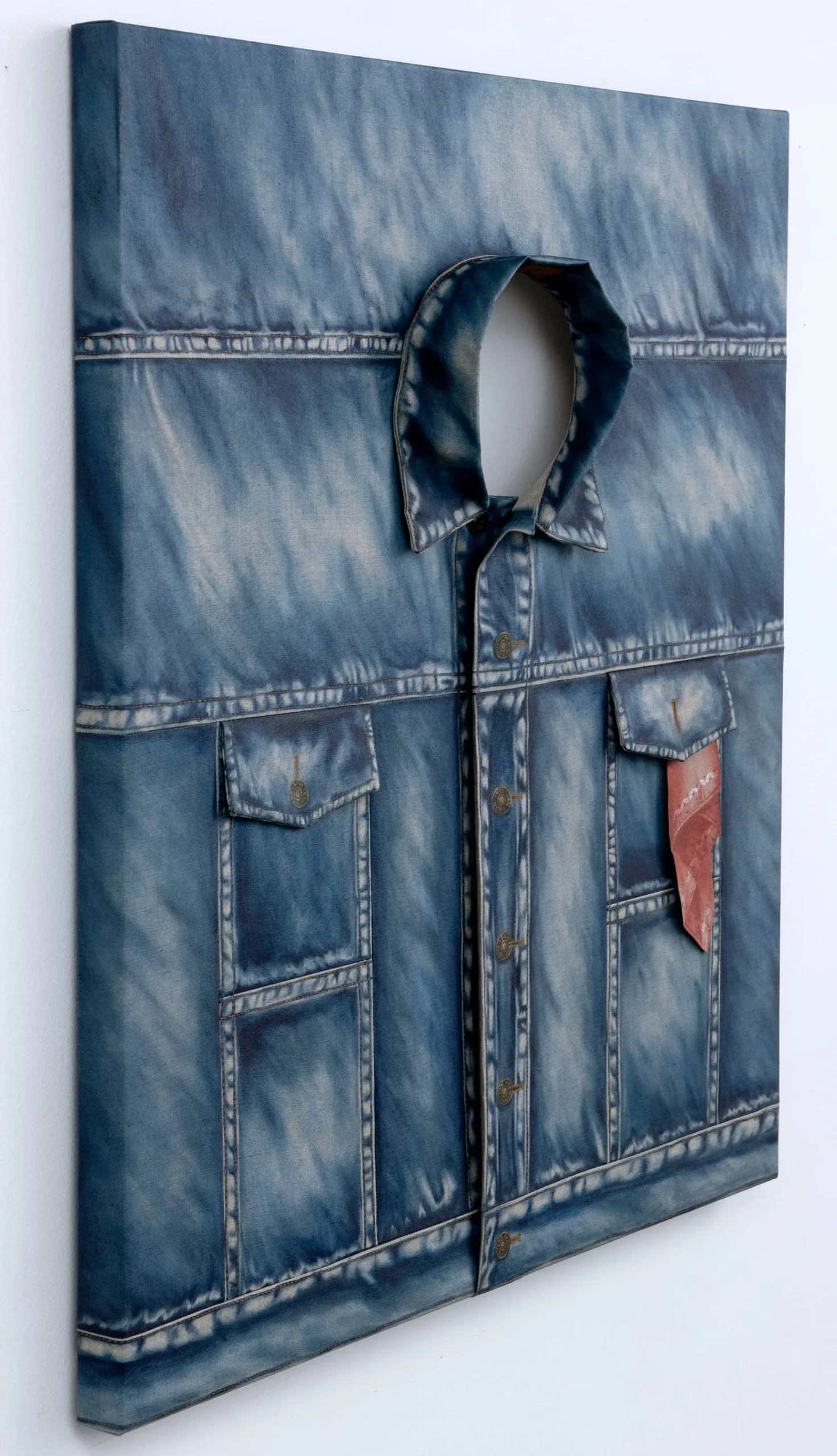
Amelia Cross transforms the familiar denim jacket into a meticulously sewn painting, using fabric, stitching, and sculptural illusion to blur the line between everyday clothing and contemporary art.
It is worth sitting with how unusual that career path actually is inside the British art world, where fashion training and fine art training tend to run on separate tracks that rarely cross before someone is already established in one or the other. Bespoke tailoring, in particular, is a trade built on precision and repetition, on getting a pattern piece exactly right before it ever gets cut, and it produces a very different set of instincts than a fine art painting degree, which tends to reward experimentation and the willingness to fail in public. Cross’s practice sits at the collision point of both instincts, and the tension between them, precision on one side, openness to accident on the other, has become the engine of the work rather than something she needed to resolve before she could start making it.
stir
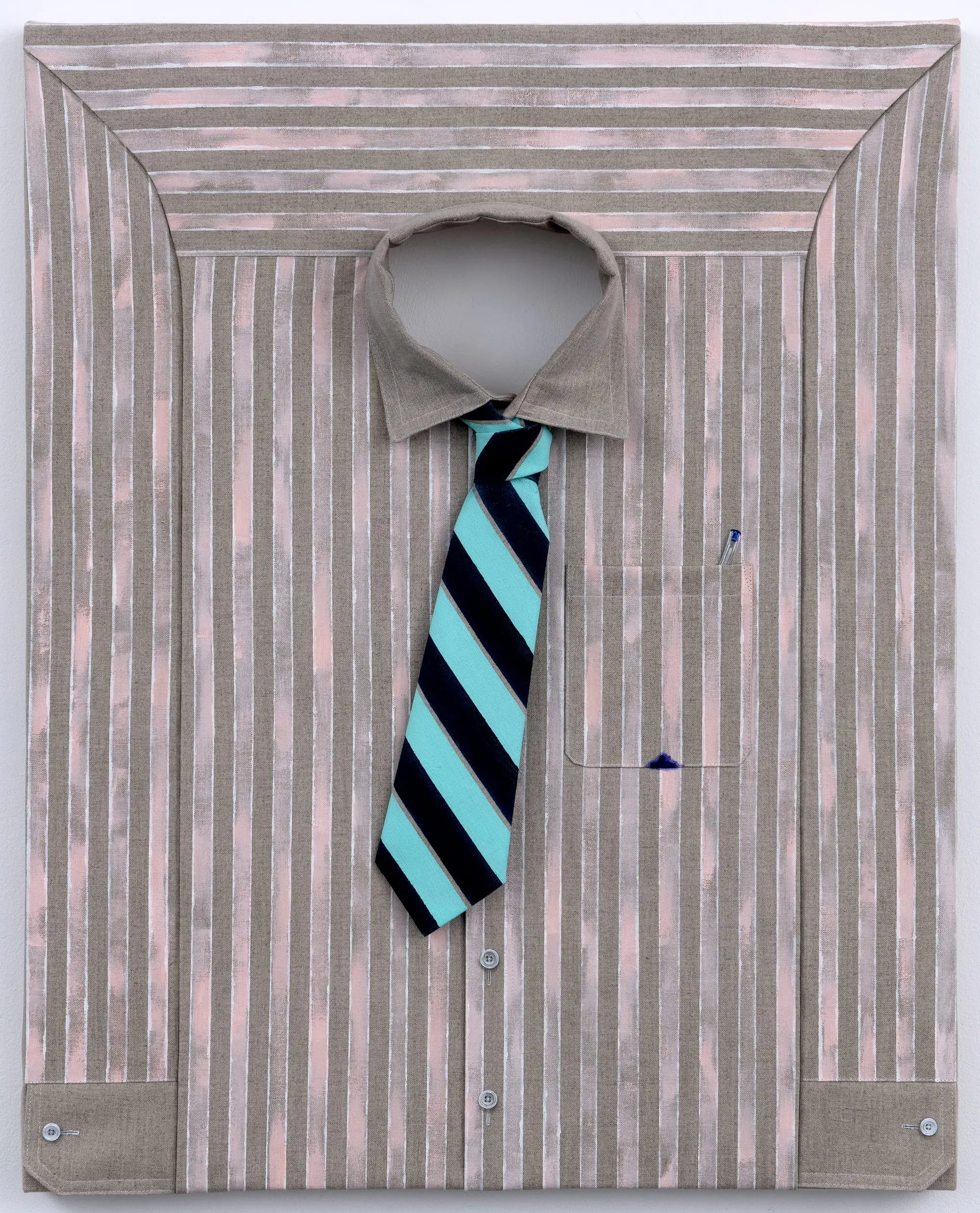
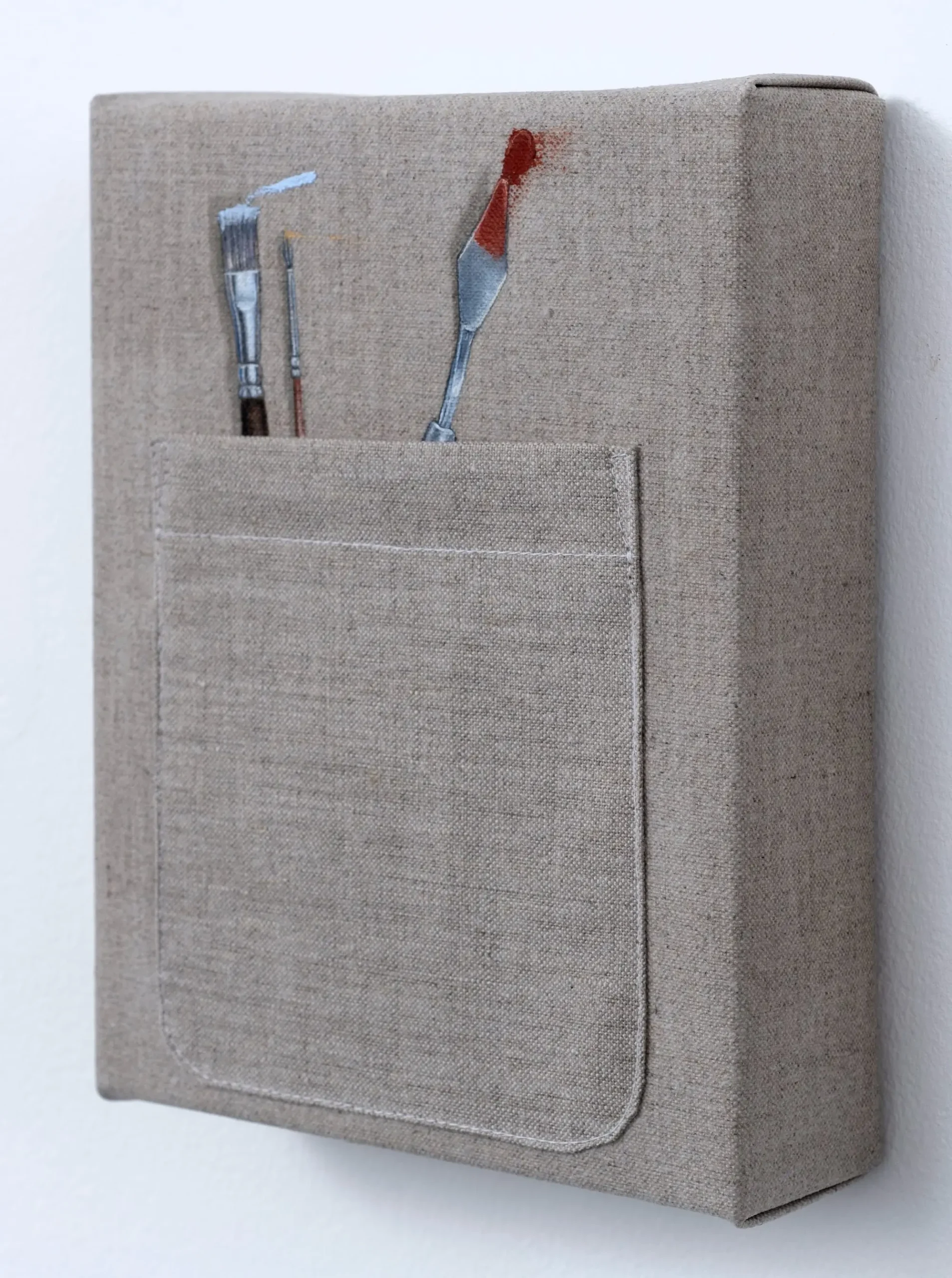
The work Cross has settled into making does not fit comfortably into either category she trained in. She calls the pieces sewn paintings, a term specific enough that she has effectively coined it herself, and the name is doing real descriptive work rather than acting as a clever label. Cross stretches her own canvases from raw linen, the same unforgiving material a tailor might use for a shirt pattern, and then paints directly onto it in a restrained, largely tonal palette. Where the trick begins is in what happens next: rather than painting every silhouette, seam, and fold, she sews some of them, using actual cotton thread stitched through the linen to create a real, three dimensional collar, pocket flap, or button that sits directly beside a painted one built from nothing but pigment and technique.
The effect draws on trompe l’oeil, the centuries old painting tradition built entirely around fooling the eye into believing a flat surface holds real depth. The technique has a long, well documented history stretching back through Roman wall painting and into countless still life traditions across Europe, where painters competed to render a fly on a painted tabletop so convincingly that a viewer might actually try to brush it away. Cross has updated that trick for an era that already assumes images can lie. Instead of asking a viewer to be fooled once and then move on, her work asks them to keep looking, to hunt for the boundary between the sewn element and the painted one, and to accept that the boundary itself is often the entire point of the piece. A folded shirt might have a genuinely stitched pocket sitting an inch away from a painted shadow that implies a second pocket that was never actually constructed. The paintings do not resolve that tension so much as sit inside it.
Cross has spoken about how the idea developed almost against her own original plan. She began by making flat, figureless paintings of clothing laid across linen in the conventional sense, images rather than objects. It was only once she started feeling the pull to bring her sewing machine back into the studio alongside the easel that the sewn pocket studies began, small experiments pairing painted buttons and shadows with a physically constructed collar or pocket. As she put it, that unusual pairing of the real and the illusionary quickly became the thing she found most compelling about her own work.
flow
It would be easy to assume a practice this technically demanding and slow, hand sewing linen while also rendering convincing painted shadow, would draw its ideas from long, quiet observation in a controlled setting. Cross’s actual source material is considerably less romantic and considerably more London: the commute. She has described how packed carriages on the Underground during rush hour end up shaping the literal composition of her paintings, since being crushed shoulder to shoulder with strangers only ever offers a partial, cropped view of what anyone around her is wearing. That practical constraint, seeing a sliver of collar or a corner of a coat pocket rather than a whole outfit, has become a formal signature of the work itself, which frequently crops in tight on a single garment detail rather than composing a full figure.
There is something quietly democratic about building an entire body of work out of what strangers on public transit accidentally reveal about themselves. A shirt pocket with a pen clipped into it, a sock riding up under a rolled trouser cuff, a nametag from a job that clearly requires one, these are not curated fashion choices so much as leftover evidence of somebody’s actual day. Cross has talked about how much of a person’s character can be built from those fragments alone, based on nothing more than what turns out to be sitting inside their pocket or which socks they happened to put on that morning for work. It is an argument that clothing tells the truth about people most convincingly in the parts nobody bothered to arrange.
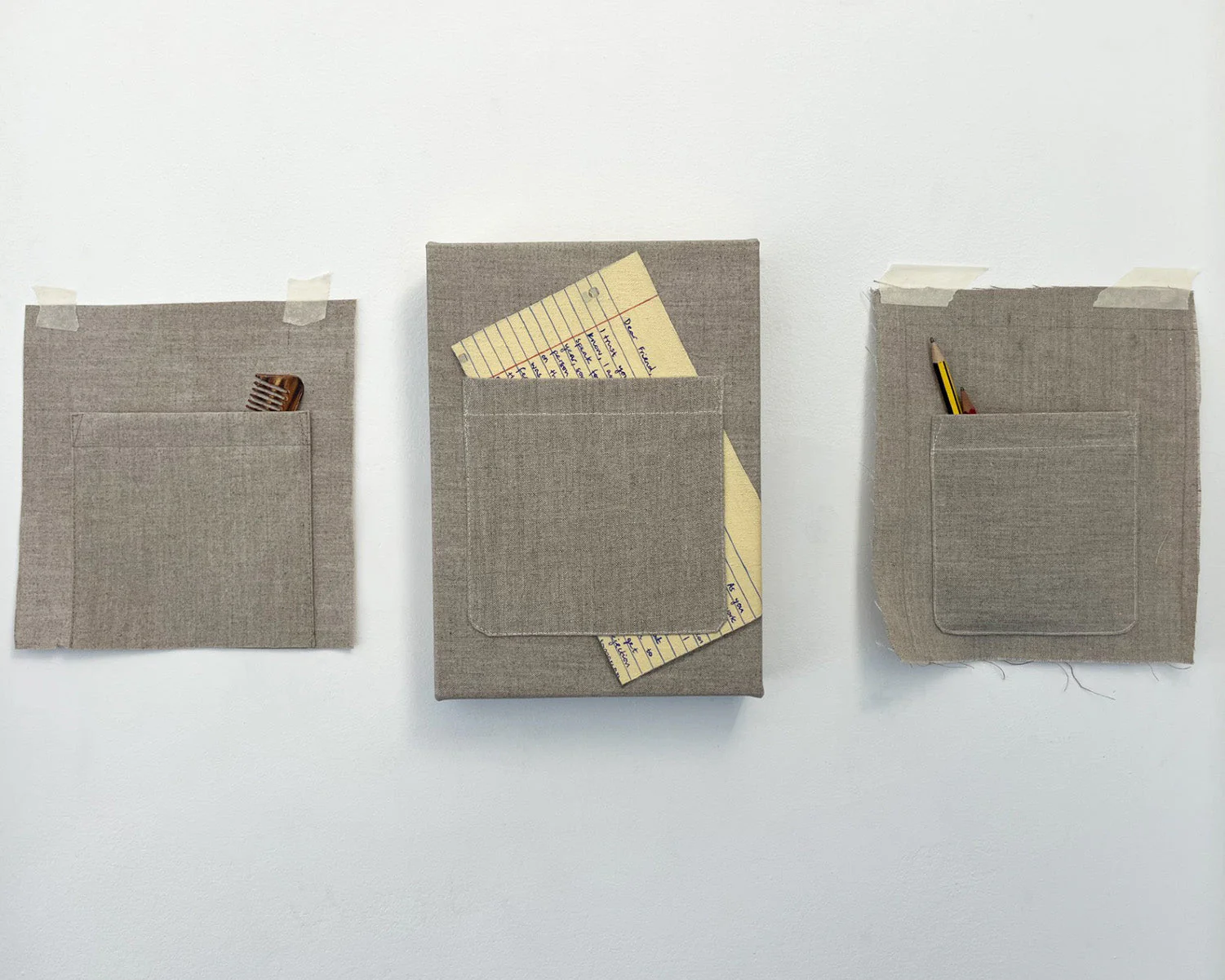
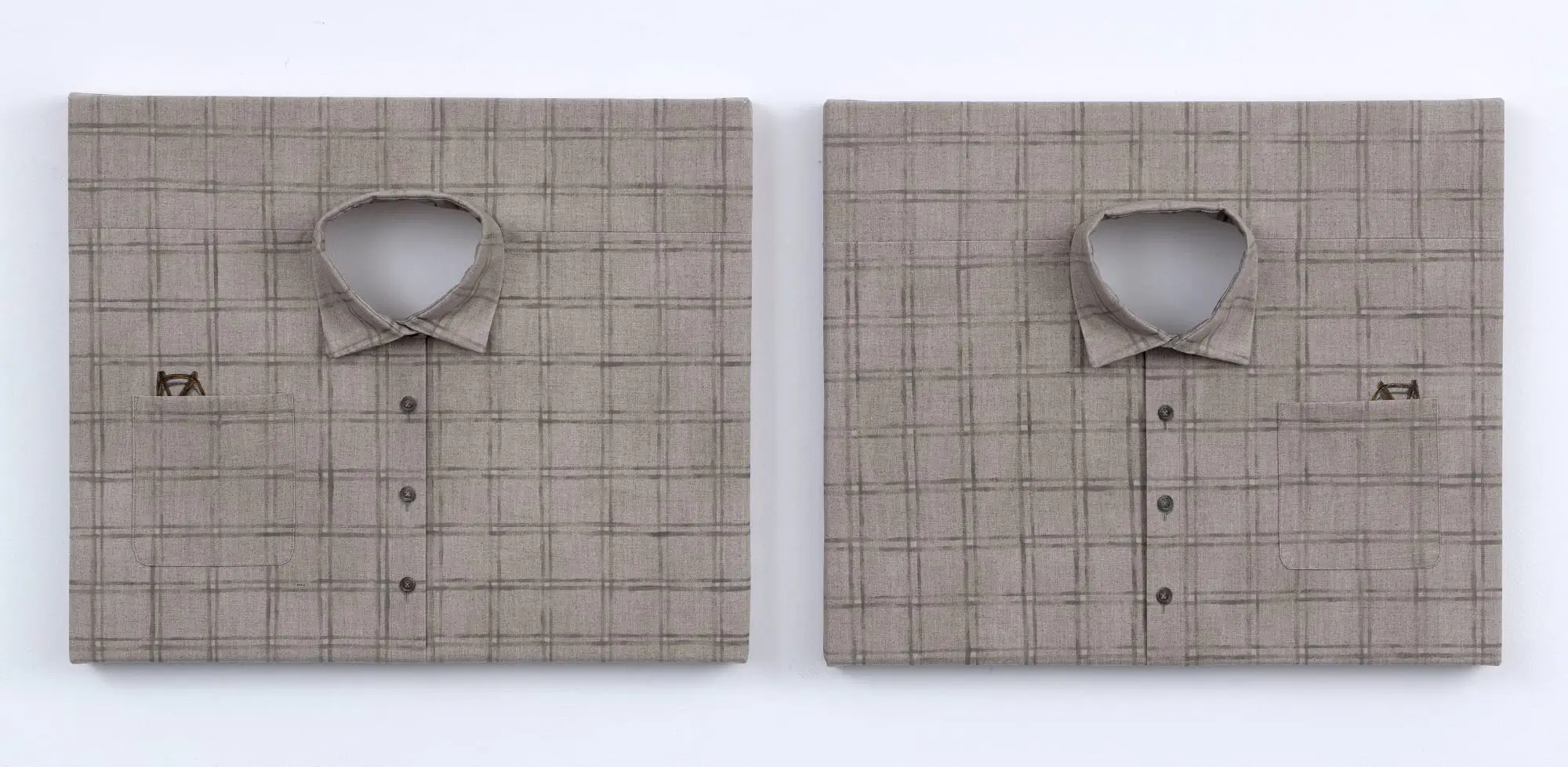
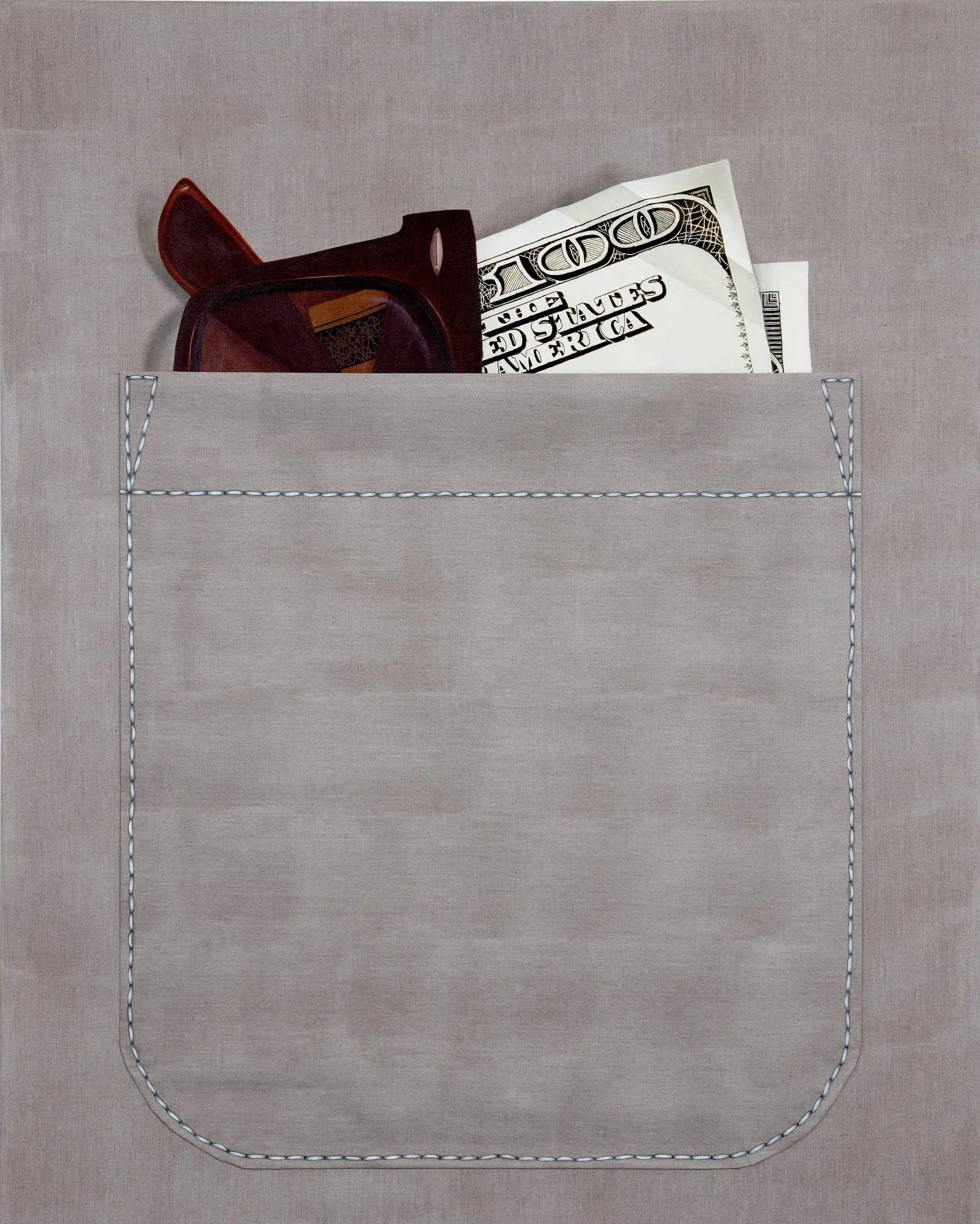
Amelia Cross presents a trio of sewn canvas pocket studies, transforming ordinary storage details and personal belongings into meticulously crafted textile artworks that blur the boundary between painting, sculpture, and daily life.
show
That interest in the unspoken rules governing how people dress runs directly into Cross’s current solo exhibition, Discipline and Display, her first solo show in the United States and her debut with Nino Mier Gallery. Where her earlier studies tended to isolate a single pocket or a single pair of shoes as a kind of intimate character study, this body of work widens the lens to look at dress codes and uniforms specifically, the garments that schools, workplaces, and other institutions use to mark who belongs where and who answers to whom.
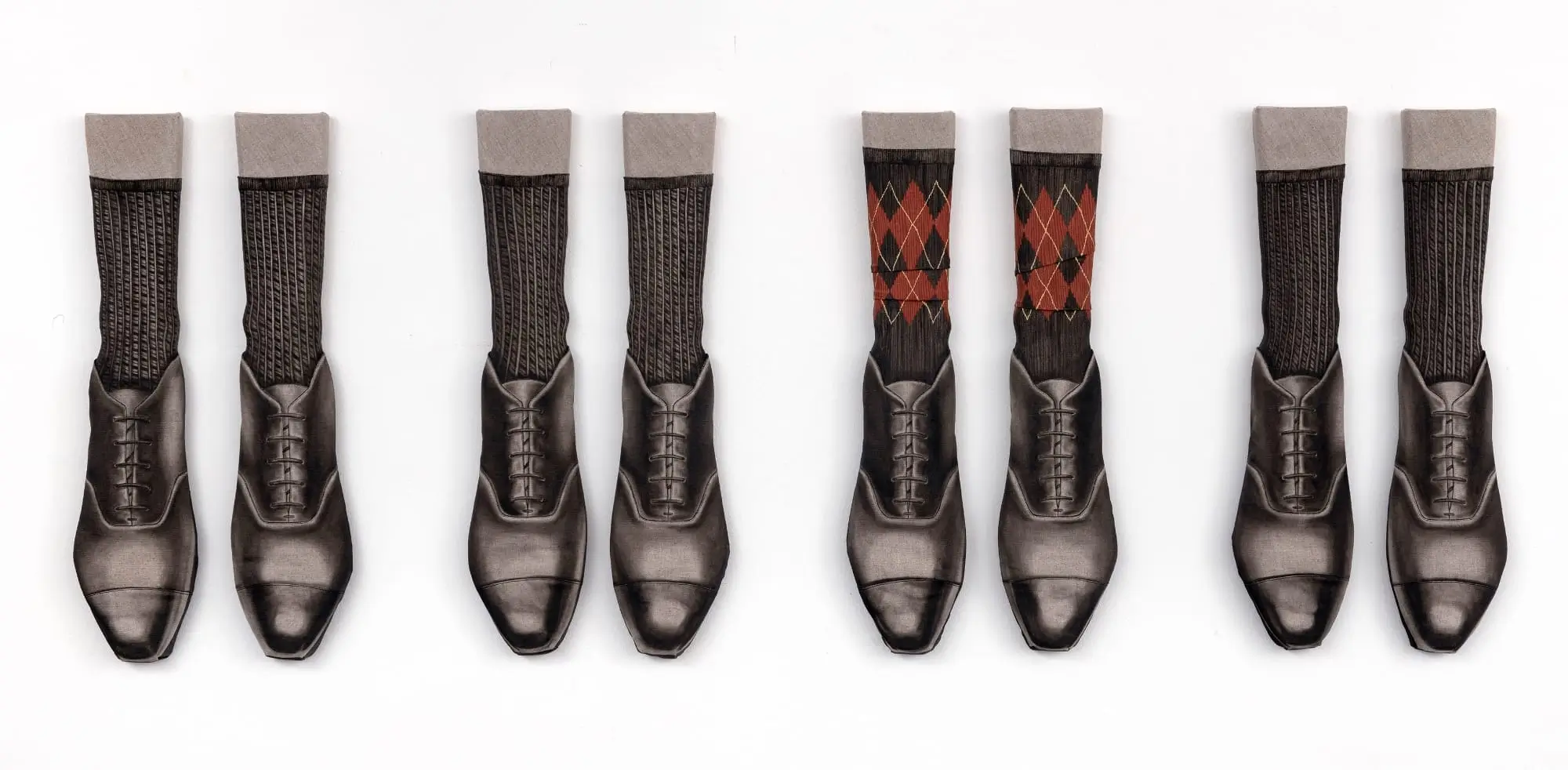
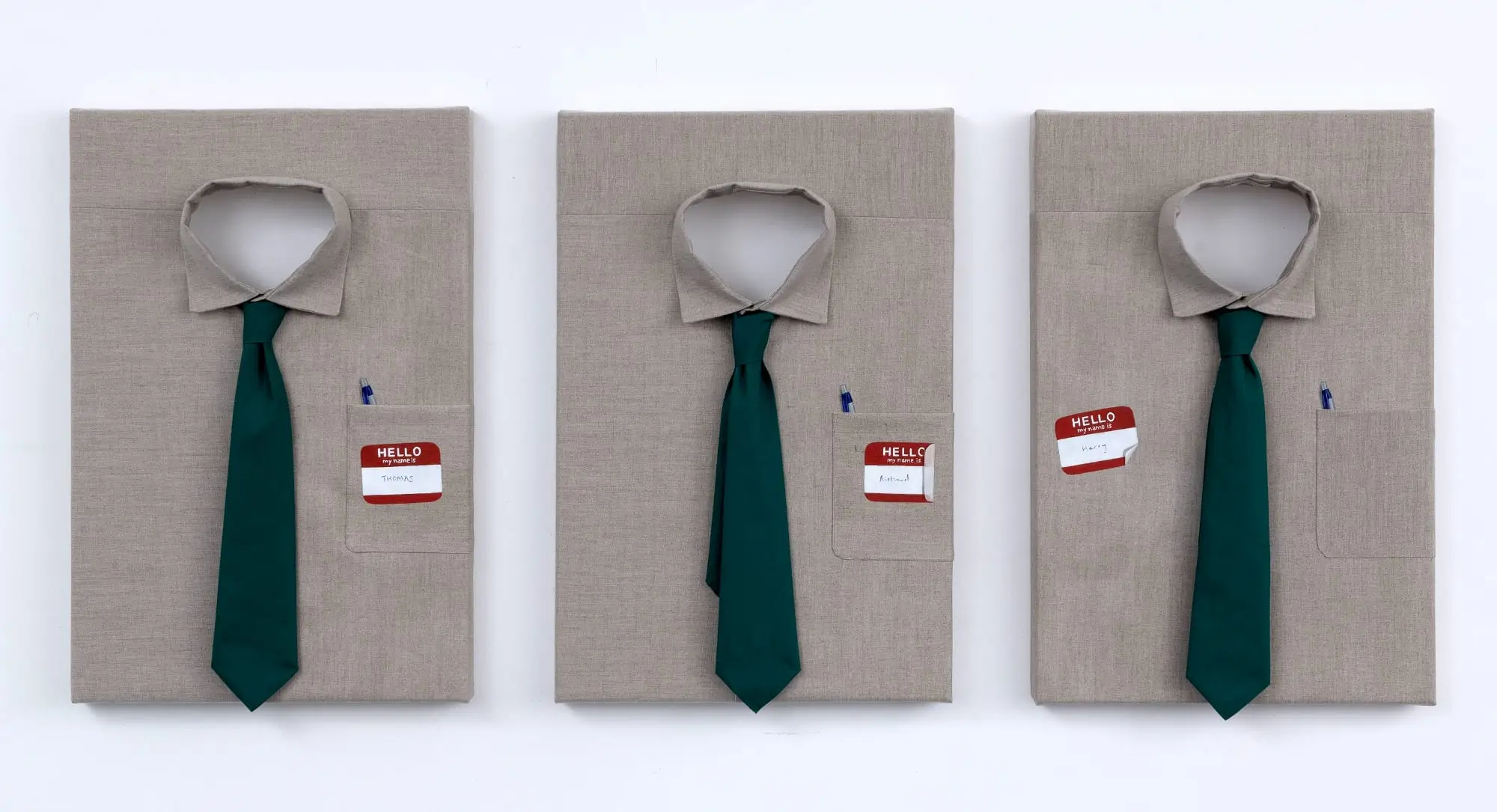
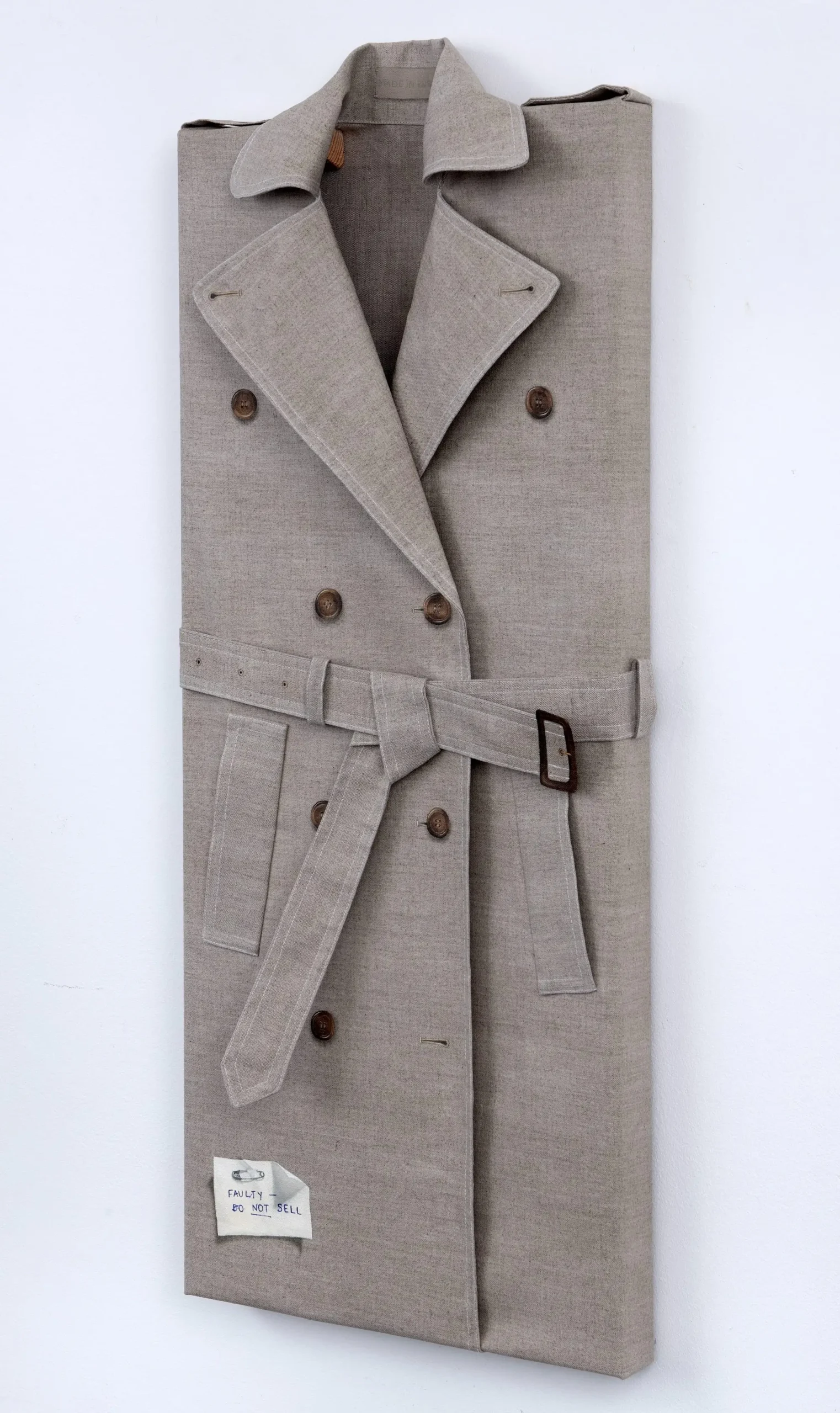
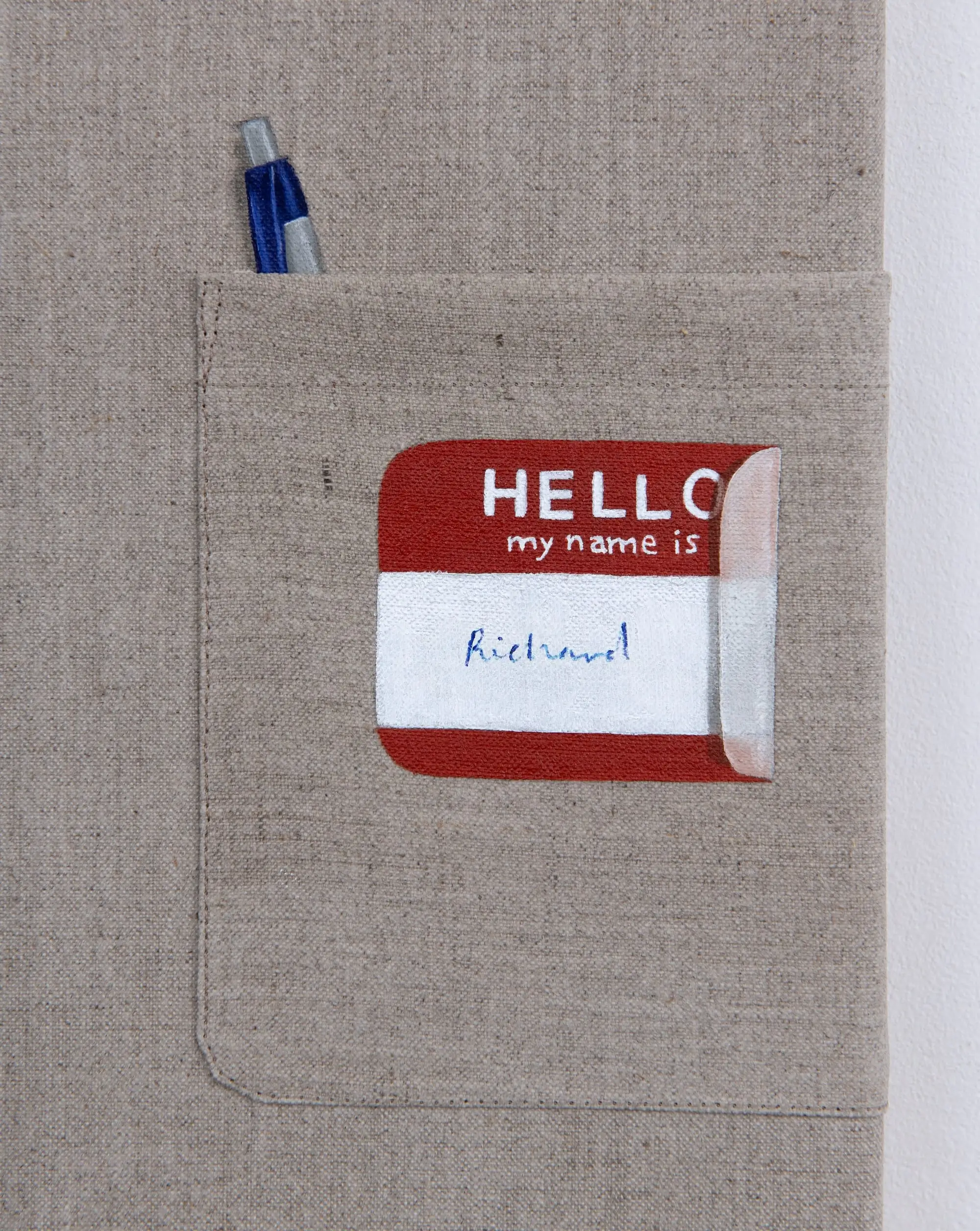
The show leans into archival research on uniforms as a subject, and several of the works make that institutional framing explicit even while keeping Cross’s tight, cropped compositional habits intact. A piece titled The Compromise pairs two pockets of dramatically different scale side by side, one monumental and one considerably smaller, in what reads as a fairly direct commentary on power and proportion within the art world itself, the larger pocket standing in for whoever holds the money and the smaller for whoever is making the work. Other pieces in the show, including The Ice breaker, The Brit, The Pair, The Miscreant, and Cowboy, continue building character studies out of specific garment fragments: a folded shirt with a name tag and a bleeding pen, a gray trench coat cinched at the waist, tall socks paired with polished brogues, a chambray shirt with a red kerchief just visible in the pocket.
Cross has also spoken about how much of the work involves deliberately hidden content, not just visual illusion but literal secrets stitched or painted into places a viewer would have to look closely, or in some cases would never find at all, to discover. Painted labels on the inside of a collar, messages left inside a pocket, buttons placed on the sides or undersides of a piece where they cannot be seen from the front, all of it is built to reward the kind of close, patient looking that a gallery encourages and a rush hour train commute never allows. Discipline and Display remains on view in New York through August 7.
fin
Cross’s practice sits at an interesting angle to a fairly long tradition of artists working at the seam between fashion and fine art, but her specific entry point, tailoring training first, painting training second, gives the work a different center of gravity than most. Painters who take up clothing as subject matter are typically interested in surface, in how fabric catches light or falls into folds worth rendering. A trained tailor thinks about clothing as a set of decisions: where a seam has to go, how much ease a collar needs to sit correctly, what a pattern piece looks like before it becomes a garment at all. Cross’s paintings carry that structural knowledge even in the parts that are pure illusion, which is likely why the trompe l’oeil elements read as convincingly as they do rather than as a decorative trick layered on top of a conventional painting practice.
She has also spent time developing this direction beyond the studio itself, taking part in the Lee Alexander McQueen Sarabande Foundation residency in London, a program built specifically to support exactly the kind of practice that refuses to sit neatly inside either fashion or fine art, and she is also a recipient of the Hesketh Hubbard Bursary. Both of those affiliations point to an art world that has started to take seriously the idea that tailoring itself can function as a legitimate artistic discipline rather than simply a craft in service of fashion, and Cross’s sewn paintings make as strong a case for that argument as anything currently on view.
There is also something worth noting in how deliberately restrained Cross keeps her palette across all of this technical ambition. Working almost entirely in natural, exposed linen with a limited range of tones layered over it, she has effectively built a rule for herself that mirrors the disciplinary theme of her current show: a tight set of constraints that, rather than limiting the work, ends up sharpening exactly which details get to carry meaning. A single unexpected tincture, a red kerchief, a green tie, a scattering of coins, reads as genuinely loud against that quiet ground in a way it never would in a more conventionally colorful painting practice. It is a small formal decision, but it is consistent with everything else about how Cross works: constraint used not as a limitation but as the condition that makes the illusion, and the confession hidden inside it, legible in the first place.
n
From the DRIFT archive: Eric Stefanski and the Art of Selective Living: A 2025 Confession Painted in Plain Sight
Related Articles
Winter Ran Down A Plywood Panel In Gaeta
Cy Twombly, Untitled (Winter Picture), 2004. Acrylic on plywood in the artist’s frame. Gagosian, Madison […]