DRIFT AUDIO
Listen to this story
Choose a voice, then press play.
A sixteen foot bronze woman once stared down a New York highway ramp. Here is how she got there, and where she stands now.
recall
- A Bronze Woman Over Tenth Avenue
- From Clay to Crucible
- Reading the Architecture
- The Missing Eyes
- Life After the High Line
- Where to Find Her Now
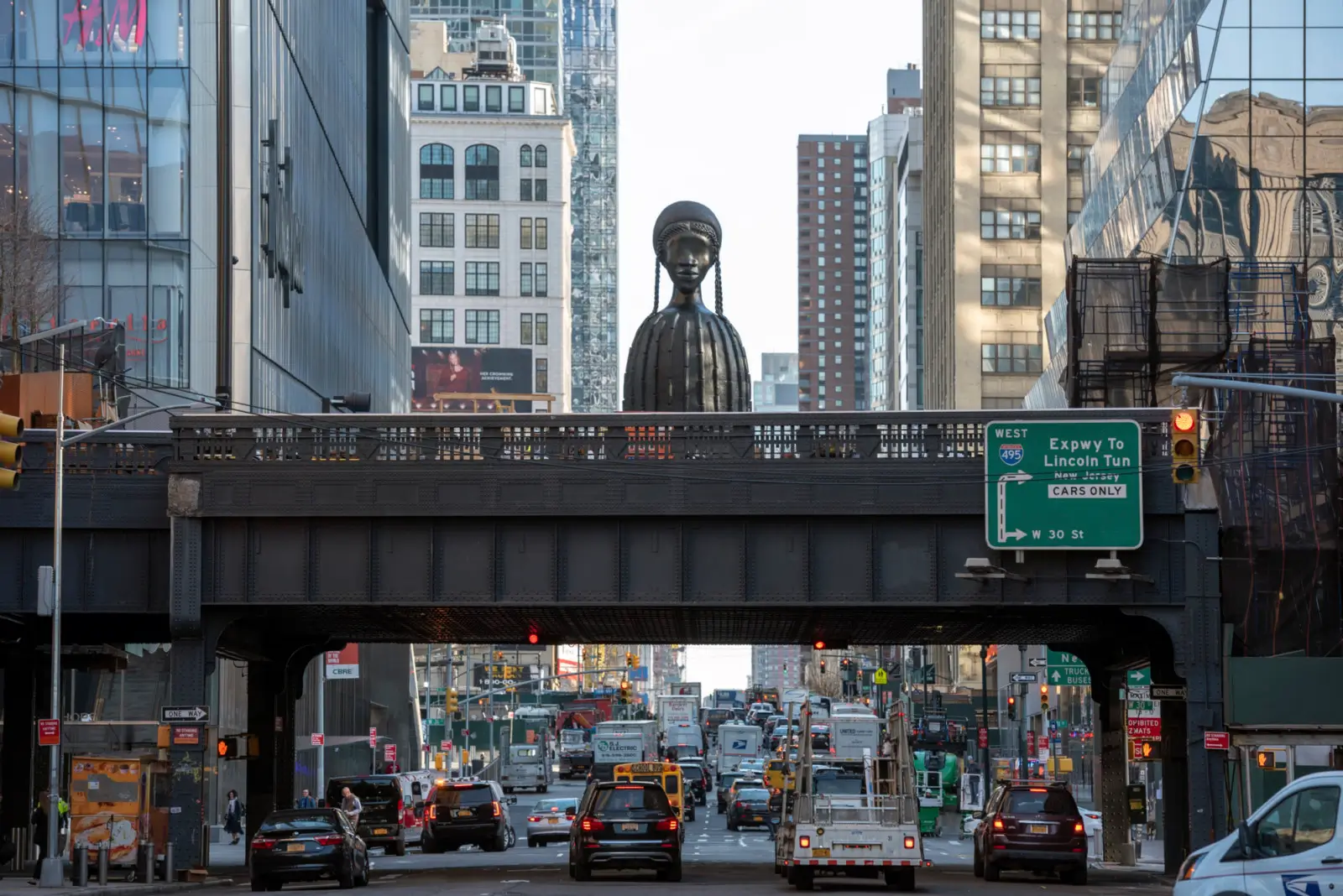
For two years, drivers approaching the Lincoln Tunnel from the West Side of Manhattan passed beneath a sixteen foot bronze bust of a Black woman, her torso flaring out into the shape of a clay house. She had no eyes. She did not need them. Simone Leigh’s Brick House went up on the High Line’s newly built Plinth at 30th Street and Tenth Avenue in the spring of 2019, the first work in what was meant to be a rotating program of major public sculpture on the elevated park. It stayed there until 2021, presiding over traffic and tourists with an expression that was somehow both serene and unreadable.
Brick House was Leigh’s first monumental sculpture, cast in bronze at nearly six thousand pounds, and it announced her arrival as a public artist in a way her ceramic and video work never quite had. The commission came from High Line Art, which had spent years developing the Spur, the newest stretch of the elevated park, as a home for large scale contemporary installations. Leigh was chosen as the inaugural artist for the Plinth, meaning her sculpture set the tone for everything that would follow it on that pedestal.
The title itself carries weight before you even look at the piece. Brick house is old slang, most commonly applied to a woman built with strength and staying power, someone who holds a room the way a well built structure holds a street corner. Leigh has said she wanted a figure that could stand in for that idea literally, a body that is also architecture, strength rendered as both flesh and foundation.
What made the sculpture land so hard when it first appeared wasn’t just its size. New York in 2019 had remarkably few public monuments to Black individuals, and fewer still to Black women. Alison Saar’s Swing Low, a tribute to Harriet Tubman in Harlem, was one of the only comparable works in the city at that scale. Brick House didn’t just add to that short list, it did so from one of the most visible perches in Manhattan, a spot thousands of commuters passed daily without ever setting foot in a museum.
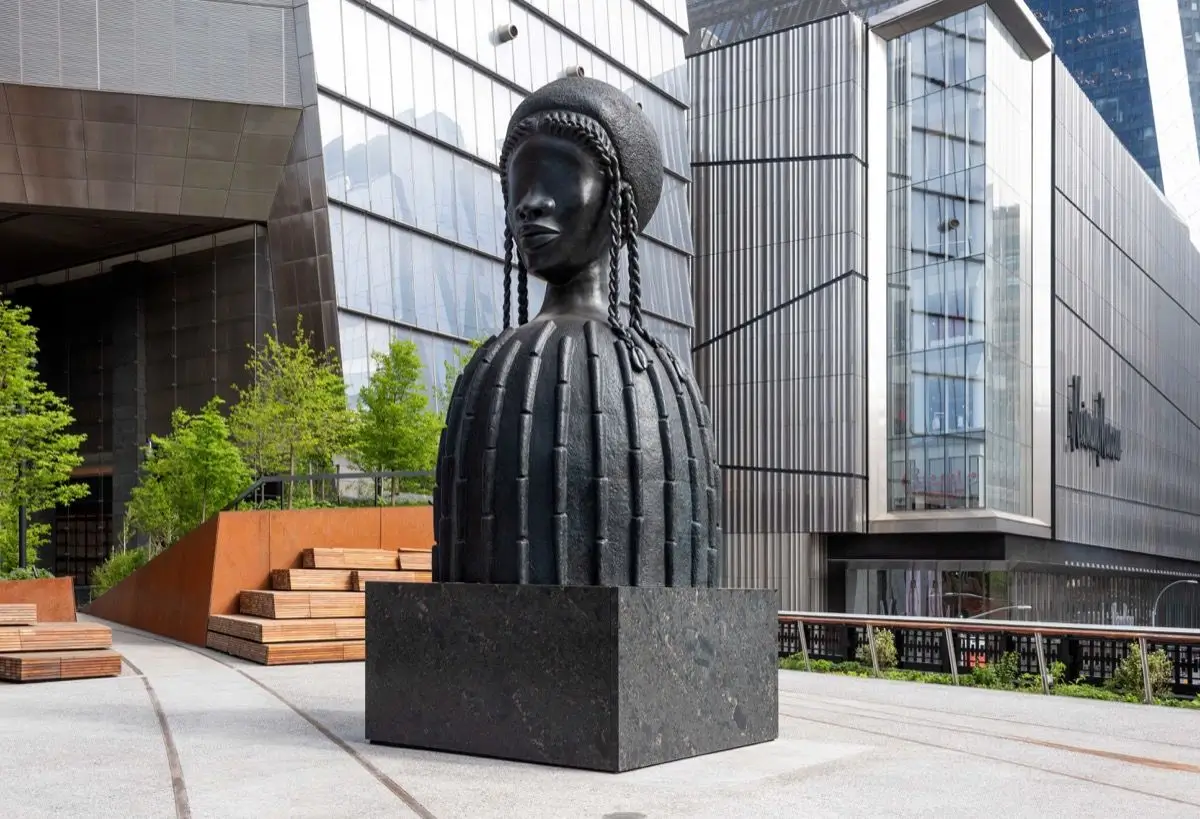
Simone Leigh’s Brick House (2019) installed on the High Line Spur in Manhattan, where its monumental bronze form transformed the elevated park into one of New York City’s most significant contemporary public art destinations.
stir
The sculpture that would eventually loom over Tenth Avenue began as something far smaller and far more fragile: a ceramic maquette built in Leigh’s Brooklyn studio. That model was scanned and turned into a digital 3D file, which the team used to plan proportions and visualize how the finished piece would actually sit on the Spur before a single pound of bronze had been poured.
From there the project moved to Philadelphia, where Leigh and High Line Art selected Stratton Sculpture Studios for its experience with large scale bronze casting. Roughly two tons of modeling clay, sourced from a French quarry with a reputation for having once supplied Auguste Rodin, were mounted onto an armature and built up by hand over months, with Leigh directing the shape and texture of every section herself. The scale of the undertaking meant conventional shortcuts, like reproducing a small maquette as a full size foam model, weren’t really viable. Everything was built close to life size in clay first.
Once the clay model was finished, it was broken into a plaster mold made of roughly one hundred separate pieces, and wax positives were cast from those molds in preparation for the bronze pour itself. The metal was melted in a crucible and poured in batches of around four hundred pounds at a time until the full six thousand pounds needed for the piece had been cast. Those individual bronze sections were then sandblasted, fitted together, and welded into the completed figure before receiving its final patina.
One detail from the process says a lot about how the final design came together. Leigh’s original plan, sketched out for an earlier 2017 proposal, called for the figure’s head to be covered in sculpted porcelain roses, a material and motif she has returned to throughout her career. At the scale Brick House demanded, hand building that many individual flowers proved too slow and too fragile to survive fabrication. Leigh and the Stratton team reworked the design, landing on a textured afro framed by two asymmetric cornrow braids, each ending in a cowrie shell. The braids, as it turns out, were partly inspired by Thelma, the daughter character from the 1970s sitcom Good Times, a small pop culture thread woven into a work otherwise steeped in continental African reference points.
arch
Brick House belongs to a body of work Leigh calls her Anatomy of Architecture series, in which she fuses the human body, almost always a Black female form, with structures drawn from across Africa and the African diaspora. The torso of the piece, nine feet across at its widest point, reads at once as a skirt and as a house, and that dual reading is deliberate.
The vertical ridges running down the sculpture’s base echo the surface of a teleuk, the dome shaped dwelling built by the Mousgoum people of Cameroon and Chad, traditionally formed from a mixture of soil, grass, and animal dung. Leigh’s team recreated that texture using sponges and steel wool worked directly into the clay before casting. Other elements of the torso draw on the Batammaliba, an architectural tradition from Benin and Togo whose name translates roughly to those who are the real architects of the earth. Batammaliba structures are treated less like objects and more like family members, with ritual gestures such as pouring drinks onto a home’s threshold so that it, too, can drink.
A third and more unexpected reference sits alongside those West African forms: Mammy’s Cupboard, a roadside restaurant in Natchez, Mississippi, built decades ago in the shape of a woman in a hoop skirt, a structure steeped in the visual language of the mammy caricature. Leigh has been direct about wanting Brick House to sit in tension with that history rather than ignore it, taking a shape historically used to demean Black women and rebuilding it as something monumental and dignified instead.
Even the cowrie shells capping the sculpture’s braids carry layered meaning. Cowries functioned as currency across parts of West Africa for centuries, including during the era of the transatlantic slave trade, and they also appear in Batammaliba divination practice. A single decorative detail ends up referencing both a spiritual tradition and one of history’s ugliest economic systems, which is fairly typical of how densely Leigh tends to load her forms.
huh
Look at Brick House long enough and the absence becomes the point. The figure has no eyes carved into her face, a choice that recurs throughout Leigh’s sculptural practice and one she has discussed at length in interviews and museum texts. The blankness isn’t an oversight or a stylistic shorthand for serenity. It functions as a refusal, a way of keeping the figure from being pinned to any single identity, historical moment, or individual likeness.
That refusal matters because so much of the history Brick House gestures toward involves Black women being looked at, catalogued, and reduced to a type, whether through the mammy caricature embedded in Mammy’s Cupboard or through the broader visual record of how Black female bodies have been represented in American public life. By withholding eyes, Leigh keeps her subject from returning that gaze in any way that could be misread as consent to being studied. The figure takes in her surroundings, viewers included, without offering herself up to be fully known.
Leigh has described her overall method as auto ethnographic, meaning she draws on research into African and diasporic art, material culture, and philosophy rather than working from a single historical or living model. She has also used the term critical fabulation to describe how she builds a sculpture like Brick House, pulling together disparate architectural and bodily forms in a way that, in her words, collapses time. Brick House is explicitly not a portrait. It is closer to an argument built in bronze.
extent
Brick House came down from the Plinth in 2021, as planned, making way for the next rotating commission. It didn’t disappear. A second edition of the sculpture had already found a permanent home at the University of Pennsylvania, installed at the corner of 34th and Walnut Streets in November 2020 as a gift from alumni Glenn and Amanda Fuhrman. It now greets visitors at one of the main entrances to the Penn campus, replacing an earlier sculpture that was relocated nearby, and it holds the distinction of being the first large scale artwork by a Black woman installed anywhere on Penn’s grounds.
The years immediately following Brick House’s debut turned into a genuine run of momentum for Leigh. In 2022 she became the first Black woman to represent the United States at the Venice Biennale, presenting a solo exhibition titled Sovereignty at the American pavilion. Brick House itself reappeared within the Biennale’s central exhibition, Milk of Dreams, and Leigh received the event’s Golden Lion award for best participant, one of the most significant honors in contemporary art.
That Biennale presentation eventually toured back to the United States as a full retrospective. It opened at the Institute of Contemporary Art in Boston in 2023, moved to the Hirshhorn Museum and Sculpture Garden in Washington, D.C., later that year, and then traveled jointly to the Los Angeles County Museum of Art and the California African American Museum through early 2025. Along the way, Leigh’s market caught up with her critical standing. Her sculpture Stick sold for 2.7 million dollars at Christie’s in 2023, a record for the artist, following an earlier sale of her work Birmingham for 2.2 million dollars at Sotheby’s the year before.
Leigh’s gallery representation has shifted over the years alongside that rising profile. She showed with Luhring Augustinethrough 2019, then with Hauser & Wirth around the time Brick House debuted, and is now represented by Matthew Marks Gallery in New York.
sum
Brick House the sculpture is easy enough to visit today, assuming you know where to look, even though its most famous perch on the High Line is long gone. The Penn campus edition remains on permanent public view at the Walnut Street entrance, a fixture of the university’s public art collection that now numbers dozens of installed works across the campus, only a handful of which are by Black women. Anyone walking through that corner of West Philadelphia will pass beneath the same afro, the same cornrows, the same cowrie shells that once watched over Manhattan traffic.
The sculpture’s original run on the High Line lasted from June 2019 to roughly the spring of 2021, timing that means an entire cohort of New Yorkers experienced Brick House purely as a fixture of their daily commute rather than as a museum object behind glass or a rope line. That was always part of the point of the Plinth program: to put major contemporary sculpture in front of people who weren’t necessarily walking into a gallery to find it.
Brick House also lives on in documentation. High Line Art and Hauser & Wirth’s Ursula publication both produced detailed behind the scenes coverage of the fabrication process at Stratton, including photography by Timothy Schenck that tracked the piece from wet clay through the final bronze pour. That material, along with contemporaneous coverage in the New York Times around the sculpture’s 2019 unveiling, remains the most complete public record of how a ceramic maquette in a Brooklyn studio became one of the more talked about additions to New York’s public art landscape in recent memory.
What sticks, six years on, is how much cultural and architectural information Leigh managed to compress into a single object without the piece ever feeling overloaded or didactic. Batammaliba theology, Mousgoum building technique, a Mississippi roadside restaurant with an ugly history, a 1970s sitcom character’s braids, and a currency once tied to the slave trade all sit inside one bronze figure that most passersby simply experienced as a striking, dignified presence on their way somewhere else. That may be the clearest measure of how well the sculpture works. It rewards the viewer who wants to dig into its references, and it still holds up entirely on its own for the one who doesn’t.
Related Articles
Winter Ran Down A Plywood Panel In Gaeta
Cy Twombly, Untitled (Winter Picture), 2004. Acrylic on plywood in the artist’s frame. Gagosian, Madison […]