DRIFT AUDIO
Listen to this story
Choose a voice, then press play.
The experimental R&B singer-songwriter’s genre-dissolving new record finds her speaking in the same distortion that raised her.
recall
- A Full-Circle Homecoming
- The Sound of Distortion and D.C. Roots
- Track by Track: Rage, Joy, and Everything Between
- The Featured Voices
- Old Ghosts, New Frame
- Why It Matters Right Now
There’s a version of this story that writes itself the lazy way: R&B singer picks up a guitar, critics reach for the word “departure,” everyone moves on. That version is already circulating, and it’s wrong. What Kelela has done on new avatar, released July 10 via Warp Records, isn’t a swerve into unfamiliar territory. It’s closer to a homecoming — one that happens to arrive at the exact moment the world seems to be asking every artist the same unspoken question: what do you do when there’s nowhere left to hide?
Before she was the woman who reconfigured what alternative R&B could sound like on Cut 4 Me and Take Me Apart, before the ambient sprawl of 2023’s Raven made her a kind of patron saint for a generation of Black artists working the seams between club music and confession, Kelela was a kid in bands in Washington, D.C. Guitars, amps, the whole unglamorous grind of the local indie circuit — that was the scene that raised her, years before Los Angeles and its producers reshaped her into the artist most people think they know. New Avatar doesn’t invent a new Kelela. It reintroduces an old one, and lets her collide with everyone she’s become since.
View this post on Instagram
stir
That collision is audible from the first seconds of “idea 1,” the album’s opener and lead single, released back in April after Kelela had gone quiet on social media for the better part of the spring. The track starts spare — soft arpeggios, synths that bend like they’re underwater — before splitting open into something closer to hymn than pop song, guitars climbing and vocal harmonies stacking toward the sky. It’s a small structural trick, but it’s also a thesis statement: patience rewarded by rupture, calm giving way to something that finally lets itself feel big. Pitchfork singled the song out for its shoegaze textures and called it a signal flare for a return to Kelela’s rock and indie roots, eventually naming it one of its best new tracks of the year.
The album’s genesis is tangled up in what Kelela has described, in the run-up to release, as an attempt to make sense of this moment rather than flee from it. In press materials tied to the album, she said the record “finds solace in confronting,” and that she doesn’t want the music to distract from what’s happening in the world so much as help it make sense — a fairly unfashionable posture for pop music to take right now, when so much of the culture seems engineered for distraction. “Idea 1” itself was reportedly written while she was reading Octavia Butler’s Parable of the Sower, the dystopian novel about a young woman navigating a collapsing California — a text that has aged, unfortunately, into something closer to prophecy than fiction with every passing year it stays in print. You can hear that novel’s fingerprints in the record’s undertow of unease, even in its most seductive moments.
Sonically, new avatar is the sound of an artist refusing to choose a lane, which is exactly the reputation Kelela has spent over a decade building. The twelve-track record — produced primarily by Oscar Scheller, known for his work with PinkPantheress and Lily Allen, with a standout collaboration produced by London artist A. K. Paul — folds shoegaze, grunge, alt-rock, UK garage, and jungle breaks into the same architecture that has always housed her voice. Resident Advisor described the effect as a reconfiguration of shoegaze and IDM into what it called a distinctly Black, femme sound built for the future, distorted guitars laced into electronic production without either element swallowing the other. DJ Mag heard echoes of her D.C. roots throughout, while noting that the futuristic sensuality that’s always defined her catalogue never actually leaves the room.

What’s most interesting is how deliberately the album resists the “rock album” framing that some of the pre-release chatter seemed to invite. In an interview tied to the release, Kelela pushed back on the idea that she was crossing some kind of genre border by picking up distortion pedals. Her point, roughly: guitar music has always lived inside Black music, going back to Prince, and R&B has never been the rigid, narrow thing people sometimes mistake it for. What she’s doing on new avatar, in her own framing, is less about borrowing from rock than about reclaiming ground that was never actually foreign to her in the first place. It’s a sharper argument than it might first appear, and it matters for how you listen to the record — not as an R&B singer cosplaying as an indie kid, but as an indie kid who spent a decade building an entirely different vocabulary and has now folded it back into the one she started with.
straddle
The tracklist itself plays like a guided tour through Kelela’s emotional range, more than through her sonic one — though the two have always been the same thing for her. “Point Blank,” the record’s second single, drops into slowed-down jungle breakbeats under lyrics about a relationship gone dangerous, with the kind of physical urgency that made her early mixtape work feel so immediate. “Goin Down” and “Crystalize” lean into what one reviewer at Paste Magazine called punky rock-ballad territory, turning heartbreak into something closer to defiance than despair — “Crystalize” in particular has been singled out for a vocal performance that lets Kelela’s voice do the work usually reserved for a lead guitar, biting into consonants like she’s picking a string. “Retaliation Lullaby” is the album’s quietest moment, rain sounds and gentle guitar wrapped around a lyric about sitting with feelings before sunrise, offering something like stillness in the middle of all that unrest.
“Against Me” carries echoes of Take Me Apart, with vocal performances that rank among her most striking since that record — proof that the through-line she’s drawing here isn’t limited to her teenage years in D.C., but stretches across every era of her catalogue at once. “Don’t Piss Me Off” leans into a rumbling, garage-adjacent low end, ricocheting vocals bouncing off distorted synths for something that feels raw and almost underground compared to the more polished moments elsewhere on the record. Even the deep cuts, in other words, are doing structural work — reaching back toward Cut 4 Me‘s grime-inflected grooves and Raven‘s clubbiest stretches without ever feeling like she’s simply repeating herself.
feat
The featured convincers earn their space rather than filling a marketing checklist. “Outta Time,” built with A. K. Paul, is a tense, unraveling duet where Paul sounds genuinely wrecked, demanding to know why Kelela would do this to him over a bed of throbbing guitar and silky vocal interplay — Kelela herself has described the track as her “Prince/Janet/D’Angelo/Nirvana bag” fully activated, which is as good a shorthand as any for what the whole album is reaching for. Fousheé shows up on “New Life Forms” for a lighter, flirtier detour, a beachside exhale in the middle of a record that otherwise keeps its intensity dialed up. And “The Bridge,” the album’s final pre-release single, pairs Kelela with PinkPantheress over a dark, airy garage beat that plays out like the nervous, electric beginning of something neither of them is sure they want to admit they want — their voices dissolving into each other rather than trading verses, which feels like the whole point.
The album closes with “If We Meet Again,” a resigned, sorrowful send-off in which Kelela works through the logic of staying friends with someone the relationship clearly can’t sustain — a quieter note to end on, after eleven tracks that spend most of their runtime either simmering or catching fire. Compared to Raven‘s ambient sprawl, several critics have noted that new avatar feels streamlined, almost economical, its rock and alt-metal textures worked into pop structures rather than left to drift. It’s an album built for specific hours — driving at night, city lights smeared through a windshield — rather than one designed to disappear into the background of a day.
frame
The path to new avatar wasn’t a straight line, either. Kelela spent 2025 on In the Blue Light, her first live album, before going quiet on social media entirely in March of this year — the kind of disappearance that, for most artists, reads as burnout or crisis management, but which in her case seems to have functioned more like clearing space. She came back in April with “Idea 1” and nothing else, no announcement, no rollout machinery grinding into gear, just a song. That restraint tracks with everything about how this album has been unveiled since: a single at a time, spaced out, each one allowed to sit with listeners before the next one landed, the tracklist itself only confirmed in early May alongside “Linknb,” built around a jittery, Mk.gee-style guitar figure that gave an early hint of how far the guitar textures would go, as Stereogum and The Line of Best Fit both reported at the time.
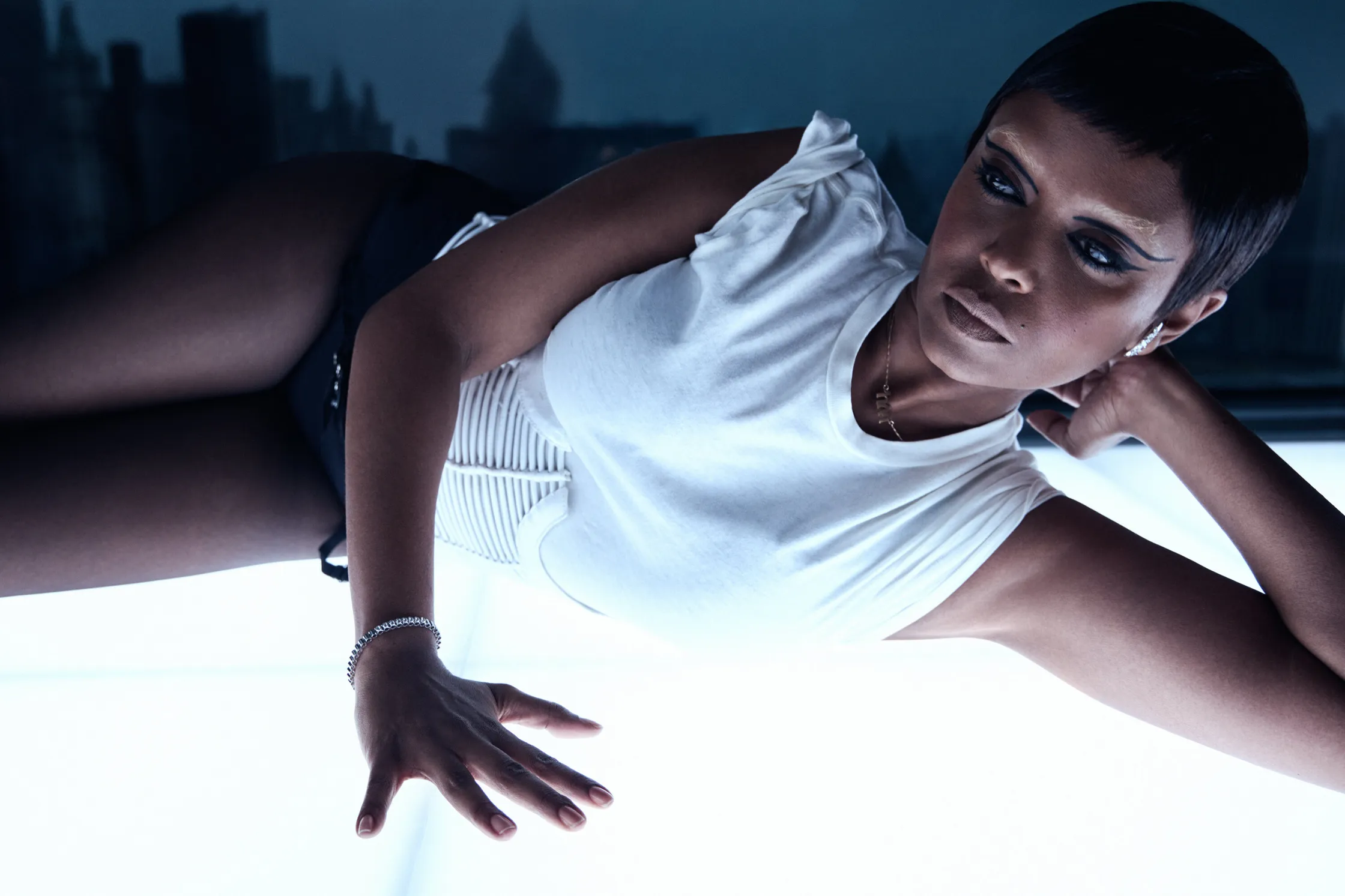
The album’s cover art plays its own quiet trick on the eye. Kelela poses close to the camera, angled down, in the kind of composition that reads instantly as a nod to an early-2000s webcam self-portrait — except the palette has been inverted into cold blues, silvers, and whites, so the nostalgia comes pre-distorted, the way memory itself gets distorted the longer you sit with it. It’s a fitting cover for a record that spends its whole runtime looking backward and forward simultaneously, refusing to let either direction win outright.
It’s worth remembering that Kelela has never been an artist who works purely on instinct, however physical and immediate her music can feel in the moment. Her process has historically involved serious reading and research — she reportedly sent collaborators on Raven a syllabus that included work on Afrofuturism and misogynoir, along with writing from bell hooks. That intellectual scaffolding doesn’t disappear on new avatar; if anything, the Octavia Butler thread running through “Idea 1” suggests it’s just as present, even if the surface of the music sounds more raw and less meticulously ambient than what came before. Across the record, she moves through Black femme rage, joy treated as a form of resistance, romantic tension, and a low-grade dystopian dread that never quite tips into despair — the same terrain she’s always worked, rendered now in a different set of textures.
huh
There’s a temptation, writing about any artist’s pivot toward guitars, to reach for words like “reinvention” or “rebrand.” Kelela’s own comments around the album, along with nearly every serious review that’s landed since its release, argue for something more interesting: not a reinvention but an integration, the D.C. kid and the L.A. club auteur finally sharing the same twelve tracks instead of existing as separate chapters. One reviewer at AllMusic put it plainly — this is new Kelela and classic Kelela, arriving at once, which is a harder trick to pull off than any straightforward departure would have been. Aggregated critical response, tracked by Metacritic, has landed on the “universal acclaim” end of the scale so far, with reviewers largely converging on the same read: this is one of Kelela’s most fully realized records to date.
None of this happens in a vacuum, and Kelela hasn’t pretended otherwise. Her framing of the record as something that confronts rather than distracts lands differently in a year defined by the kind of low, constant dread that makes escapism feel both understandable and slightly hollow. new avatar doesn’t offer easy comfort. What it offers instead is company — the sense of an artist working through the same disorientation everyone else is feeling, refusing to fake her way past it, and finding, somewhere in the noise and the distortion and the twelve songs it takes to get there, something that actually resembles beauty. That’s not a small thing to pull off in 2026. It might be the only kind of balm that actually holds up.
From the DRIFT archive: Marc Anthony’s Voice Finds a New Home Beneath the Neon