DRIFT AUDIO
Listen to this story
Choose a voice, then press play.
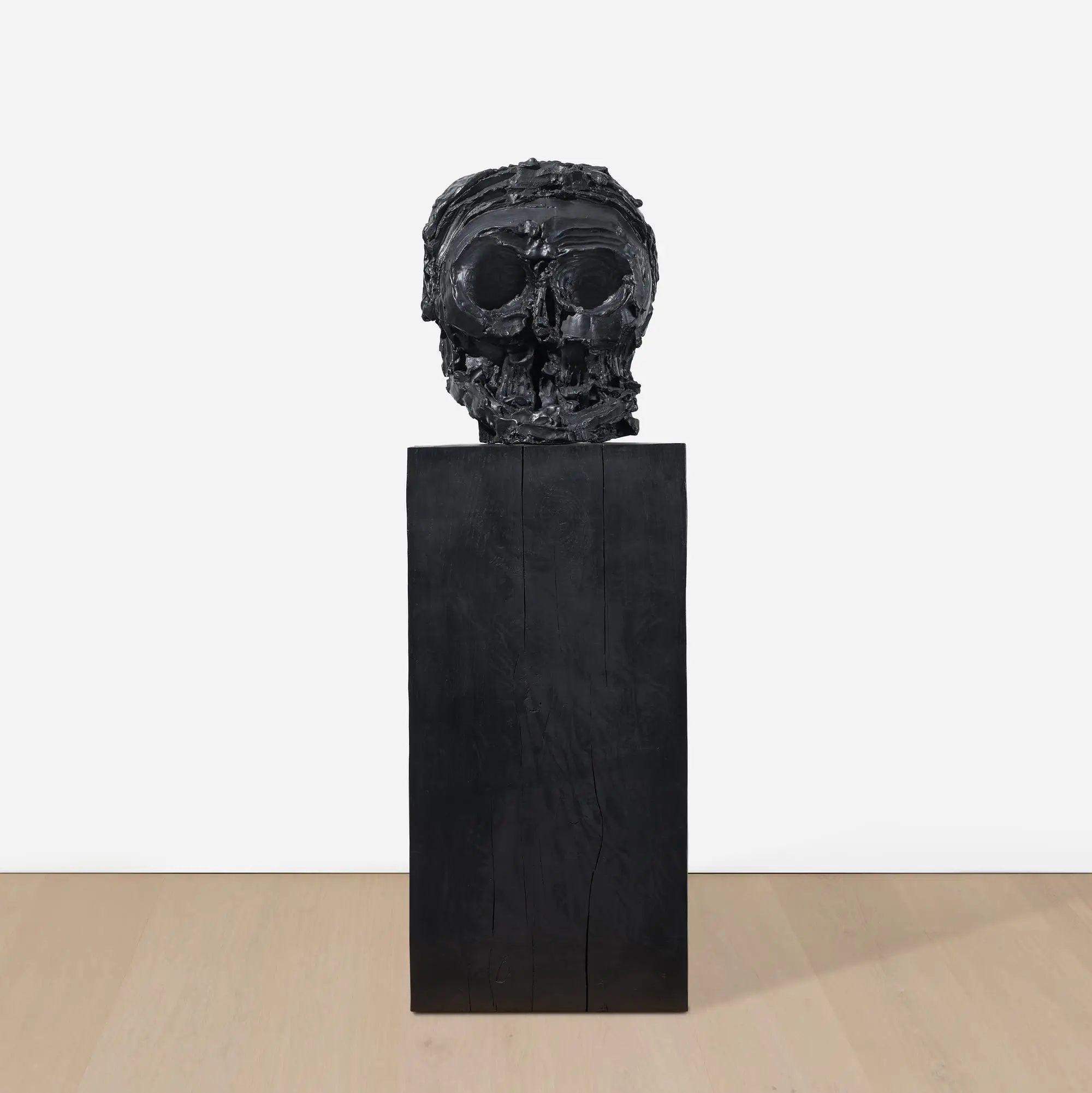
A rough-cast head on a plinth, staring at nothing. Thirty years into his career, this is still the image Thomas Houseago can’t put down.
In This Story
- A Head That Refuses to Resolve
- The Long Apprenticeship of a Working-Class Sculptor
- Why the Skull Became a Lifelong Obsession
- Plaster, Rebar, and the Beauty of an Unfinished Surface
- Material as Memory, Not Illusion
- Why Collectors Keep Coming Back
- The Debate Around Thomas Houseago’s Practice
- The Black Plinth as Part of the Sculpture
- Positioning the Work Within Houseago’s Career
- Where This Sculpture Fits in Contemporary Art Today
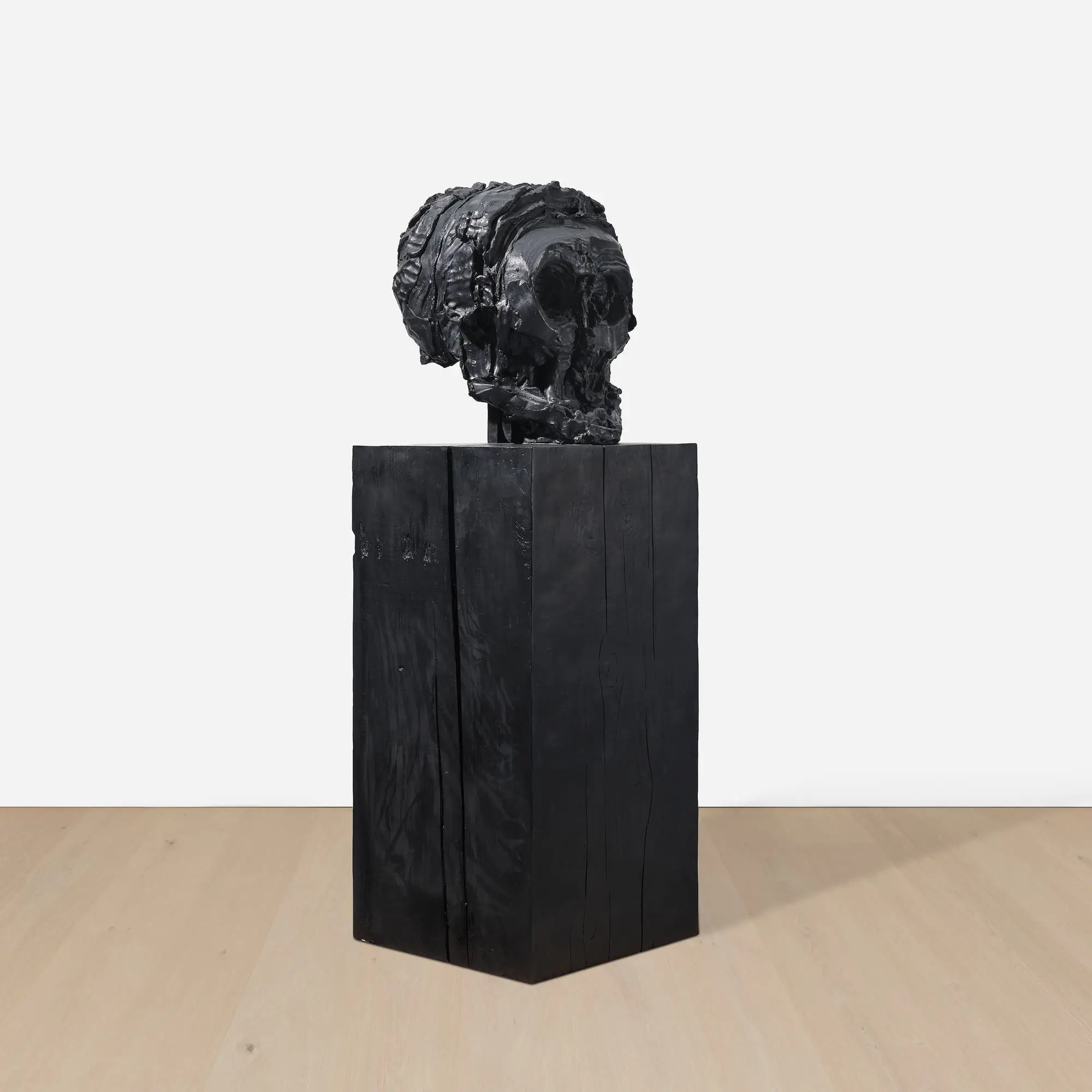
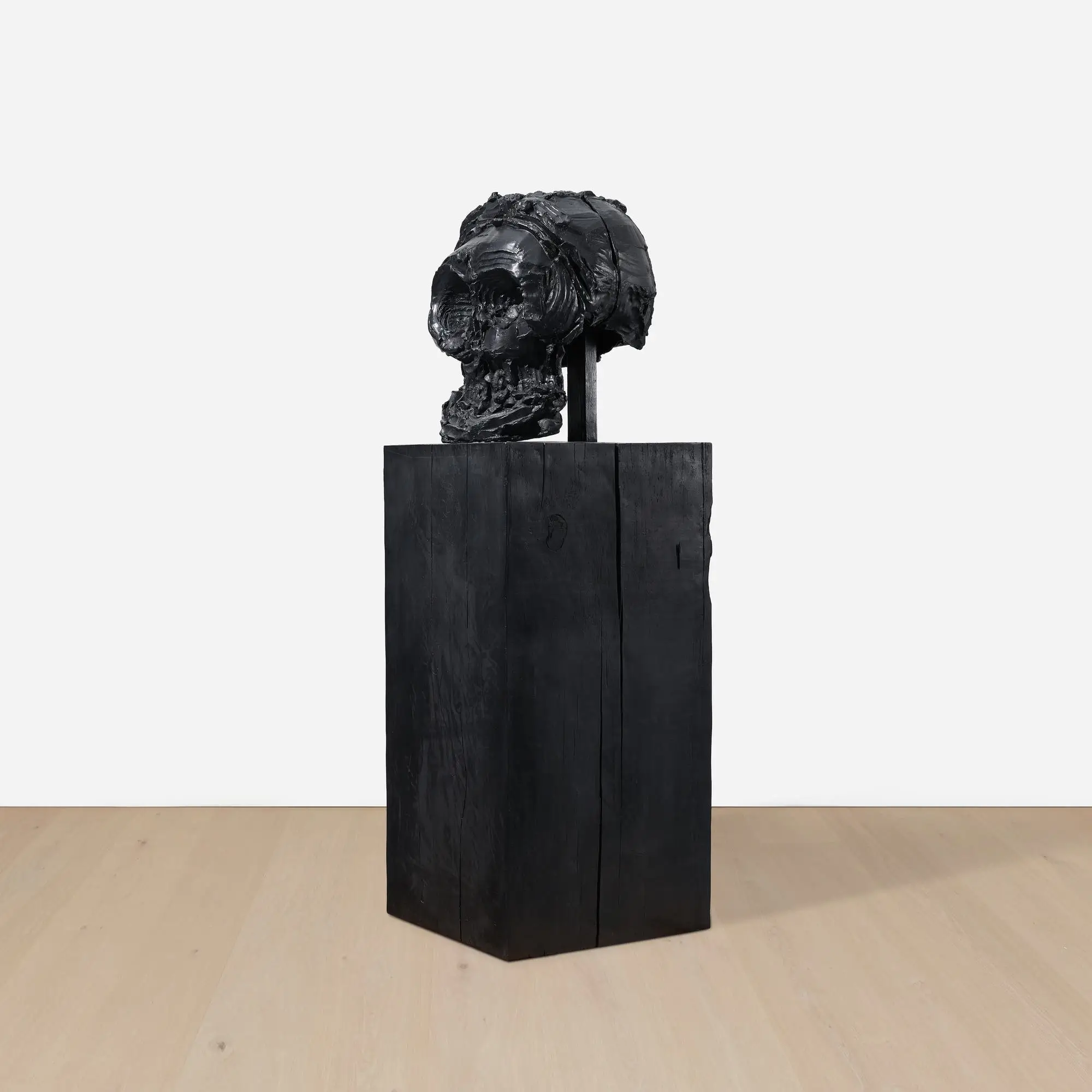
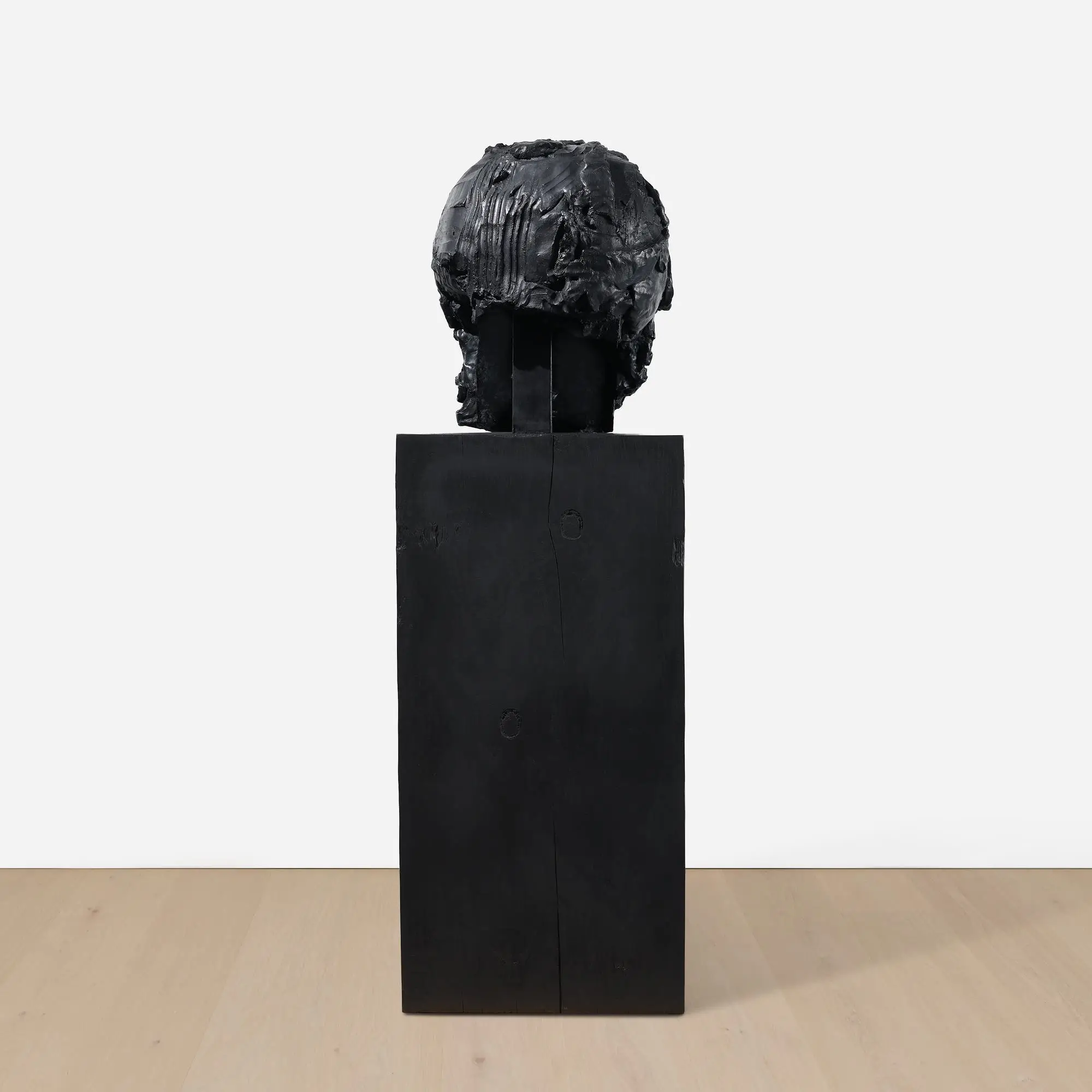
Walk up on one of Thomas Houseago’s skull heads and the first instinct is to expect a joke. It has the sil of something you’d find at a Halloween shop, or worse, a prop from a film set — the kind of object that exists to startle and then be forgotten. Then the surface starts working on you. What looked, from ten feet away, like a smooth industrial cast turns out, up close, to be a record of hands: ridges of clay dragged sideways before they set, a seam of hemp fiber poking through a socket, a strut of iron rebar visible where the plaster thinned. The skull isn’t finished so much as caught mid-argument with itself, and it’s mounted, deliberately, at a height that makes you meet its gaze rather than look down on it.
That single decision — plinth, not pedestal-as-afterthought — is where a lot of the tension in Houseago’s work lives. A plinth is supposed to be neutral, a piece of furniture for sculpture, invisible by design. Houseago has spent two decades treating it instead as a stage direction. Raise a skull to eye level and you’ve turned a still life into a confrontation.
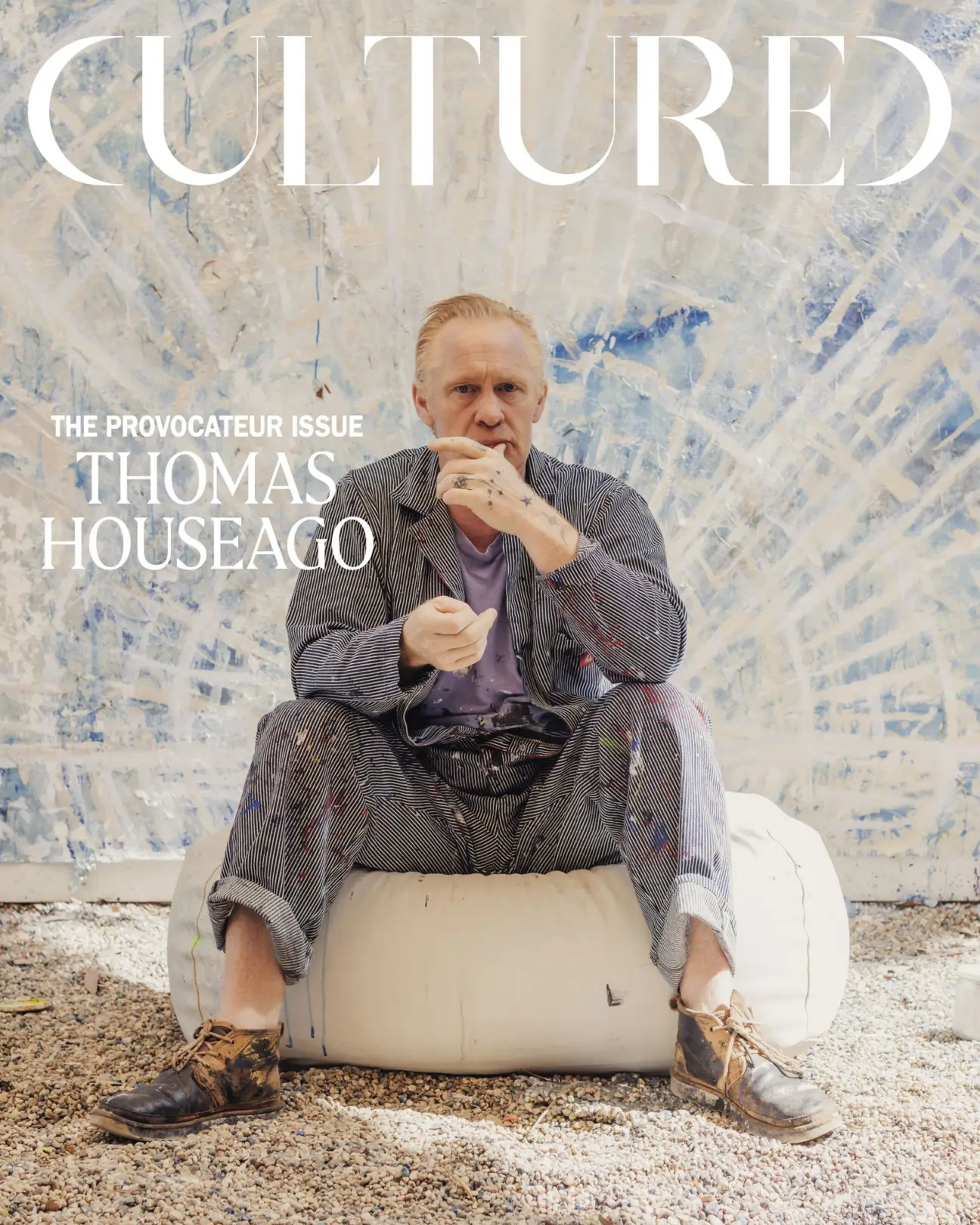
Thomas Houseago photographed in his studio for Cultured, surrounded by the expressive painted environment that reflects the raw, physical approach underlying his acclaimed sculptural practice.
stir
Houseago was born in Leeds in 1972 and has been open about growing up in a household where money was tight and art was, nonetheless, taken seriously — his mother pushed visual culture on him early, and it stuck in a way that outlasted the industrial decline reshaping the north of England around him. He left for London at nineteen to study at Central Saint Martins, then moved to Amsterdam in the mid-1990s for a residency at De Ateliers, where he crossed paths with the painter Marlene Dumas and the conceptual artist Jan Dibbets. That period shows up constantly in retrospectives of his early work — pieces like Head of a Golem trace directly back to it.
What doesn’t get mentioned as often is the decade after Amsterdam, which he spent in Brussels, broke, close to bankruptcy, watching a European career fail to take. In 2003 he left for Los Angeles with, by his own account, about $300 to his name. It wasn’t a calculated pivot toward the American market — Houseago has said plainly that it read at the time as an act of desperation, not strategy. Twenty years later he runs a studio employing around twenty people and works across five foundries casting in plaster, clay, and bronze. The distance between those two facts is basically the whole story of how his practice became what it is: unhurried, physically enormous, built on the assumption that scale earns attention that subtlety might not.
He’s shown at the Whitney Biennial in 2010, at MOCA Los Angeles, at the Stedelijk in Amsterdam, at Venice’s Palazzo Grassi, and in a dedicated survey at the Kunstmuseum Den Haag that pulled early and recent work into the same rooms specifically to show how little the vocabulary has shifted. Galleries representing him now include Gagosian, David Kordansky Gallery, Xavier Hufkens in Brussels, and Michael Werner in New York.
why
Ask Houseago directly about the skulls and he doesn’t reach for metaphor — he goes straight at it. In material produced around a recent Xavier Hufkens exhibition, he’s quoted saying: “Death. Everything leads to death. Everything is impermanent. Everything is being made and unmade at the same time. And there’s a tremendous fragility in that; there’s a beauty in that.” It’s not a poetic dodge. It’s closer to a working method. The skull, for Houseago, functions the way it did for Dutch still-life painters four centuries ago — as a memento mori, a prop that exists to remind the room that everything in it is temporary, including the room.
What’s changed, according to people who’ve tracked his output closely, is the emotional register of the motif rather than the motif itself. Earlier skull paintings and reliefs tended toward controlled, almost architecture line work — angular, maze-like, held at arm’s length. More recent pieces, including a body of monochrome skull paintings shown alongside sculpture work, are described as pulsating with a rawer, more organic energy, built up through repeated cycles of drawing, covering, and erasure until the layered image settles into something closer to calm than dread.
That shift didn’t happen in a vacuum. In 2024, ahead of a New York exhibition titled Night Sea Journey, Houseago disclosed that his siblings had told him, in 2019, that he had been sexually abused by a family member as a child — a disclosure that triggered a period of psychosis and led him into an unusually intense course of EMDR trauma therapy, which he’s credited with saving both his mental health and, in his own words, his life. The show that followed included a minotaur, an owl, and a long white wall the artist funded and installed himself along the edge of LACMA’s new campus, punctured with eye- and teardrop-shaped openings. It was a lot to fold into a gallery show. Critics covering it noted the exhibition’s aggressive, largely male-coded energy, but also singled out a quieter second-floor room of smaller wood, brass, and plaster objects arranged on plinths, where a pale ovum-like form and a wall-mounted minotaur mask offered something closer to relief. The skull motif runs underneath all of it — not as illustration of the trauma, exactly, but as the artist’s long-standing tool for metabolizing the idea that things end.
in
Houseago’s process is unusually legible for a sculptor working at this scale, and that legibility is intentional. He typically starts with a skeleton of iron rebar, then builds outward with Tuf-Cal — a reinforced plaster compound — layered over hemp fiber for tensile strength, sometimes finished in tinted plaster, sometimes cast onward into bronze or aluminum for permanence. Graphite and charcoal often go directly onto the finished plaster or wood surface, so a drawn line sits on top of a three-dimensional form the way a scar sits on skin.
The effect critics keep returning to is a kind of structure honesty bordering on theater: a figure that reads, from a distance, as monumental and vaguely archaeological — something excavated rather than made — until you get close enough to see the wire and plaster doing the actual load-bearing work. One writer described it as a “knowing deception,” the sculpture equivalent of a magician who shows you the trick and lets the illusion hold anyway. Related titled works make the pattern easy to trace: a 2013 bronze called Skull Head (Study), cast in an edition of three plus two artist’s proofs and standing well over six feet including its base; a 2009 piece titled Untitled (Plaster Head on Wood), built from Tuf-Cal, hemp, iron rebar, and California redwood; and Head of Golem from 1995, tinted plaster on a wood plinth with red clay accents, which sold through a Belgian private collection years later still carrying its original artist-made plinth as a separate accompanying object.
huh
Whatever critics make of the work know-how, the secondary market has been consistently receptive to it. Skull and mask-form heads by Houseago move regularly through Christie’s, Sotheby’s, Phillips, and Bonhams, typically in editions of three to six plus artist’s proofs, in materials ranging from plaster and hemp to bronze and cast iron. Masks (Pentagon), a 2015 installation of five interlocking skull forms at Rockefeller Center organized with the Public Art Fund, put the motif in front of a Manhattan sidewalk audience that had no particular interest in gallery politics — which was arguably the point. Houseago’s willingness to keep circling the same core image across scales, from a tabletop study to a sixteen-foot public install, has made the work unusually easy for collectors and institutions to place: you always know roughly what you’re getting, and the variation is in intensity rather than subject.
rx
Not every critic has been won over, and it’s worth saying so plainly rather than sanding the disagreement down. Writing in Artforum about a 2015 concurrent presentation of skull-form masks, the painter and critic David Salle argued the images carry an “aura of the archaeological kitsch found in video games and cartoons” and that the theatrical scale reads, to him, as compensation rather than conviction — “someone yelling too loudly because they’re afraid of not being heard.” He singled out one work in particular, noting that its plaster mask had to be propped upright on wooden shims because it couldn’t stand on its own structural logic, calling the fix “distracting” rather than integral. It’s a minority position relative to the market’s evident enthusiasm, but it’s a serious one, and it lands on the same feature other writers treat as a virtue: the view seam between illusion and armature. Where Salle sees a form that doesn’t earn its size, admirers see a sculptor deliberately refusing to hide the plumbing.
more
It’s worth stopping on the plinth specifically, because Houseago clearly does. In his large 2025–26 presentation with Xavier Hufkens, new bronze, brass, wood, aluminum, and concrete works were shown on redwood plinths described by the gallery as sculptures in their own right, not supports — a direct link, through the wood itself, to the giant sequoias native to the California coast where Houseago has lived and worked since 2003. That’s consistent with how he’s treated bases going back at least to 2000’s Caryatide with Squatting Man, a piece that takes the classical three-part column — plinth, shaft, capital — and replaces the capital with a small crouching human figure standing in for a beheaded caryatid. The plinth, in other words, isn’t neutral furniture in this practice; it’s doing the same representational work as the head it’s holding up, occasionally more of it.
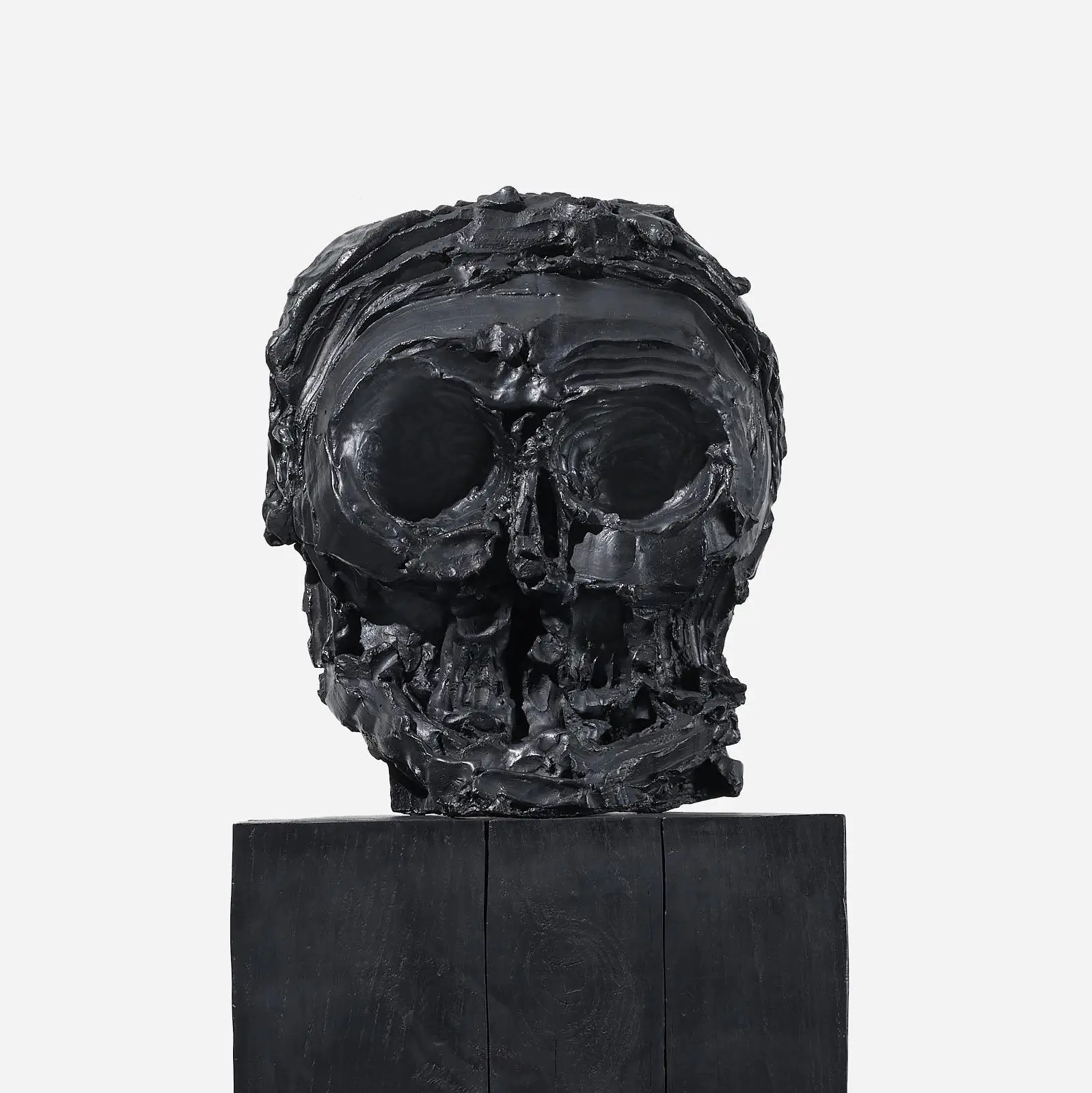
A close study of Thomas Houseago’s black skull sculpture emphasizes its raw sculptural language, where deeply carved textures, fragmented anatomy, and visible gestures of making transform a familiar form into an emotionally charged contemporary artwork.
For a skull head specifically, raising the object to standing height rather than resting it low, as a memento-mori object traditionally sits on a desk or a shelf, forces a kind of eye contact that the vanitas tradition generally avoided. Old-master still lifes let you look down at the skull, in control of the encounter. Houseago’s plinths put you level with it instead.
narr
The skull-on-plinth format isn’t a single object in Houseago’s practice so much as a recurring position he keeps returning to test — the way a musician might keep coming back to the same chord change across a whole career, hearing something new in it each time. Traced across three decades, the through-line holds: Leeds, Amsterdam, Brussels, Los Angeles; plaster to bronze; controlled line work to raw, layered erasure; private grief eventually surfacing into public installation. The individual cast, wherever it sits today — private collection, auction house, gallery storage — inherits all of that. It isn’t a stand-alone artifact so much as the latest entry in a notebook the artist has been keeping, in three dimensions, since before most of his current collectors were paying attention.
Related Articles
Winter Ran Down A Plywood Panel In Gaeta
Cy Twombly, Untitled (Winter Picture), 2004. Acrylic on plywood in the artist’s frame. Gagosian, Madison […]