DRIFT AUDIO
Listen to this story
Choose a voice, then press play.
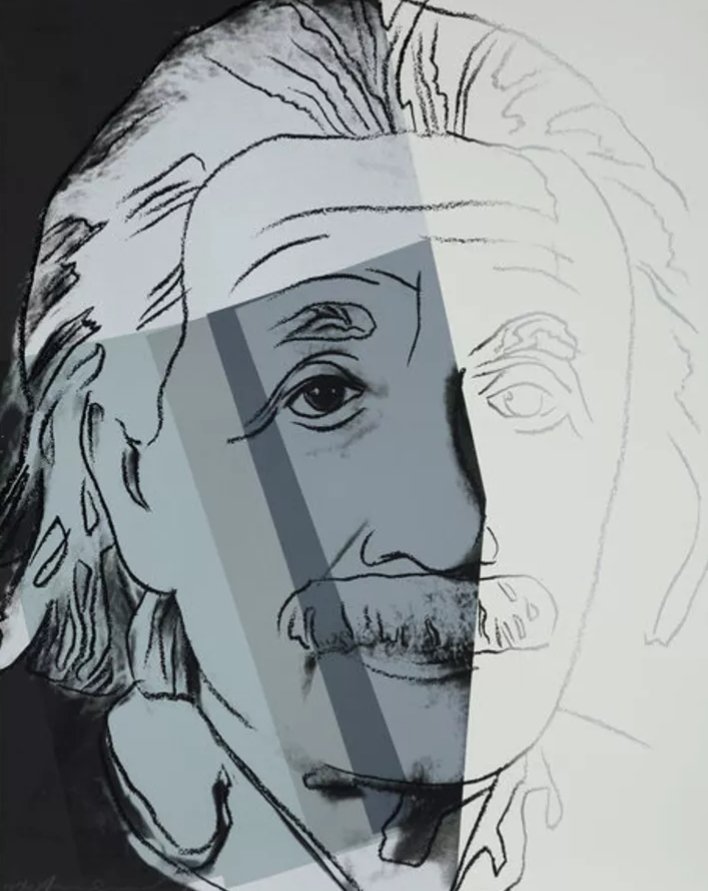
Andy Warhol’s Albert Einstein, F&S II.229, created in 1980, is a quintessential example of the artist’s ability to transform iconic figures into bold, provocative works of pop art. Part of his Ten Portraits of Jews of the Twentieth Century series, this silkscreen portrait captures Einstein’s profound legacy while framing him within Warhol’s vibrant, commercialized aesthetic. This essay delves into the significance of the artwork, its cultural and historical context, and how it exemplifies Warhol’s artistic genius.
Warhol’s Albert Einstein, F&S II.229 transforms the famed physicist into a piece of pop art, reimagining Einstein through the lens of celebrity culture. The portrait is an explosion of color and texture, with Warhol’s signature silkscreen technique applied to a stylized image of Einstein’s face. His expression, intense yet contemplative, is overlaid with vivid hues of red, blue, and yellow. This juxtaposition of vibrant colors with Einstein’s iconic visage highlights Warhol’s ability to simultaneously elevate and commodify cultural icons.
Pop art, as a movement, sought to blur the boundaries between “high” and “low” culture. Warhol, its most famous practitioner, turned everyday objects and figures into cultural phenomena. With Albert Einstein, F&S II.229, Warhol applied the same principles to one of the most significant scientific figures of the 20th century. By placing Einstein in the realm of celebrity and consumer culture, Warhol challenges viewers to consider how fame operates across different domains, from entertainment to academia.
The Ten Portraits of Jews of the Twentieth Century series is one of Warhol’s most controversial and thought-provoking works. Commissioned by Ronald Feldman Fine Arts, the series features notable figures such as Franz Kafka, Sigmund Freud, and Golda Meir, alongside Einstein. Dubbed by critics as “Warhol’s Jewish Hall of Fame,” the series celebrates individuals whose achievements left an indelible mark on history.
Warhol selected these figures based on their contributions to fields ranging from science to politics. Einstein, as the physicist behind the theory of relativity, epitomized intellectual brilliance. His inclusion in the series reflects Warhol’s interest in exploring the ways figures of genius are transformed into cultural symbols.
Critics of the series argued that it commodified Jewish identity and oversimplified its subjects. However, supporters praised Warhol for bringing attention to influential Jewish figures, emphasizing their cultural and historical importance. Einstein’s portrait, in particular, stands out as a testament to the global impact of his scientific breakthroughs.
Einstein’s image, with his distinctive wild hair and thoughtful gaze, had already become a symbol of genius long before Warhol’s interpretation. In Albert Einstein, F&S II.229, Warhol amplifies this iconicity. The silkscreen portrait strips away the details of Einstein’s life and focuses on his face, reducing him to a symbol. Warhol’s use of bright, saturated colors contrasts with the somber black-and-white photographs typically associated with Einstein, injecting the portrait with energy and immediacy.
Einstein’s scientific achievements, particularly the theory of relativity, reshaped humanity’s understanding of the universe. However, his cultural significance extended beyond science. He was a vocal advocate for civil rights, a pacifist, and a public intellectual. Warhol’s portrait captures this multifaceted legacy, presenting Einstein as both a man of intellect and a cultural phenomenon.
Warhol’s silkscreen process plays a pivotal role in the aesthetic of Albert Einstein, F&S II.229. This technique involves transferring a photographic image onto a canvas using a mesh screen and layers of ink. The result is a graphic, almost mechanical reproduction of the original image, a hallmark of Warhol’s work. This approach emphasizes reproducibility, aligning with Warhol’s fascination with mass production and consumerism.
The layering of colors in Einstein’s portrait creates a dynamic visual effect, drawing the viewer’s eye to different parts of the composition. The interplay of vibrant and muted tones suggests both the complexity and accessibility of Einstein’s legacy. Warhol’s deliberate use of imperfections, such as uneven ink application and smudges, adds texture and depth, reminding viewers of the human hand behind the machine-like process.
Warhol’s Albert Einstein, F&S II.229 holds a unique place in the intersection of art, science, and culture. By immortalizing Einstein in his signature pop art style, Warhol ensures that the physicist’s legacy extends beyond the realm of science. The artwork serves as a bridge between disciplines, inviting viewers to consider how figures like Einstein influence not only their respective fields but also broader cultural narratives.
The piece also reflects Warhol’s ability to anticipate trends in the commodification of genius. Today, Einstein’s likeness appears on posters, T-shirts, and memes, cementing his status as a pop culture icon. Warhol’s portrait captures the beginning of this phenomenon, positioning Einstein as a precursor to the celebrity scientists of the modern era.
Warhol’s Albert Einstein, F&S II.229 continues to captivate audiences, both for its artistic merits and its cultural implications. The portrait is a reminder of Warhol’s ability to transform even the most complex figures into accessible, visually arresting works of art. For Einstein, the portrait adds another layer to his legacy, solidifying his place not only as a scientific genius but also as a cultural touchstone.
The Ten Portraits of Jews of the Twentieth Century series has been the subject of numerous exhibitions and scholarly analyses, with Einstein’s portrait often serving as a focal point. The piece exemplifies Warhol’s talent for creating works that are both deeply personal and universally resonant.
Andy Warhol’s Albert Einstein, F&S II.229 is a masterpiece that transcends the boundaries of art and science. Through his use of bold colors, silkscreen techniques, and a focus on iconic imagery, Warhol transforms Einstein into a symbol of genius, creativity, and cultural significance. This portrait is not just a celebration of Einstein’s achievements but also a commentary on how society elevates and commercializes its heroes.
As part of the Ten Portraits of Jews of the Twentieth Century series, the artwork underscores the enduring impact of Jewish figures in shaping the modern world. For Warhol, Einstein’s portrait represents the perfect blend of intellect and celebrity, a fitting subject for an artist who devoted his career to exploring the intersections of fame, identity, and culture.
Warhol’s Albert Einstein, F&S II.229 remains a powerful example of how art can bridge disciplines, challenge perceptions, and celebrate the legacy of humanity’s most influential figures. It is a testament to Warhol’s vision and Einstein’s genius, ensuring their continued relevance in both the art world and popular culture.
Related Articles

Inside the Ferrari Line Where V12s, Hybrids and the Electric Luce Share One Workforce
In Maranello, the electric Luce, a hybrid V8 and a twelve-cylinder Purosangue now share one assembly line and one workforce.