

DRIFT AUDIO
Listen to this story
Choose a voice, then press play.
Apple’s latest accessory—the iPhone Pocket, created in connection with the design lineage of Issey Miyake—is something unexpected even by Apple’s meticulous standards. For decades, the brand has shaped modern culture through metal, glass, and interface design. But this new textile-based wearable marks a shift in the company’s creative trajectory, pulling technology directly into the world of fashion, movement, and personal style.
The iPhone Pocket is not a simple add-on. It is not a sleeve, not a bag, and not a case. Instead, it enters a liminal zone between garment and tool, combining pleated softness with Apple’s engineered intentionality.
flow
The connection between Apple and Issey Miyake’s design philosophy has roots that stretch back decades. When Steve Jobs adopted the iconic black mock turtlenecks designed by Miyake’s studio, he wasn’t merely selecting a uniform—he was selecting a philosophy. Tradition, movement, clarity, reduction, and comfort: these principles shaped Jobs’ view of design as much as they shaped Miyake’s.
The iPhone Pocket feels like an evolution of that long-standing dialogue.
Where Miyake translated simplicity into the human form, Apple translated it into the digital world. Now, the two converge: a sculptural, pleated object built not to dress the body or the device alone, but to integrate the two into a single, fluid motion.
The accessory reads like an archival echo—Miyake’s signature pleating combined with Apple’s commitment to resolved simplicity. Together, their vocabularies blend into a new design language that feels inevitable once seen, even though nothing quite like it existed before.
style
Unlike traditional cases or holsters, the iPhone Pocket begins with fabric, not with function. Apple’s textile engineers developed a new material—internally referred to as WeaveLight—that fuses recycled micro-poly fibers with a thermo-reactive mesh that adapts to movement.
This is Apple at its most experimental: not designing an object that holds technology, but designing a textile that responds to technology.
The pleats are structural, not aesthetic. They expand to accommodate the phone’s shape and contract to secure it. They distribute impact, dissipate heat, and contour to the curves of the device. The fabric’s soft vertical channels create visual rhythm while serving a functional purpose: flex without distortion, stretch without slack, structure without stiffness.
What emerges is a new category of object—half garment, half architecture.
utility
Issey Miyake’s long-time interest in movement becomes essential to the iPhone Pocket’s function. The accessory behaves like a textile sculpture. It shifts, breathes, bends, and adapts with the wearer. When walking, the pleated structure flows with the cadence of each step. When resting, it folds softly against the body or against a larger bag.
This sense of motion is critical to the experience. The iPhone Pocket is not meant to be hidden inside a handbag or clipped rigidly to a belt. It is designed to be worn—visible, expressive, and dynamic. In this sense, it mirrors the philosophy of Homme Plissé: garments designed to move with real life, to bend without breaking, to offer utility while remaining expressive.
Apple’s translation of Miyake’s philosophy transforms phone-carrying from a static act into a fluid gesture.
show
Apple introduces a subtle but important shift: the iPhone Pocket turns the human body into an interface surface. The accessory hangs across the torso, wraps around a hand, drapes over a shoulder, or ties onto a tote. It integrates into the movements you already make rather than demanding new ones from you.
This is a radical departure from phone cases or pockets that treat the device as an isolated object. In the iPhone Pocket, the phone becomes part of the overall silhouette of your outfit. It becomes fluid, wearable, and emotionally quieter.
Apple introduces Pocket Mode to complement this shift. When the phone is placed inside the textile, iOS softens itself. Notifications arrive as gentle vibrations through the pleats. The screen dims into a low-power state. Audio cues become subdued, recognizing that the device is in a semi-resting relationship with its wearer.
Technology becomes less demanding and more considerate.
min
The visual range of the iPhone Pocket is striking. Apple and Miyake have released a spectrum of colors that echo both brands’ aesthetics. Neon yellow, bright orange, vibrant purple, electric pink, and crisp teal deliver a burst of expressive modernity. Earthy brown, matte black, and deep blue deliver sculptural restraint.
The pocket becomes a stylistic extension of the user’s identity. It can be a bold accent against monochromatic clothing or a tonal complement to minimal wardrobes. When attached to a geometric tote, it becomes a contrasting ribbon of color. When worn crossbody, it evokes the visual language of streetwear slings and utilitarian tech-wear.
It functions as much as it communicates.
the accessory
Perhaps the most transformative aspect of the iPhone Pocket is its refusal to be purely a device carrier. It behaves like a piece of clothing. It drapes with the softness of knitwear and the architectural structure of contemporary Japanese design.
Apple has created an object that enhances an outfit rather than detracting from it. Where smartphone accessories often feel like compromises—cheap plastics, rigid leather, bulky strap systems—the iPhone Pocket feels intentional.
This is fashion-tech that respects both worlds equally.
impression
Ultimately, the iPhone Pocket is more than a product. It is a proposition. It suggests a future where technology can be soft, warm, expressive, and wearable without hiding behind novelty. It proposes that hardware can live harmoniously within fabric, that movement can become interface, and that the boundaries between garment and device can be artfully blurred.
Related Articles
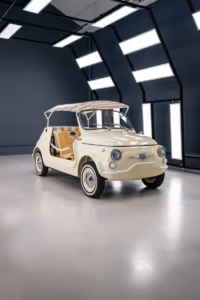
Garage Italia’s Electric Spiaggina Puts the Fiat 500’s Riviera Years on Battery Power
Ten kilowatts, rattan seats and a €85,000 starting price: Garage Italia's 500 Spiaggina rebuilds Ghia's 1958 beach car for the yacht crowd.