DRIFT AUDIO
Listen to this story
Choose a voice, then press play.
Paris Fashion Week has long been the meeting point of worlds—heritage brands colliding with avant-garde design, couture clashing with streetwear, tradition meeting disruption. Yet, even amid the constant stream of blended flows that flood the runway, the unveiling of AUTRY’s partnership with Japanese designer Maison Mihara Yasuhiro General Scale stood apart. Their capsule collection, titled “Broken Something”, didn’t just debut shoes—it introduced a dialogue between two distinct philosophies: vintage American sport heritage and Japanese reinterpretive craftsmanship.
AUTRY’s Heritage: American Simplicity With Staying Power
Founded in Dallas in 1982, AUTRY built its reputation on the clean, classic silhouettes of tennis and court shoes. With models like the Medalist, AUTRY leaned into Americana minimalism—uncluttered lines, understated branding, and a nostalgic nod to the golden age of tennis. Their footwear captured the spirit of sportswear that was functional but stylish enough to slip seamlessly into everyday wardrobes. Over the decades, the Medalist became AUTRY’s most recognizable silhouette, worn for both its authenticity and its timeless appeal.
This devotion to classic form and function has allowed AUTRY to quietly maintain relevance, even as the sneaker industry swung wildly between chunky maximalism and futuristic tech. Where other brands chased hype, AUTRY remained committed to a heritage aesthetic—making it the perfect foil for a designer known for breaking and bending sneaker norms.
Mihara Yasuhiro: The Artist of Imperfection
Mihara Yasuhiro, one of Japan’s most celebrated experimental designers, has made his career on rejecting the polished precision that dominates modern footwear. Since launching his namesake label in 1997, Mihara has turned sneakers into sculptural objects—warped soles, clay-molded edges, and hand-shaped distortions that subvert sneaker orthodoxy. His shoes are not just worn; they are interpreted.
The General Scale line, in particular, emphasizes Mihara’s philosophy of “perfect imperfection.” Each pair feels as if it has been sculpted by hand, a kind of industrial wabi-sabi, where beauty arises from irregularity. His clay-molded soles became a cult icon of their own—imitated by many, mastered by none. By fusing craft, chaos, and subtle rebellion, Mihara Yasuhiro elevated sneakers into gallery-ready conversation pieces.
“Broken Something”: Where the Two Worlds Collide
The AUTRY x Maison Mihara Yasuhiro collaboration—aptly titled “Broken Something”—isn’t about disruption for its own sake. Instead, it represents a conversation across continents and cultures. AUTRY’s Medalist sneaker, long celebrated for its vintage court design, becomes the canvas for Mihara’s intervention.
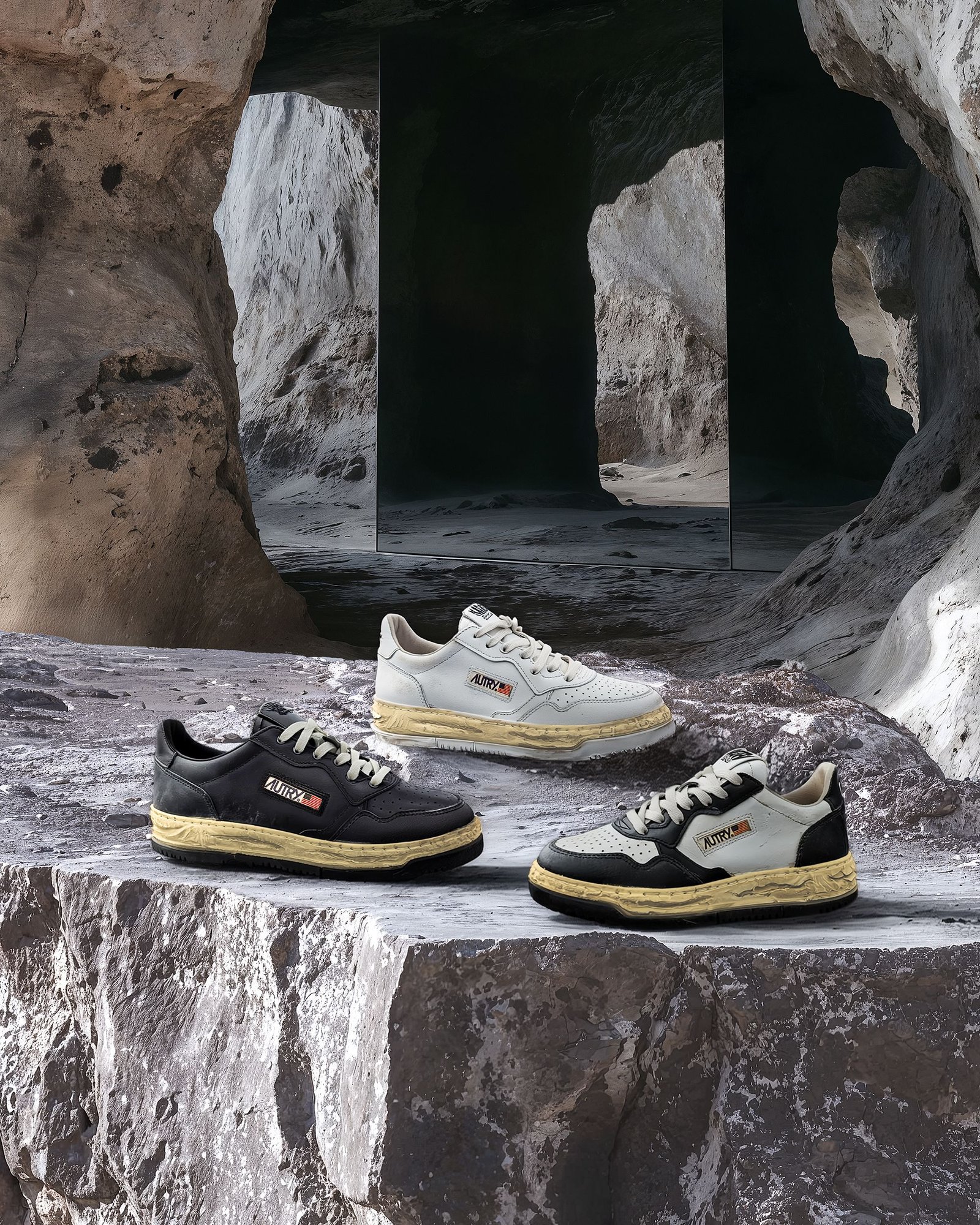
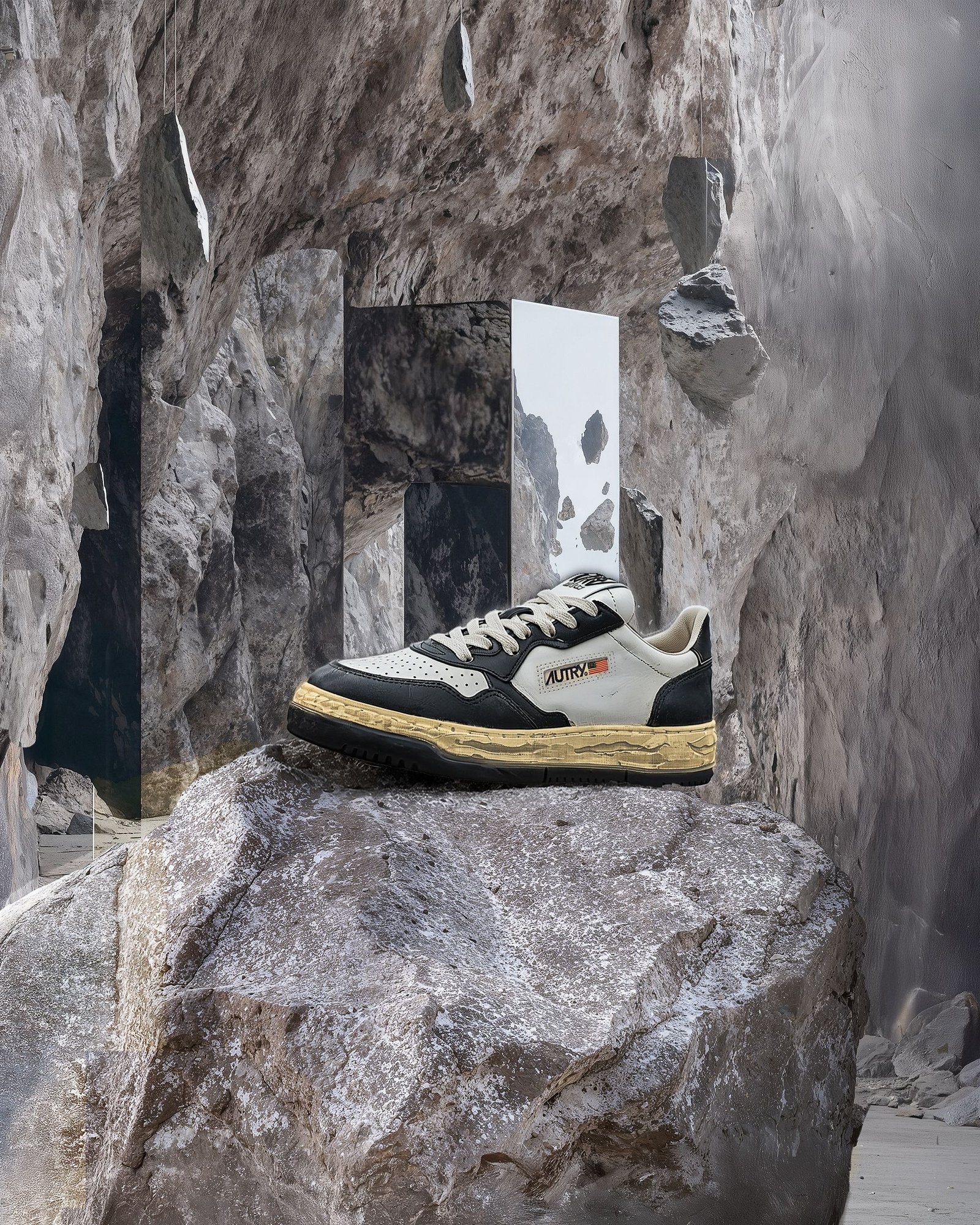
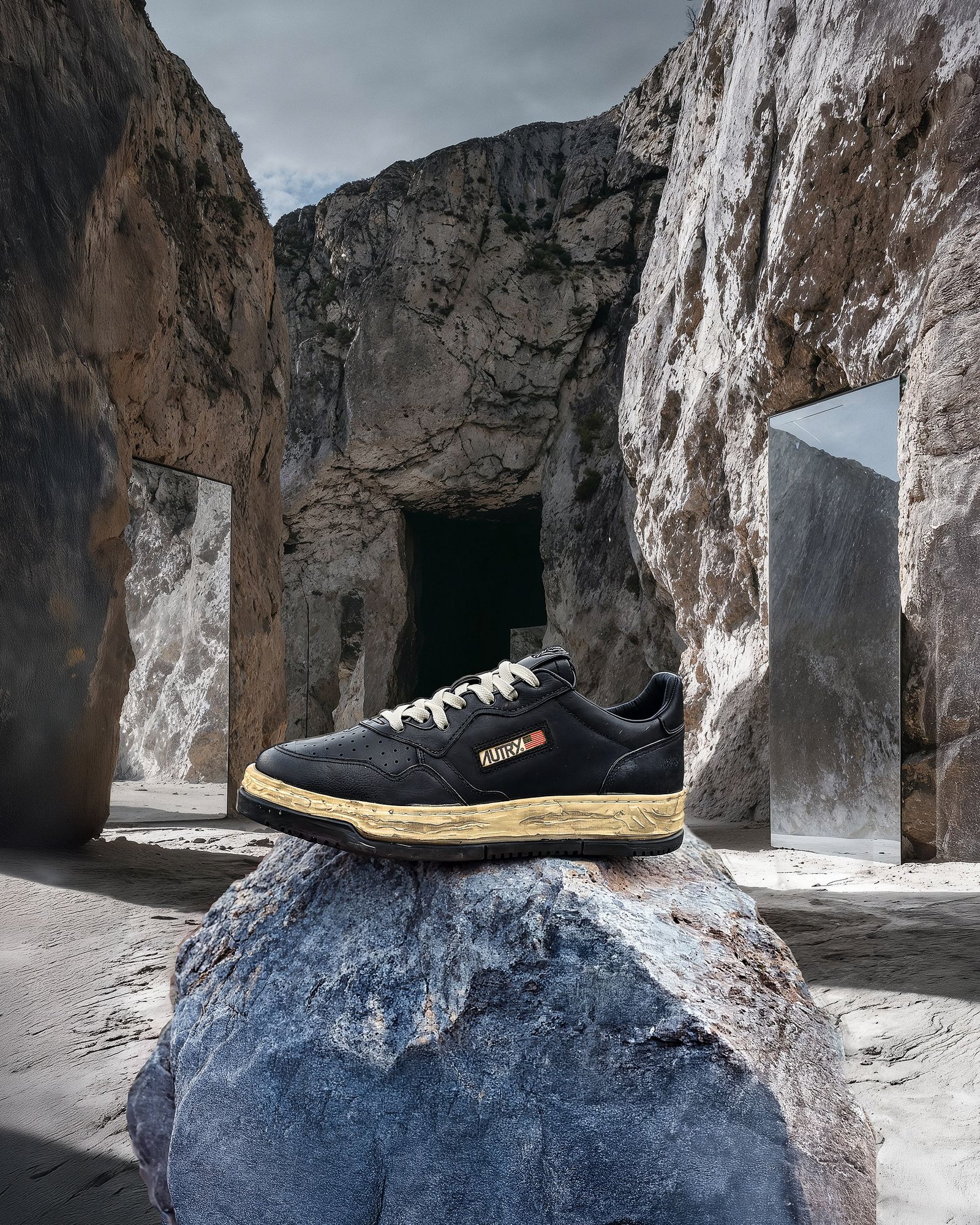
At first glance, the sneaker retains AUTRY’s recognizable paneling, perforated toe box, and retro branding. But the foundation is different: Mihara’s hand-molded clay sole, reimagined in rubber for durability, anchors the shoe with an intentionally uneven form. The sole appears as if it were sculpted on a pottery wheel, still soft from the artist’s touch, then hardened mid-movement.
This collision of order and distortion creates something strikingly original. The sneaker looks both familiar and new, balanced yet asymmetrical, traditional yet radical. It is, in essence, the fusion of East and West: American vintage structure elevated by Japanese experimental artistry.
The Idea
Shoe are often sold on specialized uniqueness—symmetry, sharpness, and flawless construction. But “Broken Something” challenges that expectation. Mihara’s warped sole disrupts the idea of sneakers as mass-produced sameness. Each pair feels personal, as though it carries the memory of the craftsman’s hand.
In Japanese aesthetics, this reflects the principle of wabi-sabi—the beauty of impermanence, imperfection, and incompleteness. Rather than hiding flaws, “Broken Something” embraces them. The sneaker suggests that individuality is not found in polished uniformity but in the small irregularities that set objects—and people—apart.
For AUTRY, a brand rooted in retro American clarity, this collaboration marks a daring step into an unfamiliar aesthetic. Yet, rather than clash, the two philosophies amplify one another. The simplicity of the Medalist allows Mihara’s sole to take center stage, while Mihara’s distortion prevents AUTRY’s heritage from feeling static or predictable.
Three Colorways, Three Interpretations
The “Broken Something” capsule launches in three versatile yet distinct colorways:
Classic White with Cream Sole – The most direct homage to AUTRY’s tennis heritage, featuring clean leather uppers that highlight the sculptural sole.
Black with Aged Effect – A darker, grittier interpretation that leans into punk and underground aesthetics, a nod to Mihara’s rebellious streak.
Neutral Beige with Tonal Sole – A muted, earthy option that reflects both natural imperfection and contemporary minimalism.
Each version speaks to a different facet of the collaboration—sport, subculture, and subtlety. Collectors will see them not just as sneakers but as wearable art objects that reinterpret classic footwear norms.
Culture Bridge
Beyond aesthetics, “Broken Something” highlights the growing cultural exchanges shaping global fashion. In the past decade, shoe merges have become more than just commercial ventures; they’ve evolved into storytelling platforms. When American heritage brands like AUTRY connect with Japanese experimentalists like Mihara Yasuhiro, the result is more than just hype. It’s a demonstration of how sneakers can serve as cultural ambassadors.
For Western audiences, the collaboration introduces Mihara’s philosophy of imperfection in a more accessible, wearable form. For Japanese consumers, it anchors Mihara’s radical vision within a classic, recognizable shape. For both, it demonstrates that heritage and innovation can co-exist without one overshadowing the other.
Reception and Anticipation
Unveiled at Paris Fashion Week, “Broken Something” was met with enthusiasm from editors, buyers, and collectors alike. Sneaker enthusiasts praised the collection for balancing AUTRY’s vintage charm with Mihara’s experimental edge. Fashion critics highlighted the collaboration as a rare instance where both partners’ identities remain intact—AUTRY doesn’t disappear under Mihara’s influence, and Mihara doesn’t dilute his vision for broader appeal.
This balance makes the sneakers not just desirable collectibles but conversation pieces. In an era where sneaker collaborations often blur into repetitive releases, “Broken Something” feels like an authentic artistic exchange.
The Future of East-West Collabs
This mix also reflects a broader trend: the rise of Japanese designers as global tastemakers in footwear. From Rei Kawakubo and Junya Watanabe to Mihara Yasuhiro, Japanese creatives have repeatedly challenged Western conventions, often reshaping them entirely. By engaging with brands like AUTRY, they bring these ideas into dialogue with Western traditions rather than standing apart.
For AUTRY, it’s also a glimpse into a future where heritage can evolve without losing its roots. Collabs like this ensure that even as the brand celebrates its American DNA, it remains relevant in a constantly shifting cultural landscape.
Flow
The AUTRY x Maison Mihara Yasuhiro General Scale “Broken Something” collection isn’t about chasing hype—it’s about redefining what sneakers can represent. By taking AUTRY’s Medalist silhouette and placing it atop Mihara’s clay-inspired sole, the emergence combined produces a shoe that feels alive, tactile, and deeply personal.
More than footwear, these shoes are an experiment in storytelling, a bridge between East and West, and a celebration of imperfection as beauty. They are not just shoes to wear but statements to embody: that fashion thrives not in flawless uniformity, but in the broken, the distorted, and the unexpected
Read Drift’s related feature, Maison MIHARA YASUHIRO’s Blakey Low-Top.
Related Articles
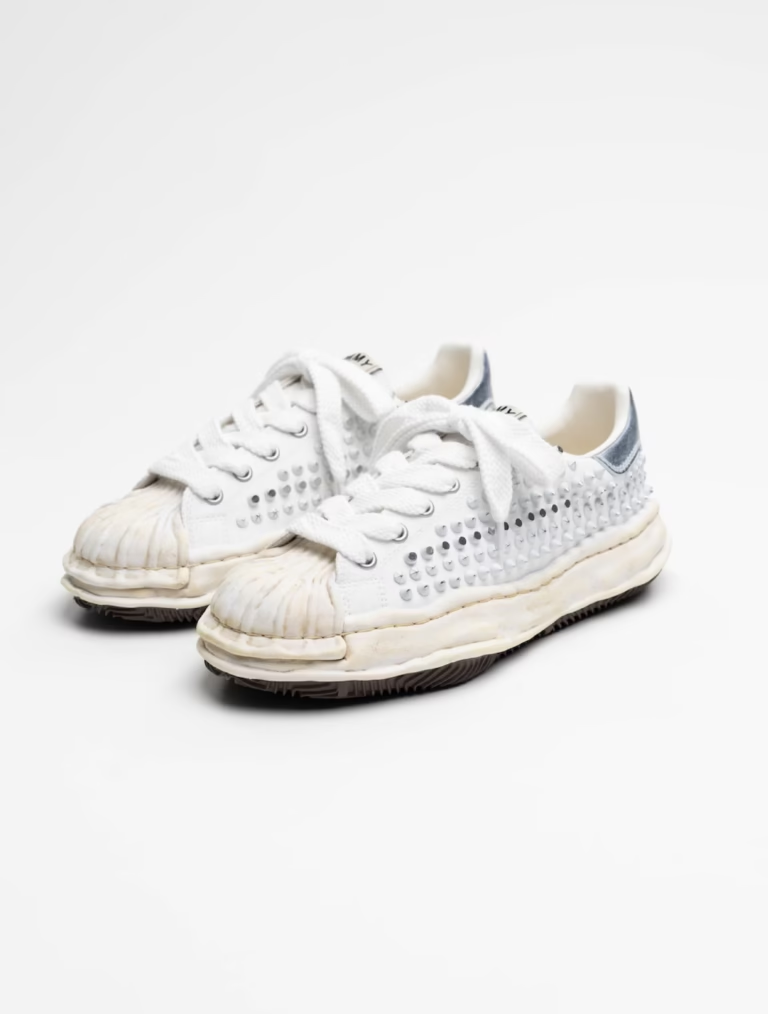
Mihara Put Three Kinds Of Studs On The BLAKEY And Scratched The Paint
EXCLUSIVE EDITION for 2026AW. Studded Original Sole. 5 September. ¥58,300. White, green, brown, black. in […]