DRIFT AUDIO
Listen to this story
Choose a voice, then press play.
Ahead of Paris Couture Week, the cult Belgian designer debuted his new label with restraint rather than spectacle.
In This Story
- A Measured Return
- From Dream to Daylight: Reading the Collection
- The Signatures Holding It Together
- Styling on a Different Frequency
- What Boloria Signals Next
There are designers whose names alone promise fireworks, and Olivier Theyskens has long been one of them. The Belgian designer built his reputation on exactly that kind of drama and theatricality across stints at Rochas, Nina Ricci, and Theory, as well as through his own gothic-tinged namesake label. So when he stepped back onto a Paris runway the day before Couture Week to unveil the debut collection for his new house, Boloria, the show’s quiet, controlled hand came as something of a surprise.
View this post on Instagram
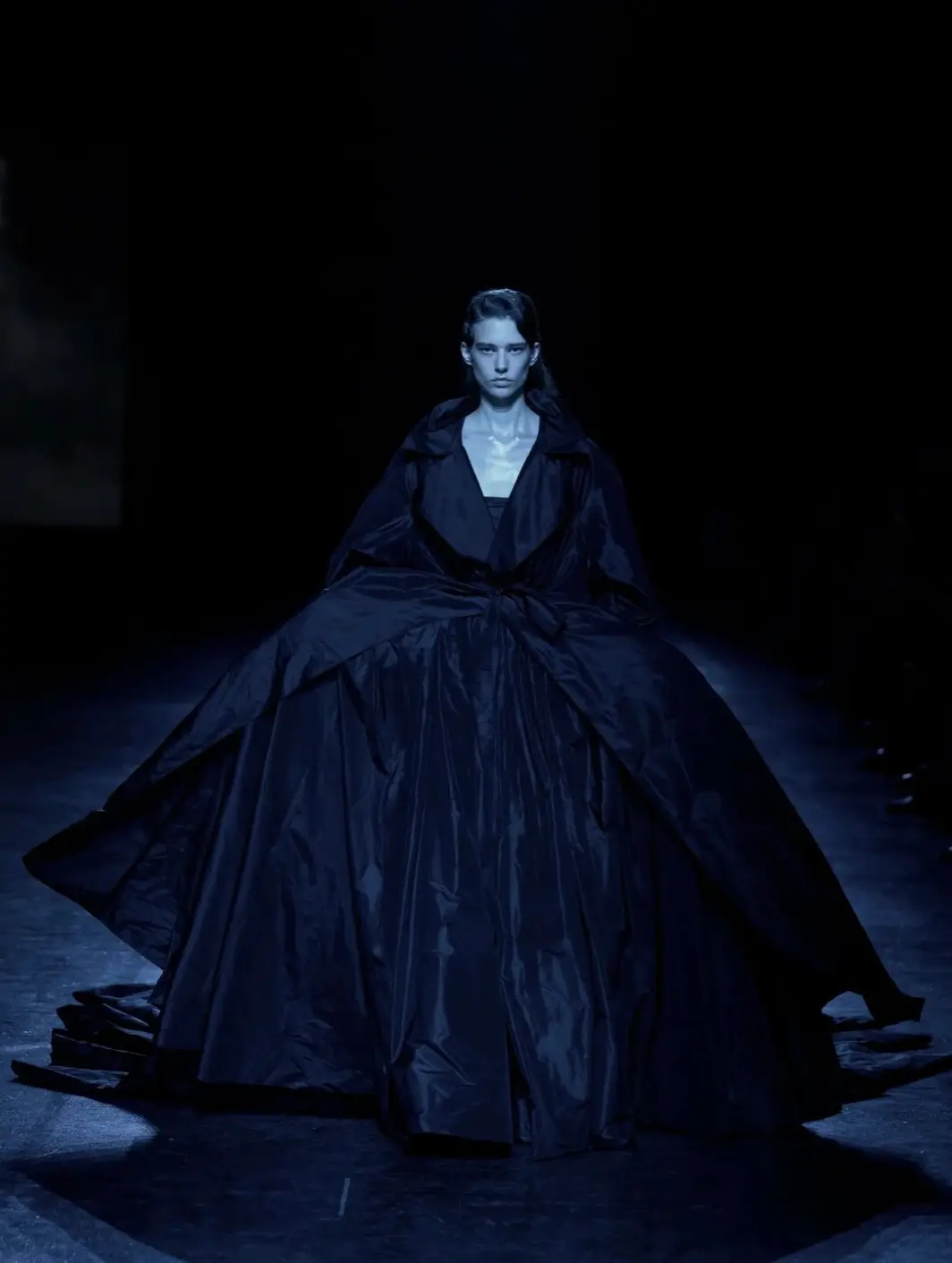
Rather than opening with a grand gesture, Theyskens offered what read like an overture: a short run of pseudo-panier dresses, followed by a longer stretch of tailored looks moving fluidly between masculine and feminine registers. It was a collection built on restraint, not spectacle — the kind of choice that only makes sense once you understand what Boloria is designed to be.
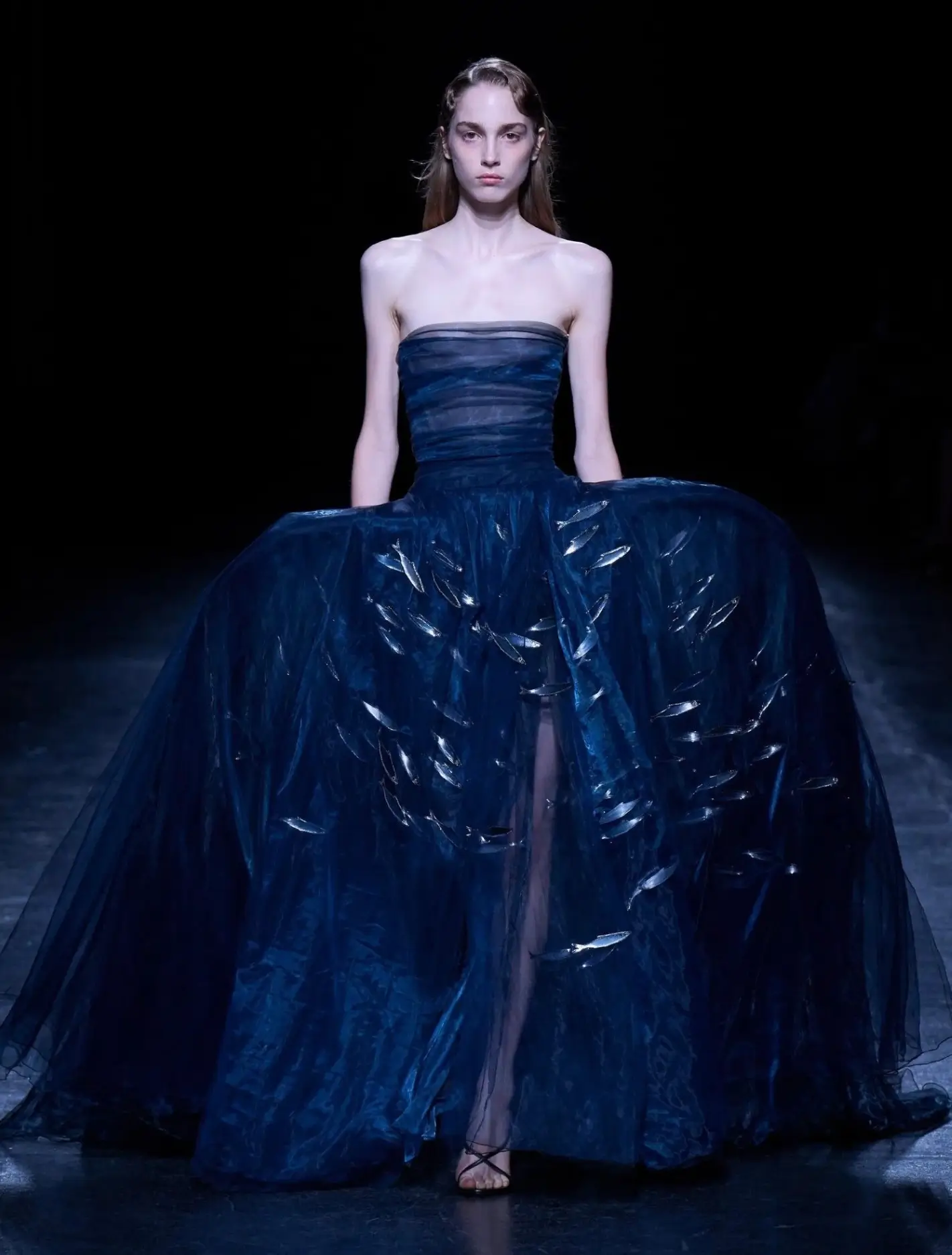
Strapless deep navy evening gown combines a sheer layered bodice, sculptural volume, and metallic feather-inspired embellishments for a dramatic runway statement.
Boloria is not a typical fashion-house launch. It is backed by WEAREONE.world, the Belgian entertainment group behind the Tomorrowland electronic music festival, marking the company’s first venture into fashion. That backing gives Theyskens a structure explicitly removed from the usual conglomerate pressures of the luxury industry, and by his own account, he used that freedom to spend two years developing this debut, refining details down to heel profiles and metallic fabric inserts.
View this post on Instagram
collection
The show unfolded in two distinct movements, separated almost cinematically by lighting. It opened with seven made-to-order, made-to-measure looks — dresses built from two-dimensional paniers, wide at the front and flat at the back, trailing into immense trains. These pieces were layered from black and midnight-blue tulle, draped in cascading, almost chaotic folds, paired with equally dramatic outerwear. One skirt suspended the silhouettes of a school of silver fish mid-air within the tulle, a striking, almost sculptural touch. Blue lighting bathed this opening sequence, framing it explicitly as a dream state.
Then the lights shifted to something closer to daylight, and with it, the clothes moved into what read as real life. This second, larger portion of the show split into three loose groups. The biggest cluster consisted of tailored looks — jackets paired with ties, worn conventionally or draped diagonally across a bare torso in one shoulder. A second group offered bias-cut dresses in clean, monochromatic tones, with sheer black elements wrapping shoulders or sleeves like gauze. The smallest group presented women’s suiting, ranging from traditional cuts to a standout tweed jacket-and-skirt set finished with micro metallic fringing.
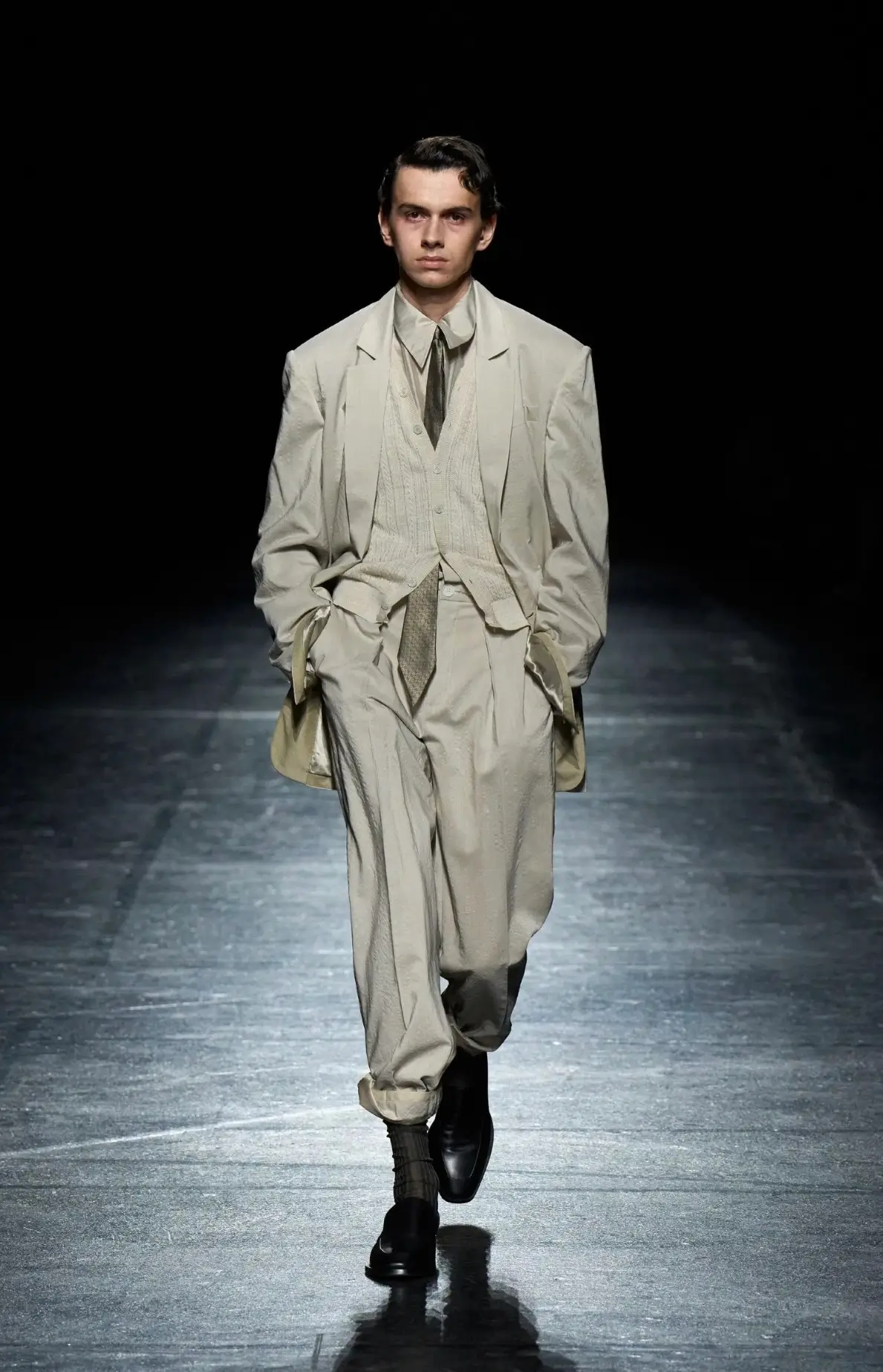
Relaxed ivory tailoring pairs a softly structured blazer, textured knit layers, and pleated trousers with understated accessories for a refined, contemporary runway look.
Taken together, the two halves of the show suggested a designer laying architectural groundwork rather than making a definitive style statement — establishing a base wardrobe before Boloria’s fuller character emerges in future seasons.
hold
Several recurring elements tied the disparate looks into something cohesive. A high-neck blouse, sometimes rendered in lace, appeared repeatedly as the innermost layer across both menswear and womenswear. The shirting, meanwhile, carried a distinct point of view: silk collars slightly wider than standard but left entirely unstructured, giving a deliberately imprecise, almost undone quality. The reference point seemed to be 1930s shirting, reworked for far greater versatility.
Underpinning nearly everything was a sense of liquidity in the fabric — a sinuous, flowing movement offset by pronounced shoulders that carved out an hourglass shape, especially in the longer dresses. It’s a tension between softness and structure that has followed Theyskens throughout his career, and its presence here suggests it will remain a throughline for Boloria as the brand develops.
unique
Handling the show’s styling was Olivier Rizzo, the veteran stylist known for his long-running work on shows for Prada, Maison Margiela Artisanal, and Coach. His touch was unmistakable, particularly in choices meant to underscore the collection’s romanticism: trousers tucked into sock elastics, hems folded outward to expose the boxers beneath, shirts tucked directly into those boxer waistbands.
These particular styling choices struck an odd note against the collection’s otherwise refined register. Exposed waistbands, askew collars, and rolled-down trouser waists have become recurring, almost predictable devices across this season’s shows, popularized to the point of cliché by TikTok. There was a discernible attempt here to stretch classic menswear tailoring into looser, harem-like proportions for added romanticism and nostalgia — but the exposed boxer and rolled waist read more as a bid for social-media-friendly “trendiness” than a natural extension of the clothes themselves, and it sat somewhat uneasily against a brand otherwise presenting itself with such restraint.
next
Despite that friction, Boloria’s debut reads as a confident first step. Theyskens is working in different territory than the one that made his name in the 1990s, and it stands to reason that future collections will need to move past this deliberately minimalist opening if the brand is to distinguish itself from the crowded field of labels chasing elevated tailoring, deconstruction, and luxurious fabrication. Few designers, though, work quite like Theyskens — and a house built specifically to give him room to develop slowly, backed by a group with no prior stake in fashion’s usual pressures, may be exactly the environment in which that distinction takes shape.
Related Articles
WACKO MARIA Brings Its Leopard Lining to the Big Leagues
Black nylon outside, leopard fur inside: WACKO MARIA’s first Major League Baseball collection reached Japan […]