DRIFT AUDIO
Listen to this story
Choose a voice, then press play.
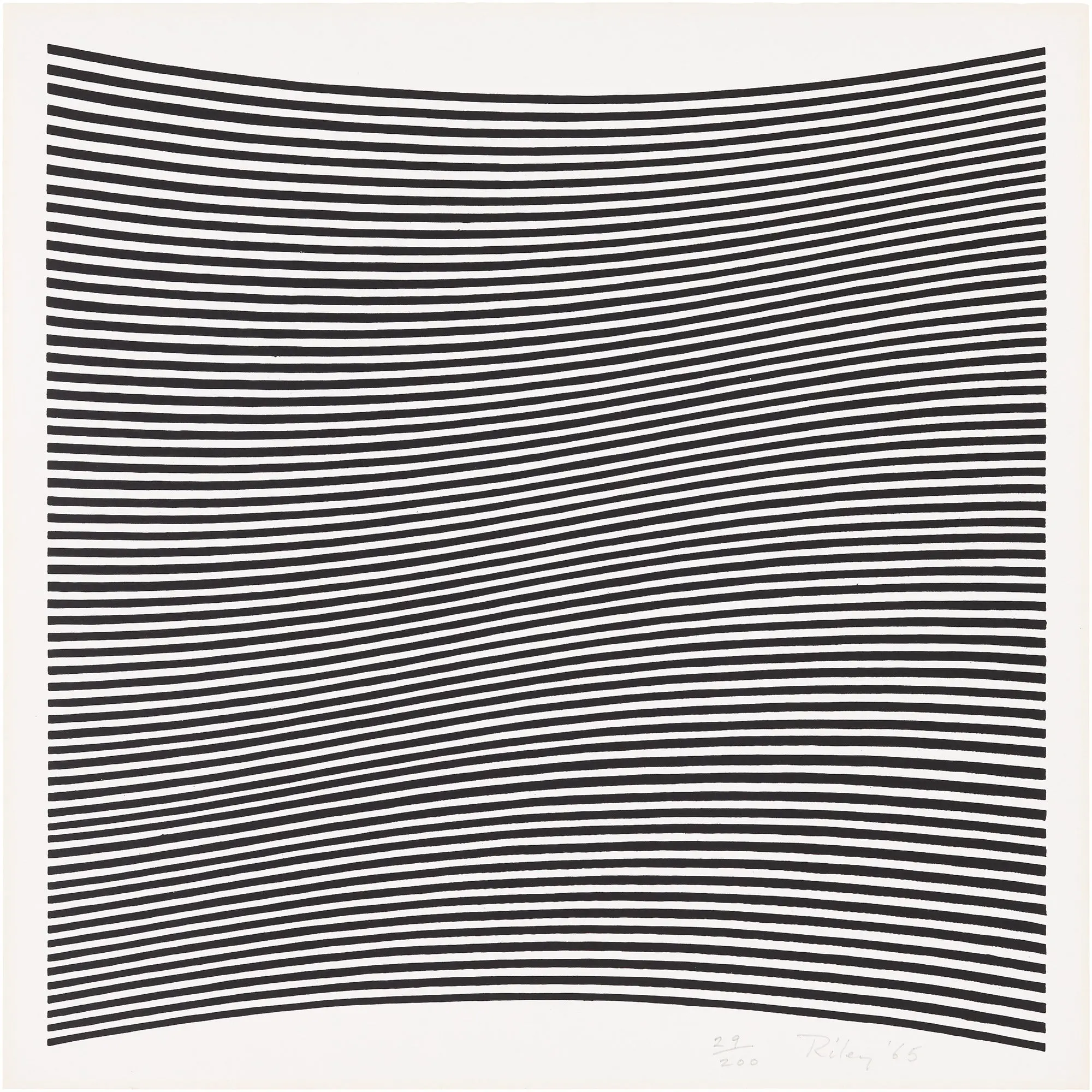
Bridget Riley’s Untitled (La Lune en Rodage – Carlo Belloli) (1965) is a quintessential example of the British artist’s early Op Art period. This limited-edition screenprint, measuring approximately 31.9 x 31.9 cm (image size), is currently estimated at £8,000–12,000 at auction. It captures the essence of Riley’s revolutionary approach to perception, movement, and visual sensation through pure geometric abstraction.
stir
Untitled (La Lune en Rodage – Carlo Belloli) is a black-and-white screenprint on wove paper. It features undulating horizontal lines that curve and ripple across the square composition, creating a hypnotic optical effect. The lines appear to bend, swell, and recede, generating a dynamic sense of motion and depth on a flat surface. This optical vibration is central to Riley’s practice: the eye is never allowed to rest. Instead, it is drawn into an active dialogue with the work, where static marks produce the illusion of waves, breathing, or shifting topography.
The print belongs to a small but significant group of early screenprints Riley produced in 1965. It was published by Editions Panderma in Basel as part of the La Lune en Rodage portfolio, curated by Carlo Belloli, an Italian poet and art critic. The edition size is 200 plus 10 artist’s proofs. The work is signed, dated ‘Riley ‘65’, and numbered in pencil. It was printed by the renowned Kelpra Studio in London, known for its high-quality screenprinting that allowed Riley precise control over her sharp, clean lines.
Visually, the piece exemplifies Riley’s mastery of repetition and variation. Thin black lines on a white ground are carefully modulated in width and spacing. Where they compress, they create darker bands; where they expand, lighter areas emerge. This creates a rhythmic pulse that feels almost musical. The title’s reference to “La Lune en Rodage” (roughly translating to “The Moon in Gear” or “The Moon in Motion”) evokes celestial movement and mechanical precision, perfectly suiting the work’s engineered optical effects.
evolve
Bridget Louise Riley was born on April 24, 1931, in London. Her early childhood was spent in Cornwall, where the dramatic coastline and intense Atlantic light left a lasting impression on her sense of color, rhythm, and natural phenomena. After her family returned to London, she studied at Goldsmiths’ College (1949–1952) and the Royal College of Art (1952–1955). Her early works were figurative and impressionistic, influenced by Post-Impressionists like Georges Seurat, whose pointillist technique taught her about optical mixing and the science of perception.
By 1960, Riley had abandoned representation entirely. A personal crisis following the end of a relationship led her to explore black-and-white geometric patterns as a form of emotional and perceptual control. Works like Kiss (1961) marked the beginning of her Op Art phase. She meticulously planned compositions using graph paper and mathematical calculations, often employing assistants to execute large-scale paintings while maintaining absolute precision.
Riley’s breakthrough came with participation in the landmark 1965 exhibition The Responsive Eye at the Museum of Modern Art in New York. This show introduced Op Art to a wide audience and catapulted Riley to international fame. Her work stood alongside that of Victor Vasarely and others, but Riley’s rigorous, stripe-based approach was distinctly her own. In 1968, she became the first British woman to win the International Prize for Painting at the Venice Biennale.
retro
Op Art (short for Optical Art) emerged in the mid-1960s as part of a broader fascination with perception, science, technology, and the psychology of vision. It coincided with the Space Age, kinetic art, and growing interest in how the human eye processes information. Riley, however, always emphasized that her work was not purely scientific but rooted in the subjective experience of looking.
Untitled (La Lune en Rodage – Carlo Belloli) was created at the height of this movement. The portfolio it belongs to was an ambitious international project bringing together artists and poets. Belloli’s involvement highlights the interdisciplinary spirit of the era—poetry meeting visual experimentation. Riley’s contribution stands out for its purity and intensity. Unlike more colorful or chaotic Op works, her black-and-white prints possess a stark elegance that heightens their perceptual impact.
The 1960s also saw Riley grapple with issues of authorship and reproduction. Screenprinting allowed her to reach wider audiences while maintaining control over quality. Editions like this one democratized access to her art, making it available beyond museum walls and major collectors.
innov
Riley’s collaboration with Kelpra Studio was crucial. The studio’s founder, Chris Prater, helped translate her precise drawings into screenprints with exceptional fidelity. Each line in La Lune en Rodage is razor-sharp, with no bleeding or variation that could disrupt the optical flow. This technical perfection is why her prints hold such strong market value today.
The work’s square format enhances its self-contained energy. Viewers often report physical sensations—dizziness, pulsing, or a sense of the surface moving—when engaging with it for extended periods. This embodied response is intentional. Riley has described her art as creating “the sensation of seeing” rather than depicting objects to be seen.
rare
At an estimate of £8,000–12,000, this print represents an accessible entry point into Riley’s market. While her major paintings can fetch millions (with auction records exceeding £4 million), her early screenprints offer collectors a chance to own a piece from her defining period at a more reasonable level. Recent sales of similar impressions have ranged from £10,000 to £14,000, showing steady demand.
Factors influencing value include condition (pristine margins and vibrant contrast are essential), provenance, and edition number. Lower numbers or those with strong exhibition history often perform better. As Riley’s market has matured—with major retrospectives at institutions like Tate Britain and the Hayward Gallery—interest in her graphic works has grown among both established collectors and newer buyers seeking iconic 20th-century art.
sig
More than half a century after its creation, Untitled (La Lune en Rodage – Carlo Belloli) continues to demonstrate the power of pure abstraction. In an age dominated by digital imagery and rapid visual consumption, Riley’s work reminds us of the complexity of human vision. Her influence extends beyond fine art into fashion, graphic design, and even architecture.
Riley herself has evolved. From the mid-1960s onward, she introduced color—first stripes, then more complex interactions of hue. Later works explore Egyptian art, nature, and music. Yet her foundational black-and-white pieces remain the most iconic. They represent a moment when art aligned with the optimism and perceptual experimentation of the 1960s while maintaining a timeless quality.
why
In today’s art market, Riley stands as one of the most respected living British artists. Her rigorous methodology, intellectual depth, and emotional resonance set her apart. La Lune en Rodage encapsulates the excitement of her early breakthrough: a small but perfectly formed object that delivers an outsized perceptual punch.
For collectors, it offers beauty, historical importance, and investment potential. For viewers, it delivers joy through pure visual experience. Whether hanging in a minimalist apartment or a scholarly collection, this print continues to “move” in the most literal and figurative sense.
The £8,000–12,000 estimate reflects its status as a desirable but attainable Riley. As the artist approaches her mid-90s, with a legacy firmly cemented in art history, works from 1965 like this one are increasingly sought after as pivotal documents of a revolutionary moment in modern art.
Bridget Riley’s Untitled (La Lune en Rodage – Carlo Belloli) is not merely a decorative object. It is a carefully engineered visual experience that challenges, delights, and expands our understanding of how we see the world. In the ever-shifting landscape of contemporary art, its steady optical pulse remains as compelling as ever.
From the DRIFT archive: London Streets Print by Arina Iastrebova Captures the Soul of a Rainy City · The Art of the Can: Chaz Bojórquez’s Hand-Signed MTN Spray Paint Edition
Related Articles
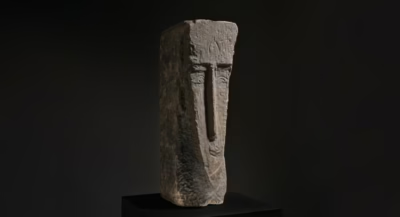
Modigliani’s Limestone ‘Tête’
Carved from a single block of limestone in Montparnasse more than a century ago, one of Modigliani's rare stone heads goes to auction for the first time…