DRIFT AUDIO
Listen to this story
Choose a voice, then press play.
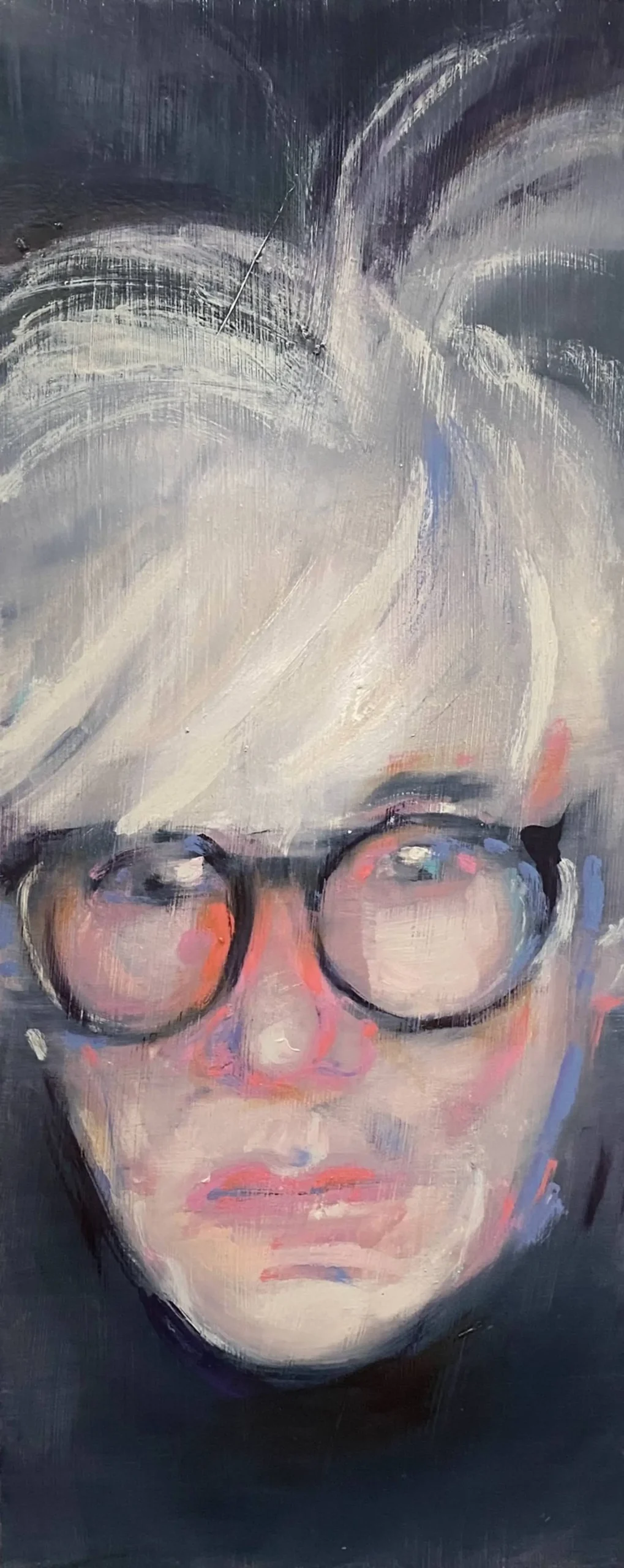
“Cristal Warhol,” an original oil painting on wood by American artist Gregg Chadwick, is a vibrant, intimate homage to one of the 20th century’s most iconic figures: Andy Warhol. Created in 2024 and measuring approximately 7 inches wide by 17.5 inches high by 5.5 inches deep, this work is not a conventional canvas painting but a piece executed directly on a vintage wooden Cristal Champagne box. This choice of support is both clever and thematically resonant, transforming a discarded luxury item into a vessel for artistic celebration.
The painting captures Warhol’s unmistakable likeness—his silver-white wig, distinctive glasses, and enigmatic expression—rendered with Chadwick’s characteristic blend of realism and expressive brushwork. Positioned among a series of other portrait “boxes” in studio displays (including figures like Basquiat and others), “Cristal Warhol” stands out as a central piece that bridges consumer culture, celebrity, and fine art, echoing Warhol’s own obsessions.
from
Gregg Chadwick, based in the United States and associated with spaces like the 18th Street Arts Center in Santa Monica, is known for his evocative portraits of culture and political figures. His work often explores themes of memory, history, and human connection through oil paint. Chadwick’s process is deeply personal; he has described portraiture as “almost magical,” a way to connect with individuals who inspire him across time.
In “Cristal Warhol,” Chadwick extends this practice by incorporating the physicality of the support itself. The Cristal Champagne box—elegant, wooden, with its own history of luxury and celebration—becomes more than a substrate. It is an active participant in the narrative. Warhol famously loved parties, Factory gatherings, and the intersection of high society and pop culture. Cristal Champagne, a symbol of opulent nightlife, aligns justifiably with Warhol’s world of Studio 54 glamour, celebrity portraits, and commodified imagery. By painting on this box, Chadwick literally and figuratively places Warhol back into the party he so adored.
scope
Working in oil on wood, Chadwick achieves a rich depth and luminosity. The wooden surface, with its inherent grain and texture, adds an organic quality that contrasts with Warhol’s often mechanical, silkscreened aesthetic. Where Warhol embraced repetition and detachment through mechanical reproduction, Chadwick’s brushstrokes feel intimate and hand-crafted—view layers of pigment that reveal the artist’s touch.
The composition likely emphasizes Warhol’s face in a direct, almost confrontational gaze, typical of Chadwick’s portrait style. Colors may include cool silvers and whites for the wig, punctuated by the warmer tones of skin and the deep, warm hues echoing the champagne branding. The three-dimensionality of the box format gives the work a sculptural presence; it is an object to be viewed from multiple angles, much like Warhol’s own explorations of surface and depth in his Brillo boxes or Campbell’s Soup Cans.
This format also nods to art historical traditions of painting on unconventional supports—think of Renaissance panels or even folk art—while remaining firmly contemporary. The box’s depth (5.5 inches) suggests it can stand alone as a sculptural element, perhaps displayed on a shelf or mantel, integrating art into everyday domestic spaces in a way Warhol himself might have appreciated.
amb
“Cristal Warhol” is explicitly an homage. In the artist’s own words: “My homage to Andy Warhol is painted on a vintage, wood Cristal Champagne box. Andy loved a party and this painting celebrates Warhol’s life and art.”
This celebration operates on multiple levels. It honors Warhol’s impact on Pop Art, his democratization of celebrity, and his blurring of boundaries between art and commerce. Warhol turned soup cans, celebrities, and disasters into high art; Chadwick turns a champagne box—itself a luxury commodity—into a portrait of the artist who elevated commodities.
The work also engages with themes of legacy. Warhol died in 1987, yet his influence permeates contemporary culture through social media, influencer culture, and the relentless image economy. By painting on a physical, tactile object in 2024, Chadwick grounds the ephemeral nature of fame in something enduring. The wooden box carries a sense of history and reuse, suggesting how culture icons persist and are repurposed across generations.
Furthermore, the choice of Cristal evokes excess, aspiration, and the American Dream’s glossy underside—elements central to Warhol’s oeuvre. It is a witty, knowing wink: Warhol as both the guest of honor and the label on the bottle at the ultimate after-party.
reflect
Chadwick’s broader body of work includes atmospheric landscapes, historical narratives, and other celebrity portraits (such as pieces inspired by Taylor Swift or political figures). His series often carry musical or literary undertones, reflecting a multidisciplinary sensibility. “Cristal Warhol” fits into his explorations of cultural memory and the power of the individual image to encapsulate larger stories.
Displayed alongside other boxed portraits in studio photos, it forms part of a larger installation-like presentation. This serial approach mirrors Warhol’s own use of repetition, creating a modern “Factory” of painted icons. Yet Chadwick’s hand-painted quality infuses warmth and humanity, softening Warhol’s cooler, more ironic detachment.
sig
Prints are also available, extending its reach. Its appearance at fairs like The Other Art Fair underscores its appeal in contemporary markets that value conceptual depth paired with technical skill.
In an era of digital saturation, a physical object like “Cristal Warhol” offers tactile refuge. Collectors are drawn to its uniqueness—the specific vintage box ensures no two works are identical even within a conceptual series. It speaks to a desire for authenticity in a world of reproductions, ironically aligning with Warhol’s fascination with exactly that tension.
fin
“Cristal Warhol” succeeds as both tribute and independent artwork. It invites viewers to consider how we remember icons, how objects carry stories, and how art can transform the discarded or commercial into something profound. Gregg Chadwick’s painting is joyful, celebratory, and quietly profound—a champagne toast in paint form to the Silver Fox of Pop Art.
The work reminds us that art history is not static but a living conversation. Chadwick doesn’t merely depict Warhol; he dialogues with him, using the very language of celebration (champagne, parties, glamour) that defined his subject. In doing so, he creates a piece that feels both timeless and urgently of our moment.
For Chadwick, portraiture is an act of connection across time. For us, viewing “Cristal Warhol” becomes an invitation to that same connection—to pop a metaphorical bottle, raise a glass, and appreciate the enduring sparkle of creative genius.
From the DRIFT archive: Andy Warhol’s Superman (1981): A Diamond-Dust Resurrection of the American Myth · Francesco Clemente’s Portrait Commission: The Human Gaze, Reimagined for The Coral Collective
Related Articles
Forty Years After Warhol, KAWS Puts His X on the Absolut Bottle
Absolut’s art program began with an Andy Warhol painting in 1985. Its newest chapter prints […]