DRIFT AUDIO
Listen to this story
Choose a voice, then press play.
If you want to participate in Pat Perry’s new photo project, you’ll have to get comfortable heading outside, grabbing a few friends, and preparing to hunt low and high for obscure spots in your neighborhood. The Detroit-based artist recently launched “Liminal Bingo,” a communal photo hunt designed specifically “for people ages 5 to 105 living in boring places or exciting places.”
Open to anyone with an internet connection, the project has a simple premise: grab a camera (phones are okay, although Perry encourages film if possible), and snap photos of his illustrated prompts. When you’ve collected five in a row, you’ve got a bingo. But this is no ordinary game. Liminal Bingo transforms everyday environments into stages for discovery, connection, and quiet wonder. It asks participants not just to look, but to see—to linger in the overlooked corners of the world and, in doing so, perhaps glimpse the “magical haunted reservoir sitting just beneath the surface of the everyday world.”
stir
Pat Perry (b. 1991 in Pontiac, Michigan) is a multidisciplinary artist whose work spans painting, drawing, photography, large-scale murals, and now participatory projects. Raised in Comstock Park, he attended Kendall College of Art and Design. His early recognition came from sketchbooks and 35mm photographs documenting years of itinerant travel—hitchhiking and riding freight trains across the United States. These works captured “America from backstage”: service roads, back alleys, freight yards, and the quiet human moments that unfold far from tourist trails or city centers.
Perry lives and works in Detroit’s East Side, where he is literally regrowing a forest on the twelve vacant lots surrounding his house. His paintings often blend the romantic and the quotidian, exploring human connection, nature’s encroachment on the built environment, and the strange beauty of ordinary life. Murals have taken him around the world, but his mid remains in the Midwest—those vast, sometimes homogenized landscapes of strip malls, residential streets, and forgotten meadows that hide metaphysical depth.
Liminal Bingo feels like a natural evolution of Perry’s practice. For years, his work has invited viewers to slow down and notice the in-between spaces. Now, he’s handing the camera (or phone) to everyone else.
flow
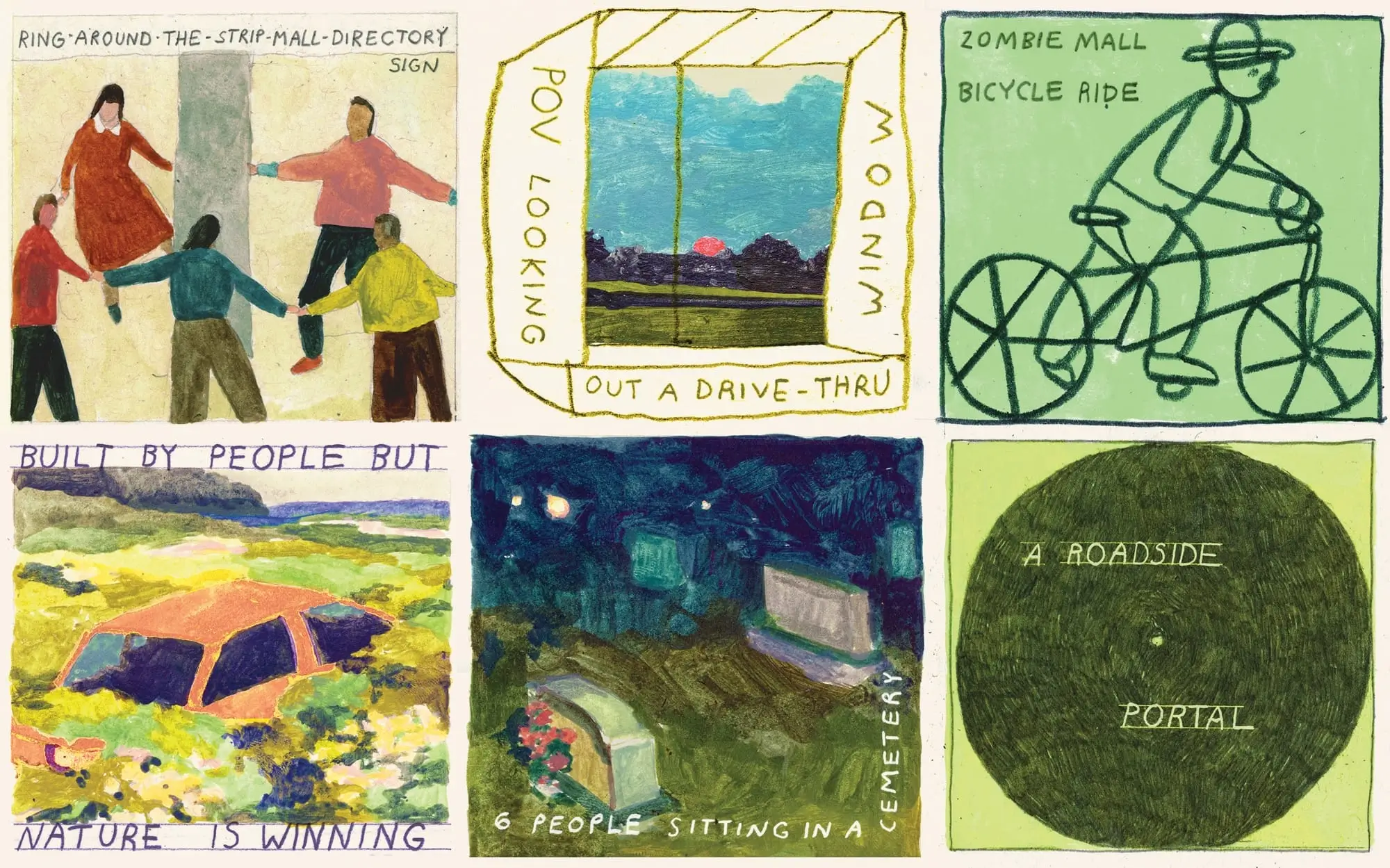
The pithy of the project is a beautifully illustrated poster featuring 25 prompts. The view style—hand-drawn, whimsical yet grounded—mirrors Perry’s illustration work. Prompts range from the purely observational to the delightfully interactive:
- Capture a handshake with a stranger while both wearing sunglasses.
- Photograph a ditch, a service road, or the space behind a shopping center.
- Send a landscape photo to someone you miss and screenshot the evidence.
- Find and document a “haunted” or liminal spot in your neighborhood.
- Other squares encourage group play, conversations with passersby, or simply standing still in places you usually pass through.
A bingo is five in a row—horizontal, vertical, diagonal, or even any five of your choosing. The flexibility is intentional. “The point is to follow what interests you,” Perry notes in the FAQ. Partial boards are welcome. Multiple bingos are encouraged. There are no prizes beyond the experience itself, though selected images may appear in an online gallery, a November 2026 exhibition at Hashimoto Contemporary in New York, and potentially a book.
Submissions can be posted to Instagram with #LIMINALBINGO and tagging @heypatyeah, or emailed. The project is open-ended, but photos shared by the end of August 2026 receive priority consideration for the exhibition.
huh
The term “liminal” comes from the Latin limen, meaning threshold. Liminal spaces are transitional—neither here nor there. Think empty hallways at twilight, abandoned parking lots, the golden hour glow on a suburban cul-de-sac, or the eerie quiet of a meadow bordered by chain-link fence. In internet culture, “liminal spaces” often evoke nostalgia or unease (the Backrooms, empty malls at night). Perry’s version is warmer, more invitational. He wants us to find the magic and the melancholy in our immediate surroundings.
In his own words from Magpies Magazine: “I keep returning to the boring Midwest and the feeling that, no matter how homogenized or generic your world of commercial strips and residential streets is, there is still some haunted, metaphysical terrain lying just out of sight.” He designed the prompts to push people into ditches, behind shopping centers, onto service roads—places they might pass daily but never truly inhabit.
This isn’t nostalgia for a lost past. It’s a call to presence. In an era of constant digital mediation and algorithmic curation of experience, Liminal Bingo insists on analog (or at least slow) engagement with the physical world and with other people.
flow
What elevates Liminal Bingo beyond a personal photo walk is its communal, even slightly disruptive, nature. Many prompts require interaction: talking to strangers, enlisting friends, creating small moments of connection. One prompt might have you and a partner approaching someone for a coordinated sunglasses handshake. Another could involve sharing photos across distances, bridging emotional gaps through literal landscapes.
Perry acknowledges this is rare in modern routines. “Most people only end up in these kinds of situations because either something has gone wrong, they’re playing Pokémon GO, they’re on mushrooms, or they’re doing an art project. So my appeal is: do the last option.”
For younger participants (the project explicitly welcomes ages 5+), it becomes a treasure hunt that teaches observation and bravery. For older adults, it can combat isolation. Families, friend groups, or even solo wanderers all find their place. The project democratizes art-making: no gallery degree required, just curiosity and a willingness to step outside.
shh
Liminal Bingo connects deeply with Perry’s history. His freight-train photographs and sketchbooks documented transient America—the liminal zones of rail yards, small towns, and highways. His murals often activate public spaces. His paintings frequently feature figures in dialogue with nature or architecture in ways that feel slightly uncanny or transcendent.
By crowdsourcing images, Perry expands his “backstage America” view into a collective archive. The resulting exhibition and book could become a nationwide (or global) portrait of how ordinary people see the extraordinary in their own backyards. It’s participatory art in the tradition of relational aesthetics—think Rirkrit Tiravanija’s dinners or JR’s large-scale portraits—but grounded in Perry’s specific Midwestern sensitivity to place and quiet wonder.
how
- Gear: Film cameras add a deliberate pace and beautiful imperfection, but phones work fine. Disposable cameras or instant film can be fun for groups.
- Mindset: Approach with openness. Some prompts may feel awkward at first—that’s part of the point. Safety first; respect boundaries when approaching strangers.
- Locations: Start close to home. Explore alleys, parks at odd hours, rooftops (with permission), or edges where suburb meets field. Urban players might find richness in industrial zones; rural ones in forgotten barns or crossroads.
- Documentation: Take behind-the-scenes shots of the process. Note how the hunt changes your perception of familiar routes.
- Community: Play with others when possible. Share progress online to inspire and connect with participants worldwide.
- Reflection: After completing squares, journal or discuss what you noticed. The real “win” is often internal—a heightened awareness that lingers long after the photos are taken.
reason
In 2026, amid ongoing discussions about screen addiction, declining social capital, and climate awareness, projects like Liminal Bingo feel timely. They counter digital exhaustion by re-enchanting the physical world. They build micro-connections in an atomized society. They remind us that wonder isn’t found only in exotic travel or grand adventures but in the threshold spaces we already inhabit.
Perry’s Detroit context adds layers. The city, long a symbol of post-industrial decline and rebirth, embodies liminality—vacant lots turning into forests (as Perry is doing), ruins hosting new life, communities forging meaning amid uncertainty. Liminal Bingo exports this Detroit spirit: resourceful, observant, hopeful.
impression
Early buzz on Instagram, Colossal, Booooooom, and Magpies suggests strong interest. If the November 2026 Hashimoto exhibition materializes with hundreds or thousands of submitted images, it could create a powerful mosaic of contemporary seeing. A book would archive not just photos but the stories behind them—participants’ reflections on their hunts.
Longer term, one hopes Liminal Bingo inspires similar low-barrier, high-reward participatory projects. Art doesn’t have to be rarefied or expensive. Sometimes it’s as simple as a printed poster, a camera, and an invitation to look closer.
fin
Visit liminalbingo.com for the free downloadable poster, full rules, FAQ, and submission details. Buy a physical poster if you want a tangible artifact. Follow @heypatyeah for updates and participant spotlights.
Then step outside. Find that weird ditch behind the big-box store. Strike up a conversation. Take the photo. Share it. In a small but meaningful way, you’ll be contributing to a growing collective artwork—and, more importantly, to your own refreshed relationship with the world right in front of you.
Liminal Bingo isn’t about winning. It’s about noticing. In Perry’s haunted, beautiful Midwest worldview, that noticing is where the magic begins.
From the DRIFT archive: Eric Stefanski and the Art of Selective Living: A 2025 Confession Painted in Plain Sight · The Art of the Can: Chaz Bojórquez’s Hand-Signed MTN Spray Paint Edition
Related Articles
Joël Andrianomearisoa Finds More Than One Black in a Square of Buttons
In La Guerre des Boutons I, a field of ordinary fasteners turns a modest textile […]