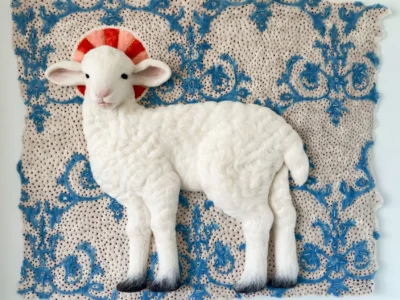
Cathalijn Wouters In the Magnolia’s Care (2026)

April 21, 2026
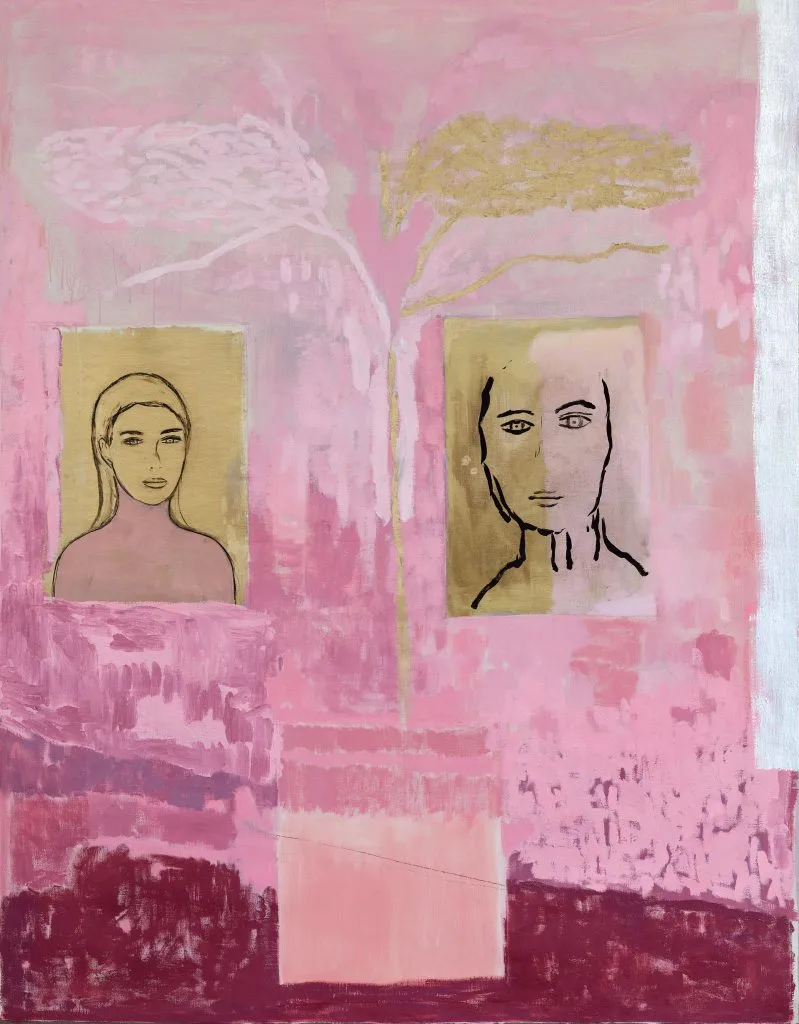
Cathalijn Wouters’ 2026 exhibition In the Magnolia’s Care, presented by SmithDavidson Gallery, unfolds not with spectacle, but with stillness. The works resist immediate interpretation, inviting the viewer into a space of patient looking—a rare gesture in an age of view saturation. Based in Amsterdam, Wouters operates at the delicate intersection of graphic precision and lyrical abstraction, crafting compositions that feel both rigorously composed and intuitively felt.
Her fields of soft tincture—earthy ochres, muted pinks, cool greys—are traversed by slender, wandering lines that suggest form without defining it. Is it a figure, a plant, a memory? The ambiguity is deliberate: a quiet refusal to conform to rigid categories of painting or drawing, figuration or abstraction.
What emerges is a visual language rooted in modernist sensibilities—echoes of Matisse’s cut-outs or Klee’s delicate marks—filtered through a contemporary lens of mindfulness and care. The title In the Magnolia’s Care signals a deeper current: tenderness, attention, the act of tending to something fragile. It is not a declaration but a whisper—one that gathers strength through rhythm, repetition, and restraint. Wouters does not demand attention; she earns it, slowly, through the accumulation of mark and mood.
behind
Wouters’ foundation in graphic design and illustration continues to shape her approach to painting. Trained in clarity, composition, and hierarchy, she brings a disciplined eye to work that might otherwise drift into abstraction. Yet rather than confine her, this background becomes a point of departure—a system she bends toward feeling over function.
Her transition into fine art is not a rejection of structure, but a reconfiguration of its purpose. Where design serves external communication, Wouters’ work serves an internal inquiry: presence, balance, emotional resonance. Based in Amsterdam—a city defined by light, restraint, and observational tradition—her practice reflects a duality of precision and introspection.
There is a humility in her mark-making, as though the image is being uncovered rather than imposed. Early illustrations hint at recurring motifs—human form, botanical elements—but in her current work, these dissolve into suggestion. What remains is the architecture of design—rhythm, contrast, spatial intelligence—redirected toward atmosphere rather than message.
view
Wouters’ compositions exist between control and release. Thin, deliberate lines curve and intersect like breath or pulse, suggesting forms that never fully resolve. They recall calligraphy, botanical study, or notation—yet resist fixed interpretation.
These lines move across soft fields of color: blush pinks, dusty blues, warm greys that hover rather than assert. The palette does not declare; it settles. It lingers.
What defines the work is balance. The lines carry precision, almost architectural in their intent, yet they remain unanchored—free from perspective or scale. The color fields, though measured, soften at the edges, introducing vulnerability. Together, they form a rhythm—choreographic, reciprocal—where neither dominates.
Negative space becomes active. What is withheld holds weight. This restraint reflects a confidence in the viewer’s role—not to decode, but to participate. In a visual culture driven by excess, Wouters’ work distinguishes itself through attention rather than volume.
consider
Wouters’ work resonates with early 20th-century modernism—its reduction, its search for essence—yet it speaks in a contemporary register. There are traces of Matisse in the contour, Klee in the balance of conjure and control, Agnes Martin in the meditative restraint. But these are not references; they are echoes, absorbed and rearticulated.
Where modernism often sought universality, Wouters embraces ambiguity. Her compositions remain unresolved, suspended between figuration and abstraction. This refusal to conclude mirrors a contemporary condition—one skeptical of fixed meaning, open to multiplicity.
Her work also exists in quiet opposition to the digital condition. In a culture of endless scroll, it insists on duration. It unfolds slowly, requiring presence. No mediation, no algorithm—only hand, surface, and time.
This is not modernism as progress, but as presence.
by hand
Wouters works with ink, watercolor, pencil, and mixed media—materials chosen for their immediacy and responsiveness. Each piece records the movement of the hand directly, without digital intervention.
Her process is iterative. Layers accumulate gradually—washes laid down, dried, revisited with line. Some marks remain crisp, others blur, absorbed into the surface. Nothing is erased; everything is integrated. The work retains its history.
Repetition functions not as duplication, but variation. A line reappears across works, altered slightly—like a phrase revisited in different tonalities. The studio becomes a space of return rather than production.
Scale reinforces intimacy. Many works require proximity, drawing the viewer closer. The material is not only physical—it becomes emotional. The act of looking mirrors the act of making: slow, attentive, deliberate.
method
At the core of In the Magnolia’s Care is an ethic of attention—care not as concept, but as method. The magnolia, fleeting in bloom, becomes a quiet metaphor for impermanence and presence.
Wouters does not depict this directly. Instead, she embeds it in the rhythm of the work: the softness of palette, the spacing of marks, the allowance for silence. The sensibility is gentle, but not passive—attuned, receptive, precise.
There is an intimacy that suggests interiority without narrative. The body is implied, not illustrated. Emotion is present, but never dramatized.
In this context, care extends to the act of making itself. Each decision—placement, pause, restraint—reflects respect: for the material, for the process, for the viewer. The work becomes not an object, but an invitation into a shared condition of attention.
show
At SmithDavidson Gallery, the exhibition is staged with restraint. The environment mirrors the work: neutral tones, diffused lighting, generous spacing. Nothing competes. Everything supports.
The pacing encourages slowness. Each piece is given room—physically and perceptually. There is no directive, no imposed reading. The absence of explanatory text reinforces trust in the viewer’s engagement.
This curatorial approach aligns with Wouters’ practice: minimal, intentional, open. The exhibition becomes less a display and more an environment—one that asks for presence rather than interpretation.
praxis
Wouters’ recognition has grown not through spectacle, but through sustained resonance. Critics have noted her ability to hold space without excess—precision balanced with vulnerability.
She is often positioned alongside artists navigating figuration and abstraction, yet her restraint distinguishes her. Where others amplify, she reduces. Where others assert, she allows.
Her practice resists categorization. It operates between disciplines, between traditions, between expectations. This ambiguity is not a limitation—it is her position.
In an era of visibility, Wouters chooses depth.
clue
In the Magnolia’s Care does not resolve—it remains. Wouters’ work exists in the space of the almost-said: lines that suggest, colors that imply, silences that hold.
This is not absence. It is intention.
In a culture defined by speed and clarity, her work proposes an alternative: attention over assertion, presence over conclusion. The magnolia becomes not an image, but a condition—a way of seeing, of holding, of being.
The exhibition is not simply viewed. It is entered.
And in that quiet entry, something shifts: a recalibration of pace, of perception, of care.
Related Articles
Julio Larraz’s “Autumn at Cumae”: Inside the Cuban Master’s Mythic Italian Landscape
recall The Lot, At a Dekko Who Is Julio Larraz Reading “Autumn at Cumae” Why […]