Carlos Cruz-Diez’s Physichromie n°2826 (2019): The Chromatic Act of Show

April 19, 2026
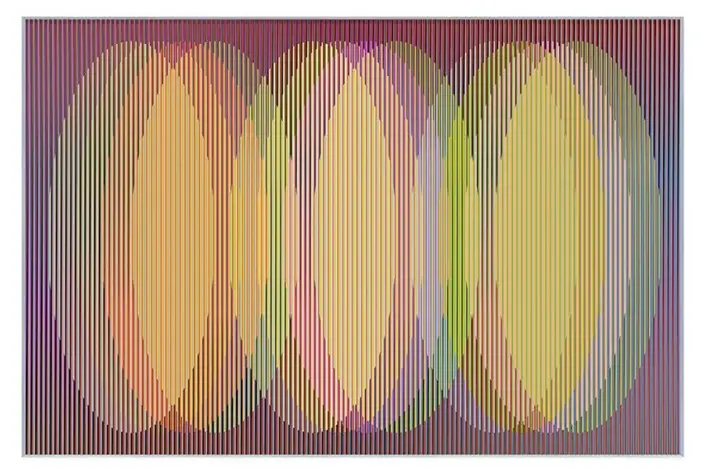
In the final year of his life, Venezuelan master Carlos Cruz-Diez completed Physichromie n°2826, a work that stands not as a farewell, but as a reaffirmation—a crystalline distillation of a lifetime spent dismantling the illusion that color is a property of objects. Measuring 100 × 150 cm and executed in chromography on aluminum, this late-career piece belongs to the Paris series, a body of work that reflects both the cosmopolitan energy of its namesake city and the artist’s unwavering commitment to perception as the true medium of art.
The Physichromie series, initiated in 1959, remains one of the most rigorous and sustained investigations into the phenomenology of color in 20th- and 21st-century art. n°2826 is not merely a continuation of this inquiry—it is its culmination. It demands not passive viewing, but active participation. This editorial argues that Physichromie n°2826transcends the boundaries of painting to become a performative act of chromatic revelation, where the viewer, through movement, becomes co-author of the visual experience. In doing so, Cruz-Diez challenges the static nature of traditional art, proposing instead a dynamic, ever-shifting dialogue between light, surface, and perception.
stir
At the center of Cruz-Diez’s practice lies the concept of chromatic induction—the phenomenon by which color is generated not by pigment, but through the interaction of light, structure, and the human eye. Unlike traditional painting, where color is fixed and contained within defined outlines, the Physichromies operate as systems—mechanisms designed to produce color through optical interference.
The surface of n°2826 is composed of precisely aligned strips or bands, often in contrasting hues, generating moiré-like effects as the viewer shifts position. This is not illusion in the conventional sense; it is a physical demonstration of how color exists in space, independent of material support.
Cruz-Diez was deeply informed by scientific studies of perception, particularly the work of Michel-Eugène Chevreul and Hermann von Helmholtz. Rejecting the symbolic or decorative function of color, he approached it as a physical force—something to be tested, structured, and revealed. In n°2826, this rigor manifests through mathematical precision: calibrated striping, controlled spacing, and subtle tonal gradation. Yet the work resists sterility. It vibrates with a near-organic energy, as though the aluminum surface itself were animated by light.
Compared to earlier Physichromies of the 1960s and 70s, n°2826 demonstrates a refined complexity. Earlier works relied on bold primary contrasts and more direct geometric arrangements. By 2019, Cruz-Diez had mastered chromatic modulation, deploying finer transitions and nuanced relationships between warm and cool tones. The work no longer declares itself—it unfolds. Its full spectrum emerges only through sustained engagement, reinforcing the idea that perception is not instantaneous, but durational.
medium
The choice of aluminum as substrate is neither incidental nor purely technical. Unlike canvas or wood, aluminum is non-absorbent and highly reflective—qualities that amplify the optical effects of chromography, a process developed by Cruz-Diez himself. This technique involves the precise application of color onto structured surfaces, often through industrial methods, merging artistic vision with engineered execution.
Aluminum carries associations of modernity, precision, and industry—alignments that resonate with Cruz-Diez’s conceptual framework. Its rigidity permits exact alignment of chromatic bands, while its reflective quality enhances luminosity. In n°2826, the surface acts as a responsive plane, capturing and redistributing ambient light. The result is instability by design: the work shifts not only with the viewer’s movement but with environmental conditions—time of day, light quality, even surrounding color fields.
Equally important is durability. Unlike traditional paint, which can fade or fracture, chromographic applications on aluminum resist environmental degradation. This decision signals intent. n°2826 is not conceived as ephemeral—it is constructed to endure, both materially and conceptually, as a lasting articulation of chromatic induction.
flow
Physichromie n°2826 is not an object to be observed from a fixed point; it is a condition to be entered. Its 100 × 150 cm format situates it within human scale—inviting proximity without overwhelming. The work refuses a singular, resolved image. Instead, it offers multiplicity: a succession of visual states, each contingent, none definitive.
As the viewer moves laterally, color fields dissolve and recombine, generating hues that did not exist seconds prior. This kinetic encounter is central to Cruz-Diez’s philosophy. Art does not reside solely in the object—it occurs in the interval between object and observer. The Physichromie does not depict movement; it enacts it.
This dialogue extends beyond the individual. Within a gallery context, multiple viewers introduce layered trajectories of perception. Each body in motion alters the chromatic field, transforming the artwork into a collective experience. Cruz-Diez’s assertion—“The spectator completes the work”—finds full realization here. The piece remains perpetually unfinished, activated only through encounter.
scope
Physichromie n°2826 belongs to the Paris series, produced during Cruz-Diez’s long residence in the French capital. Paris, historically defined by its intellectual and artistic exchange, provided fertile ground for his investigations into light and perception. The series absorbs this urban intensity while maintaining the artist’s distinct visual language.
Yet Cruz-Diez’s work is never detached from its origins. His Venezuelan heritage remains embedded in his chromatic sensibility—the vibrancy, the saturation, the intuitive understanding of color as environment. This duality positions him uniquely between Latin American color traditions and European abstraction.
Within 20th-century art history, Cruz-Diez is often aligned with Op Art and Kinetic Art. However, his work diverges in its conceptual grounding. Where Op Art frequently employs visual deception, Cruz-Diez seeks clarity—an unveiling of how color truly operates. His work is not illusionistic; it is demonstrative.
Physichromie n°2826 also resonates with contemporary immersive practices—from James Turrell to Olafur Eliasson—where perception becomes the primary medium. Decades earlier, Cruz-Diez had already articulated this shift. His work prefigures a broader movement toward embodied experience, insisting that art is not simply viewed, but inhabited.
why
In an era dominated by digital mediation, Physichromie n°2826 offers a counterpoint rooted in physical immediacy. It exists in real time, dependent on light, movement, and presence. Unlike digital images—infinitely reproducible and easily consumed—the Physichromie resists capture. A photograph reduces it to a static fragment, stripping away its essential condition: change.
This resistance positions the work as both historical culmination and contemporary intervention. It challenges passive consumption, demanding instead an active, bodily engagement. It disrupts commodification by defying replication.
Cruz-Diez’s legacy extends beyond object-making. He redefined perception itself as a creative act. n°2826 stands as a final articulation of this philosophy—a work that insists color is not something we observe, but something we generate through experience.
sum
Physichromie n°2826 is not simply a painting. It is a proposition—that art can function as a laboratory for perception, where seeing becomes an act of creation. In this final work, Cruz-Diez invites us to move beyond observation and into participation.
The result is both precise and elusive: a synthesis of science and flows, structure and instability. For critics and scholars, it offers a dense field of inquiry. For the viewer, it offers something more immediate—a moment of transformation.
It does not exist solely on the wall. It exists between wall and body, between light and eye, between one moment and the next.
Related Articles
Chasing the Sort Sol: Inside Søren Solkær’s Six Year Pursuit of Europe’s Starling Clouds
A Danish portrait photographer spent six years following a bird nobody photographs on purpose, and […]