Lincoln’s Portrait Reunited: A Roosevelt Legacy Returns

April 20, 2026
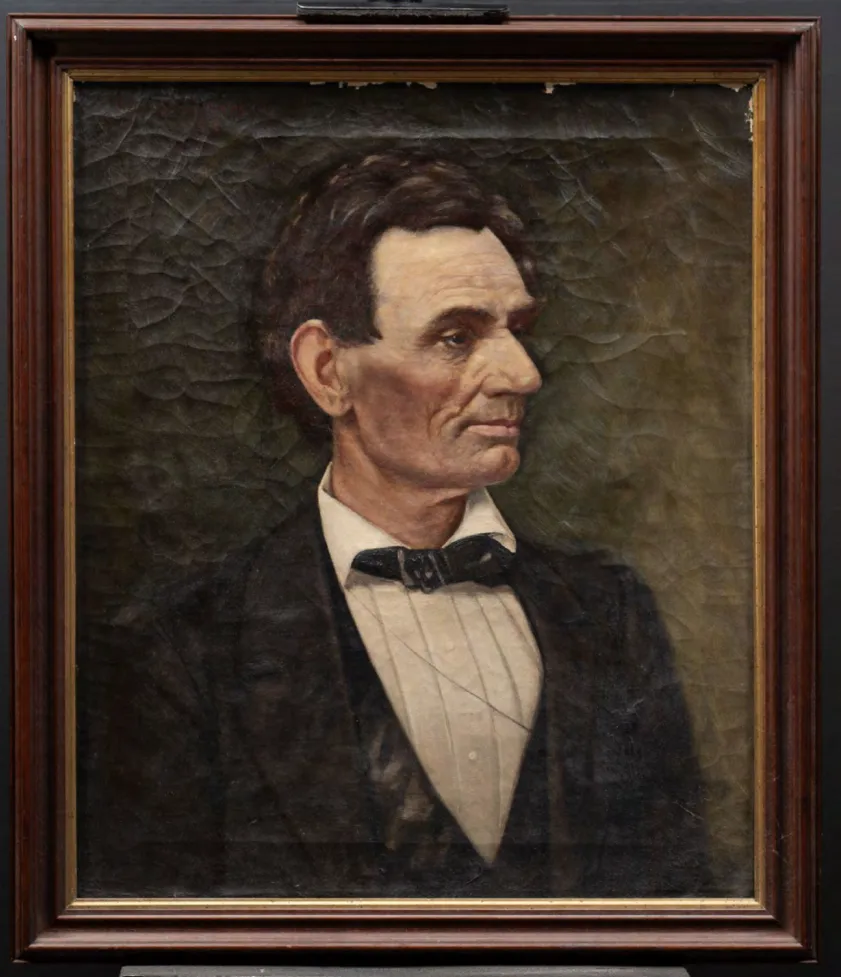
When the much-anticipated Theodore Roosevelt Presidential Library (TRPL) opens its doors in Medora, North Dakota on July 4, 2026, visitors won’t simply enter a monument to one of America’s most dynamic leaders—they will step into a living dialogue between two defining figures in the nation’s history. At the center of this exchange stands a long-lost portrait of Abraham Lincoln, painted by American realist Ernest Wells. Once displayed in President Theodore Roosevelt’s private office, the work returns to public view after more than a century in private hands.
The rediscovery of this oil-on-canvas portrait is more than an art-world revelation—it is, in many ways, a homecoming. For decades, the painting remained quietly in the possession of descendants of two Westchester County antique dealers, acquired in the early 1920s under circumstances that linger between documented history and family lore. Now, as it anchors the TRPL’s inaugural exhibition, the portrait offers an intimate window into the personal inspirations of a president who believed deeply in moral clarity—and who looked to Lincoln as both guide and measure.
a symb
Few presidents externalized their influences as openly as Roosevelt. A voracious reader, reformer, and self-fashioned figure shaped by frontier mythology, he filled the White House with objects that reflected his ideals. Among them, none carried greater personal weight than the portrait of Lincoln that hung in his study.
Historical accounts suggest Roosevelt would pause before the painting in moments of strain or decision. “He’d stand there, silent, for a full minute,” one aide recalled, “as if asking for counsel.” The gesture was not symbolic theater—it was instinctive. Roosevelt viewed Lincoln not merely as a predecessor, but as a moral compass. In an era defined by industrial expansion, labor unrest, and widening inequality, he found in Lincoln a model of conviction and restraint.
Wells’s portrait, painted in 1902 during Lincoln’s centennial year, avoids the familiar iconography of stately grandeur. Instead, it presents the 16th president in quiet introspection. His gaze, heavy yet searching, seems to extend beyond the frame—toward the burden of decisions made and the cost of preserving unity. The lighting is restrained but purposeful, illuminating the contours of a face marked by fatigue and resolve. There is no theatrical backdrop—only the presence of a man alone with consequence.
It was precisely this humanity that resonated with Roosevelt. “Lincoln was not a god,” he once wrote. “He was a man—flawed, burdened. And that is why he was great.” The portrait, in its restraint, reflects that philosophy.
flow
Following Roosevelt’s departure from office in 1909, the portrait disappeared from public record. Historians long assumed it had been lost, destroyed, or quietly absorbed into private collections. Speculation ranged from family inheritance to diplomatic gifting. The truth, as it emerged, proved more understated.
In 1923, two antique dealers from Larchmont, New York—Eleanor Whitaker and Charles Duvall—acquired a collection of furnishings from an estate sale in Oyster Bay. Among the items was a large, dust-covered canvas wrapped in burlap, labeled simply: “Portrait of Lincoln, possibly Roosevelt era.” Upon restoration, a faint inscription surfaced on the reverse: “For T.R. – With respect, E. Wells, 1902.”
Recognizing its significance, Whitaker and Duvall chose preservation over profit. Rather than circulate it within the market, they retained the painting privately. “It felt less like ownership and more like stewardship,” Whitaker later wrote. The portrait remained within their families for generations—displayed quietly, rarely discussed, and never publicly exhibited.
Its reemergence came only in 2024, during a routine estate appraisal. Through archival cross-referencing, stylistic analysis, and comparison with a previously unpublished photograph of Roosevelt’s office, experts at the Smithsonian National Portrait Gallery confirmed its authenticity.
artist
Ernest Wells remains a largely elusive figure within American art history. Born in 1868—the year of Lincoln’s assassination—he developed an enduring fascination with the 16th president. His work reflects not just study, but pursuit: an effort to render Lincoln not as symbol, but as presence.
Rooted in American realism, Wells rejected the embellished heroism common in Gilded Age portraiture. His focus was subtler—texture, light, and the psychological architecture of the face. “A man’s truth lives in the lines around his eyes,” he once remarked. “Not in what he wears.”
His Lincoln series, privately commissioned and largely unseen during his lifetime, survives today only in fragments. Of the known works, this portrait stands apart—not solely for its execution, but for its context. It is not just a depiction of Lincoln; it is an interpretation filtered through Roosevelt’s admiration.
oh
The inclusion of the portrait within the TRPL is both deliberate and symbolic. The library, a $120 million project, positions itself not only as a repository of Roosevelt’s legacy, but as a space for contemporary civic reflection. Its architectural language—combining rugged stone with expansive glass—mirrors Roosevelt’s dual identity: pragmatist and visionary.
The portrait will serve as the centerpiece of the “Leadership & Legacy” gallery, displayed under controlled conditions with interactive features that allow visitors to explore its provenance and technique. Augmented reality installations will reconstruct Roosevelt’s study, situating the painting within its original environment.
“We want visitors to feel the weight of that gaze,” noted chief curator Dr. Lena Cho. “This is not simply an artifact—it is a dialogue across time.”
The July 4 opening aligns with a broader national moment. As the United States approaches its 250th anniversary, the reappearance of this work carries a particular resonance. Its return, after more than a century in obscurity, feels less like rediscovery and more like reintroduction.
leg
In a period marked by division and uncertainty, the resurfacing of this portrait arrives with quiet relevance. It does not offer answers, nor does it attempt to resolve the tensions of the present. Instead, it reminds us of something more fundamental: that even the most consequential leaders sought guidance beyond themselves.
Roosevelt did not require a portrait to understand Lincoln’s legacy. Yet he chose to keep one within reach—perhaps because the act of looking reinforces the act of remembering.
Now, as the painting assumes its place in Medora, that act becomes collective. Visitors will encounter not just an image, but an idea—one that transcends time. Leadership, the portrait suggests, is not defined by authority, but by introspection; not by view, but by conviction.
And somewhere within that quiet exchange—between past and present, between Lincoln and Roosevelt—there remains the possibility that a single image can still shape how we think, how we lead, and how we remember.
Related Articles
Julio Larraz’s “Autumn at Cumae”: Inside the Cuban Master’s Mythic Italian Landscape
recall The Lot, At a Dekko Who Is Julio Larraz Reading “Autumn at Cumae” Why […]