DRIFT AUDIO
Listen to this story
Choose a voice, then press play.
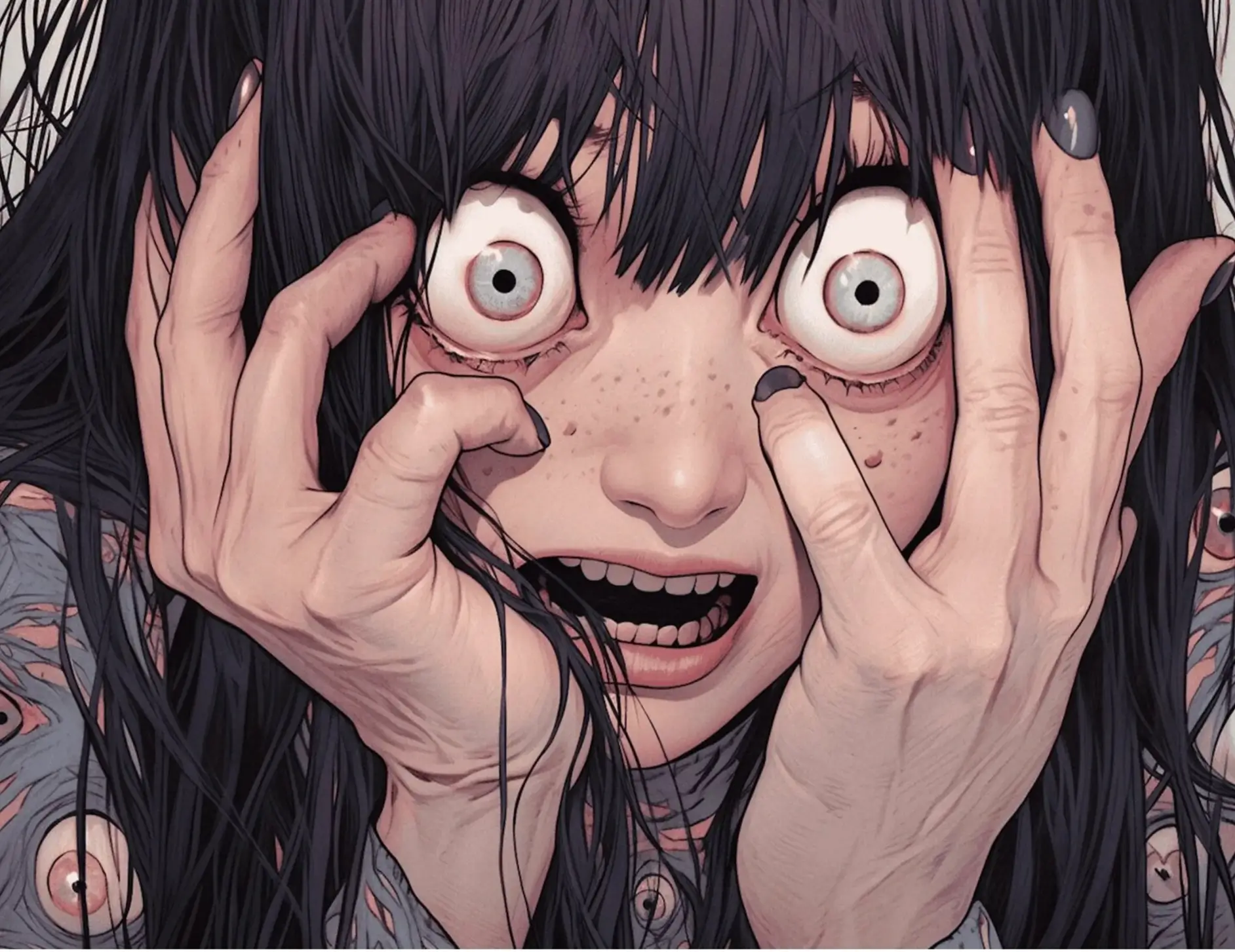
Omission of any soft entry here. No easing into composition, no gradient into mood. The image arrives already at its peak—eyes forced open, fingers pressing into skin, expression suspended between shock and something dangerously close to laughter. もうやめて! (Stop It Already!) doesn’t build tension. It begins with it.
The face is treated like material, stretched and held in place, as if emotion itself were a fabric pulled too tight over structure. The girl at the center is not posed; she is fixed. Arrested. Held at the exact moment where composure fractures but doesn’t fully collapse.
And that is where the work lives: not in breakdown, but in the refusal to let it happen cleanly.
stir
The eyes dominate immediately, but not in the way portraiture traditionally allows. They are not windows, not reflective pools of interiority. They are surfaces—expanded, strained, almost mechanical in their exposure. The irises sit too still, too present, refusing depth.
In fashion imagery, the eye often seduces. Here, it resists. It is overstated to the point of discomfort, pulling the viewer into a proximity that feels less like intimacy and more like confrontation.
The act of holding the eyelids open becomes the central gesture. Not passive, not incidental—deliberate. A refusal to blink. A refusal to rest. The body becomes complicit in its own exposure.
If the eyes anchor the image, the hands define it. They are not delicate. They do not frame the face—they distort it. Fingers press inward, pulling skin, shifting bone, creating a temporary architecture of tension.
There is something unmistakably tactile here. You can feel the pressure. The slight indentation of fingertips, the stretch of skin under strain. It’s physical in a way that bypasses metaphor.
In fashion, hands often guide the viewer—directing attention, adding gesture, suggesting narrative. Here, they do something else entirely. They enforce. They hold the image in place, preventing it from resolving, from softening, from closing.
flow
The mouth complicates everything. It opens—not wide, not fully—but enough to suggest sound. A breath caught mid-release. A laugh that doesn’t land. A scream that hasn’t committed.
This is where the emotional ambiguity sharpens. The expression resists classification. It is not pure panic, not pure hysteria, not pure play. It oscillates. It destabilizes the viewer’s instinct to categorize.
That instability is intentional. It keeps the image alive, in motion, even as it remains visually fixed.
cognizant
Behind the figure, the pattern of eyes repeats. Not decorative. Not ornamental. It functions as pressure—visual noise that refuses to recede.
The background doesn’t support the subject; it amplifies her condition. Each repeated eye echoes the central gaze, multiplying it, extending it beyond the frame. Surveillance becomes environment. Awareness becomes saturation.
In editorial terms, this is world-building through minimal means. A single motif, repeated until it becomes atmosphere.
tincture
The palette avoids excess. Skin tones carry warmth, but they are tempered—slightly muted, slightly desaturated. The hair falls into deep, almost matte black. The eyes, by contrast, hold a pale intensity, pushing forward against the rest of the composition.
There is no explosion of color here. No chromatic chaos. Instead, the restraint sharpens the impact. Every element feels considered, held within a controlled spectrum that allows the distortion of form to take precedence.
This is where the giclée process matters. The precision of ink, the clarity of line, the subtlety of tonal shifts—all preserved without noise. The image remains clean even as the subject fractures.
frame
The same principles that govern high-fashion imagery—tension, distortion, precision, restraint—are all present, translated onto the body itself.
The face becomes the garment. The hands, the tailoring. The eyes, the focal detail that refuses to be overlooked.
There is an understanding here that fashion, at its most distilled, is not about fabric but about presence. About how something occupies space, how it directs attention, how it holds or disrupts a gaze.
This image does all three.
said
The title is not supplementary. もうやめて! sits over the work like a line drawn in the sand. It doesn’t explain the image—it reinforces it.
“Stop it already” reads as both internal and external. A command directed outward, toward whatever force is being resisted. And inward, toward the self, toward the act of holding on, of maintaining control past its limit.
The image captures the exact moment where that command becomes necessary.
clue
What lingers is not the shock of the image, but its persistence. The sense that the moment depicted is not resolved, not concluded, not released.
The eyes remain open. The hands remain in place. The expression does not settle.
There is no after.
And that is precisely the point.
Monster Giclée Print 30 × 40 cm – もうやめて! (Stop It Already!) doesn’t offer relief. It offers clarity—a sharply rendered, unblinking view of what it means to hold something too long, to push past the point of comfort, to remain exposed when closure is no longer available.
It is not about collapse.
It is about the moment just before.
Related Articles
Modigliani’s Limestone ‘Tête’
Carved from a single block of limestone in Montparnasse more than a century ago, one of Modigliani's rare stone heads goes to auction for the first time…