DRIFT AUDIO
Listen to this story
Choose a voice, then press play.
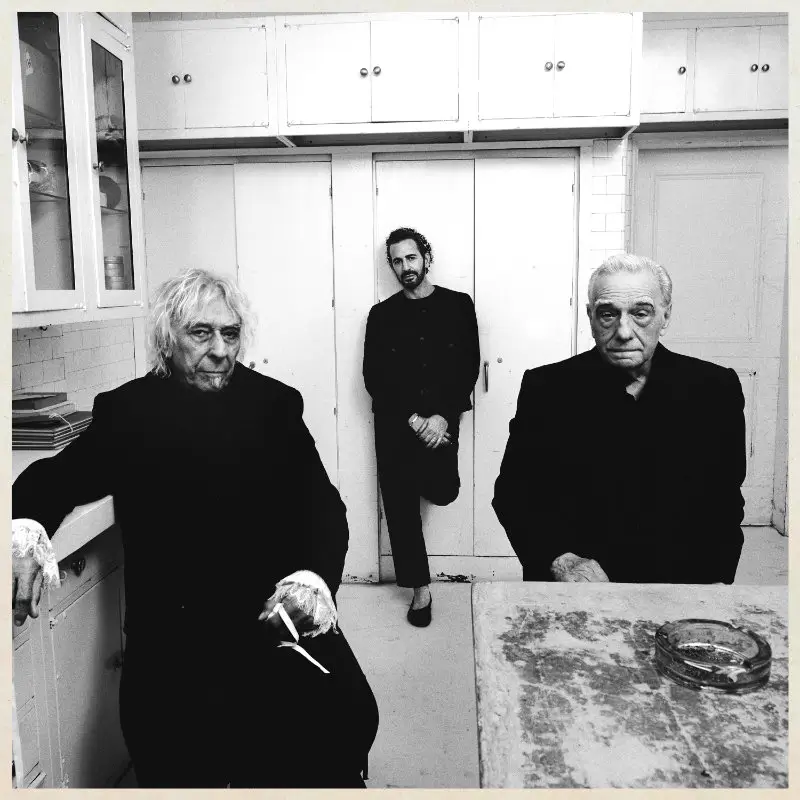
On June 1, 2026, Charli XCX surprised the world by announcing her new album Music, Fashion, Film, set for release on July 24 via Atlantic Records. The 11-track project, clocking in at just over 30 minutes, arrives as the official follow-up to her 2024 cultural juggernaut Brat. But it wasn’t the release date, track count, or even the pre-order frenzy (signed vinyl variants sold out quickly) that dominated headlines. It was the album cover: a striking black-and-white photograph featuring three legends—musician John Cale, fashion designer Marc Jacobs, and filmmaker Martin Scorsese—posed together in a dimly lit, almost mundane room. No Charli front and center. Just these icons, embodying the album’s titular triumvirate.
This move is quintessential Charli: provocative, referential, and unapologetically interdisciplinary. In an era where pop stars often center themselves with glossy selfies or AI-generated fantasy, Charli opts for absence as presence. She’s directing the gaze toward her influences, colliders, and the broader culture ecosystem that shapes her art. The cover, shot by longtime collaborator Aidan Zamiri, feels like a knowing wink to fans who’ve followed her evolution from hyperpop provocateur to mainstream disruptor.
stir
Charlotte Aitchison, known professionally as Charli XCX, has built a career on boundary-pushing. Emerging in the early 2010s with hits like “I Love It” (with Icona Pop), she carved a niche in experimental pop, blending punk energy with club beats. Albums like True Romance (2013), Sucker (2014), and the mixtape series Number 1 Angel and Pop 2 (2017) established her as a tastemaker for the underground-turned-mainstream hyperpop scene.
Brat (2024) was her breakthrough. The lime-green album art became a meme, a fashion statement, and a culture signifier. Tracks like “Von dutch,” “360,” and “Guess” captured the chaotic, hedonistic spirit of the moment, spawning “Brat Summer” as a shorthand for irreverent, party-fueled escapism. The album’s success led to remixes with Lorde, Billie Eilish, and others, plus a mockumentary film The Moment directed by Aidan Zamiri.
Post-Brat, Charli hinted at a rock shift. In a British Vogue interview, she declared “the dance floor is dead,” sparking debates and even a subtle clapback from Madonna. She walked it back on Instagram but followed through with singles like “Rock Music” (gritty guitars, tongue-in-cheek lyrics) and “SS26” (a fashion-runway strut toward apocalypse, with a Paris-shot video directed by Torso). These tracks preview a rawer, more guitar-driven sound while retaining Charli’s sharp wit and fashion obsession.
Music, Fashion, Film consolidates these threads. At 11 songs, it’s concise—perhaps a deliberate contrast to sprawling streaming-era albums—allowing for focused statements across its themes.
My new album Music, Fashion, Film is out july 24th. available to pre order now, love you xxhttps://t.co/AWqiXrEbL7 pic.twitter.com/jhwWkC7NsH
— Charli (@charli_xcx) June 1, 2026
flow
The cover photo by Aidan Zamiri shows John Cale, Marc Jacobs, and Martin Scorsese in a casual, almost candid setup. Cale and Scorsese sit at a shabby table with an ashtray; Jacobs leans against a wall in the background. The black-and-white palette evokes classic album art, documentary photography, and Scorsese’s own gritty cinematic aesthetic. It nods to “SS26”’s runway imagery while grounding the project in authenticity over glamour.
John Cale represents Music. The Welsh multi-instrumentalist, co-founder of The Velvet Underground, has influenced generations with his experimental rock, viola drones, and links (from Lou Reed to Nico). At 84, Cale remains vital—his work with Charli on “House” (a Wuthering Heights-inspired track) bridges underground legend and modern pop. His presence signals Charli’s rock ambitions and respect for avant-garde history. Velvet Underground’s intersection of art, fashion (Warhol), and film makes him a perfect avatar.
Marc Jacobs embodies Fashion. The designer revolutionized ’90s grunge at Perry Ellis, built a global empire, and championed streetwear-luxury hub. Jacobs’ runway shows are cultural events; his aesthetic—play, referential, boundary-blurring—mirrors Charli’s. His inclusion nods to Charli’s fashion-world immersion, from Met Gala appearances to Brat’s lime-green virality. Jacobs has dressed everyone from models to musicians; here, he’s the muse.
Martin Scorsese stands for Film. The 83-year-old director (Taxi Driver, Goodfellas, The Irishman) is cinema’s elder statesman, known for New York grit, moral ambiguity, and rock soundtracks (he’s connected with The Band, Robbie Robertson). Scorsese’s passion for preserving film history and his cameos add meta layers. Pairing him with Cale (rock) and Jacobs (fashion) creates a cross-generational summit. Charli, who’s dabbled in view projects like The Moment, positions herself as a peer in this dialogue.
Together, the trio isn’t just decorative—it’s thematic architecture. The album explores how these mediums collide in contemporary culture: music videos as short films, fashion influencing sonic identity, cinema borrowing pop’s immediacy. Charli’s decision to omit herself elevates the conversation. It’s humble yet audacious—a “massive flex,” as fans called it on social media.
rx
The announcement ignited immediate buzz. Olivia Rodrigo posted “hell yeah.” Fans on X and Reddit praised the “masterpiece” cover, with some joking about Yellow Magic Orchestra resemblances or wild crossover fanfic (Cale scoring a Scorsese film). Others noted the all-male lineup, sparking gender discussions in pop’s view language, though most celebrated the intergenerational homage.
Critics see it as Charli maturing without losing edge. After Brat’s youth-culture dominance, Music, Fashion, Film engages legacy artists on their turf. It reflects 2020s pop’s nostalgia-meets-futurism: hyperpop kids citing Velvet Underground, Gen Z discovering Scorsese via TikTok edits.
This fits broader trends. Artists like Taylor Swift (The Tortured Poets Department) and Beyoncé (Cowboy Carter) genre-bend with high-concept visuals. Charli differentiates through curation—selecting living legends who’ve shaped her references without overt pastiche.
scope
Charli’s history with these figures (or their worlds) runs deep. Cale’s collide was direct. Jacobs’ fashion ethos aligns with her aesthetic. Scorsese’s influence appears in Charli’s narrative-driven videos and The Moment’s mockumentary style, echoing Scorsese’s blending of fiction and reality.
Expect the album to weave these: rock-infused tracks (“Rock Music” as blueprint), fashion-as-performance anthems (“SS26”), and cinematic scope in production or interludes. Possible guests or samples could expand the universe. Previews suggest shorter, punchier songs suiting the 30-minute runtime—efficient like a great film edit.
Aidan Zamiri’s role is key. The Glasgow-born photographer/director has shaped Charli’s visuals: “Guess,” “360,” The Moment. His candid, voyeuristic style (without being intrusive) captures the cover’s intimacy. Zamiri bridges music, fashion, and film himself, making him ideal.
intercept
In 2026, culture feels fragmented yet interconnected. Algorithms silo experiences; Charli counters with synthesis. Music, Fashion, Film argues these aren’t separate—they fuel each other. A pop album cover featuring a Velvet Underground founder, a luxury designer, and a master filmmaker declares pop’s seat at the high table.
It also comments on legacy. Charli, in her early 30s, honors elders while asserting her place. In an industry obsessed with youth, she bridges generations. Scorsese and Cale have mentored or inspired countless; Jacobs redefined industry norms. Their gathering symbolizes mentorship, collaboration, and continuity.
Critics of the all-male, mostly white lineup raise valid points about representation, but the choice feels specific to Charli’s influences rather than exclusionary. Her work has always celebrated queer, female, and diverse voices (Brat’s ecosystem). This cover is one statement among many.
look
As July 24 approaches, anticipation builds. Will the album deliver on rock promises? How will tracks reference the cover’s themes? Charli’s rollout—teasing without overexplaining—keeps mystery alive.
This announcement reaffirms Charli XCX as pop’s premier conceptualist. By stepping back visually, she steps forward artistically. John Cale, Marc Jacobs, and Martin Scorsese on the cover isn’t gimmick—it’s manifesto. Music, fashion, and film aren’t just titles; they’re the DNA of her world.
In a cultural moment craving substance amid spectacle, Charli delivers both. Music, Fashion, Film promises to be more than an album—it’s a cultural artifact, a conversation starter, and a flex of impeccable taste. Charli isn’t just making music; she’s curating the zeitgeist. And with this cover, she’s invited the legends to the party.
From the DRIFT archive: A Review: Jon Batiste’s Evolution, From New Orleans Tradition to Modern Innovation · Levi’s® Launches De La Soul T-Shirt Collection Inspired by Vintage Samples: A Cultural Revival Rooted in Hip-Hop History
Related Articles

Nothing Goes Studio Grade, and V of BTS Is On Wear
A flagship with three drivers per ear, a Flat EQ switch tuned at London’s Metropolis […]