DRIFT AUDIO
Listen to this story
Choose a voice, then press play.
A giant yellow lemon, a familiar saying, and one extra line that ruins the comfort of the original. That is the entire joke, and it works.
In This Story
- A Fruit With a Catch
- From Painting to Open Edition
- The Shop Behind the Print
- Who David Shrigley Actually Is
- The Humour Underneath the Deadpan
- Where the Print Sits in the Market Now
- Why a Cheap Print Still Matters
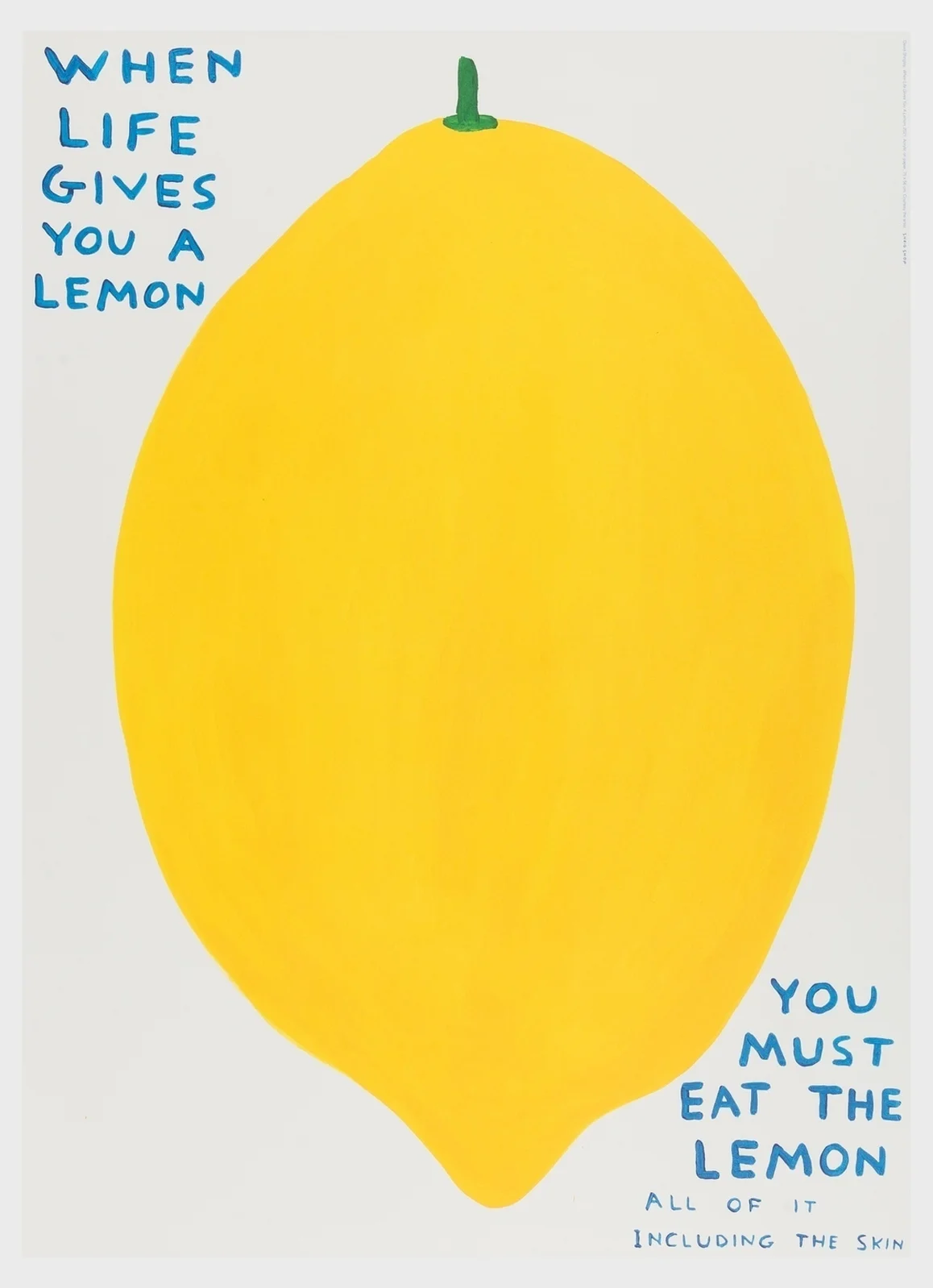
Most people know the saying before they finish reading it. When life gives you lemons, make lemonade, an instruction so worn out it barely registers as advice anymore, more of a reflex than a thought, the kind of thing said to fill a silence rather than to actually help anyone. David Shrigley’s 2021 print takes that opening line, keeps it faithfully in pale blue text, and then adds the part nobody asked for: you must eat the lemon, all of it, including the skin. The lemonade never gets made. There is no metaphor for resilience here, just a large, cheerfully rendered lemon on a plain white background and an instruction that gets worse the longer you sit with it.
The print itself is unfussy by design, an offset lithograph on 200 gram Munken Lynx paper, sized at 80 by 60 centimetres, close to the dimensions of a large travel poster. Nothing about the physical object suggests preciousness, and that is very much the point. It reproduces a painting Shrigley made the same year, titled Untitled (When Life Gives You A Lemon), translated into a flat, evenly printed edition meant to hang in an ordinary room rather than sit behind glass in a collector’s archive. The lemon itself takes up most of the sheet, rendered in the loose, slightly wobbly outline that has become something close to a signature across Shrigley’s drawn work, its yellow flat and unshaded in a way that reads as almost childlike next to the deadpan cruelty of the text wrapped around it.
stir
The path from a one off painting to a mass produced print is not incidental to how Shrigley works, it is close to the entire model. The original 2021 painting exists as a singular object, but the version most people will actually encounter is the print, made specifically to be affordable and available rather than scarce. That decision runs against almost everything the contemporary print market usually rewards, where limited runs and low numbers drive both price and prestige, and where a collector’s willingness to pay is often directly tied to how few other people can own the same thing.
Here, the opposite happens. The print is an open edition, meaning there is no fixed run size and no expiry date on when someone can buy one. Auction houses handling secondary sales of the print, including Forum Auctions and Vanguarts Auctions, list it accordingly: rarity noted plainly as open edition, materials as offset lithograph, medium simply logged as posters. That is an unusual thing to see cross an auction block at all, since open edition prints rarely carry the kind of resale interest that limited runs do, but Shrigley’s popularity has made the secondary market for his more accessible prints active anyway, with listings turning up regularly enough that specialist dealers have started treating his open editions almost like a recognisable category of their own.
flow
The print was published by Shrig Shop, a physical and online store in Copenhagen that Shrigley set up with longtime gallerist Nicolai Wallner, and printed by Narayana Press in Denmark. Shrig Shop exists specifically to solve the problem the lemon print is built around: how to let people own a piece of an artist’s work without needing gallery money or gallery patience. The shop’s own description of itself leans into that idea directly, framing the space as somewhere Shrigley’s work becomes accessible whether the object in question is a significant print or something as small as a postcard, an unusually wide range for a store operating under a single artist’s name.
That range matters for understanding what When Life Gives You a Lemon actually is within Shrigley’s practice. It sits at the accessible end of a spectrum that also includes major gallery paintings, museum commissions, and large scale public sculpture, priced and produced deliberately so that owning a piece of his visual language does not require being a serious collector, just someone willing to spend a modest amount on something that will make them laugh every time they walk past it. The comparison the shop’s own marketing has drawn, positioning Shrigley alongside artists like Andy Warhol and Keith Haring as figures whose reach extends well past the traditional art world, is not an idle one. Warhol and Haring both built parallel ecosystems around their work that ran alongside, rather than instead of, gallery representation, and Shrig Shop reads as a fairly direct continuation of that same idea updated for a Copenhagen storefront and an online checkout page.
who
Shrigley was born in Macclesfield in 1968 and studied at the Glasgow School of Art, graduating in 1991 into a career that has never settled into one medium. Drawing has always been the throughline, usually rendered in a deliberately rough, almost childlike hand, paired with text that reads like something scrawled in frustration and then published anyway. But the drawing has never been the whole story. Shrigley has worked across sculpture, animation, photography, and music, directed the video for Blur’s single Good Song, and has contributed a weekly cartoon to The Guardian’s Weekend magazine since 2005, a run long enough that generations of readers have effectively had his sense of humour delivered to their kitchen table every Saturday for two decades. That kind of sustained weekly output is rare for a visual artist working primarily in galleries, closer to the rhythm of a newspaper columnist than a painter, and it has done as much as any single exhibition to make his drawn style instantly recognisable well beyond the art world.
His most visible public moment arrived in 2016, when a monumental bronze sculpture of a giant thumbs up, titled Really Good, was installed on the Fourth Plinth in London’s Trafalgar Square, a rotating commission that has hosted work by some of Britain’s most prominent artists. The piece towered over the square at more than seven metres tall, its thumb stretched into an exaggerated, almost cartoonish elongation that undercut the unambiguous positivity of the gesture itself, turning a symbol usually read as pure approval into something that looked slightly uneasy up close. Shrigley’s work now sits in the permanent collections of the Tate, the Museum of Modern Art in New York, and the Art Institute of Chicago, institutional validation for an artist whose actual output often looks deliberately unpolished, sometimes on purpose to the point of looking unfinished, a tension between museum seriousness and deliberate roughness that has followed him for most of his career without ever quite resolving.
scope
What connects the lemon print to the thumbs up sculpture, and to two decades of Guardian cartoons, is a very specific comic instinct: take something universally understood, whether it is a platitude, a gesture, or a common object, and add one detail that curdles it. The thumbs up becomes grotesque through sheer scale and an exaggerated thumb. The reassuring cliché about lemonade becomes an endurance test through a single added clause about eating the skin. Neither piece needs a second joke stacked on top of the first. The entire effect depends on restraint, on trusting that one well placed addition will do more work than an elaborate punchline ever could.
None of it reads as cruel, exactly. It reads more like someone pointing out that the original phrase never actually made sense as advice in the first place, that turning misfortune into something sweet was always a slightly absurd promise, and that the more honest version of resilience looks a lot less pleasant than a glass of lemonade. Shrigley’s work rarely explains the joke further than that single twist, trusting that the discomfort of the added detail will do the rest of the work on its own. It is a style that reads instantly on a gallery wall and just as instantly on a phone screen, which likely explains why so much of it circulates well outside the spaces where it was originally shown, passed around online long after the exhibition that produced it has closed.
stance
Secondary market listings for When Life Gives You a Lemon show it moving through smaller auction houses and specialist dealers rather than major evening sales, priced closer to a few hundred euros than anything approaching Shrigley’s painting or sculpture values. Listings note the print’s open edition status plainly, without pretending toward the kind of scarcity that drives serious print collecting, and buyers appear to be treating it as exactly what it is: an accessible, decorative, funny object rather than an investment piece bought with resale value in mind.
That positioning has not stopped it from becoming one of the more recognisable images in Shrigley’s recent output, showing up regularly in interiors coverage and design roundups alongside far more expensive prints by artists like David Hockney and Andy Warhol, an odd but telling bit of company for a print that costs a fraction of what those names typically command. It says something about how flexible the modern art market has actually become that a Hockney lithograph and a Shrigley poster can turn up on the same dealer’s site without either one looking out of place, each serving a different kind of buyer with a genuinely different relationship to what owning art is supposed to mean.
fin
There is a temptation to treat open edition prints as the lesser cousin of serious art collecting, the kind of thing bought because it is affordable rather than because it is good. Shrigley’s lemon print resists that framing simply by being genuinely funny in a way that holds up on repeat viewing, which is a harder thing to pull off than it looks. A joke printed eighty by sixty centimetres and hung on a wall has to survive being looked at every single day, and most one liners cannot survive that kind of repetition without going flat.
What makes it work is the same thing that has made two decades of Guardian cartoons and a giant bronze thumbs up work: a refusal to let a familiar image or phrase sit comfortably unexamined. The lemon on the print looks exactly like a lemon is supposed to look, bright and simple and inoffensive, right up until the text underneath makes clear that the fruit was never the point. It is a small object, printed cheaply and sold without ceremony, doing the same job as a museum commission with a fraction of the budget and none of the institutional weight behind it.
Read Drift’s related feature, David Shrigley’s ‘Fast Train to Shitsville’: A Witty Critique of Modern Disillusionment.
n
From the DRIFT archive: The Art of the Can: Chaz Bojórquez’s Hand-Signed MTN Spray Paint Edition
Related Articles
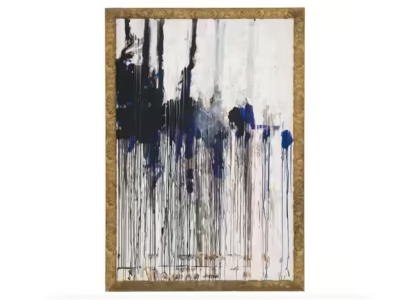
Winter Ran Down A Plywood Panel In Gaeta
Cy Twombly, Untitled (Winter Picture), 2004. Acrylic on plywood in the artist’s frame. Gagosian, Madison […]