DRIFT AUDIO
Listen to this story
Choose a voice, then press play.
The Australian designer and the French maritime house have spun the century-old striped sweater into an eight-piece capsule, built entirely in cashmere.
Australian designer Collette Dinnigan has put her name on a new capsule for Saint James, the French label that has been turning out the striped Breton sweater since 1889. The range comes down to four core sil, each cut in two colourways, for eight pieces in total, and every one of them is spun from 100 percent cashmere rather than the label’s usual cotton jersey or wool.
The lineup borrows its names from the coastline Dinnigan calls home. Port Willunga, a round-neck jumper priced at $650 AUD, comes in ivory and light grey or ivory and red. Noosa, a v-neck version at $699 AUD, is offered in navy, caramel and red or a paler mix of light grey, ivory and red. Sorrento turns the same stripe into a pair of cashmere pants at $890 AUD, and Byron Bay, a hooded jumper also priced at $890 AUD, closes out the range in the same two palettes.
View this post on Instagram
Every piece keeps Saint James’s sig horizontal stripe, but the proportions have been loosened for the switch to cashmere. Necklines sit wider, hems run longer, and the hood on Byron Bay is cut deep enough to layer over a scarf. It is Saint James’s first capsule built entirely in cashmere, sitting alongside a wider roster of designer collaborations the house has run in recent seasons, including capsules with illustrator Isabelle Ballu, Smiley and the embroidery house Macon & Lesquoy. The Dinnigan collection is currently sized from XS through XL and sold through Saint James’s own online store.
Cashmere is a real departure for a house that has built its name on technical, weatherproofed knits. Saint James typically works in double-twist wool or heavyweight cotton jersey, both chosen for how they hold up against wind and salt water rather than for softness against skin. Cashmere carries none of that functional intent; it is lighter, warmer for its weight, and closer to eveningwear than workwear. Saint James’s own site-wide tagline still reads “Made in France since 1889,” and nothing in the collection’s own listing suggests the Dinnigan capsule breaks from that standard.
The pairing puts two distinct kinds of heritage side by side. Dinnigan built her name in Paris couture through the 1990s and has since been made an Officer of the Order of Australia for her standing in the industry; Saint James has spent more than a century as a working manufacturer rather than a brand that licenses its name out, still knitting from its own Normandy mill. One side brings design pedigree and a well-documented personal design language, the other brings an unbroken production history, and the capsule leans on both rather than treating either as backdrop for the other.
stir
Saint James’s own history predates its 1889 founding date by decades. In 1850, Normandy mayor Léon Legallais established a spinning mill called Moulin du Prieur in the village of Saint-James, and the operation that would eventually take the village’s own name grew out of that mill. The house now describes itself in its own materials as more than 135 years in business, a slightly more conservative figure than the “more than 140 years” that circulated in some of the collide’s early press coverage. It also holds France’s Entreprise du Patrimoine Vivant designation, a state-issued Living Heritage Company label reserved for manufacturers judged to hold nationally significant craft expertise.
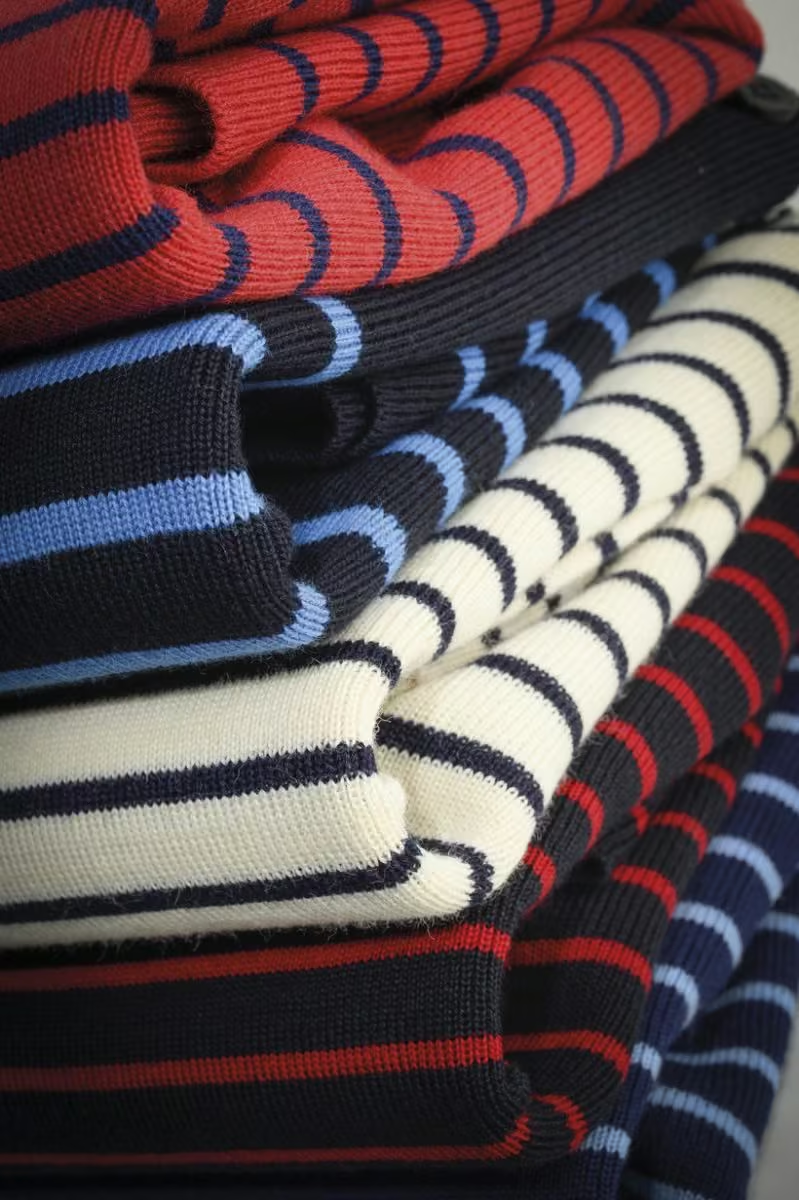
Saint James still knits its Breton stripes at its own atelier in Normandy, a short drive from Mont Saint-Michel
The Breton stripe itself has a specifically maritime origin. Saint James’s own sweater emerged in the late nineteenth century as the uniform of the Terre-Neuvas, French fishermen who spent six or seven months at a stretch working the cold waters off Newfoundland. Knitted tightly from dense wool, the sweater blocked wind and salt spray while still letting a sailor move freely on deck, and the alternating white and navy bands made a crew member easier to spot if he went overboard. According to a longstanding, if disputed, piece of French naval folklore, the original 21-stripe version worn by the French Navy was meant to correspond to 21 naval victories under Napoleon, though Saint James’s own materials don’t make that claim directly. The garment’s name has a more settled backstory: between fishing seasons, Breton and Norman sailors crossed the Channel to sell garlic in England, calling out “Marchand d’ail!” a cry English buyers heard as “chand’ail,” which became “chandail,” the French word for sweater to this day.
Saint James still describes the construction of its reference sweater, the Matelot, in almost the same technical terms it would have used a century ago: a tight, near-waterproof knit, a shoulder button for ease of movement, and what the house calls a “second skin” fit. By its own account, a single sweater takes at least 23 kilometres of thread and 18 separate manufacturing steps, passing through the hands of more than a dozen seamstresses along the way. That density of process is part of what earned the house its Living Heritage Company status, and it is also the baseline the Dinnigan capsule quietly departs from in trading technical wool and cotton for cashmere.
The stripe moved off the water and into fashion in the early twentieth century, helped along in large part by Coco Chanel, who had spotted it on the French coast and began working it into her own designs. That path from workwear to wardrobe staple is essentially the same one Dinnigan has now taken it down again, swapping the original’s cotton and wool for cashmere.
transition
Dinnigan’s own career runs on a parallel track of craft and reinvention. Born in South Africa and raised in New Zealand, she trained in fashion design at Wellington Polytechnic before moving to Sydney, where she worked in the costume department at the Australian Broadcasting Corporation ahead of launching her own lingerie label in 1990. Five years later she became the first Australian designer to stage a full-scale ready-to-wear collection in Paris, and by 1996 the Chambre Syndicale de la Haute Couture had invited her onto the official Paris Fashion Week schedule, a rare distinction for a designer from outside France. Her designs went on to dress a client list that has included Princess Mary of Denmark, Nicole Kidman, Angelina Jolie and Beyoncé.
At the end of 2013, Dinnigan scaled the business back significantly, closing her Sydney, Melbourne and London boutiques and winding down her bridal and eveningwear lines to spend more time with her family, though she has said the business remained profitable and debt-free at the time. She has continued to work on smaller, more selective collaborations since, including past projects with Miele, Specsavers and homewares label Linen House, alongside a 2015 retrospective exhibition, Unlaced, at Sydney’s Powerhouse Museum, which explored her creative process across more than a hundred signature looks and marked the first designer exhibition staged at the museum’s Centre for Fashion. Dinnigan has since been made an Officer of the Order of Australia, one of the country’s highest civilian honours, recognising her standing as one of the few Australian designers to build a genuinely international couture-level career.
The Saint James capsule was designed at her home in the Southern Highlands of New South Wales, where she moved with her husband, hotelier Bradley Cocks, and their son roughly a decade ago, and where she now splits her time between a design studio, a large garden and keeping alpacas and chickens.
navy
Dinnigan has said the collision reconnects her to years spent living and working across Europe. The navy running through several pieces nods specifically to Italy, drawn from memories of Capri and the deep blue uniforms worn by Italy’s carabinieri police. “It was my ode to Italy, kind of via Australia, back to France,” she has said of the collection, a line that captures how the capsule layers her Australian base, her European years and Saint James’s own French roots into one set of clothes.
She has also pointed to Saint James’s own story as part of the collaboration’s appeal, describing the house’s history as one she has long admired and calling it authentic in a way that mattered to her going in. That instinct lines up with how she has talked about the pieces themselves: designed for the kind of person happy to spend a whole day in loungewear without it reading as loungewear, elevated enough to leave the house in but not so precious that staying in feels like a waste of it.
It also lines up with how she has described her broader design instincts, in fashion and beyond: an Australian ease filtered through European sophistication, built more on feel than on visible polish. That sensibility, layering one place’s references over another’s rather than picking a single reference point, is the same one she has applied to her interiors work in the years since scaling back her ready-to-wear label, and it shows up here in a capsule that is nominally French, named for Australian coastal towns, and coloured in part by Italy.
hint
The result sits somewhere between at-home knitwear and travel dressing. None of the four styles is fitted in the traditional Saint James sense; each one leans into the drape and warmth cashmere allows that the house’s usual cotton jersey and wool don’t. At $650 to $890 AUD depending on the piece, the capsule sits toward the upper end of Saint James’s own pricing, reflecting both the fibre switch and Dinnigan’s design involvement.
The pairing fits a broader pattern in how heritage workwear labels have been extending their own archives lately, taking a piece originally built for function and re-running it in a fibre or finish that has nothing to do with the original job it did. Saint James has largely stuck to reissuing its own stripe in variations on cotton and wool up to now; cashmere puts the label in more explicitly luxury territory than its usual price points, without changing the stripe, the proportions, or the two-tone palette that has defined its output since the nineteenth century.
The eight pieces are available now through Saint James’s own online store, sized from XS through XL, and sit alongside the house’s other current designer collaborations in its collections listing.
Related Articles

A Tiger On The Denim / Human Made
HUMAN MADE Shinsaibashi PARCO, full renewal 17 October 2026. Tiger jacket, hoodie, keyholder. Wasted Youth popup, two days. App lottery 10:00 to 17:00.