DRIFT AUDIO
Listen to this story
Choose a voice, then press play.
In Maranello, the electric Luce, a hybrid V8 and a twelve-cylinder Purosangue now share one assembly line and one workforce. The first Luce deliveries begin this quarter.
On a recent press visit to Ferrari’s e-building in Maranello, the company’s first electric car could be watched coming together in plain view, battery cells at one end and finished cars at the other. The car was the Luce, and the detail that stood out was the company it keeps. According to GTspirit’s report from the visit, published on October 3, the Luce shares its assembly line with the hybrid V8 849 Testarossa, the V8 Amalfi and the naturally aspirated V12 Purosangue and 12Cilindri, and every one of those cars is built by the same workforce.
That arrangement is the clearest picture yet of how Ferrari’s e-building is meant to work for the rest of the decade. Rather than walling off an electric plant from its combustion business, Ferrari built one flexible hall in which a battery-electric grand tourer, a hybrid berlinetta and a twelve-cylinder four-door can follow each other between stations. The cars leaving the building are separated by what goes into them, not by where they were made.
Signal. What happened: Ferrari is now assembling its first battery-electric car, the Luce, on the same e-building line in Maranello that builds its V8, hybrid and V12 models, with first customer deliveries scheduled for the fourth quarter of 2026. Exact object: the Ferrari Luce (type F222), a five-seat, four-motor electric car whose 122 kWh battery pack is assembled in-house, reported at around €550,000 in Europe. When and where: the e-building, a 42,500 square meter factory on the northern edge of Ferrari’s Maranello campus, inaugurated June 21, 2024, with the line visit reported October 3, 2026. Source: Ferrari’s own e-building and Luce technical rel, its second-quarter 2026 filing, and a GTspirit visit to the line. Why it matters: Ferrari is betting that a single flexible line and a single workforce can absorb every powertrain it sells, while keeping the core electric components in Maranello rather than buying them in.
View this post on Instagram
stir
The battery hall is where the Luce departs most sharply from everything else on the line. Its cells come from SK On, the South Korean manufacturer that has supplied cells for Ferrari’s plug-in hybrids since 2019, but the pack itself is a Maranello product. Ferrari’s technical release for the Luce describes a battery designed, validated and built on site: 210 cells connected in series, grouped into 15 modules of 14 cells each, for a gross capacity of 122 kWh at 800 volts. Thirteen of those modules lie flat beneath the cabin floor, and two more sit under the rear seats.
The pack is also part of the structure. Its housing is made from two aluminium sheets that form the floor, plus castings and aluminium panels that close a ring around the sides, and the modules are fixed to it at 20 central anchoring points. Once that lower shell is bolted to the chassis, Ferrari says, it adds to the stiffness of the whole body. Behind the second level of modules sits what the company calls the e-Box, a compartment holding the battery monitoring system, fuses, relays and sensors that track current and gas.
The electric lines inside the building were running well before the Luce arrived. GTspirit reports that the first components to come off them were the front electric axle and the high-voltage battery for the F80, the hypercar whose shipments Ferrari says are still climbing in line with plan. Alongside battery packs, the building produces electric motors and axles, which Ferrari described at the opening as the components that most clearly differentiate its technology and performance.
Ferrari has also designed the pack to outlast its original cells. Elena Ligabue, who heads battery pack development, told reporters at the Luce’s launch that owners would not be stranded if a particular cell went out of production, because a newer type could be fitted into the same housing. The reasoning is about longevity. By Ferrari’s own count, more than 90 percent of the road cars it has ever built are still in use, and the company wants its electric cars to have the same kind of service life.
straddle
Much of the movement inside the e-building is handled by automated guided vehicles, which carry both components and finished cars between stations. The building is wired for ultra-wideband positioning, which Ferrari’s inauguration materials say is used to locate and display components in three dimensions during assembly and to stop the AGVs from colliding. Collaborative robots adjust their behaviour to the operator working beside them, digital twins mirror both products and processes, and a Wi-Fi 6 network carries production data. Vehicle assembly and logistics take up the ground floor; the upper level holds more vehicle assembly, along with engines and components.
Some of the choreography is older than the building. In a 2019 feature, Ferrari’s own magazine described how every car on its Maranello lines travels with red trolleys stocked with that car’s parts, between 10 and 15 trolleys’ worth depending on the model and specification, with the first trolley loaded and delivered to the line five hours before assembly starts. At the time Ferrari ran two lines, one for V12 models and one for V8s. A separate magazine piece on the vehicle assembly line explains why the system exists at all: clients can choose from around two million colour combinations, and more than half of the painted bodies arriving at the line on a given day are finished in different palettes.
The core sequence remains recognisable. In Ferrari’s telling, machines lift each painted body into position with large C-hooks, effectively treating the car as a top half and a bottom half. The bottom receives the powertrain coming up from engine assembly, the top receives its electrics, and then the two are joined. GTspirit’s visit took in that moment, known on the line as the marriage, as it happened to a Luce, before moving further along to see completed cars. The visit produced no previously undisclosed technical details, according to the report, but it did show the electric car being handled as one more variant on the line rather than as a special case.
That flexibility is a commercial choice as much as an engineering one. When the building opened in 2024, chief executive Benedetto Vigna said Ferrari was not looking to raise production capacity but to gain more room to personalise cars for clients. The same logic runs through Ferrari’s 2030 planning, which includes new Tailor Made personalisation centres in Tokyo and Los Angeles in 2027.
show
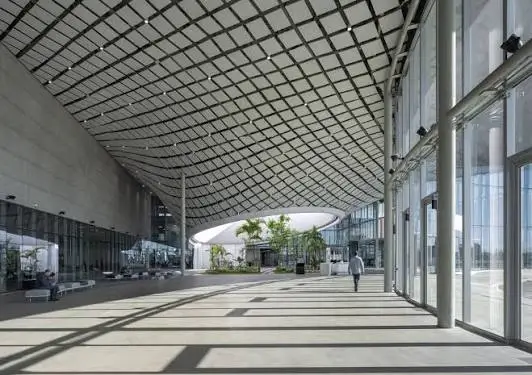
The building wrapped around all of this was designed, on its exterior façades and main interior spaces, by Mario Cucinella Architects, the Bologna studio, working alongside Ferrari’s own team. It rises as a prism-shaped volume up to 25 meters tall and holds 42,500 square meters across two main levels and two mezzanine floors. Its skin is a continuous façade of opalescent glazing broken by clear sections, so daylight reaches the line during shifts. After dark, the whole block glows white over Maranello like a lantern, an effect Cucinella has discussed at length in interviews about the project.
Ferrari executives have said the “e” stands for three words: energy, environment and evolution. Cucinella, for his part, has described the job as urban regeneration, and the description fits the site. The e-building stands on the footprints of older industrial buildings north of the historic campus, so no new land was consumed. Its façade components were designed and manufactured according to Design for Manufacturing and Assembly principles, to make them quicker to install and easier to maintain. More than 3,000 solar panels on the roof peak at around 1.3 megawatts, energy and rainwater are recovered for the production cycle, and Ferrari puts the building’s saving at 2.7 kilotons of CO2 equivalent compared with a similar non-electrified plant. Reports at the opening put the investment at around €200 million.
The interior brief was as much about people as process. Break areas use materials and colours chosen for visual comfort, green spaces push into the building, the surrounding road network limits traffic, and Ferrari red is used inside as a wayfinding colour. The plant employs more than 300 people and includes a dedicated training space, where Ferrari developed skills it had never needed on a car line before, chemistry and battery assembly among them.
extend
None of this is a new instinct for Maranello. Since the 1990s, Ferrari has commissioned architects under a program called Formula Uomo, which put working conditions at the centre of every new building on the campus. The first was the wind tunnel by Renzo Piano, opened in 1997, which leaves its machinery exposed on the outside in a form meant to recall an engine component set into a field.
Over the following decade came the machining workshop, paint shop and staff restaurant by Marco Visconti and the logistics building by Luigi Sturchio, a lineup Ferrari’s magazine has profiled as central to the campus’s identity. In 2004 the Product Development Centre by Massimiliano Fuksas followed, built on four levels linked by transparent walkways.
The closest ancestor of the e-building is the assembly hall by Ateliers Jean Nouvel, designed in 2006 and completed in 2009. It gathered a new assembly facility, showrooms, offices and retail space beneath a single large louvered roof, and clad the neighbouring older façades in reflective red panels. Seen in that sequence, Cucinella’s emphasis on daylight and worker wellbeing reads less like a novelty than a continuation, with the same idea now extended to battery chemistry and electric motors.
where
Ferrari revealed the Luce in three stages. The technology underneath it was shown inside the e-building on October 9, 2025, at the company’s Capital Markets Day. Ferrari’s February release then gave the car its name, Italian for light, along with an interior shaped by LoveFrom, the creative collective founded by Jony Ive and Marc Newson, working with Ferrari’s own design centre. The finished car was unveiled on May 25, 2026, at the Vela di Calatrava sports complex near Rome.
In production form, the Luce is a five-seat car with four doors, a rear liftgate, one motor per wheel and more than 1,000 horsepower. Ferrari claims 0 to 100 km/h in 2.5 seconds and a top speed beyond 310 km/h, and the car charges at up to 350 kW, with a WLTP range of roughly 530 kilometers. Ferrari says the project generated more than 60 new patents, and Reuters reported a European price of around €550,000.
The reception was rough. The design split critics and enthusiasts, and the Luce’s Wikipedia entry, drawing on Italian financial press, records an 8.4 percent fall in Ferrari’s shares on the day after the reveal.
The Luce was never meant to carry the volume. At the October 2025 Capital Markets Day, Ferrari’s 2030 strategic planset an average of four new launches a year from 2026 to 2030 and a 2030 lineup split of 40 percent combustion, 40 percent hybrid and 20 percent electric, halving the electric share Ferrari had projected in 2022. Vigna framed the electric car at the time as an addition to the range rather than a transition away from engines.
The second quarter of 2026 shows a company in the middle of a changeover. Shipments came to 3,366 units against 3,494 a year earlier, with combustion models making up 69.8 percent and hybrids 30.2 percent. Ferrari’s second-quarter filingcredits higher car revenue largely to a richer mix and more personalisation, with the Amalfi and 849 Testarossa still ramping up and deliveries of the 12Cilindri growing. Ferrari has since raised its full-year revenue guidance to around €7.6 billion.
Customer deliveries of the Luce are scheduled to begin this quarter, and GTspirit reports that the first media drives are due before the end of the year.
Related Articles
Under Rue de Castiglione, Liaigre Gives Hôtel Costes a Spa With No Hard Corners
A 20-meter lap pool, eight treatment rooms and not one sharp angle: Studio Liaigre’s spa […]