DRIFT AUDIO
Listen to this story
Choose a voice, then press play.
A Mauritshuis and TAGS WKGPTY collection lands exclusive colorways at Comme des Garcons Osaka today, timed to the painting’s first Japan visit in fourteen years.
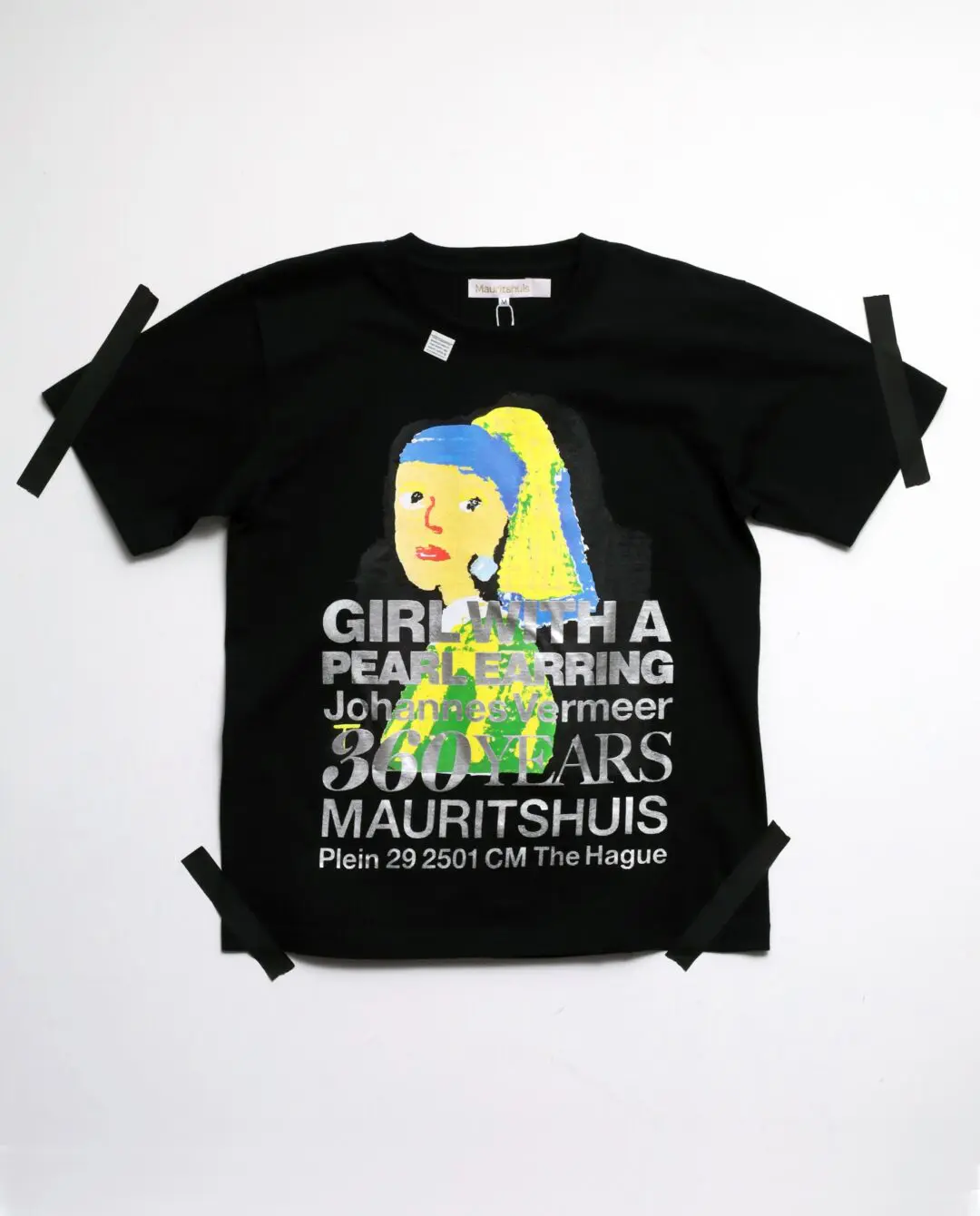
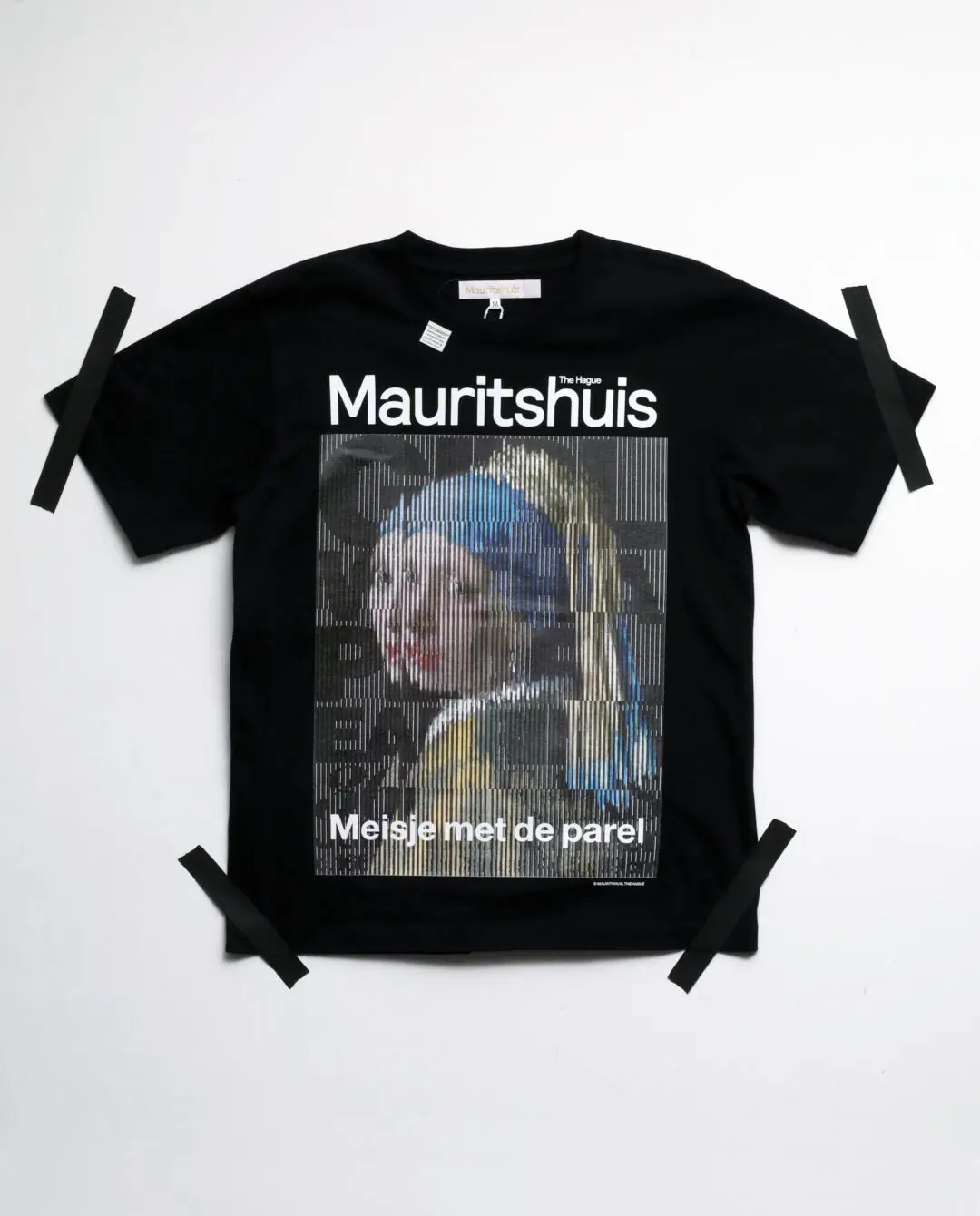
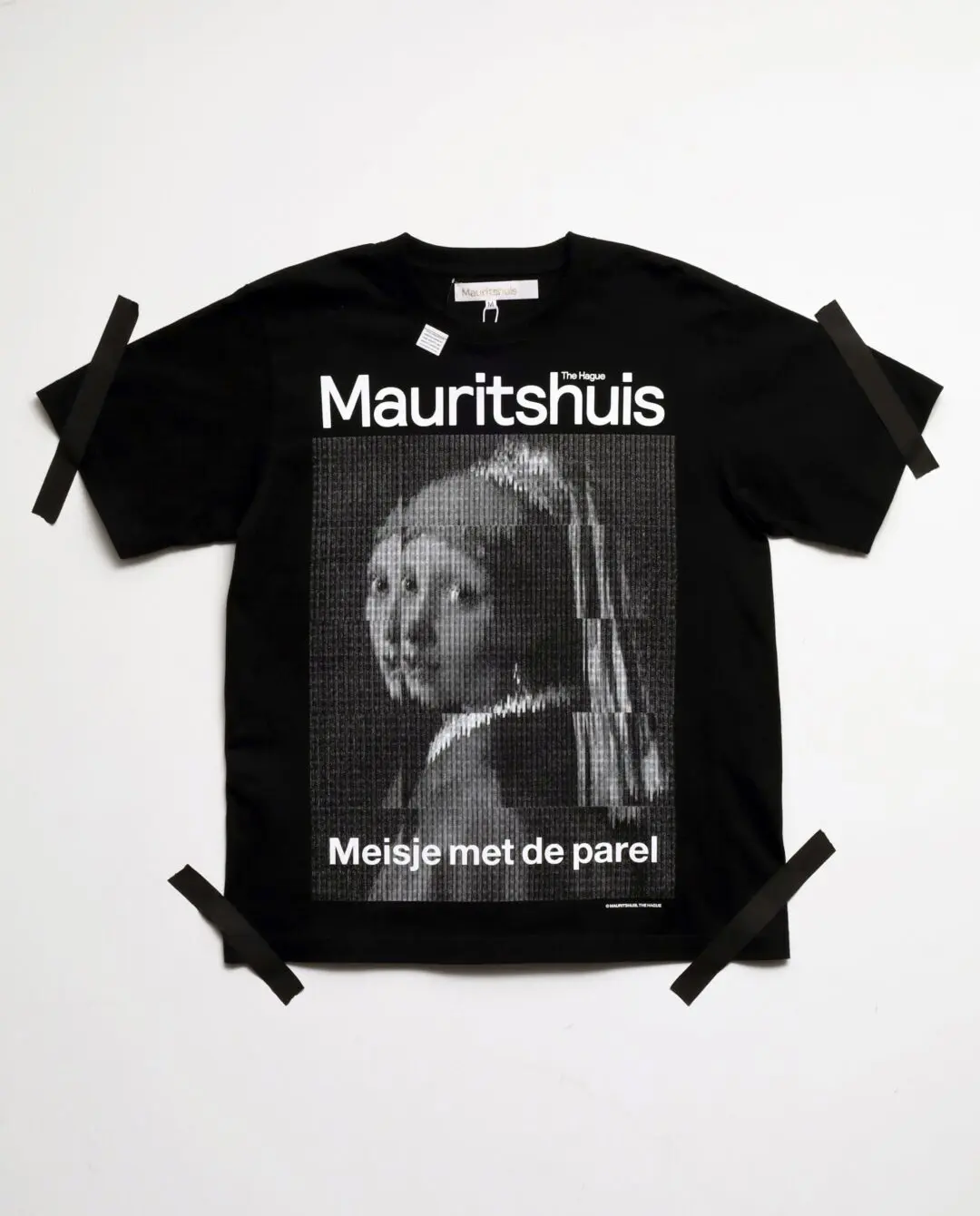
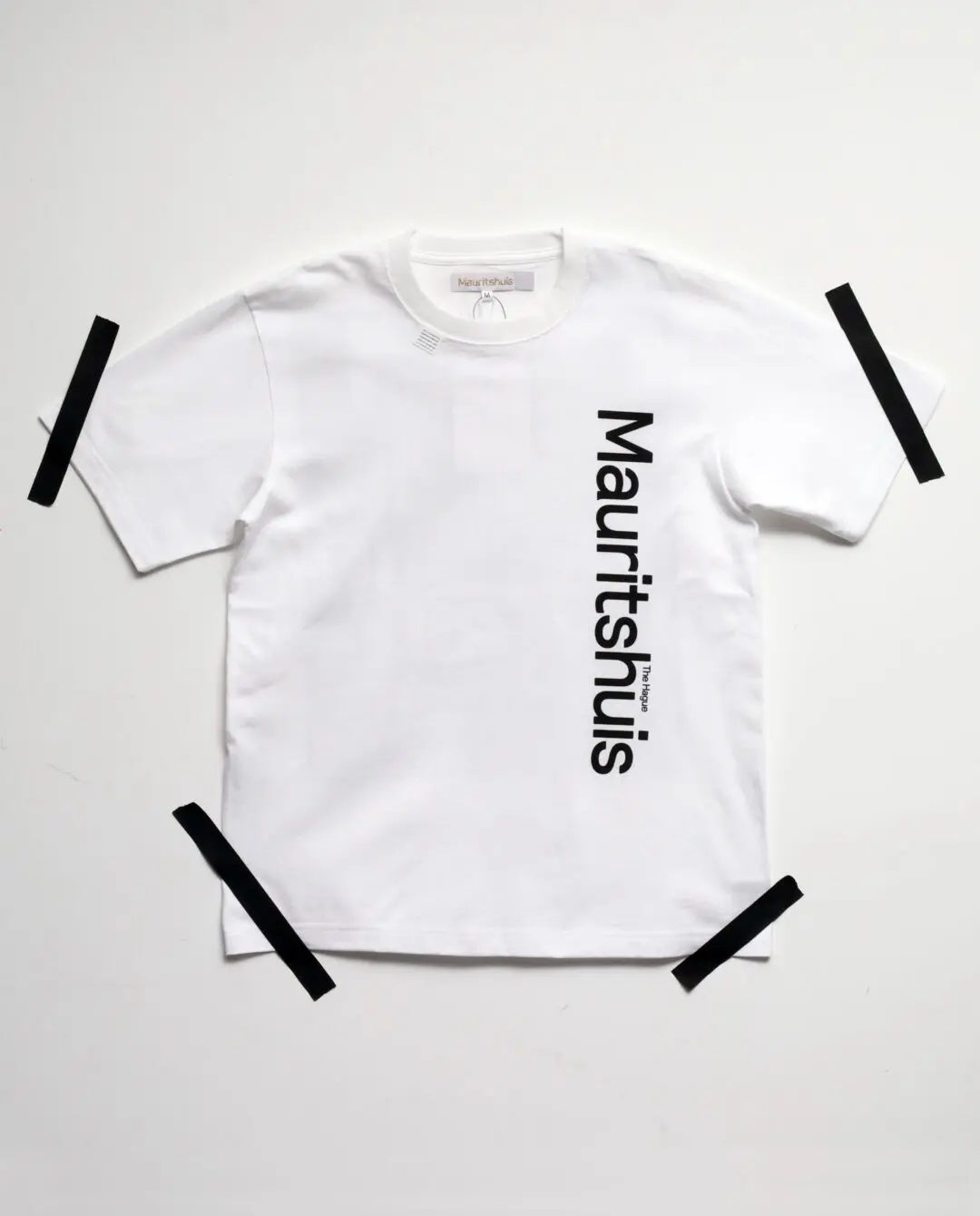
Today, from 11:00, Comme des Garçons Osaka is releasing exclusive limited colorways from a collection most people would not expect to find inside a Rei Kawakubo storefront: a set of shirts, hoodies, and accessories built around Johannes Vermeer’s Girl with a Pearl Earring, timed to the painting’s rare arrival in the same city later this month.
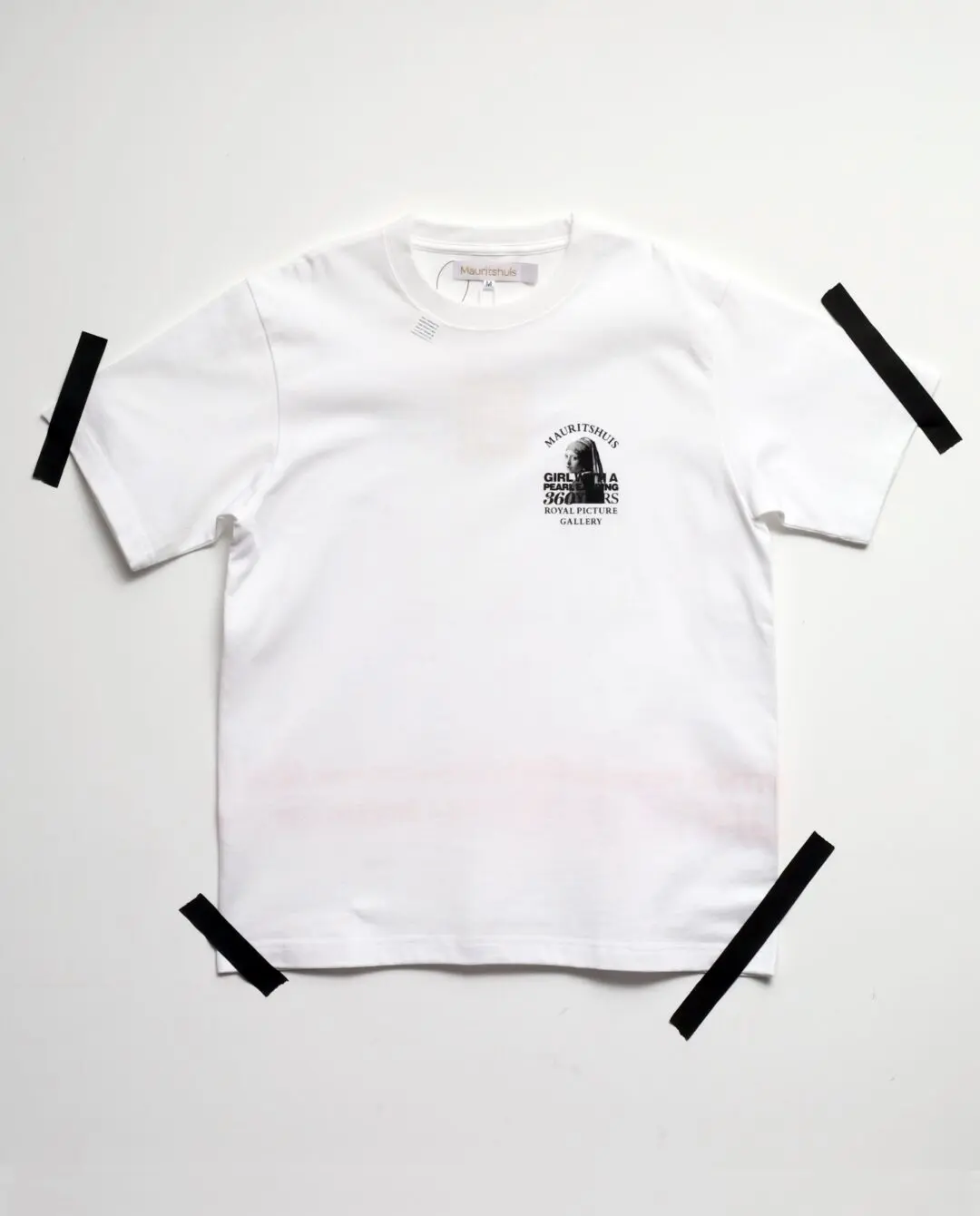
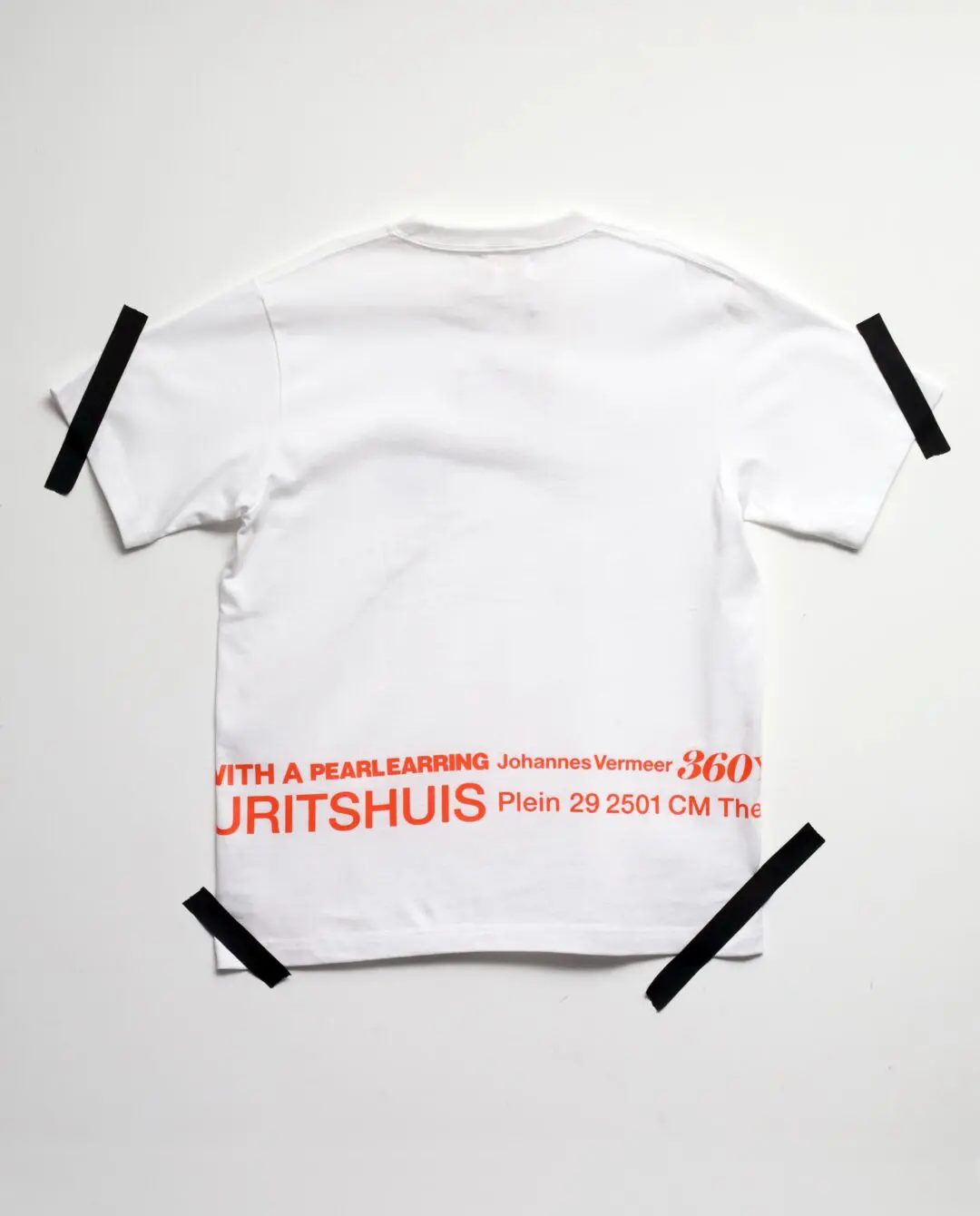
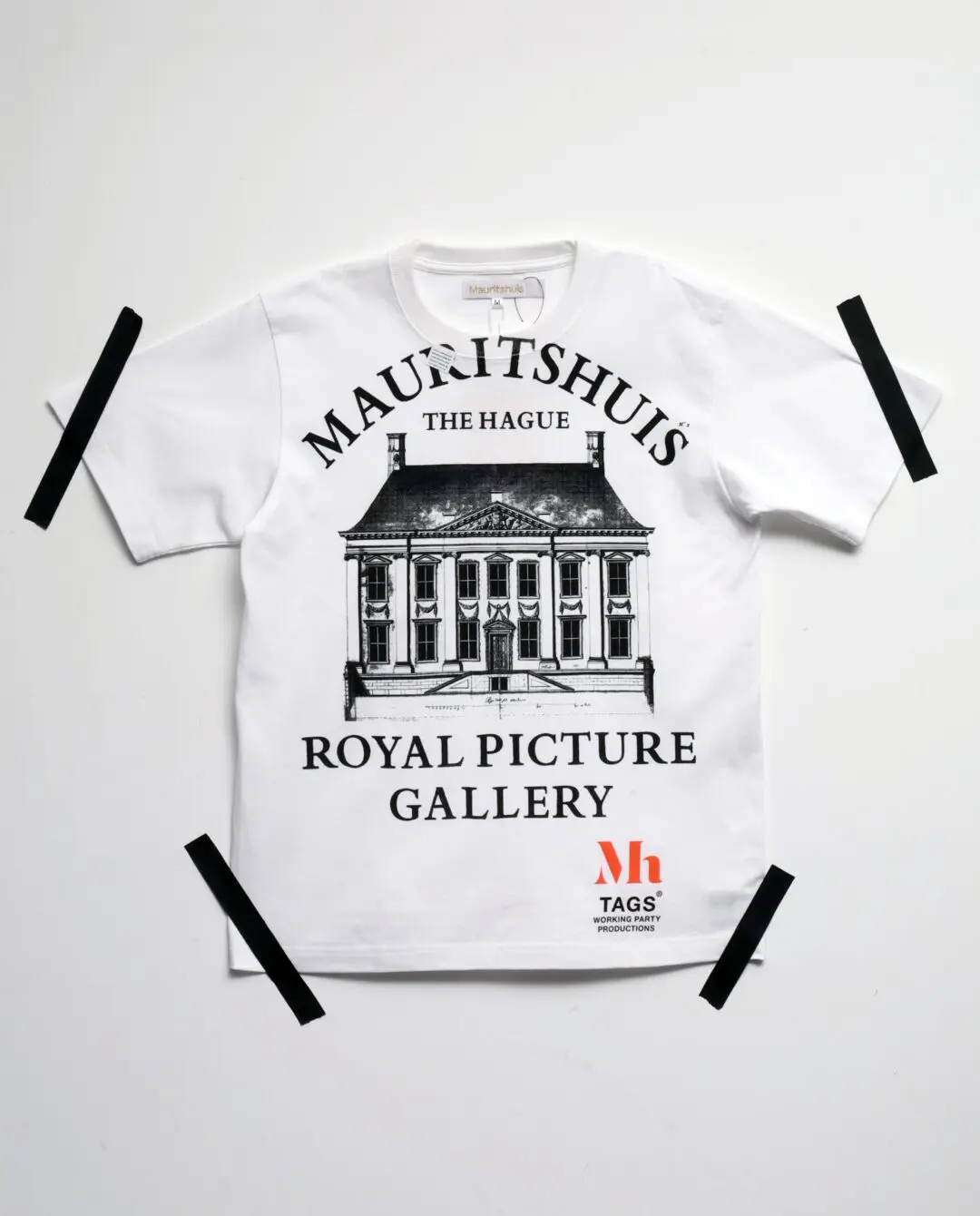
The release is part of a wider collection called Mauritshuis x TAGS WKGPTY Girl with a Pearl Earring 360 Years, an official collaboration between the Mauritshuis, the Dutch museum in The Hague that owns the painting, and TAGS WKGPTY Productions, a Tokyo design firm that has spent the past two decades turning museum archives into wearable objects. The name marks two overlapping anniversaries: 360 years since the painting was made, and the first time in fourteen years that it has left the Netherlands to be shown in Japan.
stir
Girl with a Pearl Earring does not tour. The Mauritshuis has kept it close for most of its recent history, and its last Japan appearance was back in 2012, when roughly 1.2 million people saw it across two Japanese venues. It is only coming back now because the museum itself is closing part of its building for renovation, which has briefly freed the painting to travel while its usual home is unavailable. Mauritshuis director Martine Gosselink has described this trip in fairly final terms, saying it may be the last opportunity the museum has to send the girl to visitors in Japan.
The painting has picked up the nickname the Dutch Mona Lisa over the years, largely on the strength of the same quality that made Leonardo’s portrait famous: an expression that seems to shift depending on how long you look at it, paired with real uncertainty over who the sitter actually was. It was painted around 1665, when Vermeer was in his early thirties and working in Delft, and it entered the Mauritshuis collection in 1902 as a bequest from a private Dutch collector who had bought it decades earlier for a small sum at an auction in The Hague, long before anyone recognized what it would become. That combination, genuine mystery around the subject and a museum that rarely lets the work leave the building, is a large part of why its Japan arrival has become the kind of story that reaches well beyond the usual arts press.
She will be the centerpiece of Vermeer’s Girl with a Pearl Earring: Masterpieces of Seventeenth Century Dutch Painting, a Miraculous Return, opening August 21 at the Osaka Nakanoshima Museum of Art and running through September 27. Alongside the famous portrait, the museum is also showing Vermeer’s early mythological painting Diana and her Nymphs, one of only three surviving Vermeer works in the Mauritshuis collection, plus ten further 17th century Dutch paintings from the same institution, including work by Jan Steen, Paulus Potter, and Maria van Oosterwijck. The exhibition will not travel anywhere else in Japan. Osaka is the only stop.
Japan has hosted the painting twice before, in 1984 and again in 2012, and each visit has drawn crowds that outsize what most touring museum shows manage. The 2012 run, split between Tokyo and Kobe, pulled in around 1.2 million visitors combined, numbers that put it closer to a blockbuster film release than a typical fine art exhibition. This time the show is Osaka only, ticketed through a timed entry system with no day of admission sales at the museum itself, a structure usually reserved for exhibitions where organizers already expect demand to outstrip supply well before opening day.
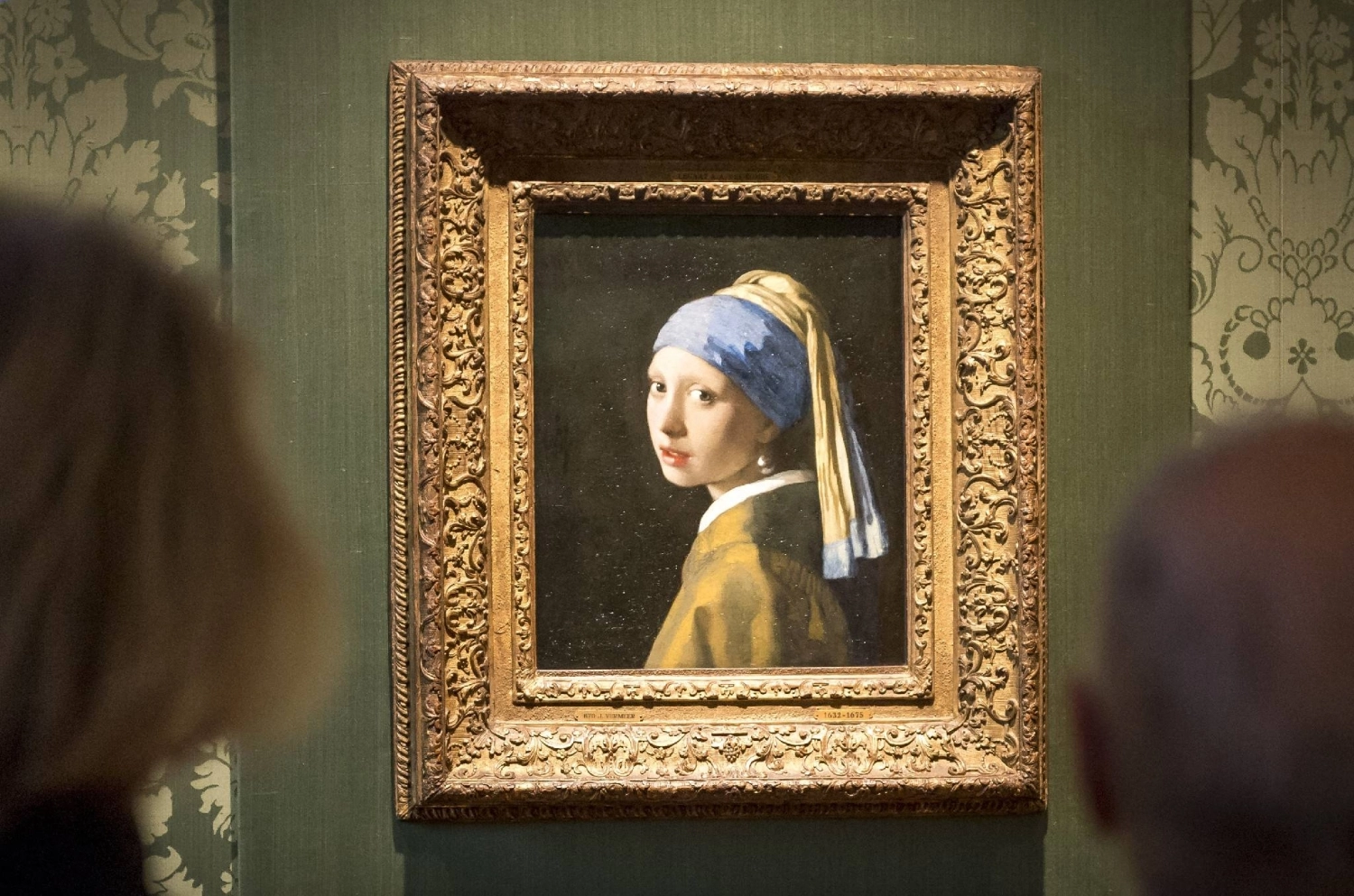
Johannes Vermeer’s Girl with a Pearl Earring hangs within an intricately carved gilded frame as museum visitors quietly admire one of the Dutch Golden Age’s most celebrated portraits, its luminous subject standing out against a deep black background.
stir
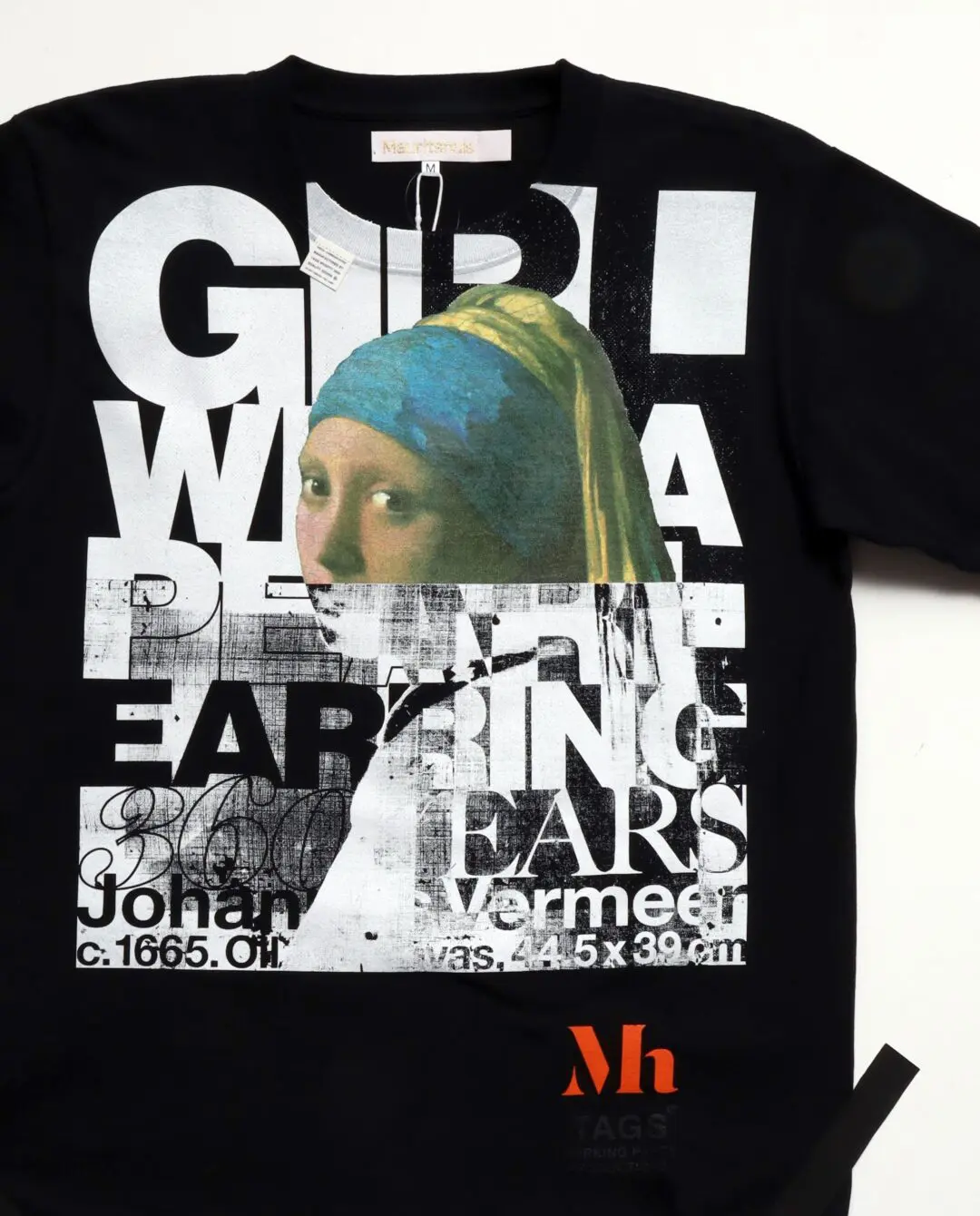
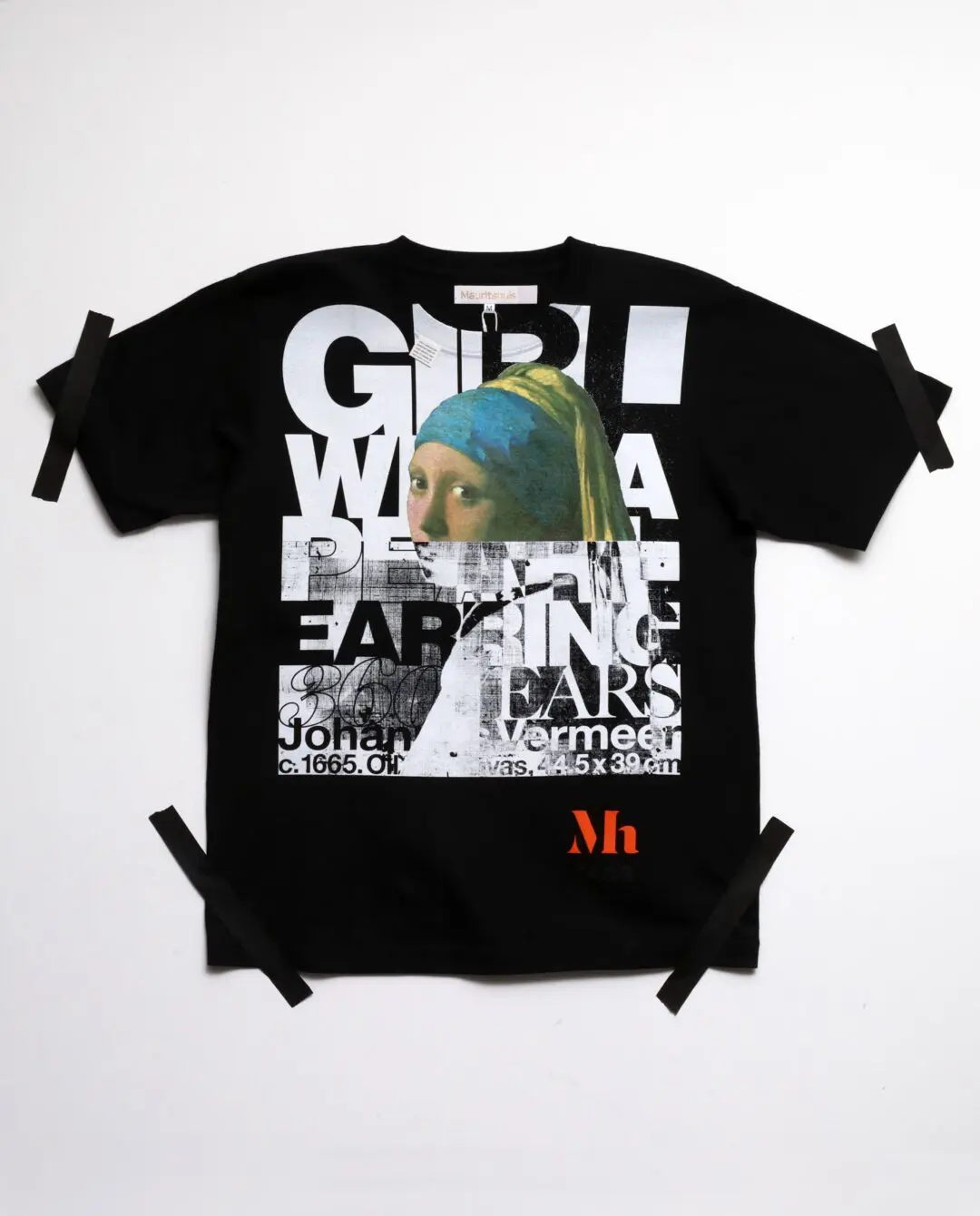
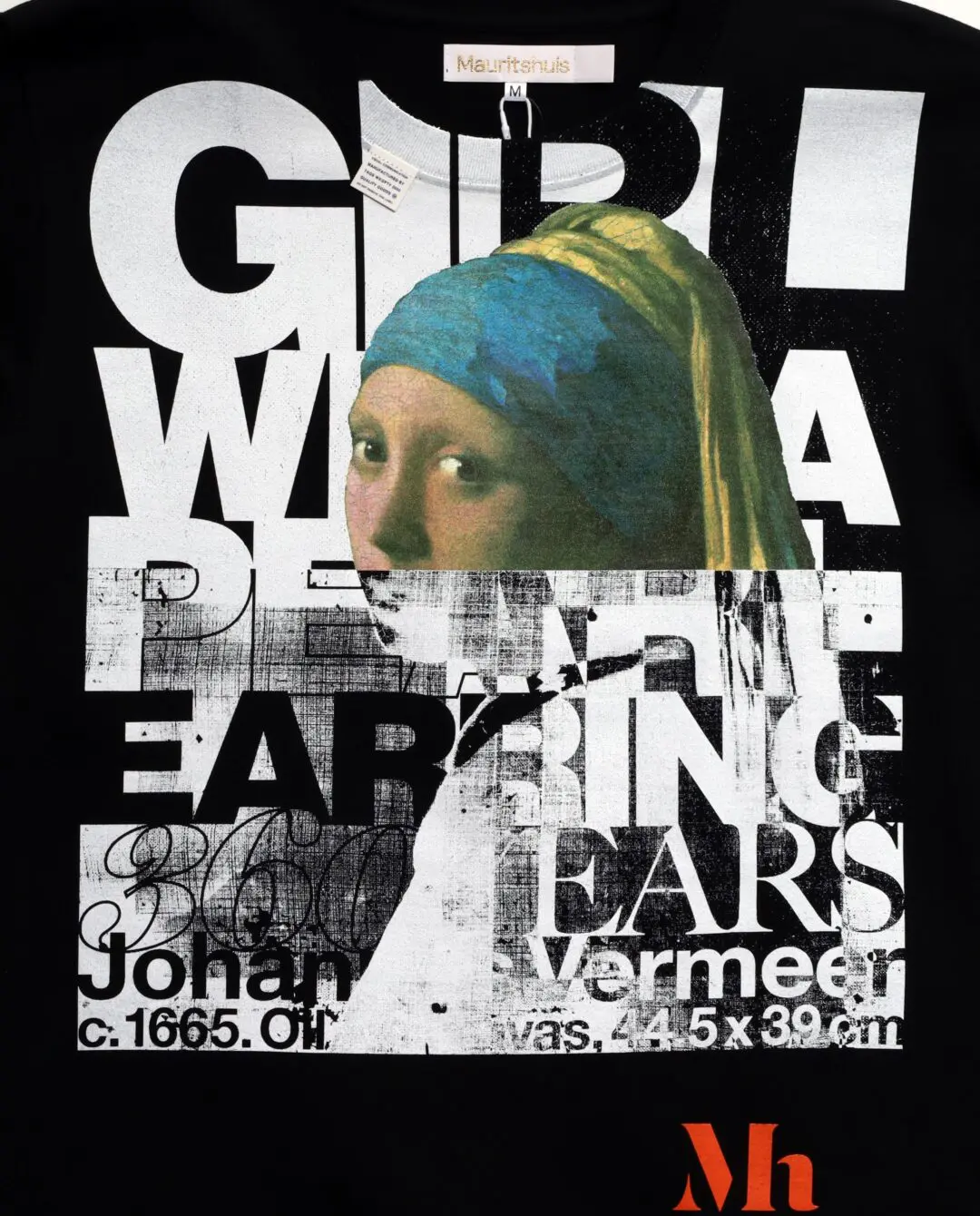
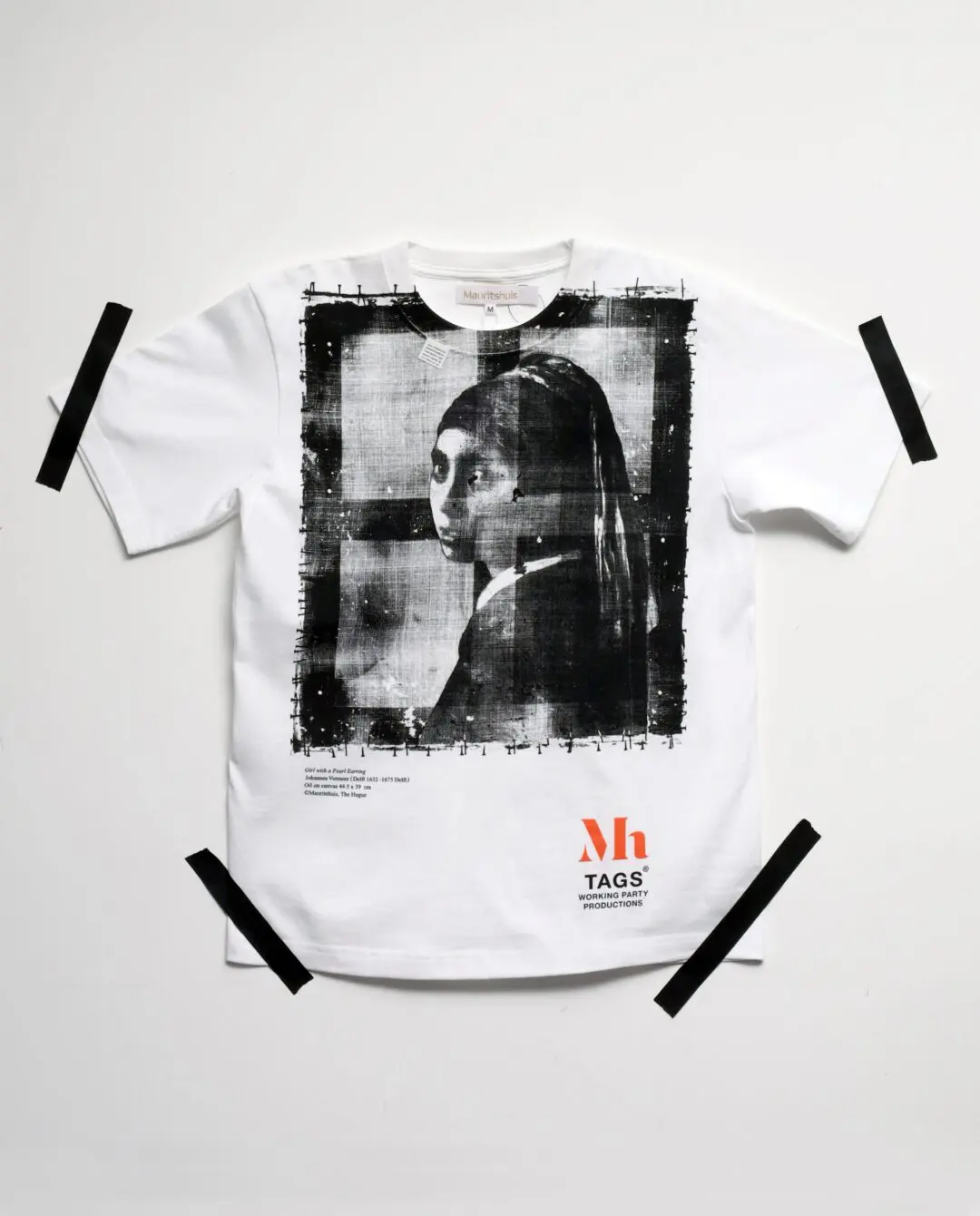
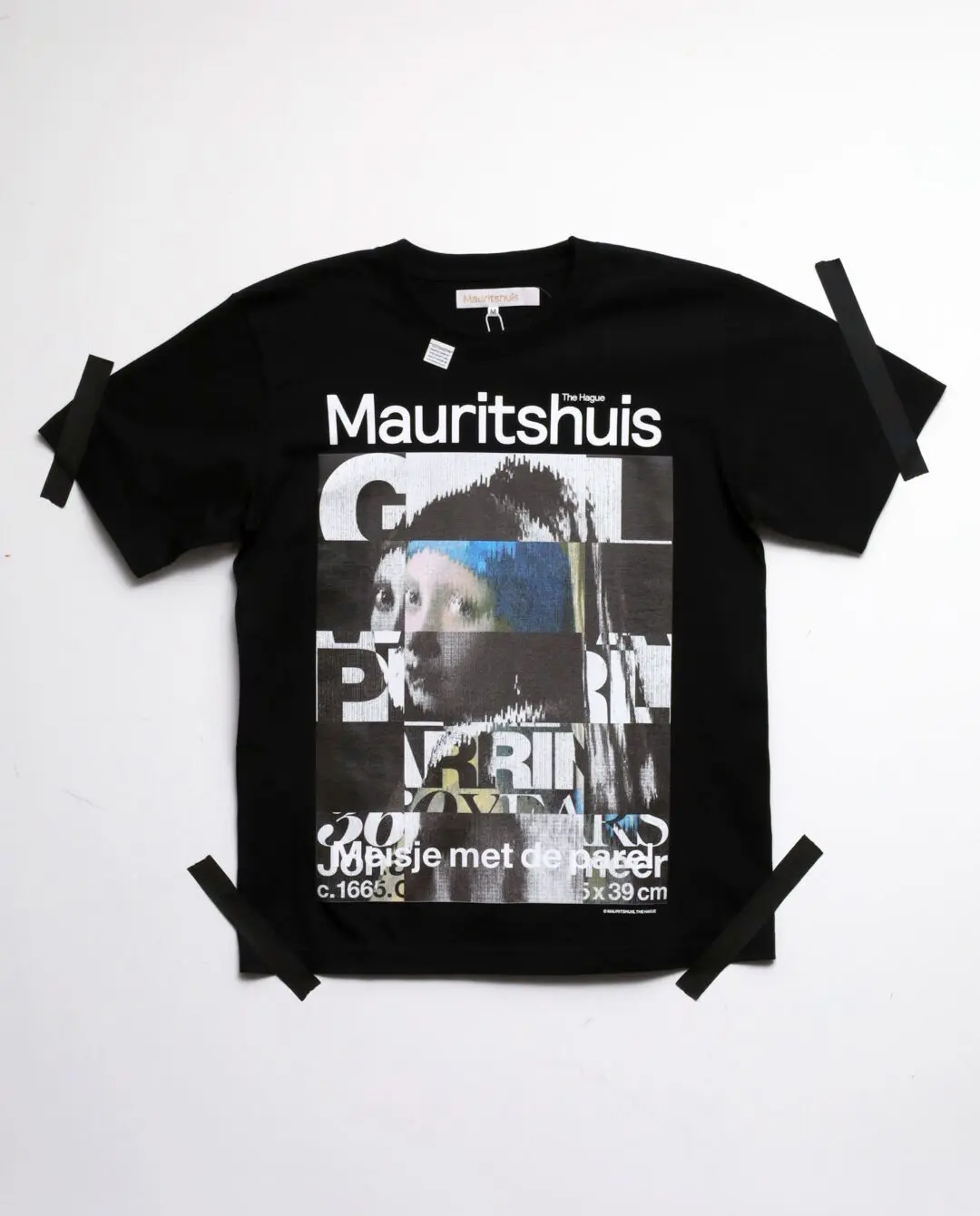
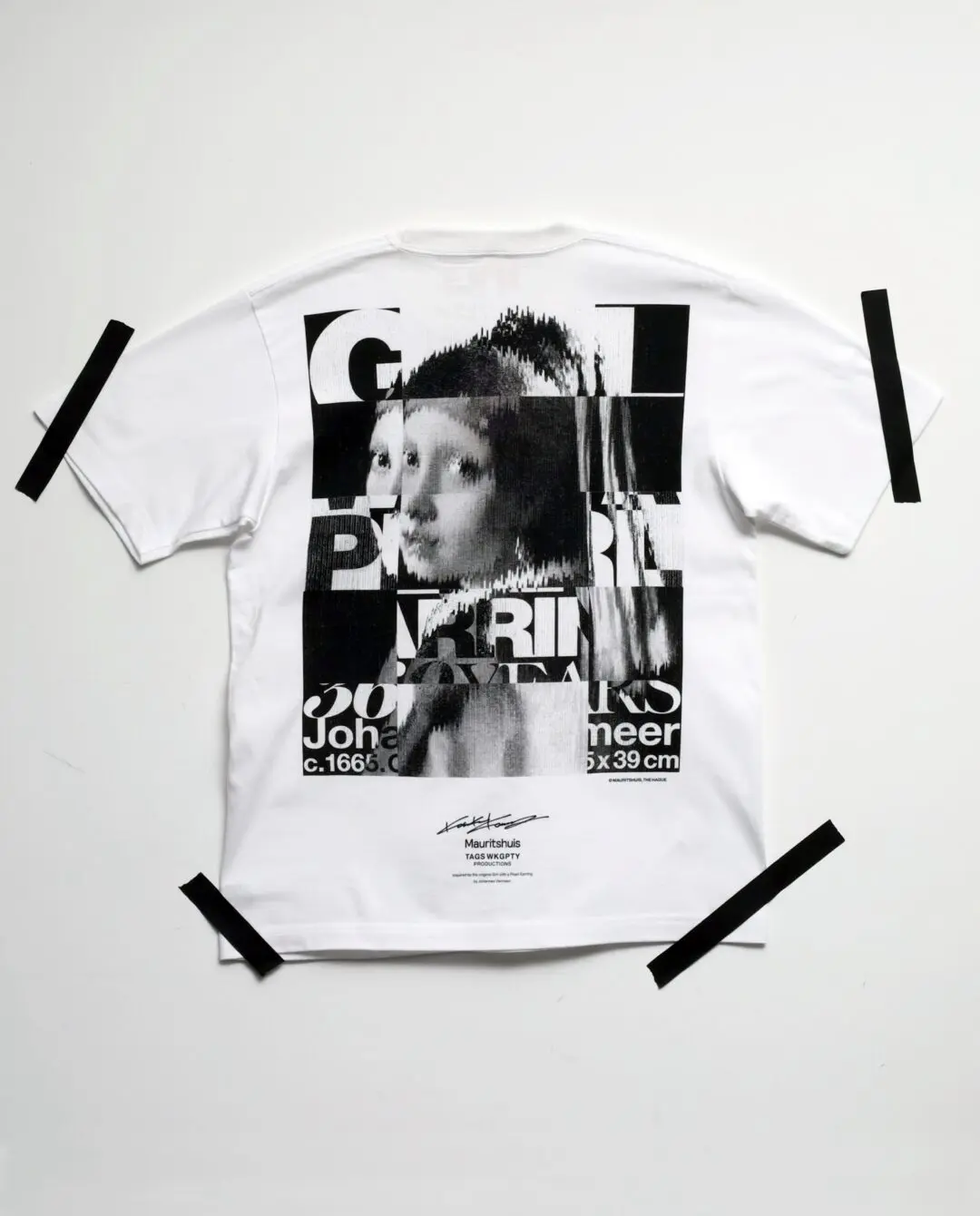
Most museum merchandise takes a painting and prints it on something. TAGS WKGPTY, working directly with the Mauritshuis, took a different approach for this collection, and it is the detail that sets the collaboration apart from the usual gift shop tote bag. Rather than lifting the finished portrait alone, the design team pulled from the conservation and research work the museum has carried out on the painting over the years, including x ray analysis that revealed the underdrawing beneath the visible paint layer, studies of the canvas’s physical structure, and the architecture of the Mauritshuis building itself. Those layers, normally visible only to conservators, become the actual graphic language of the shirts, hoodies, and accessories, which read less like merchandise and more like a document of how the painting has been studied rather than simply how it looks.
TAGS WKGPTY has built its whole practice around that kind of access. Founded in 2005 under Morioka Design Office, the Tokyo firm has handled official product collaborations for a run of overseas museums and artists, most notably a two part collection with the Van Gogh Museum in Amsterdam that ran through Trading Museum Comme des Garçons locations in Tokyo, along with a project built around photographer Kazunari Tajima’s day spent with Ryuichi Sakamoto. The Mauritshuis collaboration first went on limited pre-release back in January, well ahead of the exhibition, before expanding into today’s wider rollout timed to the painting’s actual Japan arrival.
The Girl with a Pearl Earring lineup is also wider than a single silhouette. Alongside the t shirts and hoodies most likely to show up at Comme des Garçons Osaka, the collection extends into a hanten, the short quilted coat traditionally worn over kimono in Japanese winters, along with bags and a set of smaller general goods. Folding a Dutch Golden Age portrait into a garment shape that specific is its own kind of statement, closer to translation than to licensing. It puts the painting through a Japanese domestic object rather than just a Japanese size run of a Western t shirt, which fits the way TAGS WKGPTY has generally handled its museum work: less about slapping a famous image onto stock apparel, more about finding a genuinely local form for it to live inside.

A connective graphic Tee reimagines Johannes Vermeer’s Girl with a Pearl Earring through a bold monochrome collage of fragmented portrait details, oversized typography, and glitch-inspired visual distortion, finished with Mauritshuis and TAGS WKGPTY Productions branding beneath the artwork.
huh
According to TAGS WKGPTY’s own retailer listing, the collection is carried across a small, specific set of locations rather than a broad national rollout. A pop up runs at Isetan Shinjuku’s men’s building, on the sixth floor among the store’s Men’s Creators section, from today through August 11, as part of the store’s wider Shinjuku Art Week programming. The Isetan installation reportedly recreates elements of the Mauritshuis’s own galleries as a backdrop for the collection, giving the pop up a small sense of the museum itself rather than a standard retail table. Beyond Shinjuku, the pieces are also stocked at Trading Museum Comme des Garçons in Gyre, Trading Museum Comme des Garçons in Tokyo Midtown, the Watari Museum shop On Sundays, FreeStrain in Nagasaki, and Comme des Garçons Osaka itself, which is where today’s exclusive colorways come in.
Comme des Garçons Osaka, on Minami Senba near Shinsaibashi Station, has built a habit over the past several years of using its size, it is one of the label’s largest directly operated stores, to host limited exclusives that do not appear at other Comme des Garçons locations, including past collaborations with A Bathing Ape timed to the store’s own opening anniversaries. Today’s Vermeer release follows that same pattern: colorways specific to the Osaka store, sitting inside a broader collection that is otherwise spread thin across just a handful of Tokyo and Nagasaki addresses.
The store itself opened in April 2020, roughly one and a half times the size of the label’s Aoyama flagship in Tokyo, and it was designed around a single oversized white booth at the center of the floor, with a black staircase connecting the ground and upper levels. Since opening it has folded in a full run of Comme des Garçons lines alongside shop in shop spaces for BAPE and Nike, giving it more physical room to host a project like the Mauritshuis collaboration than a smaller boutique location would have. That scale is part of why brands and cultural partners keep choosing Osaka specifically for exclusives rather than spreading the same product evenly across Comme des Garçons’ Japanese footprint.
View this post on Instagram
in
Alongside the core Mauritshuis graphics, the lineup includes a separate collaboration piece made with collage artist Kosuke Kawamura, described by Isetan’s own materials as a special addition sitting apart from the main TAGS WKGPTY design work. Kawamura, born in Hiroshima in 1979, built his name through shredder based collage and hand cut analog work before moving into digital collage, and he now serves as creative director of Uniqlo’s UT graphic tee line, a position he has held since 2021. His past work includes the key visual for Katsuhiro Otomo’s large scale Genga exhibition and a shredded artwork treatment of Oasis’s own band logo, released in 2024. Putting a name with that track record inside a 17th century museum collection is a fairly deliberate move, pairing an old master painting with an artist whose whole practice is built around cutting existing images apart and reassembling them.
Kawamura’s contribution has not been detailed item by item in the sourcing available for this piece, and no confirmed price or full specification for that specific garment could be found beyond its inclusion in the lineup. What is confirmed is a small object elsewhere in the collection that captures its overall approach well: a strap pouch shaped around the outline of the girl herself, built from a sketch based study of her silhouette, with a zip closure sized for small items and a removable strap.
fin
The merchandise is arriving into a city that has clearly decided this exhibition is a genuine event rather than a routine museum booking. Mikimoto has produced three limited pearl earrings inspired directly by the painting, sold exclusively at its Ginza and Osaka Umeda stores starting August 1, with prices running from roughly 7.7 million yen to 17.6 million yen depending on the design. Ticketing for the exhibition itself has run through a timed entry lottery system rather than standard day of sale, and the show’s organizers have already had to apologize publicly for disruptions during the ticket sales process. None of that is typical for a museum show, and it says plainly that Osaka expects real demand once the painting is actually on the wall.
Against that backdrop, a Comme des Garçons Osaka exclusive built around the same painting reads less like an isolated novelty and more like one piece of a citywide moment that a handful of brands, from jewelry houses to streetwear flagships, have decided to lean into at the same time. It also sits inside a broader pattern in Japan specifically, where major museum loans routinely spin off apparel and accessory lines through fashion partners rather than staying confined to a gift shop counter, treating a temporary exhibition like a seasonal drop with its own retail calendar. Whether these particular colorways are still on the rack by the time the exhibition itself opens on August 21 is very much an open question.
Related Articles

Polo Ralph Lauren Put A Silk Slim And Called It Tuxedo
Silk-Bib Tuxedo Shirt. Style 100068378. Silk front. Band collar. Elongated. UK site lists it unavailable. […]